
MEC-210 · Lesson 3 of 12 · 27 min
Relative and dependent motion
So far every motion has been measured from a single fixed origin. Many machine problems are easier, or only make sense, when motion is measured relative to something that is itself moving. A tote sliding across the deck of a moving shuttle, a parcel crossing from one belt onto another, a crane trolley running along a bridge that is travelling down a bay, and a load hanging from a set of pulleys all involve two or more bodies whose motions are linked. This lesson covers two tools for such problems. Relative motion with translating axes connects the motion of one particle to the motion of another. Dependent motion uses the fixed length of a cable or the geometry of a linkage to tie several motions together through a constraint.
Relative position, velocity and acceleration
Consider two particles, \(A\) and \(B\), whose positions are measured from a fixed origin \(O\) as \(\mathbf{r}_A\) and \(\mathbf{r}_B\). The position of \(B\) relative to \(A\) is the vector from \(A\) to \(B\):
Differentiating with respect to time gives the corresponding relations for velocity and acceleration:
Here \(\mathbf{v}_{B/A}\) is the velocity of \(B\) as seen by an observer who moves with \(A\) but does not rotate. These simple equations hold when the observer's axes translate without rotating, which is the case in this lesson. When the reference frame rotates, as on a turntable or a rotating arm, extra terms appear, including the Coriolis term already met in polar coordinates. Rotating frames are taken up again in Lesson 9 for rigid bodies.
The subscript notation reads naturally from left to right: the velocity of \(B\) equals the velocity of \(A\) plus the velocity of \(B\) relative to \(A\). Writing the equation this way before putting numbers in avoids the most common error, which is subtracting in the wrong order. A useful check is that \(\mathbf{v}_{A/B} = -\mathbf{v}_{B/A}\): if \(B\) appears to move north at 2 m/s as seen from \(A\), then \(A\) appears to move south at 2 m/s as seen from \(B\).
Worked problem
Two shuttles at an aisle crossing
Two shuttles approach an intersection in a storage system. Shuttle \(A\) travels east at 3.0 m/s and is speeding up at 0.50 m/s². Shuttle \(B\) travels north at 2.0 m/s and is slowing down at 0.80 m/s². Find the velocity and acceleration of \(B\) relative to \(A\).
Show solution
- Take \(x\) east and \(y\) north. Then \(\mathbf{v}_A = 3.0\,\mathbf{i}\), \(\mathbf{a}_A = 0.50\,\mathbf{i}\), \(\mathbf{v}_B = 2.0\,\mathbf{j}\) and \(\mathbf{a}_B = -0.80\,\mathbf{j}\) (it is slowing while moving north).
- \[\mathbf{v}_{B/A} = \mathbf{v}_B - \mathbf{v}_A = -3.0\,\mathbf{i} + 2.0\,\mathbf{j} \text{ m/s}\]
- Magnitude \(\sqrt{3.0^2 + 2.0^2} = 3.61 \text{ m/s}\), directed \(\tan^{-1}(2.0/3.0) = 33.7^\circ\) north of west.
- \[\mathbf{a}_{B/A} = \mathbf{a}_B - \mathbf{a}_A = -0.50\,\mathbf{i} - 0.80\,\mathbf{j} \text{ m/s}^2\]
- Magnitude \(\sqrt{0.50^2 + 0.80^2} = 0.943 \text{ m/s}^2\), directed \(58.0^\circ\) south of west.
Answer: To the controller on shuttle A, shuttle B appears to be approaching from the front left, closing on a straight line. Collision-avoidance logic works in exactly this relative frame: if the relative velocity points at the other vehicle, the two are on a collision course.
That last remark generalizes into a useful rule. Two bodies moving at constant velocity will collide if and only if their relative velocity points along the line joining them. Sailors use the same idea when they watch the bearing of another vessel: if the bearing stays constant while the range shrinks, the two are on a collision course. Automated guided vehicles in warehouses run traffic logic that is, at heart, a relative-velocity calculation repeated many times a second.
Relative motion on conveyor transfers
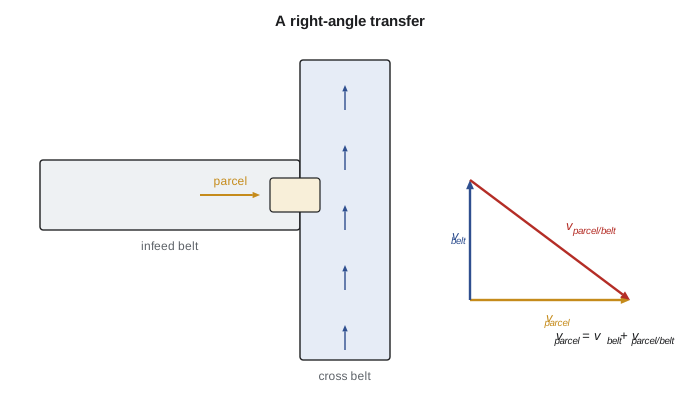
Relative velocity matters whenever a load passes from one moving surface to another. When a parcel crosses from an infeed belt onto a belt running at a right angle to it, the parcel arrives with its old velocity and the new belt is moving in a different direction. Until friction brings the parcel up to the new belt's velocity, the parcel slides relative to the belt. The friction force on the parcel acts opposite to the direction of this slip, which is the parcel's velocity relative to the belt, not its absolute velocity. Getting that direction right decides where the parcel ends up and whether it hits the side guide.
Worked problem
Slip at a right-angle transfer
A parcel moving at 2.0 m/s crosses onto a cross belt running at 1.5 m/s at right angles to the infeed. Find the velocity of the parcel relative to the cross belt at the instant it arrives, and the direction of the friction force on it.
Show solution
- Take \(x\) along the infeed and \(y\) along the cross belt. The parcel's velocity is \(\mathbf{v}_P = 2.0\,\mathbf{i}\); the belt's is \(\mathbf{v}_B = 1.5\,\mathbf{j}\).
- \[\mathbf{v}_{P/B} = \mathbf{v}_P - \mathbf{v}_B = 2.0\,\mathbf{i} - 1.5\,\mathbf{j} \text{ m/s}\]
- Magnitude \(\sqrt{2.0^2 + 1.5^2} = 2.50 \text{ m/s}\), at \(36.9^\circ\) from the infeed direction, angled against the belt motion.
- Kinetic friction on the parcel opposes this slip, so it points along \(-\mathbf{v}_{P/B}\): partly backward against the parcel's old motion and partly forward with the new belt.
Answer: The parcel slips at 2.50 m/s relative to the belt. Friction both slows its old motion and drags it along with the belt; Lesson 4 shows how long that takes and how far the parcel slides.
The program below repeats the calculation for several cross-belt speeds. A faster cross belt carries parcels away more quickly, but it also increases the slip speed and swings the friction force round, which lengthens the distance the parcel slides before it settles and throws it harder toward the far guide. Sorter designers choose belt speeds, transfer angles and guide positions with this trade-off in mind. Angled transfers, at 30 or 45 degrees rather than 90, are common precisely because they reduce the slip.
# A parcel moving at 2.0 m/s along x crosses onto a belt that runs at
# speed u in a direction 90 degrees to the infeed. Until friction brings it
# up to belt speed, the parcel slides relative to the new belt.
# Relative velocity: v_parcel/belt = v_parcel - v_belt.
import math

v_parcel = (2.0, 0.0)                       # m/s, absolute
for u in (0.5, 1.0, 1.5, 2.0, 3.0):
    v_belt = (0.0, u)
    rel = (v_parcel[0] - v_belt[0], v_parcel[1] - v_belt[1])
    mag = math.hypot(*rel)
    ang = math.degrees(math.atan2(rel[1], rel[0]))
    print(f"belt {u:3.1f} m/s: slip {mag:4.2f} m/s at {ang:6.1f} deg from the infeed direction")

# A two-segment hoist: motor winds cable at 0.6 m/s; the load hangs on a
# pulley supported by n cable segments, so v_load = v_cable / n.
for n in (2, 3, 4):
print(f"{n} supporting segments: load rises at {0.6 / n:.3f} m/s")belt 0.5 m/s: slip 2.06 m/s at -14.0 deg from the infeed direction belt 1.0 m/s: slip 2.24 m/s at -26.6 deg from the infeed direction belt 1.5 m/s: slip 2.50 m/s at -36.9 deg from the infeed direction belt 2.0 m/s: slip 2.83 m/s at -45.0 deg from the infeed direction belt 3.0 m/s: slip 3.61 m/s at -56.3 deg from the infeed direction 2 supporting segments: load rises at 0.300 m/s 3 supporting segments: load rises at 0.200 m/s 4 supporting segments: load rises at 0.150 m/s
Dependent motion: cables and pulleys
In many machines, the motions of several bodies are linked by inextensible cables, belts or chains. The constraint is that the total length of each cable stays constant. Writing the length in terms of the position coordinates of the bodies and differentiating gives relations between their velocities and accelerations directly, without any need to find the forces.
The method has four steps. First, choose a position coordinate for each moving body, measured from a fixed datum, with a clearly defined positive direction. Second, write the length of each cable as the sum of its segments in terms of these coordinates, leaving out lengths that do not change, such as the part wrapped round a fixed pulley. Third, set the total equal to a constant. Fourth, differentiate once for velocities and twice for accelerations. Because the constant disappears on differentiation, the lengths that do not change never need to be known.
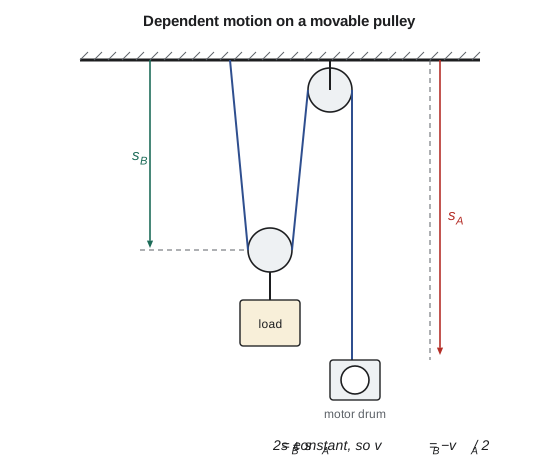
For the arrangement in the figure, let \(s_A\) be the position of the cable end being wound onto the drum, measured from the top pulley, and \(s_B\) the position of the load pulley, both measured downward. The cable length is \(s_A + 2 s_B\) plus constant lengths, so
If the drum winds cable in at 0.6 m/s, a mark on the cable between the top pulley and the drum moves downward toward the drum, so \(v_A = +0.6 \text{ m/s}\) and \(v_B = -0.3 \text{ m/s}\): the load rises at 0.3 m/s. The signs are easy to get tangled. The safest approach is to define every coordinate from a fixed datum, keep one positive direction per coordinate, and interpret the sign of each answer only at the end.
The general result is that a load supported by \(n\) cable segments moves at \(1/n\) of the speed of the cable being pulled. In return, if friction and the weight of the pulleys are neglected, the force needed is \(1/n\) of the load. This is the trade-off of a block and tackle, and of the reeving on a crane hook, where many parts of line let a modest hoist drum lift a heavy load slowly. Lesson 5 confirms it with work and energy: the force times distance at the drum equals the load times distance at the hook.
Worked problem
A three-segment lift
A maintenance lift raises a platform on a movable pulley block supported by three cable segments; the free end of the cable runs down from the fixed upper block to a winch on the floor. The winch pays in cable at 0.90 m/s and is speeding up at 0.30 m/s². Find the velocity and acceleration of the platform.
Show solution
- Measure the platform position \(s_P\) downward from the fixed upper block. For the free run of cable, put a mark on it between the upper block and the winch and measure its position \(s_C\) downward from the same block.
- The cable length is \(3 s_P + s_C + \text{constant}\). Differentiate: \(3 v_P + v_C = 0\) and \(3 a_P + a_C = 0\).
- Paying in cable draws the mark down toward the winch, so \(v_C = +0.90 \text{ m/s}\) and \(a_C = +0.30 \text{ m/s}^2\).
- \[v_P = -\frac{v_C}{3} = -0.30 \text{ m/s} \qquad a_P = -\frac{a_C}{3} = -0.10 \text{ m/s}^2\]
- With downward positive, the negative signs mean the platform moves upward and its upward speed is increasing.
Answer: The platform rises at 0.30 m/s and accelerates upward at 0.10 m/s². Check: it moves at one-third of the cable speed, in the direction that shortens the three supporting segments.
Sign errors are the main source of mistakes in dependent-motion problems, and the cure is always the same: draw the system, mark each coordinate as an arrow from a fixed point, and ask physically whether each length grows or shrinks when the motor runs. Only then put in numbers. If the mark on the free run had been measured upward from the winch instead, its velocity would have been negative and the constraint equation would have carried a minus sign, but the final answer would be the same. A quick sanity check also helps: the load should always move more slowly than the cable being pulled, by a factor equal to the number of supporting segments.
Dependent motion in linkages and belts
The same constraint idea works for rigid links and belts. Two gears in mesh have equal speeds at their pitch circles, so their angular speeds are in the inverse ratio of their radii. A belt that does not slip moves every pulley rim at the same speed. A slider driven by a rigid rod, as in a slider-crank mechanism, has its position fixed by the geometry of the rod and the crank angle; differentiating that geometric relation gives the slider velocity. Lessons 8 and 9 treat these rigid-body constraints systematically, but the principle is the same as for cables: write the geometry, then differentiate.
| Constraint | Geometric relation | Velocity relation |
|---|---|---|
| Cable with n segments to the load | n s_load + s_end = const | v_load = -v_end / n |
| Belt on two pulleys, no slip | Rim speeds equal | ω₁ r₁ = ω₂ r₂ |
| Gears in mesh | Pitch-line speeds equal | ω₁ r₁ = ω₂ r₂ (opposite senses) |
| Rack and pinion | Rack moves one pitch circumference per turn | v_rack = ω r |
| Wheel rolling without slipping | Contact point has zero velocity | v_G = ωr at the wheel axle G |
Common mistakes
MistakeSubtracting velocities in the wrong order.
InsteadWrite v_B = v_A + v_B/A first, then rearrange.
MistakeUsing the absolute velocity of a sliding load to find the direction of friction.
InsteadFriction opposes the velocity relative to the surface in contact.
MistakeMeasuring cable coordinates from moving points.
InsteadMeasure every coordinate from a fixed datum.
MistakeIncluding constant lengths, such as cable wrapped on fixed pulleys, in the differentiation.
InsteadThey vanish on differentiation; leave them out of the working.
MistakeApplying translating-axes formulas in a rotating frame.
InsteadRotating frames need extra terms; see Lesson 9.
Summary and key terms
- With translating axes, r_B = r_A + r_B/A, and likewise for velocity and acceleration.
- Two bodies at constant velocity collide if their relative velocity points along the line joining them.
- At belt transfers, friction acts opposite to the load's velocity relative to the new belt.
- Dependent motion uses the constant length of a cable: write the length, then differentiate.
- A load on n supporting segments moves at 1/n of the cable speed.
- Draw coordinates from fixed datums and check signs physically.
- Belts, gears and rolling wheels give similar velocity constraints.
- Relative velocity
- The velocity of one body as seen by an observer moving with another, non-rotating.
- Translating axes
- A moving reference frame that does not rotate.
- Dependent motion
- Motion of several bodies linked by a constraint such as a cable.
- Constraint equation
- A geometric relation that ties position coordinates together.
- Datum
- A fixed reference point or line from which positions are measured.
- Slip velocity
- The velocity of a load relative to the surface it is sliding on.
- Block and tackle
- A system of pulleys that trades speed for force.
- Reeving
- The arrangement of cable segments between the blocks of a hoist.
Practice problems
Work each problem on paper first, then reveal the answer to check.
Shuttle A moves east at 2 m/s and shuttle B moves west at 3 m/s on the same rail. What is the velocity of B relative to A?
Show answer
5 m/s west.
In the transfer example, what is the slip velocity if the cross belt runs at 2.0 m/s?
Show answer
2.83 m/s at 45° from the infeed direction.
A load hangs on four cable segments and the winch pays in cable at 1.2 m/s. How fast does the load rise?
Show answer
0.30 m/s.
Why do many sorters use 30° or 45° diverts instead of 90°?
Show answer
The slip velocity at the transfer is smaller, so parcels settle faster and hit guides less hard.
Two gears of radius 50 mm and 150 mm mesh. If the small one turns at 30 rad/s, how fast does the large one turn?
Show answer
10 rad/s, in the opposite sense.
Modify the program to use a 45° transfer. What changes?
Show answer
The belt velocity has components along and across the infeed, so the slip is smaller for the same belt speed.
Lesson quiz · 5 questions
Score 60% or more to complete this lesson.
Create a free account to save your progress, take quizzes and earn a certificate.