
MCAT-111 · Lesson 7 of 12 · 21 min
Evolution
▶ Video coming soon A video version of this lesson is on the way.
Ezequiel arrived at the session with a story from his EMT years: a patient with a urinary infection that had not responded to two rounds of antibiotics. 'The doctor said the bacteria had learned to beat the drug,' he said. Thandiwe asked the group what was wrong with that sentence. Elliot got there: 'Bacteria do not learn. The resistant ones were already there, or appeared by mutation, and the drug killed the others.' 'Good,' she said. 'If you can explain that sentence properly, you understand natural selection better than most people.'
This lesson covers the mechanisms of evolution: natural selection and fitness, genetic drift, gene flow and mutation, nonrandom mating, patterns of selection, speciation, and the evidence for common descent. It maps to the evolution heading of content category 1C on the AAMC outline, which builds directly on the Hardy-Weinberg principle from lesson 6. Evolution questions on the MCAT are usually conceptual and often hide in passages about antibiotic resistance, cancer, viruses or population studies.
Evolution as change in allele frequencies
Biologists define evolution at the population level as a change in allele frequencies over generations. Individuals do not evolve; populations do. The Hardy-Weinberg principle describes a population that is not evolving, so each of its five conditions points to a force that causes evolution when the condition fails: natural selection, genetic drift (small population size), gene flow (migration), mutation and nonrandom mating. Of these, only natural selection consistently adapts populations to their environment.
| Force | What it does | Effect on variation | Adaptive? |
|---|---|---|---|
| Natural selection | Alleles that improve survival or reproduction rise in frequency | Can reduce or maintain variation | Yes |
| Genetic drift | Random changes in allele frequencies, strongest in small populations | Reduces variation within a population; can fix or lose alleles | No |
| Gene flow | Migration moves alleles between populations | Increases variation within, reduces differences between populations | Not necessarily |
| Mutation | Creates new alleles | The ultimate source of new variation; acts slowly | No; most new mutations are neutral or harmful |
| Nonrandom mating | Changes genotype frequencies, for example by inbreeding | Inbreeding increases homozygosity without changing allele frequencies directly | No |
Natural selection and fitness
Charles Darwin and Alfred Russel Wallace described natural selection in 1858, and Darwin's On the Origin of Species appeared in 1859. The argument has three premises and a conclusion. Individuals in a population vary. Some of that variation is heritable. More offspring are produced than can survive and reproduce, so individuals with heritable traits that improve survival or reproduction in a given environment leave more offspring. Over generations, those traits become more common.
Fitness in biology means reproductive success: the number of offspring an individual contributes to the next generation, relative to others in the population. It is not strength or health in the everyday sense. A long-lived individual that leaves no offspring has a fitness of zero. Relative fitness compares genotypes; the most fit genotype is usually given a relative fitness of 1, and the others are expressed as fractions of that.
Selection acts on phenotypes, but only heritable variation can respond. If a trait's variation is entirely due to the environment, selection on it produces no change in the next generation. Selection also cannot plan ahead; it favours what works now. Antibiotic resistance illustrates the point. Resistance alleles arise by mutation or arrive by gene transfer (lesson 11) whether or not an antibiotic is present. The antibiotic does not create them; it changes the environment so that cells carrying them survive and reproduce while others die.
Patterns of selection
Selection on a continuous trait, such as body size, takes three main forms.
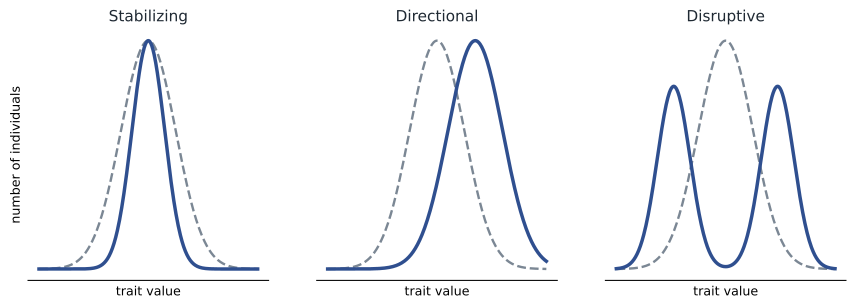
- Stabilizing selection favours intermediate values and reduces variation. Human birth weight is a textbook example: very low and very high birth weights have historically had higher infant mortality.
- Directional selection favours one extreme and shifts the mean. The increase in resistance to an antibiotic or pesticide over time is directional selection.
- Disruptive selection favours both extremes over intermediates and can split a population into two forms. Some seed-eating finches with large or small beaks thrive on hard or soft seeds, while intermediate beaks do poorly on both.
Other forms of selection matter as well. Sexual selection favours traits that improve mating success, either by competition within one sex (often males, as in antlers) or by mate choice (often females, as in elaborate plumage). Traits favoured by sexual selection can reduce survival, as the peacock's tail does, if they increase reproduction enough to compensate. Frequency-dependent selection makes a phenotype's fitness depend on how common it is; in negative frequency-dependent selection, rare forms have an advantage, which maintains variation.
Balancing selection and heterozygote advantage
Some harmful alleles remain common because selection favours heterozygotes. The best-known example is the sickle cell allele from lesson 3. People homozygous for it have sickle cell disease. Heterozygotes have sickle cell trait, which usually causes few symptoms and gives substantial protection against severe malaria caused by Plasmodium falciparum. In regions where this form of malaria has long been common, the allele is maintained at higher frequency than mutation alone would predict. This is heterozygote advantage, a form of balancing selection.
Heterozygote advantage shows why "harmful allele" is always relative to an environment. In a region without malaria, the sickle cell allele confers no advantage, and its frequency would be expected to decline slowly over many generations.
Genetic drift, bottlenecks and founder effects
Genetic drift is random change in allele frequencies due to chance in which individuals reproduce and which alleles they pass on. Drift is strongest in small populations: flip a coin ten times and getting seven heads is common; flip it ten thousand times and getting 70 percent heads is almost impossible. Over time drift can fix an allele (raise it to 100 percent) or eliminate it, regardless of whether it is beneficial.
Two special cases are often tested. A population bottleneck occurs when a population shrinks sharply, for example after a disaster or overhunting, so that the survivors carry only a sample of the original variation. Northern elephant seals were hunted to perhaps a few dozen individuals by the 1890s; although the population has since recovered to many tens of thousands, its genetic diversity remains very low. A founder effect occurs when a small group starts a new population, carrying only a subset of the source population's alleles. Founder effects help explain why certain inherited conditions are more common in some isolated or historically small communities, such as Ellis-van Creveld syndrome among the Old Order Amish of Lancaster County, Pennsylvania.
Worked problem
Drift or selection?
Researchers follow an allele in two populations of the same insect for 40 generations. In a population of 20,000, its frequency stays near 0.30. In an isolated population of 30, the frequency wanders up and down and reaches 1.0 after 25 generations. Laboratory tests show no difference in survival or reproduction between genotypes. (Data invented for this course.) What best explains the small population's result?
Show solution
- There is no fitness difference, so natural selection is unlikely.
- The large population is stable, so mutation or a general environmental change is unlikely.
- Only the small population changes, and it changes erratically.
- Random fluctuation that is strongest in small populations is genetic drift.
Answer: Genetic drift. In a population of 30, chance alone can fix an allele within a few dozen generations.
Gene flow, mutation and nonrandom mating
Gene flow is the movement of alleles between populations through migration of individuals or their gametes. It tends to make populations more similar and can counter local adaptation. When gene flow stops, populations diverge more easily, which is one step toward speciation.
Mutation is the ultimate source of new alleles. Its direct effect on allele frequencies is small because mutation rates per gene are low, but over long periods it supplies the variation on which selection and drift act. Most new mutations are neutral or harmful; a small fraction are beneficial in a particular environment.
Nonrandom mating changes genotype frequencies. Inbreeding, mating between relatives, increases homozygosity across the genome. Because many harmful alleles are recessive, inbreeding increases the chance that offspring are homozygous for them, reducing fitness, a pattern called inbreeding depression. Outbreeding, mating between less related individuals, tends to increase heterozygosity. Assortative mating, in which individuals choose mates similar to themselves for a trait, increases homozygosity for genes affecting that trait.
Species and speciation
The biological species concept defines a species as a group of populations whose members can interbreed in nature and produce fertile offspring, and which are reproductively isolated from other such groups. The concept works poorly for asexual organisms and fossils, so biologists also use morphological and phylogenetic definitions, but the MCAT focuses on reproductive isolation.
Reproductive isolating barriers fall into two groups. Prezygotic barriers prevent mating or fertilization: habitat isolation, temporal isolation (breeding at different times), behavioural isolation (different courtship signals), mechanical isolation (incompatible reproductive structures) and gametic isolation (eggs and sperm that cannot fuse). Postzygotic barriers act after fertilization: reduced hybrid viability, reduced hybrid fertility (the mule, offspring of a horse and a donkey, is usually sterile) and hybrid breakdown, in which later generations of hybrids are weak or sterile.
Speciation usually begins when populations stop exchanging genes. In allopatric speciation, a geographic barrier separates populations, which then diverge through selection and drift until they can no longer interbreed. In sympatric speciation, a new species arises without geographic separation, for example through polyploidy in plants, where an error in cell division doubles the chromosome number and produces individuals that cannot produce fertile offspring with the parent population. Adaptive radiation is the rapid diversification of one ancestral lineage into many species adapted to different niches, as in the Galápagos finches and Hawaiian honeycreepers.
Patterns of evolution
Several broader patterns appear in passages. Divergent evolution produces homologous structures, which share ancestry but may differ in function, such as the forelimbs of humans, whales and bats. Convergent evolution produces analogous structures, which serve similar functions but evolved independently, such as the wings of birds and insects. Parallel evolution occurs when related lineages evolve similar traits independently. Coevolution occurs when two species influence each other's evolution, as with flowering plants and their pollinators or hosts and parasites.
The pace of evolution is debated in two models. Phyletic gradualism describes slow, steady change. Punctuated equilibrium, proposed by Niles Eldredge and Stephen Jay Gould in 1972, describes long periods of little change interrupted by rapid change, often around speciation events. The fossil record shows examples of both.
Evidence for evolution
Evidence for common descent comes from several independent sources that agree with each other.
| Line of evidence | Example |
|---|---|
| Fossil record | Transitional forms such as Tiktaalik, between fish and four-limbed animals, and the sequence of whale ancestors with hind limbs |
| Comparative anatomy | Homologous structures, and vestigial structures such as the human coccyx |
| Embryology | Pharyngeal arches appear in the embryos of all vertebrates |
| Molecular biology | The shared genetic code, and DNA and protein similarities that mirror anatomical relationships |
| Biogeography | Island species most closely resemble species on the nearest mainland |
| Direct observation | Antibiotic resistance, pesticide resistance and changes in beak size in Galápagos finches during droughts |
Molecular evidence lets researchers estimate how long ago lineages diverged. If a gene accumulates neutral substitutions at a roughly constant rate, the number of differences between two species acts as a molecular clock. Clocks must be calibrated with fossils and are less reliable over long periods or between lineages with different generation times, but they have shown, for example, that humans and chimpanzees share a common ancestor that lived roughly 6 to 7 million years ago.
Evolution in medicine
Evolutionary reasoning is essential in medicine, which is why it appears on a test for medical school. Bacteria, viruses and cancer cells evolve during treatment. Combination therapy for HIV and tuberculosis works partly because a pathogen is far less likely to carry resistance to several drugs at once than to one. A tumour is a population of cells under selection: a treatment that kills most cells can leave a resistant subpopulation that grows back. Influenza vaccines are updated regularly because the virus's surface proteins evolve. Understanding selection, drift and mutation helps clinicians understand why resistance appears and how to slow it.
Common mistakes
MistakeIndividuals evolve when they adapt to a new environment.
InsteadPopulations evolve; individuals may acclimatize, but their genes do not change in response.
MistakeAntibiotics cause bacteria to develop resistance mutations.
InsteadResistance arises by mutation or gene transfer; the antibiotic selects for cells that already carry it.
MistakeGenetic drift always reduces fitness.
InsteadDrift is random; it can fix harmful, neutral or beneficial alleles.
MistakeFitness means physical strength or long life.
InsteadFitness means reproductive success relative to other genotypes.
MistakeInbreeding changes allele frequencies directly.
InsteadInbreeding increases homozygosity; by itself it changes genotype frequencies, not allele frequencies.
Summary and key terms
- Evolution is a change in allele frequencies in a population; the failure of each Hardy-Weinberg condition points to a force of evolution.
- Natural selection acts on heritable variation in fitness, meaning reproductive success; only selection produces adaptation consistently.
- Selection can be stabilizing, directional or disruptive; sexual, frequency-dependent and balancing selection are further forms.
- Genetic drift, bottlenecks and founder effects change allele frequencies by chance, most strongly in small populations.
- Gene flow, mutation and nonrandom mating also shape variation; inbreeding raises homozygosity and can reveal harmful recessive alleles.
- Speciation requires reproductive isolation, through prezygotic or postzygotic barriers, often after geographic separation.
- Fossils, anatomy, embryology, molecular biology, biogeography and direct observation all support common descent.
- Fitness
- Reproductive success relative to other genotypes in the population.
- Genetic drift
- Random change in allele frequencies, strongest in small populations.
- Bottleneck effect
- Loss of genetic variation after a sharp reduction in population size.
- Founder effect
- Reduced variation in a population started by a small number of individuals.
- Heterozygote advantage
- Higher fitness of heterozygotes than of either homozygote, which maintains both alleles.
- Inbreeding depression
- Reduced fitness from increased homozygosity for harmful recessive alleles.
- Allopatric speciation
- Formation of new species after geographic separation of populations.
- Homologous structures
- Structures in different species that share a common evolutionary origin.
Practice problems
Work each problem on paper first, then reveal the answer to check.
Average beak depth in a finch population increases after a drought in which only large, hard seeds remain. What kind of selection is this?
Show answer
Directional selection toward deeper beaks.
Why does the sickle cell allele remain common in some populations despite causing disease in homozygotes?
Show answer
Heterozygotes are protected against severe malaria, so selection favours them where malaria is common.
Two frog species breed in the same pond but one breeds in early spring and the other in late spring. What barrier separates them?
Show answer
Temporal isolation, a prezygotic barrier.
Are bird wings and bat wings homologous or analogous as wings?
Show answer
Analogous as wings, because flight evolved independently; the underlying forelimb bones are homologous.
Which Hardy-Weinberg condition fails when two previously separate populations begin to exchange migrants?
Show answer
No migration; gene flow now occurs.
Lesson quiz · 5 questions
Score 60% or more to complete this lesson.
Create a free account to save your progress, take quizzes and earn a certificate.