
MCAT-111 · Lesson 6 of 12 · 22 min
Genetics and inheritance: Mendelian and population genetics
▶ Video coming soon A video version of this lesson is on the way.
Devika said she liked genetics problems "the way some people like crosswords". Ezequiel said he liked them the way some people like dental work. Thandiwe promised them both the same thing: 'Every genetics question on this test can be solved with four tools. Probability rules, the Punnett square, pedigree logic and Hardy-Weinberg. We will practise each until it is boring.'
This lesson covers Mendelian inheritance and its extensions, sex linkage, linkage and recombination mapping, pedigree analysis and the Hardy-Weinberg principle. It maps to content category 1C on the AAMC outline: Mendelian concepts, meiosis and other factors affecting genetic variability, and analytic methods. The MCAT expects quick arithmetic without a calculator, so this lesson shows how to set problems up so that the numbers stay simple.
The vocabulary
A gene is a unit of heredity, usually a DNA sequence that encodes a product. Its position on a chromosome is its locus. Alternative versions of a gene are alleles. A diploid organism carries two alleles for each autosomal gene, one from each parent. If the two are the same, the individual is homozygous; if they differ, heterozygous. The genotype is the set of alleles; the phenotype is the observable trait, which depends on the genotype and, often, on the environment.
In complete dominance, one allele (dominant) determines the phenotype in a heterozygote, masking the other (recessive). Dominance describes how alleles interact to produce a phenotype; it says nothing about which allele is more common or more beneficial. Many dominant alleles are rare, and many recessive alleles are common.
Mendel's laws
Gregor Mendel's experiments with pea plants, published in 1866, led to two principles. The law of segregation states that the two alleles of a gene separate during gamete formation, so each gamete carries one. The law of independent assortment states that alleles of different genes assort into gametes independently of each other. Both laws have a physical basis in meiosis, covered in lesson 10: segregation reflects the separation of homologous chromosomes, and independent assortment reflects the random orientation of different homologous pairs. Independent assortment holds for genes on different chromosomes or far apart on the same chromosome; linked genes, discussed below, are the main exception.
Monohybrid and dihybrid crosses
A cross between two heterozygotes, Aa by Aa, gives offspring in the genotype ratio 1 AA to 2 Aa to 1 aa and, with complete dominance, a phenotype ratio of 3 dominant to 1 recessive. A test cross mates an individual of dominant phenotype with a homozygous recessive. If all offspring show the dominant phenotype, the tested individual is probably homozygous dominant; if about half show the recessive phenotype, it is heterozygous.
A dihybrid cross between two individuals heterozygous at two unlinked genes, AaBb by AaBb, gives the famous 9 to 3 to 3 to 1 phenotype ratio. You can draw a 16-square Punnett square, but it is faster to multiply. The probability of the dominant phenotype for A is 3/4, and for B is 3/4, so both dominant is 3/4 times 3/4, or 9/16. Dominant A with recessive b is 3/4 times 1/4, or 3/16, and so on.
Probability rules
Two rules solve most genetics arithmetic. The product rule says the probability that two independent events both happen is the product of their probabilities. The sum rule says the probability that one of two mutually exclusive events happens is the sum of their probabilities. Combine them carefully. In a cross AaBbCc by AaBbCc, the probability of an offspring that is aabbcc is 1/4 times 1/4 times 1/4, or 1/64. The probability of an offspring heterozygous at exactly one of two genes from AaBb by AaBb is (1/2 times 1/2) for heterozygous A and homozygous B, plus (1/2 times 1/2) for homozygous A and heterozygous B, which is 1/2.
Worked problem
Using the product rule
Two parents are both heterozygous carriers of an autosomal recessive disorder. They plan to have three children. What is the probability that none of the three is affected?
Show solution
- For each child, the chance of being affected is 1/4, so the chance of being unaffected is 3/4.
- Each child is an independent event, so multiply: 3/4 times 3/4 times 3/4.
- That is 27/64.
Answer: 27/64, a little over 40 percent. The chance that at least one child is affected is 1 minus 27/64, or 37/64.
Beyond simple dominance
Many traits do not follow simple dominance, and the MCAT tests the common patterns by name.
| Pattern | What happens | Example |
|---|---|---|
| Incomplete dominance | Heterozygote has an intermediate phenotype | Snapdragon flower colour: red by white gives pink |
| Codominance | Both alleles are fully expressed in the heterozygote | ABO blood group: IA and IB together give type AB |
| Multiple alleles | More than two alleles exist in the population | ABO has three common alleles: IA, IB and i |
| Pleiotropy | One gene affects several traits | Marfan syndrome affects connective tissue in the eyes, heart and skeleton |
| Epistasis | One gene masks or modifies the effect of another | In Labrador retrievers, one gene controls pigment deposition regardless of pigment colour |
| Polygenic inheritance | Many genes each add a small effect | Height and skin pigmentation show continuous variation |
| Incomplete penetrance | Not everyone with the genotype shows the phenotype | Some BRCA1 carriers never develop cancer |
| Variable expressivity | People with the same genotype show the trait to different degrees | Neurofibromatosis type 1 ranges from mild to severe |
ABO blood type deserves a moment because it combines codominance and multiple alleles. IA and IB are codominant with each other and both dominant to i. A person with type A blood can be IAIA or IAi; type B can be IBIB or IBi; type AB is IAIB; type O is ii. A cross between IAi and IBi can produce all four blood types, each with probability 1/4, a favourite question for that reason.
Epistasis changes the familiar 9 to 3 to 3 to 1 ratio. In recessive epistasis, homozygosity for the recessive allele of one gene masks the other gene, giving a 9 to 3 to 4 ratio. In the Labrador example, the B gene determines black (B) or brown (bb) pigment, and the E gene determines whether pigment is deposited in the coat; ee dogs are yellow regardless of B. When a passage reports a modified dihybrid ratio such as 9 to 7 or 9 to 3 to 4, epistasis is the likely explanation.
Sex-linked inheritance
In humans, females are usually XX and males XY. Genes on the X chromosome show X-linked inheritance. A male has only one X, so a single recessive X-linked allele produces the phenotype; males are said to be hemizygous. X-linked recessive conditions such as hemophilia A, Duchenne muscular dystrophy and red-green colour blindness are therefore far more common in males. Key patterns: an affected male passes his X to all his daughters (who become carriers if the mother contributes a normal allele) and to none of his sons; a carrier mother passes the allele to half her sons (affected) and half her daughters (carriers).
X-linked dominant conditions are rarer. An affected father passes the trait to all daughters and no sons. Y-linked traits pass from father to all sons. Mitochondrial DNA is inherited almost entirely through the egg, so mitochondrial disorders pass from an affected mother to all her children, while affected fathers do not pass them on.
Reading pedigrees
Pedigrees use squares for males and circles for females, shaded symbols for affected people, horizontal lines for matings and vertical lines to children. A few clues identify the mode of inheritance quickly.
| Clue in the pedigree | Suggests |
|---|---|
| Two unaffected parents have an affected child | Recessive inheritance |
| The trait appears in every generation and affected people usually have an affected parent | Dominant inheritance |
| Affected males greatly outnumber affected females, and the trait passes through unaffected females | X-linked recessive |
| An affected father has an affected son | Not X-linked (sons receive the father's Y) |
| An affected father has all daughters affected and no sons affected | X-linked dominant |
| All children of affected mothers are affected; no children of affected fathers are | Mitochondrial |
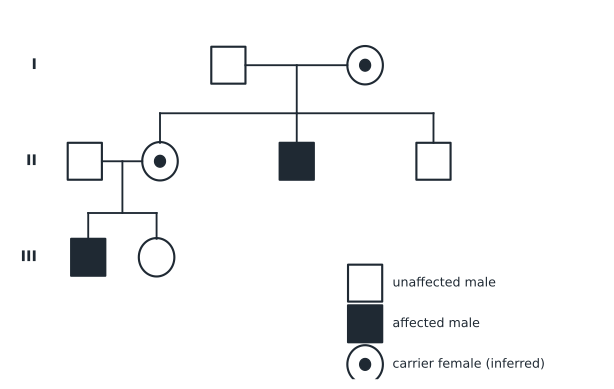
Thandiwe stressed one discipline: decide what the pedigree rules out, not just what it is consistent with. The pedigree above is consistent with both X-linked recessive and autosomal recessive inheritance. A single affected father with an affected son would rule out X-linked inheritance; an affected daughter of an unaffected father would rule out X-linked recessive inheritance. Many MCAT pedigree questions ask which mode "cannot" explain the data.
Linkage and recombination mapping
Genes close together on the same chromosome tend to be inherited together; they are linked. During meiosis, homologous chromosomes exchange segments by crossing over, which can separate linked alleles and create recombinant gametes. The farther apart two genes are, the more likely a crossover between them. Thomas Hunt Morgan and his student Alfred Sturtevant used this idea in fruit flies; Sturtevant built the first genetic map in 1913.
Recombination frequency is the number of recombinant offspring divided by the total. One percent recombination equals one map unit, also called a centimorgan. Because multiple crossovers between distant genes can cancel each other, recombination frequency never exceeds 50 percent; genes that far apart behave as if unlinked. With three genes, map distances are roughly additive, so if A-B is 8 map units and B-C is 5, A-C is about 13 or about 3, depending on order. A three-point test cross resolves the order: the gene in the middle is the one that switches in the rarest, double-crossover class.
Worked problem
Calculating a map distance
A fly heterozygous for linked genes, with dominant alleles on one chromosome and recessive alleles on the other, is test-crossed. The offspring are 420 with both dominant traits, 410 with both recessive traits, 85 with the first dominant and the second recessive, and 85 with the reverse. (Data invented for this course.) What is the map distance?
Show solution
- The parental classes are the most frequent: 420 and 410.
- The recombinant classes are 85 and 85, a total of 170.
- The total number of offspring is 420 + 410 + 85 + 85 = 1,000.
- Recombination frequency is 170 / 1,000 = 0.17.
Answer: 17 map units (17 centimorgans).
Population genetics and Hardy-Weinberg
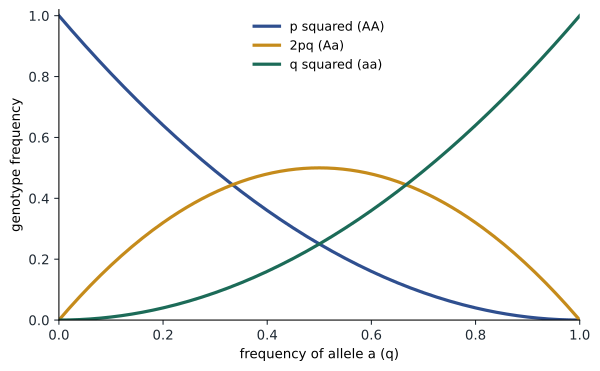
Population genetics asks how allele frequencies behave in a group. The gene pool is the set of all alleles in a population. For a gene with two alleles, let p be the frequency of one and q the frequency of the other, so p + q = 1. The Hardy-Weinberg principle, described independently by G. H. Hardy and Wilhelm Weinberg in 1908, states that in a large, randomly mating population with no mutation, migration or selection, allele frequencies stay constant from generation to generation and genotype frequencies are p squared, 2pq and q squared.
The five conditions are worth memorizing as a list, because questions often ask which violation explains a change: a very large population (no genetic drift), random mating, no mutation, no migration (gene flow) and no natural selection. Real populations rarely meet all five, but the principle provides a baseline against which change can be measured.
The classic calculation starts from the frequency of a recessive phenotype. If an autosomal recessive condition affects 1 in 10,000 people, then q squared is 1/10,000, so q is 1/100, or 0.01, and p is 0.99. Carriers occur at 2pq, about 2 times 0.99 times 0.01, or roughly 0.02: about 1 person in 50. Carriers are about 200 times as common as affected people, which shows how recessive alleles can persist hidden in heterozygotes.
For X-linked genes, the frequency of affected males equals q directly, because males have one X. If 1 in 12 males in a population has a particular X-linked colour vision variant, q is about 0.08, and affected females (q squared) are about 0.0064, roughly 1 in 150. That difference between males and females is a frequent quick question.
Common mistakes
MistakeA dominant allele is the most common allele in a population.
InsteadDominance describes how alleles combine in a heterozygote, not frequency.
MistakeIn Hardy-Weinberg problems, the frequency of the recessive phenotype equals q.
InsteadFor autosomal genes, the recessive phenotype frequency is q squared; take its square root to find q.
MistakeAn affected father can pass an X-linked recessive allele to his son.
InsteadFathers give sons their Y chromosome, not their X.
MistakeRecombination frequency can exceed 50 percent for distant genes.
InsteadIt reaches at most 50 percent, when genes assort as if unlinked.
MistakeCodominance and incomplete dominance are the same thing.
InsteadIn codominance both phenotypes appear fully; in incomplete dominance the heterozygote is intermediate.
Summary and key terms
- Alleles segregate during gamete formation, and unlinked genes assort independently, reflecting chromosome behaviour in meiosis.
- Aa by Aa gives 3 to 1 phenotypes; AaBb by AaBb gives 9 to 3 to 3 to 1; the product and sum rules solve most probability questions.
- Incomplete dominance, codominance, multiple alleles, pleiotropy, epistasis, polygenic traits, penetrance and expressivity extend Mendel's patterns.
- X-linked recessive traits are more common in males and never pass from father to son; mitochondrial traits pass through mothers.
- Recombination frequency measures map distance: 1 percent equals 1 centimorgan, with a ceiling of 50 percent.
- Hardy-Weinberg: p + q = 1 and p squared + 2pq + q squared = 1, under five conditions whose violation changes allele frequencies.
- Allele
- An alternative form of a gene at a given locus.
- Heterozygous
- Having two different alleles of a gene.
- Test cross
- A cross with a homozygous recessive individual to reveal an unknown genotype.
- Codominance
- Full expression of both alleles in a heterozygote.
- Epistasis
- Interaction in which one gene masks or modifies the effect of another.
- Penetrance
- The proportion of individuals with a genotype who show the expected phenotype.
- Centimorgan
- A map unit equal to 1 percent recombination between two loci.
- Hardy-Weinberg equilibrium
- A state in which allele and genotype frequencies stay constant across generations.
Practice problems
Work each problem on paper first, then reveal the answer to check.
What fraction of offspring from AaBbCc by AaBbCc show all three dominant phenotypes?
Show answer
3/4 times 3/4 times 3/4 = 27/64.
A type A mother and a type B father have a type O child. What are the parents' genotypes?
Show answer
IAi and IBi; each must carry an i allele.
In a population at Hardy-Weinberg equilibrium, 16 percent of people show a recessive trait. What fraction are carriers?
Show answer
q squared = 0.16, so q = 0.4 and p = 0.6; carriers are 2pq = 0.48, or 48 percent.
A carrier mother of an X-linked recessive condition and an unaffected father have a son. What is the chance he is affected?
Show answer
1/2; he receives one of his mother's two X chromosomes.
Genes A and B show 50 percent recombination. What can you conclude?
Show answer
They assort independently: they are on different chromosomes or far apart on the same chromosome.
Lesson quiz · 5 questions
Score 60% or more to complete this lesson.
Create a free account to save your progress, take quizzes and earn a certificate.