
MCAT-111 · Lesson 5 of 12 · 21 min
Biotechnology methods
▶ Video coming soon A video version of this lesson is on the way.
Thandiwe had taught biochemistry labs for six years, and it showed in this session. She shared a photograph of an agarose gel from her own teaching days, with a ladder in the first lane and fuzzy bands in the others. 'Every one of you will see a gel in a passage,' she said. 'Some of you will see a western blot, a PCR curve or a CRISPR knockout. The test does not want you to run the experiment. It wants you to read it. So today we read.'
This lesson reviews the laboratory methods listed under recombinant DNA and biotechnology in content category 1B of the AAMC outline: restriction enzymes, cloning and libraries, the polymerase chain reaction, gel electrophoresis and blotting, DNA sequencing, methods for measuring and changing gene expression, and some applications and ethical questions. Many of these methods also appear in Chem/Phys and Bio/Biochem passages as tools rather than topics, so the reasoning here pays off well beyond this content category.
Restriction enzymes and recombinant DNA
Restriction endonucleases are bacterial enzymes that cut DNA at specific short sequences, usually four to eight base pairs long and often palindromic: the sequence reads the same 5' to 3' on both strands. EcoRI, for example, recognizes GAATTC. In bacteria these enzymes defend against viruses; the bacterium protects its own DNA by methylating the same sites. Some enzymes cut straight across both strands, leaving blunt ends. Others cut at offset positions, leaving short single-stranded overhangs called sticky ends. Any two pieces of DNA cut with the same enzyme have complementary sticky ends, so they can pair and be joined by DNA ligase. That simple fact made recombinant DNA possible in the early 1970s.
A typical cloning procedure inserts a gene into a vector, often a bacterial plasmid. A useful cloning plasmid has an origin of replication, one or more unique restriction sites in a multiple cloning site, and a selectable marker such as an antibiotic resistance gene. Researchers cut the plasmid and the gene with the same enzyme, ligate them, introduce the recombinant plasmids into bacteria by transformation and grow the bacteria on medium containing the antibiotic. Only cells that took up a plasmid survive. Many vectors also allow a second screen: if the insert disrupts a reporter gene such as lacZ, colonies with an insert are white on a medium containing a substance that turns blue when cut by beta-galactosidase, while colonies without an insert are blue.
Libraries and cDNA
A genomic library is a collection of clones that together contain the whole genome of an organism, in fragments. A cDNA library contains copies of the mRNAs present in a particular tissue at a particular time. To make cDNA, researchers isolate mRNA (often by its poly(A) tail), use reverse transcriptase to copy it into complementary DNA and then make the second strand. Because cDNA comes from mature mRNA, it lacks introns. That is the key reason to clone cDNA when the goal is to make a human protein in bacteria: bacteria cannot splice, so a genomic copy with introns would not be translated correctly.
Expressing a eukaryotic protein in bacteria also requires bacterial promoter and ribosome-binding sequences in the vector. Even then, bacteria cannot add many eukaryotic post-translational modifications, such as complex glycosylation, so some proteins are made in yeast, insect or mammalian cells instead. Human insulin, approved for medical use in 1982, was the first recombinant human protein drug and is made in bacteria or yeast.
The polymerase chain reaction
The polymerase chain reaction (PCR), developed by Kary Mullis in the 1980s, copies a specific DNA region millions of times. A reaction contains the template DNA, two short primers that flank the region of interest (one for each strand), the four deoxynucleotides, a heat-stable DNA polymerase such as Taq polymerase from the bacterium Thermus aquaticus, and a buffer with magnesium ions. Each cycle has three steps.
- Denaturation at about 94 to 98 degrees Celsius separates the strands.
- Annealing at roughly 50 to 65 degrees lets the primers pair with their complementary sequences; the temperature is chosen to suit the primers.
- Extension at about 72 degrees, near the optimum for Taq polymerase, lets the polymerase extend each primer.
Each cycle roughly doubles the number of copies of the target region. After n cycles, one starting molecule gives up to 2 to the power n copies. Thirty cycles give 2 to the 30th, about one billion, copies. In practice the reaction slows as primers and nucleotides run out, producing a plateau. The exponential growth also explains why PCR is so sensitive to contamination: a single stray molecule can be amplified into a visible band.
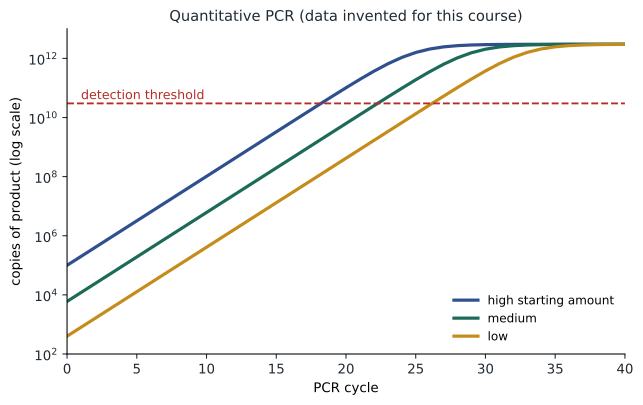
Quantitative, or real-time, PCR measures fluorescence as the product accumulates. The cycle at which fluorescence crosses a threshold, often called the Ct or Cq value, falls as the starting amount rises. Because each cycle doubles the product, a sample whose Ct is 3 cycles lower than another had about 2 cubed, or 8 times, as much starting template. Reverse transcription PCR first copies RNA into cDNA, so it can measure mRNA levels or detect RNA viruses. Real-time reverse transcription PCR was the main diagnostic test for SARS-CoV-2 during the COVID-19 pandemic.
Worked problem
Comparing Ct values
In a quantitative reverse transcription PCR experiment, a gene's mRNA has a Ct of 24 in untreated cells and 21 in drug-treated cells. A reference gene has the same Ct in both. (Data invented for this course.) How did the drug change expression?
Show solution
- The reference gene is unchanged, so the samples are comparable.
- The treated sample crosses the threshold 3 cycles earlier.
- Each cycle doubles the product, so 3 cycles corresponds to 2 times 2 times 2 = 8.
- A lower Ct means more starting template.
Answer: About an eightfold increase in that mRNA in treated cells.
Gel electrophoresis
Gel electrophoresis separates molecules by size using an electric field. DNA and RNA have negatively charged phosphate backbones, so they migrate toward the positive electrode (the anode). Because the charge-to-mass ratio of nucleic acids is nearly constant, separation depends mainly on size: smaller fragments move faster through the gel matrix and travel farther. Agarose gels separate larger DNA fragments, roughly hundreds to tens of thousands of base pairs; polyacrylamide gels separate smaller ones with finer resolution. A ladder of fragments of known sizes runs in one lane for comparison. Distance travelled is roughly linear with the logarithm of fragment size over the useful range of the gel.
Proteins are usually separated by SDS-PAGE. Sodium dodecyl sulphate (SDS) denatures proteins and coats them with negative charge roughly in proportion to their length, so proteins also separate mainly by size. A reducing agent such as beta-mercaptoethanol is often added to break disulfide bonds, so a protein made of subunits joined by disulfides runs as its separate subunits. Native gels, without SDS, separate by size, shape and charge together. Isoelectric focusing separates proteins by their isoelectric point, the pH at which their net charge is zero; MCAT-110 covers protein charge in more detail.
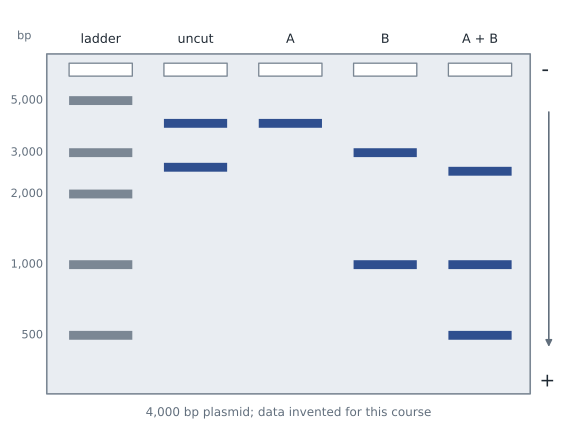
Restriction mapping is a common passage task. In the gel above, enzyme A gives a single 4,000-base-pair band, so it cuts the circular plasmid once and linearizes it. Enzyme B gives 3,000 and 1,000, so it cuts twice. The double digest gives 2,500, 1,000 and 500, which places the single A site 500 base pairs from one B site and inside the 3,000-base-pair B fragment. A circular plasmid cut n times gives n fragments; a linear molecule cut n times gives n plus 1. Uncut plasmid often runs as more than one band because supercoiled and nicked forms migrate differently, which a passage may mention to see whether you are thrown by it.
Blotting and probes
Blotting transfers molecules from a gel to a membrane so they can be detected. The names follow a joke on Edwin Southern's name.
| Method | Detects | Probe |
|---|---|---|
| Southern blot | Specific DNA sequences | Labelled single-stranded DNA or RNA that hybridizes to the target |
| Northern blot | Specific RNA sequences, such as an mRNA | Labelled nucleic acid probe |
| Western blot | Specific proteins | Antibodies, usually a primary antibody and a labelled secondary antibody |
ELISA, the enzyme-linked immunosorbent assay, also uses antibodies to detect and measure proteins, but in wells rather than on a gel. Microarrays, which carry thousands of DNA probes on a chip, and RNA sequencing, which counts RNA fragments directly, measure expression of many genes at once. When a passage compares a northern blot and a western blot for the same gene, it is often testing whether a change happens at the level of mRNA or protein: if the mRNA stays the same but the protein falls, the change is after transcription.
DNA sequencing
The Sanger method, developed by Frederick Sanger in 1977, uses dideoxynucleotides (ddNTPs), which lack the 3' hydroxyl needed to add the next nucleotide. When a polymerase incorporates a ddNTP, synthesis stops. A reaction with the template, a primer, normal deoxynucleotides and a small amount of fluorescently labelled ddNTPs produces fragments of every length, each ending at a labelled base. Separating the fragments by size, usually in a capillary, and reading the colour of each in order gives the sequence. Sanger sequencing remains common for checking individual clones.
Next-generation sequencing methods sequence millions of fragments in parallel and have made whole-genome sequencing routine. The Human Genome Project, declared essentially complete in 2003, took more than a decade; a gap-free human sequence from the Telomere-to-Telomere consortium was published in 2022. Today a human genome can be sequenced in days. On the MCAT, sequencing questions most often test the logic of chain termination: why the 3' hydroxyl matters, and how fragment lengths correspond to positions.
Changing genes: knockouts, transgenics and CRISPR
To learn what a gene does, researchers often remove or change it and watch the result. A knockout removes or inactivates a gene; a knock-in replaces it with a modified version; a transgenic organism carries an added gene. Knockout mice were first made by homologous recombination in embryonic stem cells, work recognized with a Nobel Prize in 2007. RNA interference (lesson 4) reduces expression without changing the gene and is called a knockdown.
CRISPR-Cas9 has made gene editing far easier. The system comes from a bacterial defence against viruses. A guide RNA of about 20 nucleotides directs the Cas9 nuclease to a matching DNA sequence next to a short motif called the PAM (for the most common Cas9, NGG). Cas9 makes a double-strand break. The cell repairs it by non-homologous end joining, which often leaves small insertions or deletions that knock out the gene, or by homology-directed repair, which can insert a new sequence if a template is supplied. Emmanuelle Charpentier and Jennifer Doudna received the 2020 Nobel Prize in Chemistry for developing the method. The first CRISPR-based therapy, for sickle cell disease and beta thalassemia, was approved in the United Kingdom in November 2023 and by the US Food and Drug Administration in December 2023; it edits a patient's own blood stem cells outside the body to restore production of fetal haemoglobin.
Applications and ethics
Biotechnology has applications in medicine (recombinant proteins, gene therapy, diagnostic tests), agriculture (genetically modified crops), forensics and ancestry (DNA profiling using short tandem repeats) and research. The AAMC outline lists "safety and ethics of DNA technology" explicitly, and Psych/Soc and CARS passages sometimes raise related questions. Common themes include informed consent for genetic testing, privacy of genetic data, unequal access to expensive therapies, editing of somatic cells (affecting only the patient) compared with germline cells (affecting descendants), and environmental release of modified organisms. The widely condemned 2018 report of gene-edited babies in China sharpened the distinction between somatic and germline editing. On the test, ethics questions reward careful reading of what the passage claims, not your own opinion.
Stem cells, briefly
Stem cells can divide to renew themselves and differentiate into specialized cells. Embryonic stem cells are pluripotent: they can form any cell type of the body. Adult stem cells, such as blood-forming stem cells in bone marrow, are usually multipotent, limited to a family of cell types. In 2006 Shinya Yamanaka showed that adding four transcription factors could reprogram adult cells into induced pluripotent stem cells, earning a share of the 2012 Nobel Prize. Stem cells link this lesson to development, covered in MCAT-112.
Common mistakes
MistakeIn gel electrophoresis, larger DNA fragments travel farther.
InsteadSmaller fragments move faster and travel farther toward the positive electrode.
MistakeA genomic clone of a human gene will produce the correct protein in bacteria.
InsteadBacteria cannot remove introns; use cDNA made from mature mRNA.
MistakeA northern blot detects proteins.
InsteadNorthern blots detect RNA; western blots detect proteins.
MistakeA higher Ct value in quantitative PCR means more starting template.
InsteadA higher Ct means less template; it took more cycles to reach the threshold.
MistakeA ddNTP stops synthesis because it lacks a base.
InsteadIt lacks the 3' hydroxyl needed to form the next phosphodiester bond.
Summary and key terms
- Restriction enzymes cut at specific sites; matching sticky ends let ligase join DNA from different sources into recombinant molecules.
- Plasmid vectors carry an origin, cloning sites and selectable markers; cDNA made by reverse transcription lacks introns.
- PCR amplifies a target region by repeated denaturation, annealing and extension; each cycle roughly doubles the product.
- Gel electrophoresis separates nucleic acids and SDS-coated proteins by size; Southern, northern and western blots detect DNA, RNA and protein.
- Sanger sequencing uses chain-terminating ddNTPs; next-generation methods sequence millions of fragments in parallel.
- Knockouts, RNA interference and CRISPR-Cas9 reveal gene function; applications raise questions of safety, consent, privacy, access and germline editing.
- Restriction enzyme
- A bacterial endonuclease that cuts DNA at a specific recognition sequence.
- Sticky ends
- Short single-stranded overhangs left by staggered cuts that can pair with complementary overhangs.
- Vector
- A DNA molecule, such as a plasmid, used to carry foreign DNA into a host cell.
- cDNA
- DNA copied from mRNA by reverse transcriptase; it lacks introns.
- PCR
- A method that amplifies a specific DNA region through repeated cycles of copying.
- Western blot
- A method that detects a specific protein after electrophoresis using antibodies.
- Dideoxynucleotide
- A nucleotide lacking a 3' hydroxyl, which terminates DNA synthesis.
- Guide RNA
- The RNA that directs Cas9 to a matching DNA sequence in CRISPR editing.
Practice problems
Work each problem on paper first, then reveal the answer to check.
How many copies of a target can 20 PCR cycles produce from one molecule, ideally?
Show answer
2 to the 20th, about one million (1,048,576).
A circular plasmid is cut with an enzyme and gives three fragments. How many times did the enzyme cut?
Show answer
Three times; a circle cut n times gives n fragments.
mRNA for a protein is unchanged after a treatment, but the protein band on a western blot is much weaker. Where is the effect?
Show answer
After transcription: at translation or protein stability, not at transcription.
Why is Taq polymerase used in PCR instead of E. coli DNA polymerase?
Show answer
It is heat-stable, so it survives the repeated denaturation steps near 95 degrees Celsius.
What is the main difference between somatic and germline gene editing?
Show answer
Somatic edits affect only the treated person; germline edits can be passed to future generations.
Lesson quiz · 5 questions
Score 60% or more to complete this lesson.
Create a free account to save your progress, take quizzes and earn a certificate.