
MBA-601 · Lesson 7 of 12 · 22 min
Performance management and feedback
Leo brings a spreadsheet to the seventh session. Kestrel ran its first company-wide performance review last spring, with every employee rated on a five-point scale by their manager. The results show something odd. One engineering manager rated nine of her eleven people as exceeding expectations; another, leading a similar team on the same product, rated only one of twelve that high. Bonuses were tied to the ratings, so two engineers who, by most accounts, were doing similar work received bonuses that differed by several thousand dollars. Three of the lower-rated engineers have since resigned. Leo asks whether the answer is to drop ratings altogether, as he has read some large companies did. Dr. Rahimi says the question is a good one, but that it comes after a more basic one: what is performance management for?
What performance management is for
Performance management is the continuous process of setting expectations, observing and discussing performance, developing people and making decisions based on how they perform. It serves two purposes that pull in different directions. The administrative purpose uses performance information to make decisions about pay, promotion, retention and dismissal; it needs comparable, defensible judgments. The developmental purpose uses it to help people improve; it needs candid, specific feedback in a conversation where the employee is willing to hear criticism. When the same annual meeting announces a rating that determines pay and tries to coach the employee on improvement, the employee hears the number and little else.
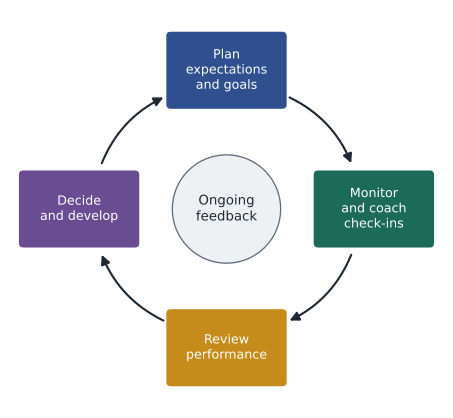
Dr. Rahimi draws the performance management cycle on the board. It starts with planning, where expectations and goals are agreed. It continues through the year with monitoring and coaching: regular conversations, feedback on specific work and adjustment of goals as circumstances change. It reaches review, where performance over a period is assessed. It ends with decisions and development planning, which feed into the next cycle. Most organizations treat the review as the whole system. In well-run systems, the review is a summary of conversations that have already happened, so that nothing in it surprises the employee.
Setting expectations: goals and standards
Goal-setting theory, developed by Edwin Locke and Gary Latham over several decades, is one of the best supported ideas in organizational psychology. Specific, difficult goals lead to higher performance than vague goals such as do your best, provided that people are committed to the goals, have the ability to achieve them and receive feedback on progress. The cohort met the theory in MBA-503. In performance management, it suggests that expectations should be specific and measurable where possible, that a small number of goals is better than a long list, and that goals should be revisited during the year.
Goals have limits. Narrow numerical goals can crowd out important work that is hard to measure, encourage gaming and, when very difficult and tied to rewards, encourage unethical shortcuts. Lisa Ordóñez and colleagues called this goals gone wild, with examples such as sales targets that drove fraudulent account openings at a large bank. Many organizations therefore combine results goals with behavioural expectations: how work gets done, including collaboration, customer focus and integrity. Objectives and key results, a method popularized at Intel and later Google, sets ambitious objectives with a few measurable key results, reviewed quarterly, and deliberately separates them from pay to encourage ambition.
Rating performance and its errors
Ratings are judgments, and judgments contain error. Leniency is the tendency to rate everyone high, often to avoid difficult conversations; severity is its opposite. Central tendency is rating everyone in the middle. Halo is letting one strong impression shape every dimension. Recency is weighting the last few weeks more than the whole period. Similarity bias favours people like the rater. Research by Steven Scullen, Michael Mount and Maynard Goff in 2000 found that more of the variation in ratings was attributable to the individual rater's tendencies than to the performance of the person being rated. Ratings tell us at least as much about the rater as about the ratee.
Rating scales can be improved. Rating scales with behavioural anchors, often called BARS, describe what performance looks like at each level of each dimension, using critical incidents from job analysis, so that raters compare observed behaviour with concrete examples rather than with an abstract idea of a three. Training raters on common errors and on the anchors helps somewhat. Asking managers to rate the actions they would take rather than abstract qualities can help more: Deloitte's redesign in 2015 asked team leaders questions such as whether they would always want this person on their team and whether they would give this person the highest possible pay increase, which raters answer more consistently than general ratings of performance.
Forced distribution and calibration
Forced distribution requires managers to place fixed shares of employees in each rating category, such as 20 per cent at the top, 70 per cent in the middle and 10 per cent at the bottom. General Electric under Jack Welch made it famous, removing the bottom group each year. Its advocates argue that it counters leniency and forces managers to differentiate. Its critics argue that it assumes every team has the same distribution of performance, which is false for small or selectively built teams; that it pits colleagues against each other and discourages collaboration; and that removing the bottom group every year eventually removes adequate performers. Microsoft abandoned its stack ranking in 2013 after complaints that it had damaged collaboration and innovation.
Calibration is a less mechanical alternative. Managers who rate similar jobs meet, present their proposed ratings with evidence, and adjust them to apply common standards. Calibration can reduce leniency differences between managers and expose bias, but it has its own risks: the most persuasive or senior manager can dominate, and employees who are not well known to other managers can be marked down. Good practice includes clear criteria, evidence for each rating, a facilitator who asks about patterns, such as whether people on leave or working remotely are rated lower, and a check of rating distributions by group afterward.
# Calibrating Kestrel's engineering ratings: compare managers' rating patterns
from statistics import mean, pstdev
ratings = {   # manager: ratings of team members on a 1-5 scale
    "manager A": [5, 4, 4, 5, 4, 4, 5, 4, 3, 4, 4],
    "manager B": [3, 2, 3, 3, 4, 3, 2, 3, 3, 3, 2, 3],
    "manager C": [4, 3, 3, 4, 3, 4, 3, 3, 2, 4],
}
all_r = [r for rs in ratings.values() for r in rs]
company_mean = mean(all_r)
print(f"company mean {company_mean:.2f}")
for m, rs in ratings.items():
    top = sum(r >= 4 for r in rs) / len(rs)
    print(f"{m}: mean {mean(rs):.2f}  sd {pstdev(rs):.2f}  rated 4 or 5: {top:.0%}")

# A crude check: if teams are similar, a manager's mean far from the company mean suggests rater
# leniency or severity, a prompt for discussion in calibration rather than an automatic correction.
for m, rs in ratings.items():
    gap = mean(rs) - company_mean
    print(f"{m}: deviation from company mean {gap:+.2f}",
"-> discuss evidence" if abs(gap) > 0.5 else "")company mean 3.42 manager A: mean 4.18 sd 0.57 rated 4 or 5: 91% manager B: mean 2.83 sd 0.55 rated 4 or 5: 8% manager C: mean 3.30 sd 0.64 rated 4 or 5: 40% manager A: deviation from company mean +0.76 -> discuss evidence manager B: deviation from company mean -0.59 -> discuss evidence manager C: deviation from company mean -0.12
The output shows what Leo suspected. Manager A's average rating is more than half a point above the company's, with nearly all her team rated four or five, while manager B's is more than half a point below. Dr. Rahimi cautions against simply adjusting scores to a common mean: manager A may genuinely have a stronger team. The deviations are a prompt for calibration, where each manager shows the evidence for her ratings against shared standards. Leo realizes Kestrel had no shared standards at all; each manager had invented her own meaning of exceeds expectations.
The move away from annual ratings
From about 2012, a number of large companies, including Adobe, Deloitte, Accenture and General Electric, announced that they were scrapping or overhauling annual reviews and ratings in favour of frequent check-ins between managers and employees. Adobe replaced its annual review with regular check-ins and reported a fall in voluntary turnover. The reasons included the time annual reviews consumed, the evidence that ratings were unreliable and the observation that feedback once a year is too late to help anyone improve.
Experience since then has been mixed. Many organizations that dropped ratings found that managers still had to make pay and promotion decisions, which then became less transparent, because the judgments were made but not shown. Some reintroduced simpler ratings. Dr. Rahimi's view is that the debate about ratings is less important than three practices that matter with or without them: frequent conversations about work and development, clear standards that managers share, and decisions about pay and promotion that are explained and consistent. She suggests separating the developmental conversation from the pay decision in time, by a few weeks or a different meeting, so each has room.
Giving feedback that helps
Feedback does not always improve performance. Avraham Kluger and Angelo DeNisi's 1996 meta-analysis of feedback interventions found that while feedback improved performance on average, in about a third of the cases it made performance worse. Feedback hurt most when it drew attention to the person rather than to the task, for example by implying that the person lacked ability, or when it threatened self-esteem. It helped most when it was specific about the task, focused on how to improve, and given soon after the behaviour.
Dr. Rahimi gives the cohort a simple structure that she used with airline supervisors: describe the situation, the behaviour observed and its impact, then ask for the employee's view and agree on what happens next. Specific praise matters as much as criticism, because it tells people what to repeat. Multisource or 360-degree feedback gathers views from peers, direct reports and others as well as the manager. It is valuable for development, especially for managers' interpersonal behaviour, but less suited to pay decisions, because raters soften their views when they know consequences follow.
Potential, the nine-box grid and talent reviews
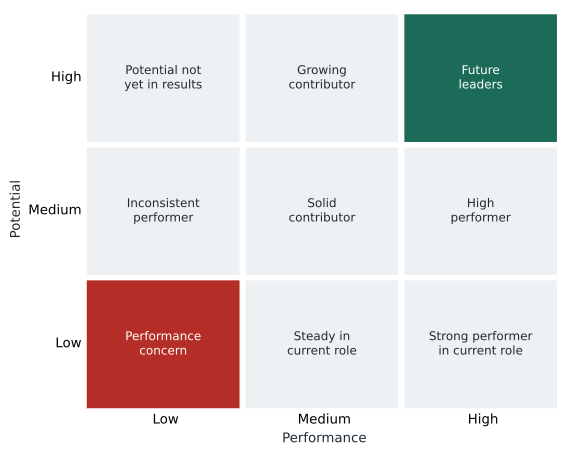
Performance describes what someone has achieved in their current role; potential describes their capacity to grow into larger roles. Many organizations combine the two in a nine-box grid used in talent reviews, with performance on one axis and potential on the other, each rated low, medium or high. The grid helps leaders discuss who might be ready for promotion, who needs development and who may be in the wrong role. Its weaknesses are serious. Potential is hard to judge and easily confused with confidence, visibility or similarity to current leaders. Research has found, for example, that women were rated lower on potential than men despite higher performance ratings, and then went on to outperform the potential ratings. Dr. Rahimi recommends defining potential with specific criteria, such as learning agility and ambition, and checking grid placements for patterns by group.
Managing poor performance
When performance is below expectations, the first step is diagnosis. Is the problem ability, motivation or opportunity, in the terms of lesson 1? Does the employee know what is expected? Do they have the tools, training and time? Is there a personal or health issue that requires accommodation? Many performance problems are management problems: unclear expectations, missing resources or a poor fit between the person and the role. If the problem persists after these are addressed, a performance improvement plan sets out the gap, the expectations, the support offered, the time frame and the consequences, and the manager meets the employee regularly to review progress. The plan should be a genuine attempt to help, documented honestly, not a paper trail for a decision already made.
Canadian law shapes the end of this process. Dismissal for poor performance as just cause, without notice, requires the employer to show that it set clear standards, warned the employee that their job was at risk, gave reasonable support and time to improve, and that the employee still failed to meet the standards. Without that, the employer must give reasonable notice. Accurate records of conversations and ratings matter, and inflated past ratings are a common reason employers lose cases.
Worked problem
Redesigning Kestrel's performance system
Kestrel's 180 employees were rated once a year on a five-point scale, with bonuses of up to 15 per cent of pay tied directly to the rating. Managers interpreted the scale differently, employees learned their ratings only at the annual meeting, and three engineers left after receiving low ratings they considered unfair. Leo wants a system that supports development, rewards strong contributors and is seen as fair. Propose a design.
Show solution
- Clarify purposes and separate them in time: quarterly development conversations focused on goals, feedback and growth; an annual decision on pay and promotion a few weeks after the year-end development conversation.
- Set expectations with a few quarterly objectives per person plus a short set of behavioural expectations derived from Kestrel's competencies, with anchored descriptions of what meeting and exceeding them looks like.
- Replace the abstract five-point rating with three categories for decision purposes, such as developing, strong and exceptional, defined with anchors, and with two forward-looking questions for managers, such as whether they would rehire the person and whether they are ready for a larger role.
- Hold calibration meetings by function with a facilitator, evidence for each proposed rating and a check of distributions by group, remote status and leave.
- Link bonus partly to company results and partly to the individual category, so that the individual component is smaller and less sensitive to rater differences. Train managers in feedback and check-ins.
Answer: The redesigned system separates development from pay, defines expectations clearly, uses simpler ratings with anchors, adds calibration to align standards across managers, and reduces the weight of individual ratings in pay. It should be judged after a year by employees' perceptions of fairness, the consistency of ratings across managers and the retention of strong performers.
Common mistakes
MistakeThe annual review is the performance management system.
InsteadIt is one stage of a continuous cycle of goals, feedback, review and development.
MistakeRatings measure the employee’s performance.
InsteadMuch of the variation in ratings reflects rater tendencies; anchors and calibration are needed.
MistakeForced distribution makes managers fair.
InsteadIt assumes every team has the same distribution and can damage collaboration; calibration is usually better.
MistakeMore feedback always helps.
InsteadFeedback aimed at the person rather than the task can lower performance; keep it specific and focused on improvement.
Summary and key terms
- Performance management serves administrative and developmental purposes, which are best separated in time.
- Specific, difficult goals raise performance when people are committed and get feedback, but narrow goals can be gamed.
- Ratings suffer from leniency, central tendency, halo, recency and rater idiosyncrasy; anchored scales and calibration help.
- Frequent check-ins, shared standards and explained decisions matter more than whether ratings exist.
- Feedback helps when it is specific, task-focused and timely; potential judgments in nine-box grids need checks for bias.
- Performance management
- The continuous process of setting expectations, giving feedback, assessing and developing performance.
- Behavioural anchors
- Descriptions of observable behaviour at each level of a rating scale.
- Leniency error
- Rating employees higher than their performance warrants.
- Halo effect
- Letting one impression influence ratings on every dimension.
- Forced distribution
- Requiring fixed shares of employees in each rating category.
- Calibration
- A meeting in which managers align ratings to common standards using evidence.
- Nine-box grid
- A matrix of performance and potential used in talent reviews.
- Performance improvement plan
- A documented plan setting out a performance gap, support, time frame and consequences.
Practice problems
Work each problem on paper first, then reveal the answer to check.
A manager rates all twelve team members as 4 out of 5. Name two possible errors.
Show answer
Leniency and central tendency, or a lack of differentiation; it may also reflect halo if ratings ignore differences.
Why might forced distribution be unfair to a small, carefully selected team?
Show answer
The team may have few or no poor performers, but the system forces some into the bottom category.
Rewrite this feedback to focus on the task: you are careless.
Show answer
In last week’s client report, three figures in the summary table did not match the source data; please check totals against the source before sending.
Give one way to reduce bias in potential ratings.
Show answer
Define potential with specific criteria, require evidence and check placements for patterns by group.
Lesson quiz · 5 questions
Score 60% or more to complete this lesson.
Create a free account to save your progress, take quizzes and earn a certificate.