
MBA-601 · Lesson 6 of 12 · 20 min
Onboarding, learning and development
Hana opens the sixth session with a number that worries her: one in four of Lakeview's newly graduated nurses leaves within the first year. Exit interviews tell the same story each time. The new nurse was given a two-day orientation full of policies and passwords, assigned to a busy unit with a preceptor who was also carrying a full patient load, and left to sink or swim on night shifts within a month. Those who stayed say they learned the job in spite of the system. Dr. Rahimi says the story contains most of this lesson's themes: the first months shape whether people stay, most learning happens on the job whether or not it is designed, and development is an investment that the organization either manages or loses.
Onboarding
Onboarding, sometimes called organizational socialization, is the process by which new employees acquire the knowledge, skills and relationships to become effective members of the organization. It is different from orientation, which is the event on the first day or two. Good onboarding lasts months and has a structure. Talya Bauer summarized it in four levels. Compliance covers the rules and paperwork. Clarification makes sure new hires understand their job and what is expected of them. Culture conveys the organization's norms and how things are really done. Connection builds the relationships and networks that new hires need to get work done and to feel they belong. Most organizations do the first well and the last two poorly.
Research on socialization points to a few outcomes that predict whether new hires stay and perform: role clarity, confidence in their ability to do the job, called self-efficacy, and social acceptance. Practices that build them include a clear plan for the first ninety days, early and frequent feedback, a buddy or mentor who is not the new hire's manager, structured introductions to the people the new hire will depend on, and early tasks that allow quick wins. The manager's behaviour in the first weeks matters more than any program: whether they meet the new hire on day one, explain priorities, check in regularly and introduce them to the team.
The cost of poor onboarding shows up as early turnover and slow ramp-up. Time to proficiency is the time a new hire takes to reach the productivity of an experienced employee. During ramp-up, the organization pays full wages for partial output, and colleagues spend time helping. Dr. Rahimi shows that the cost of ramp-up is the area between the productivity curve of an experienced worker and the curve of a new hire, and that onboarding's job is to make that area smaller.
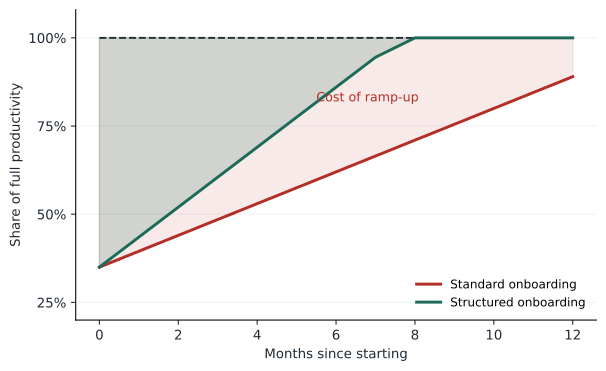
# Cost of ramp-up for a new nurse at Lakeview, with standard vs structured onboarding
pay_per_month = 7_900          # pay and benefits per month

def productivity(month, speed):
    # share of full productivity, rising toward 1.0
    return min(1.0, 0.35 + speed * month)

def ramp_cost(speed, months=12):
    return sum((1 - productivity(m, speed)) * pay_per_month for m in range(1, months + 1))

standard, structured = ramp_cost(0.045), ramp_cost(0.085)
program = 6_500                # extra preceptor time, residency sessions and mentor pay per nurse
print(f"ramp-up cost, standard onboarding:   {standard:9,.0f}")
print(f"ramp-up cost, structured onboarding: {structured:9,.0f}")
print(f"saving per nurse before turnover effects: {standard - structured - program:,.0f}")

# Add the turnover effect: first-year leaving falls from 25% to 12%; each leaver costs 60,000
hires = 80
avoided = hires * (0.25 - 0.12)
print(f"leavers avoided per year: {avoided:.0f}, worth about {avoided * 60_000:,.0f}")ramp-up cost, standard onboarding: 33,891 ramp-up cost, structured onboarding: 17,143 saving per nurse before turnover effects: 10,248 leavers avoided per year: 10, worth about 624,000
The calculation persuades Hana that a structured residency program for new graduates would pay for itself even before its effect on turnover, which is worth far more: ten fewer leavers a year at a replacement cost of about 60,000 dollars each is about 620,000 dollars. Owen notes that his figure for replacing a control room operator, who takes two years to qualify fully, would be several times higher. Dr. Rahimi adds that residency and preceptor programs for new nurses are well established in the nursing literature, and that their main ingredient is protected time: preceptors whose patient loads are reduced so that teaching is part of the job rather than an extra.
Learning on the job and the 70-20-10 idea
Much of what people learn at work they learn by doing it. A widely quoted rule of thumb, which came from interviews with executives at the Center for Creative Leadership in the 1980s, holds that about 70 per cent of development comes from challenging assignments, 20 per cent from other people such as bosses, mentors and peers, and 10 per cent from formal courses. Dr. Rahimi warns that the numbers are not research findings and should not be used as a budget formula. The useful point is that formal training is only one part of development, and that assignments and relationships should be designed as deliberately as courses.
Development assignments include stretch roles, rotations, projects across functions, starting something new, fixing something broken and leading people for the first time. They work when they are chosen for what the person needs to learn, when there is support and feedback during the assignment, and when the person has time to reflect afterward. Mentoring pairs a less experienced person with a more experienced one for guidance on career and skills; sponsorship goes further, with a senior person using their influence to advocate for the protégé's advancement. Research has found that women and members of under-represented groups are often mentored but less often sponsored.
Designing training
Formal training is most effective when it starts from a clear need. A training needs analysis looks at three levels. Organizational analysis asks where training fits the strategy and whether the organization will support the use of new skills. Task analysis identifies what must be learned to perform the job, drawing on job analysis. Person analysis identifies who needs the training, because performance problems are not always skill problems: an employee who knows how to do the job but is not doing it may face poor tools, unclear expectations or misaligned incentives, none of which training will fix. A common design model, ADDIE, moves through analysis, design, development, implementation and evaluation.
Research on learning gives practical rules. Spaced practice, spread over time, beats massed practice crammed into one session. Retrieval practice, in which learners recall and apply what they have learned, beats rereading. Practice should resemble the conditions of the job, including realistic errors. Feedback should be prompt and specific. Simulation is valuable for rare, high-stakes situations, which is why airlines train pilots and nurses train for cardiac arrests in simulators. Online learning scales cheaply and works well for knowledge, especially in short modules; skills that involve judgment, interpersonal behaviour or physical technique need practice with feedback.
Transfer of training
Training is wasted if people do not use what they learned back on the job. Timothy Baldwin and Kevin Ford's 1988 review of transfer identified three groups of factors: the trainee's ability and motivation, the design of the training and the work environment. The work environment is often decisive. Trainees who return to managers who ignore the training, colleagues who mock it or a workload that leaves no time to practise it soon revert to old habits. Practical steps to improve transfer include involving managers before and after training, setting goals for applying the skills, giving early opportunities to use them and following up weeks later.
Daniel says Northfield learned this with a problem-solving course for production leads. The course itself was rated highly, but six months later few leads were using the method, because their supervisors still demanded quick fixes and nobody asked for root-cause reports. When the plant manager began opening each weekly meeting by reviewing two problem-solving reports, use of the method rose sharply within a quarter.
Evaluating training
Donald Kirkpatrick proposed in 1959 a four-level model for evaluating training that remains the most used framework. Level 1, reaction, asks whether participants liked the training. Level 2, learning, measures whether they gained knowledge or skill, through tests or demonstrations. Level 3, behaviour, asks whether they changed what they do on the job. Level 4, results, asks whether the organization's outcomes improved, such as quality, sales, safety or turnover. Jack Phillips added a fifth level, return on investment, which compares the money value of results with the cost of the training.
| Level | Question | Example measure for Lakeview’s residency program |
|---|---|---|
| 1 Reaction | Did participants find it useful? | Survey of new nurses after each module |
| 2 Learning | Did they gain knowledge and skills? | Simulation assessments of patient deterioration |
| 3 Behaviour | Do they use it on the job? | Preceptor observation checklists at months 3 and 6 |
| 4 Results | Did outcomes improve? | First-year retention, medication errors, time to independent practice |
| 5 Return on investment | Was it worth the cost? | Turnover and ramp-up savings compared with program cost |
Most organizations measure level 1 and stop. Dr. Rahimi explains why: reactions are easy to collect, while results are affected by many things besides training, so attributing them to training requires comparisons. Where possible, compare trained and untrained groups, or measure before and after with a comparison group, as the cohort learned to do with experiments in MBA-512. Where that is impossible, at least measure behaviour on the job, because training that does not change behaviour cannot change results.
Careers, reskilling and paying for development
Career development has changed from a ladder to a lattice. Fewer organizations promise long careers with predictable promotions, and more employees expect to move across functions and between employers. The organization's role is to make internal opportunities visible, through internal job postings and talent marketplaces that match employees to projects, and to support development that builds skills employees and the organization both value. Many employers fear that training makes employees more attractive to rivals. Research generally finds the opposite on balance: employers that invest in development tend to have lower turnover, especially when development is paired with opportunities to use new skills internally.
Governments in Canada support some employer training. Several provinces offer grants that share the cost of training for employees, and apprenticeship programs come with federal grants and tax credits. Quebec requires employers with a payroll above two million dollars to invest at least one per cent of payroll in training or pay the difference into a provincial fund. Employer-paid tuition for courses related to the job is generally not a taxable benefit to the employee.
Artificial intelligence is changing both what people need to learn and how they learn it. Some tasks in many jobs, especially in writing, analysis, coding and customer service, can now be done faster with AI tools, which shifts the skills needed toward judgment, checking and working with clients. Leo says Kestrel's support engineers now use AI to draft responses and diagnose common problems, so new hires reach basic proficiency faster but need more training in recognizing when the tool is wrong. Dr. Rahimi asks the cohort to treat reskilling as part of workforce planning: identify roles whose tasks are changing, estimate the new skill needs and start development before the change arrives.
Worked problem
Building Cedarline's demand planner pipeline
The supply chain redesign needs eight demand planners within two years; Cedarline has three. The external market for experienced fashion planners is tight. Cedarline has about 40 merchandising assistants, store managers and distribution analysts who know the products and are interested in planning roles. Design a development pipeline and an evaluation plan.
Show solution
- Define the role through job analysis: forecasting with time-series methods, reading early sell-through, working in sales and operations planning, negotiating with merchants and analyzing data in spreadsheets and the planning system.
- Select candidates with a structured process from lesson 5, including a work sample in which candidates analyze a sales dataset and recommend a reorder quantity.
- Design a twelve-month program: a short formal course on forecasting and inventory models; a rotation of three months each in merchandising, distribution and planning; a mentor from the current planners; and a real assignment managing a small product category with supervision.
- Support transfer by giving graduates planning roles with clear decision rights, as recommended in MBA-503 and MBA-513, and by having the chief operating officer review their category results monthly.
- Evaluate at all levels: assessments of forecasting skill after the course, observation during the assignment, forecast error and sell-through of the categories they manage, and retention of graduates after two years.
Answer: Cedarline should build most of its planner pipeline internally, selecting about eight candidates a year from interested employees, with formal learning, rotation, mentoring and a real assignment, and should hire one or two experienced planners to anchor the team while the first cohort develops. The pipeline's success should be judged by forecast error and sell-through, not by course ratings.
Common mistakes
MistakeOnboarding is the first day's orientation.
InsteadOnboarding lasts months and covers clarification, culture and connection as well as compliance.
MistakeTraining fixes performance problems.
InsteadOnly problems caused by lack of skill or knowledge; others need better tools, expectations or incentives.
MistakeIf participants liked the course, it worked.
InsteadReaction tells little about learning, behaviour or results; evaluate further up the levels.
MistakeTraining employees makes them leave for rivals.
InsteadDevelopment paired with internal opportunity usually lowers turnover.
Summary and key terms
- Onboarding builds role clarity, self-efficacy and social acceptance; managers’ behaviour in the first weeks is decisive.
- Time to proficiency is a hidden cost that structured onboarding can shrink.
- Most development happens through assignments and relationships, which should be designed deliberately.
- Training should start from needs analysis and use spaced, realistic practice with feedback; transfer depends heavily on the work environment.
- Evaluation should go beyond reactions to learning, behaviour, results and, where possible, return on investment.
- Onboarding
- The process by which new hires become effective, connected members of the organization.
- Time to proficiency
- How long a new hire takes to reach the performance of an experienced employee.
- Training needs analysis
- Analysis of organizational, task and person needs before designing training.
- Transfer of training
- The application of learned skills on the job.
- Kirkpatrick model
- Four levels of training evaluation: reaction, learning, behaviour and results.
- Sponsorship
- Active advocacy by a senior person for another person’s advancement.
- Talent marketplace
- An internal platform matching employees with projects, roles and development.
Practice problems
Work each problem on paper first, then reveal the answer to check.
A new hire costs 6,000 dollars a month and is 50 per cent productive in month 1, 70 per cent in month 2 and 90 per cent in month 3. What is the ramp-up cost over three months?
Show answer
(0.5 + 0.3 + 0.1) × 6,000 = 5,400 dollars.
Why might a training course fail to change behaviour even if trainees learned the material?
Show answer
The work environment may not support it: managers, workload or incentives may discourage using new skills.
Give one measure at each of Kirkpatrick’s levels 3 and 4 for a safety training program.
Show answer
Level 3: observed use of safe procedures; level 4: injury rate or lost-time incidents.
What is the difference between mentoring and sponsorship?
Show answer
A mentor advises; a sponsor uses influence to advocate for the person’s advancement.
Lesson quiz · 5 questions
Score 60% or more to complete this lesson.
Create a free account to save your progress, take quizzes and earn a certificate.