
MBA-601 · Lesson 10 of 12 · 21 min
Labour relations and collective bargaining
Daniel opens the tenth session with a calendar. Northfield's collective agreement with the union local representing its 260 hourly employees expires on 31 March. Bargaining starts in January. The last round, three years ago, ended with a two-week strike that cost the plant two automotive programs and left relationships on the floor that are only now recovering. The union's priorities this time are wages that keep up with the inflation of the past few years, limits on mandatory overtime and protection against the outsourcing of maintenance work. The company's are flexibility in scheduling, a new job classification for the robotic welding cells and moving new hires to a defined contribution pension. Dr. Rahimi, who sat across the table from unions at the airline for more than a decade, says that the outcome will depend less on the opening positions than on what each side does in the next three months.
Why unions exist and what they do
A union is an organization of employees that bargains collectively with an employer over wages, hours and other terms of employment. Its power comes from collective action: an individual employee has little bargaining power, but a group that can withdraw its labour together has a great deal. Unions also give employees a voice, in the phrase of Richard Freeman and James Medoff, whose 1984 book What Do Unions Do? argued that unions have two faces. The monopoly face raises wages above market levels and can reduce flexibility and profits. The voice face gives employees a channel to raise problems without quitting, which lowers turnover, encourages training and can raise productivity. Which face dominates depends heavily on the relationship between management and the union.
Unionized workplaces differ in predictable ways. Pay is set by the collective agreement, usually with fixed rates or steps for each classification rather than individual merit. Seniority plays a large role in layoffs, recalls, shift choice and sometimes promotion. Discipline must meet a standard of just cause and can be challenged through a grievance procedure ending in arbitration. Changes to working conditions must be bargained. For managers used to non-union workplaces, the main adjustment is that many decisions they once made alone must be made within the agreement or negotiated.
The legal framework
Labour relations in Canada are governed by provincial labour relations acts for most employers and by Part I of the Canada Labour Code for federally regulated industries. The basic model, adopted across Canada after the Second World War, gives employees the right to organize and to choose a union as their exclusive bargaining agent, and requires the employer to recognize the union and bargain in good faith once a labour relations board has certified it. Certification rules differ by province: some certify a union on the basis of signed membership cards from a majority of employees in the bargaining unit, while others, including Ontario for most industries, require a secret-ballot vote after a threshold of card support. Unfair labour practices, such as threatening or dismissing employees for union activity, can lead the board to order remedies, including certification in serious cases. Several jurisdictions provide for first contract arbitration when parties cannot reach a first agreement.
Canada's approach includes several features that distinguish it from the United States. Collective agreements must contain a no-strike clause and provide for final and binding arbitration of disputes during their term. Most jurisdictions require conciliation before a strike or lockout is legal. Under the Rand formula, named after a 1946 arbitration award by Justice Ivan Rand, employees in a bargaining unit can be required to pay union dues whether or not they join. Quebec and British Columbia prohibit employers from using replacement workers during a legal strike, and since 20 June 2025 amendments to the Canada Labour Code from Bill C-58 have banned the use of replacement workers in federally regulated workplaces, with exceptions for threats to health and safety and serious damage to property.
Union density
Union coverage is far higher in Canada than in the United States. Statistics Canada reported that 30.6 per cent of employees were covered by a collective agreement in 2025, with rates ranging from 39.9 per cent in Quebec to 26.3 per cent in Ontario and 23.8 per cent in Alberta. Coverage is much higher in the public sector than in the private sector, where it has declined over several decades. In the United States, by comparison, about 10 per cent of wage and salary workers were union members in 2025, and fewer than 6 per cent in the private sector. Researchers attribute much of the gap to differences in law, especially certification by card check, restrictions on employer campaigns and first contract arbitration in many Canadian jurisdictions.
Why do employees unionize? Research points to dissatisfaction with pay, security and treatment, combined with the belief that a union can improve them. Arbitrary discipline, unequal treatment in scheduling, unresponsive management and a sense that complaints go nowhere are common triggers. Dr. Rahimi tells the cohort that the most effective way to avoid unionization is to make it unnecessary, by giving employees fair treatment and a real voice. Once an organizing campaign begins, managers must know the rules: they may share facts and opinions, but they may not threaten, interrogate, promise benefits to discourage support or spy on employees, and missteps can lead to legal remedies and a union victory anyway.
Collective bargaining
Richard Walton and Robert McKersie's 1965 A Behavioral Theory of Labor Negotiations distinguished four processes that go on simultaneously. Distributive bargaining divides a fixed pie, such as the wage increase. Integrative bargaining looks for solutions that create value for both sides, such as a scheduling system that gives employees predictability and the company flexibility. Attitudinal structuring shapes the relationship between the parties. Intra-organizational bargaining is the negotiation within each side: the union's bargaining committee must sell the deal to its members, and the company's negotiators must sell it to senior management and the board. Many agreements fail not at the table but in ratification, when members or executives reject a deal their representatives accepted.
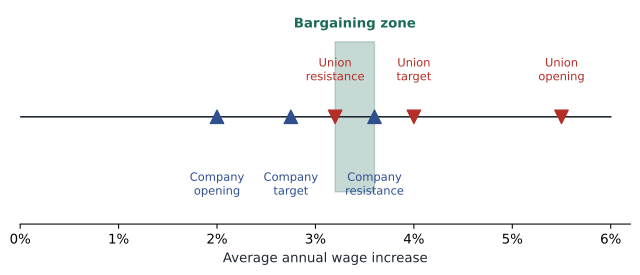
In distributive bargaining, each side has a target, the outcome it hopes for, and a resistance point, the worst outcome it will accept before choosing a strike or lockout. If the union's resistance point is below the company's, there is a positive bargaining zone in which a settlement is possible; if not, there is no deal without a change in positions, often forced by the costs of a strike. Each side's walkaway option, its best alternative to a negotiated agreement or BATNA, the term the cohort met in MBA-503, determines its resistance point. The union's alternative depends on members' willingness and ability to strike; the company's depends on its ability to operate during a strike, its inventory and its customers' patience.
Interest-based bargaining, also called mutual gains bargaining, applies the principles of Roger Fisher and William Ury's Getting to Yes to labour negotiations. Instead of exchanging positions, the parties identify their underlying interests, share information, generate options together and evaluate them against agreed criteria. It works best on issues with integrative potential, such as scheduling, training, technology changes and health benefits, and when trust is reasonably high. Many negotiations combine it with traditional bargaining on wages.
Costing a settlement
Before bargaining, management must know what each proposal costs. A wage increase has effects beyond base pay, because many costs are tied to wages: overtime premiums, vacation and holiday pay, shift premiums, payroll taxes and, in some plans, pension contributions. The roll-up factor captures these: if every dollar of base pay brings 25 cents of related cost, a wage increase costs 1.25 times its base amount. Increases compound over the life of the agreement, and the timing matters: an increase in month one of a year costs more than the same increase in month twelve. Lump-sum payments, which do not enter the wage base, cost less over time than equivalent percentage increases.
# Costing Northfield's wage proposals over a three-year agreement
employees, hours, wage = 260, 2_000, 34.00
rollup = 0.24                         # related costs per dollar of base pay

def cost(increases, lump=0.0):
    base0 = employees * hours * wage
    total, w = 0.0, wage
    for inc in increases:
        w *= 1 + inc
        total += employees * hours * (w - wage) * (1 + rollup)
    return total + lump * employees, w

for label, incs, lump in [("company opening", (0.020, 0.020, 0.020), 0),
                          ("union opening", (0.060, 0.050, 0.050), 0),
                          ("possible settlement", (0.035, 0.030, 0.030), 0),
                          ("settlement with lump sum", (0.030, 0.030, 0.030), 1_000)]:
    extra, final_wage = cost(incs, lump)
    print(f"{label:25s} extra cost over 3 years {extra / 1e6:5.2f} million, final wage {final_wage:5.2f}")

# Compare with a strike: lost contribution per week and the risk of losing programs
weekly_contribution = 0.65e6
print(f"two-week strike: lost contribution about {2 * weekly_contribution / 1e6:.1f} million plus customer risk")company opening extra cost over 3 years 2.67 million, final wage 36.08 union opening extra cost over 3 years 7.49 million, final wage 39.73 possible settlement extra cost over 3 years 4.36 million, final wage 37.33 settlement with lump sum extra cost over 3 years 4.29 million, final wage 37.15 two-week strike: lost contribution about 1.3 million plus customer risk
The costing shows the stakes. Measured against today's wages, the union's opening proposal would cost Northfield about 7.5 million dollars over three years and the company's about 2.7 million, a gap of almost 5 million. A settlement around 3.5, 3 and 3 per cent costs about 1.7 million more than the company's opening. Replacing the first-year half point with a lump sum of 1,000 dollars per employee trims the three-year cost a little, gives employees cash up front and, because the lump sum never enters the wage base, leaves a lower base for the next agreement. Daniel notes that the last strike cost far more than the gap between the two sides' final positions, once the lost programs were counted. Dr. Rahimi adds that the costing is also a negotiating tool: both sides can agree on the arithmetic even when they disagree about the outcome, which narrows arguments.
Strikes, lockouts and government intervention
Strikes and lockouts are legal in Canada only after the collective agreement has expired and the required conciliation or mediation steps have been completed. Governments can intervene. Provincial and federal legislatures have passed back-to-work laws, and since 2024 the federal government has repeatedly used section 107 of the Canada Labour Code, which allows the minister to refer matters to the Canada Industrial Relations Board, to end stoppages by ordering binding arbitration: at the two national railways in August 2024, at ports in Montreal and British Columbia in November 2024, at Canada Post in December 2024 and at Air Canada in August 2025, when the flight attendants' union defied the order for several days before a tentative agreement was reached. Unions argue the practice undermines the right to strike, which the Supreme Court of Canada recognized as constitutionally protected in its 2015 Saskatchewan Federation of Labour decision; employers argue it protects the economy. Canada Post and its main union signed new agreements in June 2026, running until January 2029.
Living with the agreement
Most labour relations work happens during the agreement, not at the table. Grievances are complaints that the employer has violated the agreement: a dismissal without just cause, overtime given out of seniority order, a job posted incorrectly. The grievance procedure typically has several steps, from a conversation between the steward and supervisor to meetings with senior managers, and ends in binding arbitration. Arbitrators interpret the agreement and develop principles such as progressive discipline, which requires that discipline escalate from warnings to suspensions before dismissal except for serious misconduct. Supervisors are the front line: most grievances arise from how a supervisor applied the agreement, and most can be resolved early if supervisors understand it and listen.
Union-management relationships range from conflict to cooperation. Labour-management committees on safety, training and productivity, gainsharing plans like Northfield's from lesson 9, and joint job evaluation committees create forums for solving problems outside bargaining. Thomas Kochan and colleagues at MIT documented partnerships, such as the one at Kaiser Permanente, that combined union security with joint work on quality and cost. These partnerships are fragile and depend on trust built over years, but where they work they are among the hardest advantages for rivals to copy.
Worked problem
Preparing Northfield for bargaining
Daniel's plant manager asks him to lead the company's preparation for bargaining. The plant needs to remain competitive for new automotive programs, the union's members are angry about inflation and overtime, and the last round ended in a strike. Outline a preparation plan.
Show solution
- Gather data: wage and benefit comparisons with similar plants and recent settlements in the industry and region; overtime records by employee; grievance history; costs of each likely proposal using the costing model; the plant's financial position and customer requirements.
- Clarify the company's interests and priorities: cost competitiveness for new programs, a classification for robotic welding, and scheduling flexibility. Decide what the company can concede, such as limits on mandatory overtime, which the data show falls heavily on a small group of employees.
- Set the mandate with senior management: target and resistance points for wages, a ranked list of other issues, and clear authority for the bargaining team, to avoid a deal rejected internally.
- Plan the process: propose interest-based sessions on overtime, scheduling and the new classification, where both sides have integrative interests, and traditional bargaining on wages. Share the costing method with the union so that arguments focus on choices rather than arithmetic.
- Prepare for a strike while working to avoid one: inventory and customer contingency plans, and communication to employees that is factual and respectful.
Answer: Northfield should enter bargaining with data, a clear and authorized mandate, a costing model shared with the union and a proposal to solve overtime and scheduling jointly. The goal is an agreement that keeps the plant competitive and rebuilds the relationship damaged by the last strike, which matters for the new programs as much as the wage settlement.
Common mistakes
MistakeUnions only raise costs.
InsteadUnions also give employees voice, which can lower turnover and support productivity, depending on the relationship.
MistakeManagers can say anything during an organizing campaign.
InsteadThreats, interrogation, promises and surveillance are unfair labour practices with serious consequences.
MistakeA wage increase of 3 per cent costs 3 per cent of base pay.
InsteadRoll-up costs and compounding make the true cost higher; lump sums cost less over time.
MistakeLabour relations happen at the bargaining table.
InsteadMost of the relationship is shaped by how supervisors apply the agreement and handle grievances day to day.
Summary and key terms
- Unions bargain collectively for employees and have both a monopoly face and a voice face.
- Canadian labour law is mostly provincial, with certification by labour boards, mandatory arbitration during agreements and growing limits on replacement workers.
- Bargaining combines distributive, integrative, attitudinal and internal processes; a bargaining zone exists when resistance points overlap.
- Costing must include roll-up and compounding; lump sums cost less over time than equivalent increases.
- Grievances and arbitration govern life under the agreement, and supervisors are the front line of the relationship.
- Collective agreement
- A written contract between an employer and a union setting terms of employment.
- Certification
- Legal recognition of a union as the exclusive bargaining agent for a unit of employees.
- Unfair labour practice
- Conduct by an employer or union that interferes with rights under labour law.
- Bargaining zone
- The range between the parties’ resistance points within which settlement is possible.
- Roll-up
- Costs tied to base pay, such as overtime, vacation pay and payroll taxes.
- Grievance
- A complaint that the collective agreement has been violated.
- Interest-based bargaining
- Negotiation focused on underlying interests and joint problem solving.
Practice problems
Work each problem on paper first, then reveal the answer to check.
A union seeks 4 per cent in each of three years; the company offers 2 per cent. For a payroll of 10 million and roll-up of 25 per cent, what is the extra cost in year 3 of the union proposal over the company’s?
Show answer
Year 3 wages: 10 × 1.04^3 = 11.25 vs 10 × 1.02^3 = 10.61; difference 0.64 million × 1.25 ≈ 0.80 million.
Give one integrative issue in bargaining and explain why it is integrative.
Show answer
Scheduling: a system can give employees predictability and the company flexibility at the same time.
Why do many agreements fail at ratification?
Show answer
Intra-organizational bargaining fails: members or executives reject terms their negotiators accepted.
What is progressive discipline?
Show answer
Escalating responses, from warnings to suspensions to dismissal, except for serious misconduct.
Lesson quiz · 5 questions
Score 60% or more to complete this lesson.
Create a free account to save your progress, take quizzes and earn a certificate.