
MATH-499 · Lesson 3 of 12 · 24 min
Reading mathematics: papers, monographs and the arXiv
Textbooks are written to be read from the beginning by students. Research papers are written to be read by experts who already know the field, who are in a hurry, and who want to know quickly what is new. Reading them is therefore a different skill, and one that nobody is born with. The first research paper most students open feels impenetrable: definitions are cited rather than stated, steps are omitted as routine, and the main theorem may not appear until page nine. This lesson describes how mathematical literature is organized, how to read a paper efficiently and actively, and how to extract what your project needs without getting lost.
The kinds of mathematical writing
A research article announces new results with complete proofs. It is refereed by experts before publication in a journal and usually runs from ten to fifty pages. Its audience is specialists. A survey article reviews the state of a field for a wider mathematical audience, organizing the results, giving key ideas of proofs and listing open problems. Surveys are often the best entry point into an area, and journals such as the Bulletin of the American Mathematical Society specialize in them. A monograph is a book-length treatment of a specialized topic for researchers; a graduate textbook is similar but written for students and includes exercises. Lecture notes, theses, expository articles in magazines such as the American Mathematical Monthly or Mathematics Magazine, and online resources fill in the spectrum.
For an honours project, the most useful sources are often not the original research papers, which may be difficult, terse and use outdated notation, but surveys, recent expository articles and graduate texts that present the same results with modern proofs. You should still identify and cite the original source of each major result, but you need not learn it from there.
The arXiv
Since 1991, when the physicist Paul Ginsparg set up an electronic archive at Los Alamos for preprints in high-energy physics, most research in mathematics and physics has appeared first on the arXiv, now hosted by Cornell University. Authors upload a preprint, often at the same time as they submit it to a journal, and it becomes freely available within a day or so. By late 2026 the arXiv held more than three million papers across all subjects, with mathematics one of its largest sections. Papers are lightly moderated for relevance and basic standards but are not refereed, so an arXiv paper carries no guarantee of correctness. Most are correct, many are later published essentially unchanged, and a few contain errors corrected in later versions or never published at all.
Each arXiv paper has an identifier. Since 2015 these have the form YYMM.NNNNN: two digits for the year, two for the month of submission and a five-digit sequence number, so 2409.01234 was submitted in September 2024. Papers from 2007 to 2014 have four-digit sequence numbers, and older papers have identifiers of the form math/0501234 that include the subject archive. A version suffix such as v2 indicates a revision. Mathematics categories have names such as math.NT for number theory, math.CO for combinatorics and math.DG for differential geometry, and you can browse the new submissions in a category each day. The program below parses identifiers in all three styles; it is the kind of small tool that becomes useful when you manage a few hundred references.
import re

def parse_arxiv(ident):
    """Return (year, month, number, version) for an arXiv identifier, or raise ValueError."""
    m = re.fullmatch(r'(\d{2})(\d{2})\.(\d{4,5})(v\d+)?', ident)
    if m:
        yy, mm, num, ver = m.groups()
        year = 2000 + int(yy)
        if not 1 <= int(mm) <= 12:
            raise ValueError('bad month')
        if year >= 2015 and len(num) != 5 or year < 2015 and len(num) != 4:
            raise ValueError('sequence number has the wrong length for that year')
        return year, int(mm), int(num), int(ver[1:]) if ver else 1
    m = re.fullmatch(r'([a-z\-]+(?:\.[A-Z]{2})?)/(\d{2})(\d{2})(\d{3})(v\d+)?', ident)
    if m:
        arch, yy, mm, num, ver = m.groups()
        year = 1900 + int(yy) if int(yy) >= 91 else 2000 + int(yy)
        return year, int(mm), int(num), int(ver[1:]) if ver else 1
    raise ValueError('not an arXiv identifier: ' + ident)

for s in ['2409.01234', '2409.01234v3', '1312.6114', 'math/0501234v2', 'hep-th/9711200', '1512.1234', '2413.00001']:
    try:
        print(f"{s:16s} -> {parse_arxiv(s)}")
    except ValueError as e:
print(f"{s:16s} -> rejected ({e})")2409.01234 -> (2024, 9, 1234, 1) 2409.01234v3 -> (2024, 9, 1234, 3) 1312.6114 -> (2013, 12, 6114, 1) math/0501234v2 -> (2005, 1, 234, 2) hep-th/9711200 -> (1997, 11, 200, 1) 1512.1234 -> rejected (sequence number has the wrong length for that year) 2413.00001 -> rejected (bad month)
The anatomy of a paper
Almost every mathematics paper follows the same plan. The abstract states the main results in a paragraph. The introduction explains the problem, its history and motivation, states the main theorems precisely, compares them with earlier work, and often sketches the strategy of proof and the organization of the paper. A preliminaries section fixes notation and recalls known results. The body proves the results, usually building through lemmas and propositions to the main theorems. A final section may discuss open problems. The references list the works cited.
This structure is designed for selective reading. The abstract and introduction are written for a wide audience and contain most of what a casual reader needs; the body is written for those who want to check or use the proofs. Learning to exploit this design is the core of efficient reading.
Three passes
The computer scientist Srinivasan Keshav described in 2007 a three-pass method for reading research papers, and it adapts well to mathematics. The idea is that each pass has a definite purpose and a time limit, and that most papers deserve only the first pass.
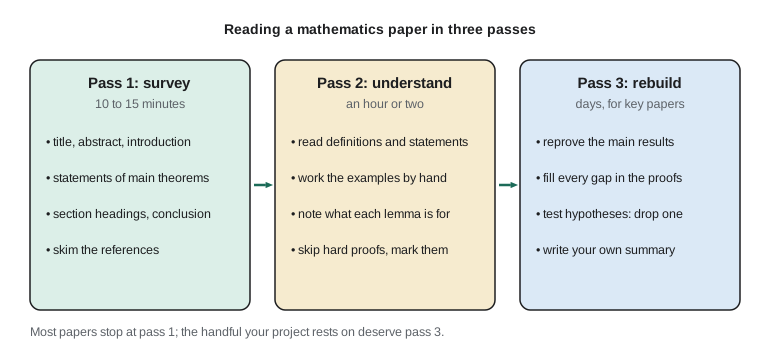
In the first pass you read the title, abstract and introduction, the statements of the main theorems, the section headings and the conclusion, and glance at the references to see which works you recognize. At the end you should be able to say what problem the paper addresses, what it proves, roughly how, and whether it matters for your project. Fifteen minutes is enough. Many papers end here: they turn out to be about a different question, or to use methods you will not need.
In the second pass you read the paper properly but without verifying every proof. Read each definition and work out an example of it. Read each statement and ask what it says in the simplest nontrivial case. For each lemma, figure out what it is for: which later result uses it, and why. When a proof becomes hard, mark it and move on. At the end you should be able to explain the main ideas to a fellow student, and to judge whether you need the details.
In the third pass, reserved for the few papers on which your project rests, you rebuild the paper. Try to prove each result before reading the proof. Fill in every omitted step. Ask what happens if a hypothesis is weakened: find the place where the proof uses it, and look for a counterexample when it is removed. Write a summary in your own words and notation. This pass can take days for a single paper, and it is where much of the real learning of a project happens.
Reading actively
Mathematics cannot be read passively. Keep paper and a computer beside you. When a definition appears, construct an example and a non-example. When a theorem appears, test it on your examples. When a proof says clearly or it is easy to see, stop and see it; if you cannot within a reasonable time, note the gap and return later, perhaps asking your supervisor. When notation is introduced, write it down in a running glossary, since papers often use a symbol defined twenty pages earlier.
It is normal to read a key paper several times over weeks, understanding more each time. It is also normal for a paper to contain errors, usually small ones: a misprint in a formula, an off-by-one in an index, a lemma whose stated hypotheses are slightly too weak. Finding such an error is a sign that you are reading carefully. Check it thoroughly, by examples and computation, before concluding that the paper is wrong, and then discuss it with your supervisor.
Worked problem
Reading a short classical argument actively
A source states: the number of ways to write \(n\) as a sum of consecutive positive integers equals the number of odd divisors of \(n\), since each such sum corresponds to a factorization \(2n = k \cdot m\) into factors of opposite parity with \(k < m\). Read this actively.
Show solution
- Identify the claimed correspondence. A sum of \(k\) consecutive integers from \(a\) gives \(2n = k(2a + k - 1)\), so set \(m = 2a + k - 1\). Then \(m - k = 2a - 1\) is odd and positive, so \(k\) and \(m\) have opposite parity and \(k < m\).
- Check the converse. Given \(2n = km\) with opposite parity and \(k < m\), put \(a = (m - k + 1)/2\), which is a positive integer because \(m - k\) is odd and positive. So representations correspond to such factorizations.
- Count the factorizations. The source asserts these are counted by odd divisors but does not say how. Each factorization has exactly one odd factor, which is an odd divisor \(d\) of \(n\) (odd divisors of \(2n\) and of \(n\) coincide). Conversely each odd divisor \(d\) determines the pair \(\{d, 2n/d\}\), which has opposite parity since \(2n/d\) is even; ordering the pair so that \(k < m\) gives exactly one factorization.
- Test on an example: \(n = 15\), \(2n = 30\). Odd divisors 1, 3, 5, 15 give pairs \(\{1, 30\}, \{3, 10\}, \{5, 6\}, \{15, 2\}\), so \((k, m) = (1, 30), (3, 10), (5, 6), (2, 15)\) and \(a = 15, 4, 1, 7\): the four representations found in lesson 1.
Answer: Reading actively turned a one-sentence claim into a complete proof with an explicit bijection, exposed the step the source left implicit and confirmed it on an example. This proof is a candidate for the thesis; lesson 6 develops it further.
Notes, summaries and reading logs
Keep a reading log: for each item you read, record the full reference, the date, what pass you gave it, a summary of its main results in two or three sentences, and how it relates to your project. A spreadsheet or plain text file is fine; reference managers such as Zotero or JabRef can store the same information along with the bibliographic data you will need for citations in lesson 10. Six months later you will not remember which of forty papers proved the lemma you need, and the log will save you.
For key papers, write a longer summary in your own notation. These summaries often become the background chapter of the thesis, but be careful: a background chapter must be your own writing with clear citations, not a stitched-together set of paraphrases. Writing summaries from the start in your own words and notation, rather than copying sentences, avoids this problem and deepens understanding.
Handling difficulty
Sometimes a paper is simply too hard at your current level. Signs are that you cannot follow the introduction, that every page requires two other papers, or that after a week of work you understand nothing beyond the abstract. The remedy is usually to step back: find a survey or textbook that covers the background, read an earlier paper by the same authors, or look for lecture notes or a thesis on the topic, since PhD theses often contain detailed versions of arguments that papers compress. Ask your supervisor whether you need the paper at all; it may be enough to quote its main result.
A different difficulty is the paper that seems easy but on which you cannot reproduce a computation. Here the third pass is essential. Write the computation in full, check each step on a numerical example, and compare with the paper at the point of divergence. The discrepancy is either your error, which you will learn from, or a misprint, which you can then correct in your own write-up with a footnote.
A first-pass worksheet
The program below is a template for a first-pass record. It is deliberately simple: it stores a few fields for each paper and prints a reading list sorted by relevance, which is how you decide which papers deserve a second or third pass.
papers = [
    dict(key='Sylvester1882', year=1882, title='A constructive theory of partitions, arranged in three acts, an interact and an exodion',
         result='partition bijections; politeness = odd divisors > 1 attributed here', relevance=3, passes=1),
    dict(key='Mason1912', year=1912, title='On the representation of an integer as the sum of consecutive integers',
         result='two-to-one link between representations over all integers and odd divisors', relevance=5, passes=2),
    dict(key='LeVeque1950', year=1950, title='On representations as a sum of consecutive integers',
         result='counts and averages of representation numbers', relevance=3, passes=1),
    dict(key='Pong2007', year=2007, title='Sums of consecutive integers',
         result='bijection with odd factors; length spectrum', relevance=5, passes=2),
    dict(key='HardyWright1938', year=1938, title='An Introduction to the Theory of Numbers',
         result='background on divisor functions', relevance=2, passes=1),
]

print(f"{'key':14s} {'year':>4s} {'rel':>3s} {'pass':>4s}  result")
for p in sorted(papers, key=lambda p: (-p['relevance'], p['year'])):
    print(f"{p['key']:14s} {p['year']:4d} {p['relevance']:3d} {p['passes']:4d}  {p['result']}")

need_third = [p['key'] for p in papers if p['relevance'] >= 5]
print("schedule a third pass:", need_third)key year rel pass result Mason1912 1912 5 2 two-to-one link between representations over all integers and odd divisors Pong2007 2007 5 2 bijection with odd factors; length spectrum Sylvester1882 1882 3 1 partition bijections; politeness = odd divisors > 1 attributed here LeVeque1950 1950 3 1 counts and averages of representation numbers HardyWright1938 1938 2 1 background on divisor functions schedule a third pass: ['Mason1912', 'Pong2007']
These entries are real: they are the items Amara found in the literature search described in lesson 4, and each was checked against the actual article before it entered the log. That check matters. A recurring hazard in student theses is the citation that nobody verified, copied from another bibliography or suggested by a search tool, which turns out to have the wrong year, the wrong title or not to exist at all. Only papers with relevance 5 get a third pass here; the others are quoted for history or background.
Common mistakes
MistakeReading a paper linearly from the first page to the last.
InsteadUse passes: survey first, then understand, then rebuild only the papers that matter most.
MistakeSkipping examples and reading only the theorems.
InsteadConstruct examples for every definition and test every statement on them.
MistakeAssuming an arXiv preprint is correct because it is public.
InsteadPreprints are not refereed; check results carefully and prefer published versions when they exist.
MistakeCopying sentences from sources into notes.
InsteadSummarize in your own words and notation from the start to avoid accidental plagiarism later.
MistakeCiting a reference you have not seen.
InsteadVerify every reference against the actual document before it enters your bibliography.
Summary and key terms
- Mathematical literature includes research articles, surveys, monographs, textbooks, theses and expository articles; surveys and modern texts are often the best entry points.
- The arXiv, founded by Paul Ginsparg in 1991, holds over three million preprints; identifiers since 2015 have the form YYMM.NNNNN, and preprints are not refereed.
- Papers follow a standard anatomy designed for selective reading: abstract, introduction with main theorems, preliminaries, proofs, references.
- Read in three passes: survey (minutes), understand (hours), rebuild (days, for key papers only).
- Read actively: examples for definitions, tests for theorems, and every 'clearly' checked.
- Keep a reading log and summaries in your own words, and verify every reference before citing it.
- preprint
- A paper made public before or independently of journal publication.
- refereeing
- Expert review of a paper before publication in a journal.
- survey article
- An article reviewing the main results and open problems of a field for a broad audience.
- monograph
- A book-length specialized treatment of a topic for researchers.
- three-pass method
- Reading a paper first to survey, then to understand, then to rebuild.
- reading log
- A record of each item read, with its reference, summary and relevance.
Practice problems
Work each problem on paper first, then reveal the answer to check.
What can you infer from the arXiv identifier 2603.04512v2?
Show answer
Submitted in March 2026, sequence number 04512 in that month, and this is the second version.
List what you should be able to say after a first pass through a paper.
Show answer
What problem it addresses, what its main results are, roughly how they are proved, and whether it is relevant to your project.
In the active reading example, why is \(a = (m - k + 1)/2\) a positive integer?
Show answer
\(m - k\) is odd, so \(m - k + 1\) is even, and \(m > k\) gives \(m - k + 1 \ge 2\), so \(a \ge 1\).
Find the factorization pairs and representations for \(n = 21\) using the bijection.
Show answer
\(2n = 42\); odd divisors 1, 3, 7, 21 give pairs \((1, 42), (3, 14), (6, 7), (2, 21)\), so \(a = 21, 6, 1, 10\): \(21\), \(6 + 7 + 8\), \(1 + 2 + \cdots + 6\), \(10 + 11\).
A paper you need is far too hard. Give three strategies.
Show answer
Find a survey or textbook covering the background; read a thesis or lecture notes on the same topic; ask your supervisor whether quoting the main result is enough.
Why are PhD theses often useful for honours students?
Show answer
They typically include detailed background and fuller versions of arguments that the corresponding papers compress.
Lesson quiz · 5 questions
Score 60% or more to complete this lesson.
Create a free account to save your progress, take quizzes and earn a certificate.