
MATH-499 · Lesson 1 of 12 · 24 min
What an honours project is: from coursework to original mathematics
For most of an undergraduate degree, mathematics arrives in finished form. A lecturer states a theorem, proves it, and sets exercises whose answers are known in advance and whose difficulty has been calibrated so that a prepared student can finish them in an evening. An honours project reverses almost every one of those conditions. You choose the question, or help to choose it. Nobody, including your supervisor, may know the answer. The difficulty is unknown until you are in the middle of it, and the deliverable is not a sheet of solutions but a piece of mathematical writing that someone else can read, check and learn from. This course is about making that transition well.
The project is the capstone of the mathematics program. It draws directly on the courses behind it: the analysis of MATH-341, the algebra of MATH-323, and whichever electives you took, such as number theory in MATH-351, optimization in MATH-372, mathematical modelling in MATH-424, differential geometry in MATH-430 or combinatorics in MATH-460. But a project exercises skills that coursework mostly leaves implicit: finding a question of the right size, reading research literature, experimenting, conjecturing, recovering from dead ends, writing precisely at length, and explaining your work aloud. Each of those skills gets a lesson here, and a single model project runs through the whole course so that you can watch them work together.
What counts as an honours project
Departments vary in the details, but an honours project in mathematics is usually a supervised piece of independent work lasting two terms, worth the equivalent of one or two courses, and assessed on a written thesis of roughly 25 to 50 pages together with an oral presentation. The thesis is read by the supervisor and at least one second examiner. The standard expected is that of a careful, correct and well-organized document whose author clearly understands every line of it. Original results are welcome and sometimes happen, but they are not the defining requirement. What is required is that you take ownership of a piece of mathematics beyond the standard curriculum.
Projects fall roughly into three kinds, and most real projects mix them.
An expository project takes an established but advanced topic, such as the proof of the prime number theorem, the classification of finite simple groups of small order, the four-colour theorem's reduction to unavoidable configurations, or the Gauss–Bonnet theorem for surfaces with boundary, and presents it coherently, filling in the details that the sources omit, choosing good examples and organizing the material in a way that is your own. Exposition is a genuine skill: anyone who has tried to reconstruct a proof from a paper that says the remaining cases are similar knows how much work lies in making mathematics complete.
A computational or experimental project uses computers to explore a mathematical question: tabulating a sequence, searching for counterexamples, verifying a conjecture over a large range, implementing and comparing algorithms, or simulating a model. The mathematics lies in designing the computation, understanding why it works, proving whatever can be proved about the output and interpreting what cannot. A project on the Collatz problem, for example, cannot hope to solve it, but it can measure stopping times, prove some partial results about them and explain clearly what the data does and does not suggest.
A research project aims at a new result, usually a modest one: a generalization of a known theorem, a special case of an open problem, a new proof of an old fact, a count of some family of objects, or the answer to a question nobody had happened to ask. Supervisors with experience can often identify such questions in their own area, small enough that an undergraduate can make progress but real enough that the answer is not in a textbook.
How a project differs from coursework
Several differences matter more than students expect.
The problem is not pre-sized. A textbook exercise has a solution of predictable length using techniques from the current chapter. A project question may turn out to be trivial, impossible or anything in between, and part of the work is to resize it as you learn more: specializing when the original question is too hard, generalizing when it falls too easily.
Nobody checks you each week. Coursework has a built-in feedback loop of assignments, marks and exams. A project has a supervisor who meets you perhaps every week or two and who cannot read everything you produce. You must check your own work, which means developing habits of verification: testing claims on examples, recomputing by a second method, and writing proofs out in full rather than trusting a sketch.
Being stuck is normal. In coursework, being stuck for a week usually means something has gone wrong. In research it is the ordinary state of affairs. Productive projects are not those where the student is never stuck, but those where the student has strategies for becoming unstuck: trying special cases, changing representation, reading around the problem, asking a precise question of the supervisor, or temporarily working on a different part.
Writing is part of the mathematics. In coursework, writing a solution is the final step after the thinking is done. In a project, writing is how you discover what you actually know. A proof that seemed complete in your head will often reveal a gap the moment you try to write the second paragraph. Experienced mathematicians start writing early for exactly this reason.
The model project: sums of consecutive integers
Throughout this course we follow a model project from first question to finished thesis. It is deliberately elementary, so that the mathematics never obscures the process, but it contains genuine theorems with complete proofs, a computational component, a literature trail and natural generalizations. Imagine a student, whom we will call Amara, who noticed while doing a puzzle that
while 8 cannot be written as a sum of two or more consecutive positive integers at all. She asked her supervisor whether there was a pattern. The supervisor's response was the right one: find out. Which positive integers can be written as a sum of two or more consecutive positive integers, and in how many ways?
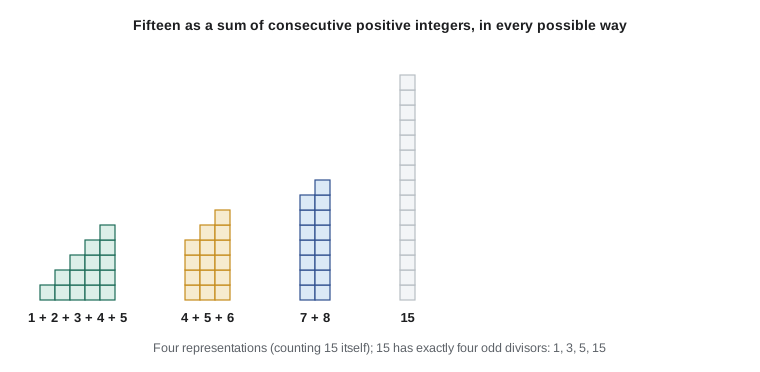
This question has several features of a good starter project. It is easy to state and to compute with, so experiments can begin immediately. Small cases reveal a striking pattern quickly. The pattern can be proved with tools from first-year number theory, but the proof requires a genuine idea. And the question opens outward in many directions: sums of consecutive odd numbers, of consecutive squares, of consecutive terms in other arithmetic progressions, representations with a fixed number of terms, and asymptotic counts. It is also, as we will find in lesson 4, a known problem with a literature, which is itself a useful lesson.
Let us do what Amara did first, which is to compute. Call a representation of \(n\) a list of one or more consecutive positive integers summing to \(n\); the trivial representation \(n = n\) has one term. A sum of \(k\) consecutive integers starting at \(a\) is
So \(n\) has a representation with \(k\) terms starting at \(a \ge 1\) exactly when \(2n = k(2a + k - 1)\). For each \(k\) we can solve for \(a\) and check whether it is a positive integer. Since \(a \ge 1\) forces \(k(k + 1) \le 2n\), only finitely many \(k\) need checking. The following program lists every representation of every \(n\) up to 40 and counts them.
def representations(n):
    """All lists of one or more consecutive positive integers summing to n."""
    reps = []
    k = 1
    while k * (k + 1) // 2 <= n:
        rest = n - k * (k - 1) // 2          # n = k*a + k(k-1)/2
        if rest % k == 0:
            a = rest // k
            reps.append(list(range(a, a + k)))
        k += 1
    return reps

for n in range(1, 41):
    r = representations(n)
    shown = '  '.join('+'.join(map(str, t)) for t in r if len(t) > 1)
print(f"{n:3d} count {len(r)} {shown}")1 count 1 2 count 1 3 count 2 1+2 4 count 1 5 count 2 2+3 6 count 2 1+2+3 7 count 2 3+4 8 count 1 9 count 3 4+5 2+3+4 10 count 2 1+2+3+4 11 count 2 5+6 12 count 2 3+4+5 13 count 2 6+7 14 count 2 2+3+4+5 15 count 4 7+8 4+5+6 1+2+3+4+5 16 count 1 17 count 2 8+9 18 count 3 5+6+7 3+4+5+6 19 count 2 9+10 20 count 2 2+3+4+5+6 21 count 4 10+11 6+7+8 1+2+3+4+5+6 22 count 2 4+5+6+7 23 count 2 11+12 24 count 2 7+8+9 25 count 3 12+13 3+4+5+6+7 26 count 2 5+6+7+8 27 count 4 13+14 8+9+10 2+3+4+5+6+7 28 count 2 1+2+3+4+5+6+7 29 count 2 14+15 30 count 4 9+10+11 6+7+8+9 4+5+6+7+8 31 count 2 15+16 32 count 1 33 count 4 16+17 10+11+12 3+4+5+6+7+8 34 count 2 7+8+9+10 35 count 4 17+18 5+6+7+8+9 2+3+4+5+6+7+8 36 count 3 11+12+13 1+2+3+4+5+6+7+8 37 count 2 18+19 38 count 2 8+9+10+11 39 count 4 19+20 12+13+14 4+5+6+7+8+9 40 count 2 6+7+8+9+10
Look at the output before reading on. Which numbers have only the trivial representation? Which have many? The numbers with count 1 are 1, 2, 4, 8, 16 and 32: exactly the powers of two in range. The count for 15 is 4, for 9 it is 3, for 45 it would be 6. The odd primes all have count 2. The count for \(n\) seems to be unchanged when \(n\) is doubled: 3, 6, 12 and 24 all have count 2, and 5, 10, 20 and 40 likewise. That suggests the count depends only on the odd part of \(n\), and the data for odd numbers suggests that it equals the number of divisors of that odd part. In other words, the conjecture is that the number of representations of \(n\) equals the number of odd divisors of \(n\).
We will prove this conjecture in lesson 6 and write it up properly in lesson 12. For now, notice how much the computation did. Within a few minutes Amara had moved from a vague question to a precise, falsifiable conjecture backed by forty cases. That is the typical opening of a successful project, and it is why every lesson in this course has a computational component.
Roles: student, supervisor and examiners
The supervisor is the most important resource of the project, and also the most misunderstood. A supervisor is not a lecturer who will teach you the material, nor a manager who will tell you what to do each week. A good supervisor suggests directions and readings, asks probing questions, spots errors, tells you when you are stuck in an unproductive place, and helps you judge when the work is ready. The student is responsible for doing the mathematics, keeping the project moving, preparing for meetings and producing the thesis.
The examiners, usually the supervisor and a second reader, assess the finished thesis and presentation. Typical criteria are correctness, understanding, clarity of exposition, the difficulty and scope of the material, the degree of independence shown and, where relevant, originality. Because the second reader has not followed the project, the thesis must stand alone: it must define its terms, state its results precisely and prove them in a way an informed outsider can check.
Planning the year
A two-term project has a natural rhythm. The first weeks go into choosing a topic and supervisor and into background reading. The middle of the first term mixes reading, experimenting and small results, often ending in an interim report or short presentation. The second term is dominated by the main results and by writing, with a full draft ideally reaching the supervisor several weeks before the deadline so that there is time for revision. The final weeks are for polishing the thesis and preparing the talk. Lesson 2 builds a concrete timeline, and lesson 9 explains why writing should start long before the second term.
Worked problem
Sizing a project question
A student proposes the question: when is a positive integer a sum of two squares of positive integers, and in how many ways? Is this a sensible honours project?
Show solution
- Check whether the answer is known. It is: Fermat stated and Euler proved that an odd prime is a sum of two squares exactly when it is congruent to 1 modulo 4, and the number of representations of \(n\) by \(x^2 + y^2\) with integers \(x, y\) is \(4(d_1(n) - d_3(n))\), where \(d_i(n)\) counts divisors of \(n\) congruent to \(i\) modulo 4. MATH-351 proves the first fact.
- So as a research question it is closed. As an expository project it could be excellent: presenting the divisor formula with a complete proof through Gaussian integers (MATH-323), with computations confirming it, is a substantial piece of work.
- To add a research or experimental component, one could look at variations: sums of two squares of consecutive integers, of primes, or the distribution of the counts, all of which have tractable questions.
Answer: The proposal is a good expository project and a poor research question as stated. A sensible plan is to master the known theory first, then choose a variation with a computational component.
Ethics and integrity
Honours work is held to the standards of research. Every idea, result, proof, figure or piece of code that comes from someone else must be credited, including results from your supervisor's suggestions, from online forums and from software. Paraphrasing a published proof without citation is plagiarism even if every word is changed. The same applies to text or mathematics produced with the help of AI systems: departmental policies differ on whether and how such tools may be used, but they agree that you must disclose substantial use and that you are responsible for every claim in your thesis. In lesson 7 we discuss how to use computational tools, including AI assistants, as aids to verification rather than as substitutes for understanding.
Common mistakes
MistakeChoosing a topic because it sounds impressive, such as the Riemann hypothesis or the Navier–Stokes problem.
InsteadChoose a question where meaningful progress is possible in eight months. Famous problems can be the backdrop to a project, but the question itself must be sized for you.
MistakeWaiting to understand everything before computing or writing anything.
InsteadCompute and write from the first week. Experiments generate questions, and drafting reveals gaps in understanding.
MistakeTreating the supervisor as a lecturer and arriving at meetings without material.
InsteadBring something to each meeting: a computation, a partial proof, a specific question or a page of draft.
MistakeBelieving that an expository project is second-rate.
InsteadA clear, complete and well-chosen exposition of advanced material is valuable and is assessed on its own merits.
MistakeTrusting a pattern after a few cases.
InsteadPatterns in small data can fail, as lesson 5 shows. Conjectures must be tested hard and then proved.
Summary and key terms
- An honours project is a supervised, two-term piece of independent mathematics, assessed on a thesis and a presentation.
- Projects may be expository, computational or research-oriented; most combine all three.
- Unlike coursework, the problem is not pre-sized, feedback is sparse, being stuck is normal and writing is part of the thinking.
- The model project asks which integers are sums of consecutive positive integers; experiment suggests the count of representations equals the number of odd divisors.
- The supervisor guides and checks; the student drives the work; examiners judge correctness, clarity, scope, independence and originality.
- All borrowed ideas, results and code must be credited, and any substantial use of AI tools disclosed.
- honours project
- A supervised piece of independent mathematical work culminating in a thesis and presentation.
- expository project
- A project that presents established advanced mathematics in a complete, organized and original way.
- research project
- A project that aims at a new result, however modest.
- representation
- In the model project, a list of one or more consecutive positive integers with a given sum.
- conjecture
- A precise mathematical statement believed true but not yet proved.
- second examiner
- A reader other than the supervisor who assesses the finished thesis.
Practice problems
Work each problem on paper first, then reveal the answer to check.
Find all representations of 30 as a sum of consecutive positive integers.
Show answer
\(30 = 9 + 10 + 11 = 6 + 7 + 8 + 9 = 4 + 5 + 6 + 7 + 8\), together with the trivial representation: four in all, matching the four odd divisors 1, 3, 5, 15.
Show that a power of two \(2^m\) has no representation with two or more terms.
Show answer
If \(2^{m+1} = k(2a + k - 1)\), then \(k\) and \(2a + k - 1\) have opposite parity, so one of them is odd and greater than 1 when \(k \ge 2\) (because \(2a + k - 1 > k \ge 2\)), contradicting that \(2^{m+1}\) has no odd divisor greater than 1.
Using \(2n = k(2a + k - 1)\), show that \(n\) has a representation with exactly 3 terms if and only if \(n\) is a multiple of 3 and \(n \ge 6\).
Show answer
With \(k = 3\), \(2n = 3(2a + 2)\), so \(n = 3(a + 1)\) with \(a \ge 1\), meaning \(n\) is a multiple of 3 that is at least 6.
Classify these proposals as expository, computational or research: (a) a complete account of the proof that \(\pi\) is transcendental; (b) computing the number of graphs on up to 10 vertices with a given property; (c) determining which Ramsey-type colourings of a new small structure exist.
Show answer
(a) Expository. (b) Computational, with expository background on graph enumeration. (c) Research, likely with a computational search.
Give two reasons a supervisor might advise against the project question: prove the Collatz conjecture.
Show answer
It is a famous open problem on which very strong mathematicians have made limited progress, so success is extremely unlikely; and there is no natural smaller version guaranteed to yield results, unless the question is reframed as an experimental study of stopping times.
Predict the number of representations of 105 and of 96, then check by computation.
Show answer
105 = 3 · 5 · 7 has 8 odd divisors, so 8 representations. 96 = 32 · 3 has odd divisors 1 and 3, so 2 representations: 96 itself and 31 + 32 + 33.
Lesson quiz · 5 questions
Score 60% or more to complete this lesson.
Create a free account to save your progress, take quizzes and earn a certificate.