
MATH-499 · Lesson 11 of 12 · 22 min
Presenting mathematics: talks, posters and the oral defence
Most honours programs end with a public presentation, often a talk of fifteen to thirty minutes to faculty and fellow students, sometimes a poster session, and frequently an oral examination in which the examiners question you about the thesis. Presenting mathematics aloud is a different skill from writing it. A reader can pause, reread and look back; a listener cannot. A talk that would make an excellent paper often makes a bewildering presentation. This lesson covers how to plan and deliver a mathematics talk, how to design a poster, and how to prepare for and handle the oral examination.
What a talk is for
A short talk cannot teach the audience your thesis. It can do three things: convince them that your question is interesting, tell them what you found, and give them one idea of why it is true. Everything else is detail that belongs in the thesis. Paul Halmos, who wrote about lecturing as well as writing, suggested that a good talk should have one main point; the audience should leave knowing it. Choosing that point is the first and most important step in preparing.
Know your audience. An honours presentation typically has faculty from several areas of mathematics, fellow students and perhaps family members. Pitch the talk so that a third-year student can follow the first half completely, and so that the specialists learn something from the second half. Define every term that is not in the core curriculum, and give an example immediately after each definition.
Structure and timing
A good structure for a short talk is: a hook and the question, definitions through examples, the main result, the key idea of the proof, computations or further results, open questions, and a brief recap. The figure shows a time budget for an 18-minute talk. The proportions matter more than the exact numbers: most time goes to motivation, examples and one key idea, not to the full proof.
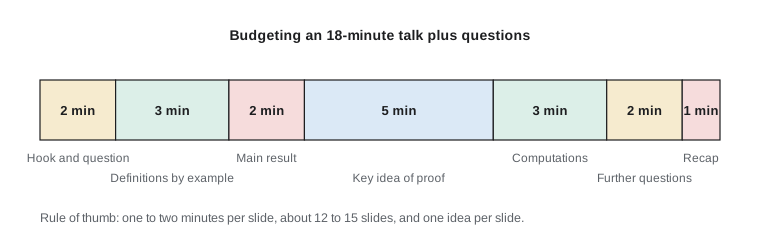
Start with something concrete. Amara opens her talk with the puzzle that started her project: 15 can be written as \(7 + 8\), \(4 + 5 + 6\) and \(1 + 2 + 3 + 4 + 5\); can 16? She asks the audience to try for thirty seconds. By the time she states the theorem, everyone in the room has a stake in it. Abstract openings, such as let \(n\) be a positive integer and let \(\mathcal{R}(n)\) denote, lose half the audience in the first minute.
State the main result clearly and early, on its own slide, in words as well as symbols. Then present the key idea, not the whole proof. For Amara the key idea is the factorization \(2n = k(2a + k - 1)\) into factors of opposite parity, illustrated with \(n = 15\), whose four factorizations \(30 = 1 \cdot 30 = 2 \cdot 15 = 3 \cdot 10 = 5 \cdot 6\) correspond to its four representations. Details such as the inequality ensuring \(a \ge 1\) are mentioned, not proved.
End on time. Running over is the most common fault of student talks and the one audiences notice most. Decide in advance which slides you will skip if you are running late, and put a backup slide or two after the final slide for anticipated questions.
Slides
Most mathematics talks now use slides, typically made with the Beamer class for LaTeX, created by Till Tantau in 2003, which lets you reuse your thesis notation and formulas. Some speakers prefer the board, which naturally slows the pace to one the audience can follow; for short presentations slides are usually expected. Good slides follow a few rules. One idea per slide. Few words: slides support what you say, they are not a script. Large type, so that every formula is legible from the back of the room. Pictures and examples wherever possible. Build up complex slides step by step, so the audience sees each piece as you discuss it. A rough guide is one to two minutes per slide, so an 18-minute talk needs about 12 to 15 slides, not 40.
Do not read your slides aloud, and do not put on a slide anything you do not intend to discuss. Do not show dense proofs: an audience cannot read and listen at once, and will do neither well. Number your slides, so that questioners can refer to them.
Rehearsal
Rehearse the talk aloud, with a timer, at least three times, and at least once in front of someone else, ideally fellow students and, if possible, your supervisor. Rehearsal reveals what reading slides silently does not: transitions that do not work, explanations that take three times longer than planned, and words you stumble over. Record the time spent on each slide. The program below uses such rehearsal times to decide which optional slides to keep within a time limit, maximizing their value to the talk, which is a small instance of the knapsack problem from optimization.
# slide: (minutes in rehearsal, value to the talk 1-10, essential?)
slides = {
    'title and puzzle':        (1.5, 10, True),
    'definitions by example':  (2.5, 9, True),
    'main theorem':            (1.5, 10, True),
    'history: Sylvester, Mason': (1.5, 5, False),
    'key idea: 2n = k(2a+k-1)': (3.0, 10, True),
    'worked example n = 45':   (2.0, 8, False),
    'length spectrum':         (2.5, 7, False),
    'odd-number variation':    (2.5, 6, False),
    'computations to 10^6':    (1.5, 5, False),
    'open questions':          (1.5, 6, True),
    'recap':                   (1.0, 7, True),
}
limit = 18.0
essential = [s for s, (t, v, e) in slides.items() if e]
used = sum(slides[s][0] for s in essential)
optional = [(s, t, v) for s, (t, v, e) in slides.items() if not e]

# 0/1 knapsack on half-minute units
cap = int(round((limit - used) * 2))
best = [(0, [])] * (cap + 1)
for s, t, v in optional:
    w = int(round(t * 2))
    for c in range(cap, w - 1, -1):
        cand = (best[c - w][0] + v, best[c - w][1] + [s])
        if cand[0] > best[c][0]:
            best[c] = cand
value, chosen = best[cap]
total = used + sum(t for s, t, v in optional if s in chosen)
print(f"essential slides take {used} min; {limit - used} min left for optional slides")
print("keep:", chosen)
print("cut: ", [s for s, t, v in optional if s not in chosen])
print(f"planned length {total} min, total value {sum(slides[s][1] for s in essential) + value}")essential slides take 11.0 min; 7.0 min left for optional slides keep: ['worked example n = 45', 'length spectrum', 'odd-number variation'] cut: ['history: Sylvester, Mason', 'computations to 10^6'] planned length 18.0 min, total value 73
The essential slides take 11 minutes, leaving 7 for optional material; the program keeps the worked example, the length spectrum and the odd-number variation, which fill the 7 minutes exactly with the most value, and drops the history and computations slides, which can move to the backup section in case someone asks. The numbers are subjective, but making the trade-offs explicit is better than discovering at minute 17 that four slides remain.
Delivery
Speak to the audience, not to the screen. Point to what you are discussing. Pause after stating the main result so that it registers. Slow down at the key idea and speed up through routine material. Repeat questions from the audience before answering them, so that everyone hears them. Nerves are normal and decrease with rehearsal; it helps to know your first two sentences by heart.
Answering questions
Questions after a talk are a conversation, not an attack. Listen to the whole question, and if you do not understand it, ask for clarification. If you know the answer, give it briefly. If you do not, say so honestly: that is a good question, I have not checked that case, but my guess is, is a perfectly respectable answer. Never bluff; experienced mathematicians recognize it instantly, and it undermines everything else you have said. If a question reveals an error, acknowledge it and say how it affects the result.
Posters
Poster sessions are common at undergraduate research conferences. A poster is read standing up, from a distance of a metre or two, in about the time it takes to decide whether to stay. It must therefore communicate the question and the main result within seconds, and reward a longer look with the key idea and examples.
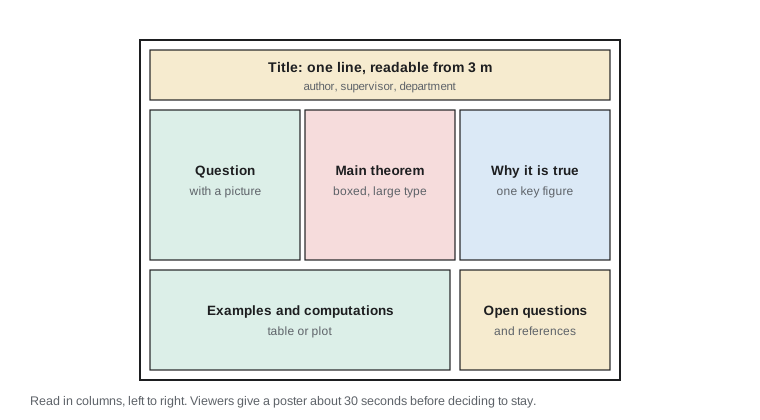
Use a large title readable from three metres, a clear flow in columns from left to right, more pictures and fewer words than you think, and the main theorem boxed in large type. Prepare a one-minute spoken summary and a three-minute version for visitors who want more. Bring a copy of the thesis or a handout, and stand beside, not in front of, the poster.
The oral examination
Many programs examine honours students orally on their thesis, sometimes after the public talk. The examiners have read the thesis and want to establish that you understand it, that the work is your own, and how well you can think about the mathematics beyond what is written. The atmosphere is usually friendly, and examiners often want you to do well; but they will probe.
Prepare by rereading the whole thesis shortly before the examination, checking that you can explain every definition, every step of every proof and every computation. Prepare examples for each definition and theorem. Know the limitations of your results: which hypotheses are necessary, where the methods fail, what you would do with more time. Know the main references well enough to say what each contributes. Make a list of errors you have found since submission, with corrections; examiners respect a candidate who has found their own mistakes.
| Type of question | Example for the model thesis | What examiners look for |
|---|---|---|
| Explain a step | Why is a positive in the inverse map of Theorem 2? | Understanding of each line |
| Give an example | Show the bijection for n = 45. | Fluency with the definitions |
| Test a hypothesis | What changes if zero and negative terms are allowed? | Grasp of why hypotheses matter |
| Context | How does your result relate to partitions into distinct parts? | Knowledge of the literature |
| Extension | What about sums of consecutive squares? | Ability to think beyond the thesis |
| Method | How did you check the computations? | Reliability and independence |
During the examination, take your time. It is fine to think silently for a moment, to ask for paper or a board, and to work through an example. If an examiner points out an error, consider it carefully; if they are right, say so and explain whether the result can be repaired. If you disagree, explain your reasoning politely. The examination is also an opportunity: candidates who discuss their work with enthusiasm and insight often improve their marks.
Worked problem
Answering an extension question
An examiner asks: your thesis treats sums of consecutive integers; which \(n\) are sums of two consecutive squares, and is there an analogous theorem? How might Amara answer, having not studied this?
Show solution
- Say honestly that the thesis does not treat this, then think aloud.
- Compute: \(a^2 + (a + 1)^2 = 2a^2 + 2a + 1\), so \(n\) is a sum of two consecutive squares exactly when \(2n - 1 = (2a + 1)^2\), that is when \(2n - 1\) is an odd square. The values are 1, 5, 13, 25, 41, 61, ...
- Generalize: \(k\) consecutive squares from \(a\) give \(ka^2 + k(k - 1)a + \frac{(k - 1)k(2k - 1)}{6}\), a quadratic in \(a\), so for fixed \(k\) the question becomes whether a certain quadratic expression in \(n\) is a perfect square, a Diophantine question unlike the linear one in the thesis.
- Conclude that the representation count is not given by a divisor formula in the same way, because the equation is no longer a factorization of a linear expression, and that the case of many terms would involve the arithmetic of quadratic forms.
Answer: A good answer combines honesty about the limits of the thesis with live mathematical thinking: a quick computation, a reduction to a known type of problem, and a reasoned guess about how the theory changes.
Common mistakes
MistakeTrying to present the whole thesis in a short talk.
InsteadChoose one main point: the question, the result and one key idea.
MistakeSlides full of text and complete proofs.
InsteadOne idea per slide, few words, large formulas and pictures; proofs reduced to their key idea.
MistakeRunning over time.
InsteadRehearse with a timer, decide in advance what to cut, and keep backup slides for questions.
MistakeBluffing when a question cannot be answered.
InsteadSay honestly what you know and do not know, and reason aloud from there.
MistakeNot rereading the thesis before the oral examination.
InsteadReread it fully, prepare examples, know the limitations and list any errors with corrections.
Summary and key terms
- A short talk should make the audience care about the question, tell them the result and give one key idea of why it is true.
- Structure: hook and question, definitions by example, main result, key idea, further results, open questions, recap; most time goes to motivation and the key idea.
- Slides: one idea each, few words, large formulas, pictures, about one to two minutes per slide.
- Rehearse aloud with a timer, plan what to cut and prepare backup slides.
- Posters must communicate the question and result in seconds, in columns with large type and pictures.
- For the oral examination, know every line of the thesis, prepare examples and limitations, and answer honestly.
- hook
- An opening that engages the audience, often a concrete puzzle or example.
- Beamer
- A LaTeX document class for presentation slides.
- backup slide
- A slide placed after the conclusion to answer anticipated questions.
- oral examination
- A spoken examination in which examiners question a candidate about the thesis.
- knapsack problem
- Choosing items of given weights and values to maximize value within a capacity.
- rehearsal
- Practising a talk aloud, with timing, before delivering it.
Practice problems
Work each problem on paper first, then reveal the answer to check.
Write a one-sentence main point for Amara's talk.
Show answer
The number of ways to write \(n\) as a sum of consecutive positive integers equals the number of odd divisors of \(n\), because each representation corresponds to splitting \(2n\) into an odd and an even factor.
How many slides are appropriate for a 25-minute talk?
Show answer
Roughly 15 to 20 at one to two minutes each, fewer if some slides carry worked examples.
In the slide-selection program, what changes if the limit is 20 minutes?
Show answer
Nine minutes become available. All five optional slides would need 10 minutes, so the program keeps all of them except one of the two 1.5-minute slides of value 5 (history or computations), planning 19.5 minutes in total.
List three questions you would expect in an oral examination of the model thesis.
Show answer
For example: explain why the starting term is positive in Theorem 2; show the bijection for \(n = 45\); what happens if consecutive odd numbers are used instead.
How should you answer a question you cannot answer?
Show answer
Acknowledge it honestly, say what you do know or would try, and reason aloud if appropriate; never bluff.
Why should the main theorem appear early in a talk rather than at the end?
Show answer
The audience can then follow the rest of the talk as an explanation of a result they already know, rather than waiting without knowing where the talk is going.
Lesson quiz · 5 questions
Score 60% or more to complete this lesson.
Create a free account to save your progress, take quizzes and earn a certificate.