
MATH-334 · Lesson 9 of 12 · 24 min
Power series, Taylor series and Laurent series
In real analysis a function can be infinitely differentiable without being equal to its Taylor series: the classic example \(e^{-1/x^2}\) (extended by 0 at the origin) has every derivative 0 at 0, yet is not the zero function. In complex analysis this cannot happen. An analytic function equals its Taylor series on every disk inside its domain, and the radius of convergence is exactly the distance to the nearest point where analyticity fails. This lesson develops power series, proves Taylor's theorem from the integral formula, derives the identity theorem, and introduces Laurent series, which allow negative powers and describe functions near isolated singularities. Laurent series set the stage for residues in lesson 10.
Series of complex numbers
A series \(\sum_{n=0}^{\infty}a_n\) of complex numbers converges to \(S\) if its partial sums \(S_N = \sum_{n=0}^{N}a_n\) tend to \(S\). Equivalently, the real and imaginary parts converge. If \(\sum|a_n|\) converges, the series converges absolutely, and absolute convergence implies convergence, by the same Cauchy-sequence argument as for real series. All the familiar tests (comparison, ratio, root) carry over with \(|\cdot|\) for the absolute value. The most important example is the geometric series:
\[\sum_{n=0}^{\infty}z^n = \frac{1}{1 - z} \quad \text{for } |z| < 1,\]
since \(S_N = \frac{1 - z^{N+1}}{1 - z}\) and \(z^{N+1} \to 0\) when \(|z| < 1\). For \(|z| \ge 1\) the terms do not tend to 0 and the series diverges.
Power series and the radius of convergence
A power series about \(z_0\) is \(\sum_{n=0}^{\infty}a_n(z - z_0)^n\). Its basic property is: if it converges at some \(z_1\), then it converges absolutely at every \(z\) with \(|z - z_0| < |z_1 - z_0|\). (The terms at \(z_1\) are bounded, say by \(K\); then \(|a_n(z - z_0)^n| \le K\rho^n\) with \(\rho = \frac{|z - z_0|}{|z_1 - z_0|} < 1\), and we compare with a geometric series.) It follows that there is an \(R\) with \(0 \le R \le \infty\), the radius of convergence, such that the series converges absolutely for \(|z - z_0| < R\) and diverges for \(|z - z_0| > R\). On the circle itself anything can happen. The Cauchy–Hadamard formula gives \(\frac{1}{R} = \limsup_{n \to \infty}|a_n|^{1/n}\), and when the limit exists, \(R = \lim\big|\frac{a_n}{a_{n+1}}\big|\).
Examples: \(\sum\frac{z^n}{n!}\) has \(R = \infty\); \(\sum z^n\) has \(R = 1\) and diverges at every point of the unit circle; \(\sum\frac{z^n}{n}\) has \(R = 1\), diverges at \(z = 1\) and converges at every other point of the circle; \(\sum\frac{z^n}{n^2}\) has \(R = 1\) and converges at every point of the circle; \(\sum n!\,z^n\) has \(R = 0\).
Theorem. A power series is analytic inside its disk of convergence, and can be differentiated term by term: \(\frac{d}{dz}\sum a_n(z - z_0)^n = \sum na_n(z - z_0)^{n-1}\), with the same radius of convergence.
Proof. On any closed disk \(|z - z_0| \le r < R\) the partial sums converge uniformly, by comparison with \(\sum|a_n|r^n\) (the Weierstrass M-test). The partial sums are polynomials, hence analytic, so the Weierstrass theorem of lesson 8 shows the limit is analytic and the derivatives converge. The derived series has the same radius because \(n^{1/n} \to 1\). \(\square\)
Repeating, \(f^{(k)}(z_0) = k!\,a_k\), so the coefficients are \(a_k = \frac{f^{(k)}(z_0)}{k!}\): a convergent power series is the Taylor series of its sum.
Taylor's theorem
Theorem (Taylor). If \(f\) is analytic on the disk \(|z - z_0| < R\), then for every \(z\) in that disk
\[f(z) = \sum_{n=0}^{\infty}\frac{f^{(n)}(z_0)}{n!}(z - z_0)^n.\]
Proof. Fix \(z\) with \(|z - z_0| < r < R\), and let \(C\) be the circle \(|w - z_0| = r\). For \(w\) on \(C\), \(q = \frac{z - z_0}{w - z_0}\) has \(|q| = \frac{|z - z_0|}{r} < 1\), so the geometric series gives
\[\frac{1}{w - z} = \frac{1}{(w - z_0)(1 - q)} = \sum_{n=0}^{\infty}\frac{(z - z_0)^n}{(w - z_0)^{n+1}},\]
converging uniformly for \(w\) on \(C\). Substitute into the integral formula and integrate term by term (justified by uniform convergence):
\[f(z) = \frac{1}{2\pi i}\oint_C\frac{f(w)}{w - z}\,dw = \sum_{n=0}^{\infty}\Big(\frac{1}{2\pi i}\oint_C\frac{f(w)}{(w - z_0)^{n+1}}\,dw\Big)(z - z_0)^n,\]
and by lesson 8 the bracket is \(\frac{f^{(n)}(z_0)}{n!}\). \(\square\)
So the radius of convergence of the Taylor series at \(z_0\) is at least the radius of the largest disk about \(z_0\) on which \(f\) is analytic. It is also at most that radius when \(f\) blows up at a boundary point. This explains a puzzle from real calculus. The function \(\frac{1}{1 + x^2}\) is smooth on the whole real line, yet its Taylor series \(\sum(-1)^nx^{2n}\) at 0 converges only for \(|x| < 1\). The reason is invisible on the real line: in the complex plane \(\frac{1}{1 + z^2}\) has singularities at \(\pm i\), at distance 1 from the origin.
The standard series follow at once: \(e^z = \sum\frac{z^n}{n!}\), \(\sin z = \sum\frac{(-1)^nz^{2n+1}}{(2n+1)!}\), \(\cos z = \sum\frac{(-1)^nz^{2n}}{(2n)!}\), all with \(R = \infty\); and \(\operatorname{Log}(1 + z) = \sum_{n \ge 1}\frac{(-1)^{n+1}z^n}{n}\) for \(|z| < 1\), obtained by integrating the geometric series for \(\frac{1}{1 + z}\) term by term.
Computing with series
Power series with positive radii can be added, multiplied and divided like polynomials, and the results are again the Taylor series of the sum, product or quotient. The product of \(\sum a_nz^n\) and \(\sum b_nz^n\) is the Cauchy product \(\sum c_nz^n\) with \(c_n = \sum_{k=0}^{n}a_kb_{n-k}\), valid where both converge. Quotients are found by undetermined coefficients. For example, the Taylor series of \(\tan z = \frac{\sin z}{\cos z}\) at 0 is odd, so write \(\tan z = t_1z + t_3z^3 + t_5z^5 + \dots\) and require
\[\Big(t_1z + t_3z^3 + t_5z^5 + \dots\Big)\Big(1 - \frac{z^2}{2} + \frac{z^4}{24} - \dots\Big) = z - \frac{z^3}{6} + \frac{z^5}{120} - \dots\]
Comparing coefficients: \(t_1 = 1\); \(t_3 - \frac{1}{2} = -\frac{1}{6}\), so \(t_3 = \frac{1}{3}\); \(t_5 - \frac{t_3}{2} + \frac{1}{24} = \frac{1}{120}\), so \(t_5 = \frac{2}{15}\). Hence \(\tan z = z + \frac{z^3}{3} + \frac{2z^5}{15} + \dots\). Its radius of convergence is \(\frac{\pi}{2}\), the distance from 0 to the nearest zero of \(\cos z\), even though nothing in the coefficients makes that obvious.
Composition works too, when the inner series has zero constant term: \(e^{\sin z} = 1 + \sin z + \frac{\sin^2 z}{2} + \dots = 1 + z + \frac{z^2}{2} + 0 \cdot z^3 + \dots\). These manipulations are the everyday tool for finding the first few Laurent coefficients, and in particular residues, in lesson 10.
Zeros and the identity theorem
Let \(f\) be analytic at \(z_0\) with \(f(z_0) = 0\), and not identically zero near \(z_0\). Then some Taylor coefficient is non-zero; let \(a_m\) be the first. Then
\[f(z) = (z - z_0)^m g(z), \qquad g(z) = a_m + a_{m+1}(z - z_0) + \dots, \qquad g(z_0) = a_m \ne 0.\]
We say \(z_0\) is a zero of order \(m\). By continuity \(g \ne 0\) near \(z_0\), so \(f\) has no other zeros nearby: the zeros of a non-zero analytic function are isolated.
Identity theorem. If \(f\) and \(g\) are analytic on a domain \(D\) and \(f = g\) on a set with a limit point in \(D\) (for example a segment, or a convergent sequence of distinct points with limit in \(D\)), then \(f = g\) on all of \(D\).
Proof sketch. \(h = f - g\) has non-isolated zeros at the limit point, so \(h\) vanishes on a disk there. The set of points near which \(h\) vanishes identically is open, and its complement in \(D\) is open too (by the isolated-zeros argument and continuity of all derivatives), so by connectedness it is all of \(D\). \(\square\)
This is why the complex exponential, sine and cosine are the only possible analytic extensions of their real versions, and why identities such as \(\sin^2 z + \cos^2 z = 1\) follow from their real counterparts: both sides are entire and agree on the real axis.
Laurent series
Near a point where \(f\) is not analytic, a Taylor series is impossible, but a series with negative powers may work. An annulus is a region \(A = \{r_1 < |z - z_0| < r_2\}\) with \(0 \le r_1 < r_2 \le \infty\).
Theorem (Laurent, 1843). If \(f\) is analytic on the annulus \(A\), then
\[f(z) = \sum_{n=-\infty}^{\infty}a_n(z - z_0)^n, \qquad a_n = \frac{1}{2\pi i}\oint_C\frac{f(w)}{(w - z_0)^{n+1}}\,dw,\]
where \(C\) is any positively oriented circle \(|w - z_0| = r\) with \(r_1 < r < r_2\). The series converges absolutely on \(A\) and uniformly on closed sub-annuli, and the expansion is unique.
Proof idea. For \(z\) in \(A\), take circles \(C_2\) and \(C_1\) of radii just inside \(r_2\) and just outside \(r_1\) with \(z\) between them. The integral formula for the ring between them (a deformation argument as in lesson 7) gives \(f(z) = \frac{1}{2\pi i}\oint_{C_2}\frac{f(w)}{w - z}\,dw - \frac{1}{2\pi i}\oint_{C_1}\frac{f(w)}{w - z}\,dw\). Expand \(\frac{1}{w - z}\) as a geometric series in \(\frac{z - z_0}{w - z_0}\) on \(C_2\), as in Taylor's theorem, and in \(\frac{w - z_0}{z - z_0}\) on \(C_1\). The first gives the non-negative powers, the second the negative ones. \(\square\)
The part with negative powers is called the principal part. Uniqueness means any method of finding a series of the right form gives the Laurent series, so in practice the coefficients are found by algebra rather than by integration.
Worked problem
One function, three expansions
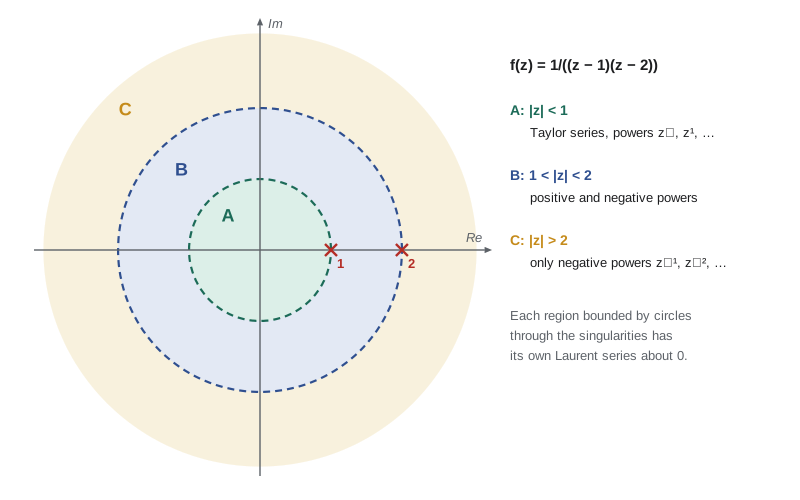
Find the Laurent series about 0 of \(f(z) = \frac{1}{(z - 1)(z - 2)}\) on \(|z| < 1\), on \(1 < |z| < 2\), and on \(|z| > 2\).
Show solution
- Partial fractions: \(f(z) = \frac{1}{z - 2} - \frac{1}{z - 1}\).
- For \(|z| < 2\): \(\frac{1}{z - 2} = -\frac{1}{2}\cdot\frac{1}{1 - z/2} = -\sum_{n \ge 0}\frac{z^n}{2^{n+1}}\). For \(|z| > 2\): \(\frac{1}{z - 2} = \frac{1}{z}\cdot\frac{1}{1 - 2/z} = \sum_{n \ge 0}\frac{2^n}{z^{n+1}}\).
- For \(|z| < 1\): \(-\frac{1}{z - 1} = \sum_{n \ge 0}z^n\). For \(|z| > 1\): \(-\frac{1}{z - 1} = -\sum_{n \ge 0}\frac{1}{z^{n+1}}\).
- Combine the appropriate pieces in each region.
Answer: For \(|z| < 1\): \(\sum_{n \ge 0}(1 - 2^{-n-1})z^n\), a Taylor series. For \(1 < |z| < 2\): \(-\sum_{n \ge 0}\frac{z^n}{2^{n+1}} - \sum_{n \ge 1}z^{-n}\). For \(|z| > 2\): \(\sum_{n \ge 1}(2^{n-1} - 1)z^{-n}\).
Worked problem
A Laurent series at an essential point
Find the Laurent series of \(e^{1/z}\) on \(0 < |z| < \infty\).
Show solution
- Substitute \(w = \frac{1}{z}\) in \(e^w = \sum\frac{w^n}{n!}\).
Answer: \(e^{1/z} = \sum_{n \ge 0}\frac{1}{n!\,z^n} = 1 + \frac{1}{z} + \frac{1}{2z^2} + \dots\), with infinitely many negative powers. The coefficient of \(\frac{1}{z}\) is 1, which will be its residue at 0.
import cmath, math

# Partial sums of the exponential series converge everywhere.
z = 2 + 3j
s, term = 0, 1
for n in range(30):
    s += term
    term *= z / (n + 1)
print("30 terms of exp series at 2+3i:", s, " cmath.exp:", cmath.exp(z))

# Radius of convergence by the root test, for coefficients of 1/(1+z^2) about z0 = 1.
# Taylor coefficients by Cauchy's formula on a circle inside the disk of analyticity, trapezoid rule.
def coeff(f, z0, n, r=0.5, m=512):
    return sum(f(z0 + r*cmath.exp(2j*math.pi*k/m)) * cmath.exp(-2j*math.pi*k*n/m) for k in range(m)) / (m * r**n)

f = lambda w: 1/(1 + w*w)
for n in [10, 20, 40, 80]:
    a = max(abs(coeff(f, 1, k, r=1.3, m=1024)) for k in range(n - 3, n + 1))   # largest of four, as in limsup
    print(f"n={n}: (max |a_k|)^(-1/n) = {a**(-1/n):.4f}")
print("distance from 1 to the singularity i:", abs(1 - 1j), " (the root test converges slowly, like n-th roots do)")

# Laurent coefficients of 1/((z-1)(z-2)) on the circle |z| = 1.5 (the middle annulus).
g = lambda w: 1/((w - 1)*(w - 2))
for n in range(-3, 3):
    a = coeff(g, 0, n, r=1.5)
    exact = -2.0**(-n-1) if n >= 0 else -1.0
print(f"a_{n:+d} = {a.real:+.8f} formula {exact:+.8f}")30 terms of exp series at 2+3i: (-7.315110094901104+1.0427436562359047j) cmath.exp: (-7.315110094901103+1.0427436562359045j) n=10: (max |a_k|)^(-1/n) = 1.4142 n=20: (max |a_k|)^(-1/n) = 1.3660 n=40: (max |a_k|)^(-1/n) = 1.3899 n=80: (max |a_k|)^(-1/n) = 1.4020 distance from 1 to the singularity i: 1.4142135623730951 (the root test converges slowly, like n-th roots do) a_-3 = -1.00000000 formula -1.00000000 a_-2 = -1.00000000 formula -1.00000000 a_-1 = -1.00000000 formula -1.00000000 a_+0 = -0.50000000 formula -0.50000000 a_+1 = -0.25000000 formula -0.25000000 a_+2 = -0.12500000 formula -0.12500000
Common mistakes
Common mistakes
MistakeAssuming a function smooth on the real line has a Taylor series converging on the whole line.
InsteadThe radius is the distance to the nearest complex singularity: for \(\frac{1}{1 + x^2}\) at 0 it is 1.
MistakeExpecting a power series to converge or diverge uniformly on its circle of convergence.
InsteadBehaviour on the circle varies: \(\sum\frac{z^n}{n}\) converges at all points except \(z = 1\).
MistakeUsing the expansion \(\frac{1}{1 - w} = \sum w^n\) with \(|w| > 1\).
InsteadRewrite to get a ratio of modulus less than 1, e.g. \(\frac{1}{z - 2} = \frac{1}{z}\cdot\frac{1}{1 - 2/z}\) for \(|z| > 2\).
MistakeThinking a function has one Laurent series about a point.
InsteadIt has one for each annulus of analyticity centred there.
MistakeApplying the identity theorem when the agreement set has no limit point in the domain.
Instead\(\sin z\) and 0 agree on \(\{k\pi\}\), which has no finite limit point, and they are different.
Summary and key terms
- A power series converges absolutely inside a disk of radius \(R = \frac{1}{\limsup|a_n|^{1/n}}\) and diverges outside; inside, it is analytic and differentiable term by term.
- An analytic function equals its Taylor series on every disk in its domain; the radius extends to the nearest singularity.
- Zeros of a non-zero analytic function are isolated and have finite order; analytic functions agreeing on a set with a limit point agree everywhere.
- On an annulus an analytic function has a unique Laurent series \(\sum_{-\infty}^{\infty}a_n(z - z_0)^n\).
- Laurent coefficients are given by contour integrals but are usually found by algebra and geometric series.
- Radius of convergence
- The radius of the largest open disk on which a power series converges.
- Taylor series
- \(\sum\frac{f^{(n)}(z_0)}{n!}(z - z_0)^n\).
- Zero of order m
- A point where \(f = (z - z_0)^mg\) with \(g(z_0) \ne 0\).
- Laurent series
- A series in positive and negative powers of z minus z0, converging on an annulus.
- Principal part
- The part of a Laurent series with negative powers.
Practice problems
Work each problem on paper first, then reveal the answer to check.
Find the radius of convergence of \(\sum\frac{n^2z^n}{3^n}\).
Show answer
\(|a_n|^{1/n} = \frac{n^{2/n}}{3} \to \frac{1}{3}\), so \(R = 3\).
Without computing coefficients, find the radius of convergence of the Taylor series of \(\frac{1}{z^2 - 4z + 13}\) at 0.
Show answer
The singularities are \(2 \pm 3i\), at distance \(\sqrt{13}\) from 0.
Find the Taylor series of \(\frac{1}{(1 - z)^2}\) at 0.
Show answer
Differentiate the geometric series: \(\sum_{n \ge 0}(n + 1)z^n\), \(|z| < 1\).
Find the order of the zero of \(z\sin z\) at 0.
Show answer
\(z\sin z = z^2 - \frac{z^4}{6} + \dots\), order 2.
Find the Laurent series of \(\frac{\sin z}{z^3}\) on \(0 < |z| < \infty\).
Show answer
\(\frac{1}{z^2} - \frac{1}{6} + \frac{z^2}{120} - \dots\)
Lesson quiz · 5 questions
Score 60% or more to complete this lesson.
Create a free account to save your progress, take quizzes and earn a certificate.