
MATH-334 · Lesson 3 of 12 · 24 min
Limits, continuity and complex differentiability
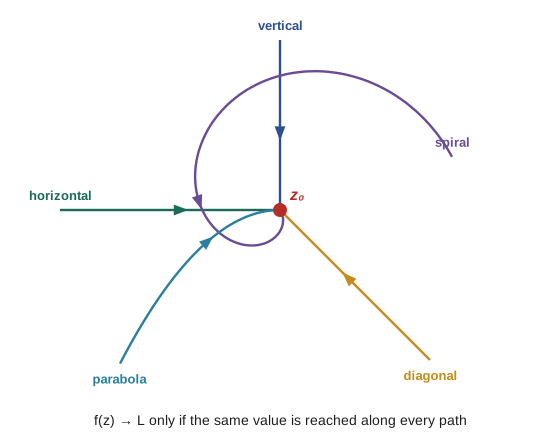
Calculus begins with limits, and so does complex analysis. The definitions look exactly like the real ones, with the absolute value replaced by the modulus. But there is a crucial difference. A real variable can approach a point from only two directions, left and right; a complex variable can approach from infinitely many directions and along any curve. Requiring a limit to be the same along every path is a much stronger condition, and when we apply it to the difference quotient that defines the derivative, it produces a theory of differentiation far more restrictive, and far more powerful, than the real one.
Limits
Let \(f\) be defined on a punctured disk around \(z_0\). We say \(\lim_{z \to z_0} f(z) = L\) if for every \(\varepsilon > 0\) there is a \(\delta > 0\) such that
\[0 < |z - z_0| < \delta \implies |f(z) - L| < \varepsilon.\]
Geometrically, every point of the punctured disk of radius \(\delta\) about \(z_0\) is sent inside the disk of radius \(\varepsilon\) about \(L\). The condition \(0 < |z - z_0|\) means the value of \(f\) at \(z_0\) itself, if any, plays no role.
Because \(|\operatorname{Re} w| \le |w|\), \(|\operatorname{Im} w| \le |w|\) and \(|w| \le |\operatorname{Re} w| + |\operatorname{Im} w|\), a complex limit exists exactly when the limits of the real and imaginary parts exist: \(f = u + iv \to L = a + ib\) if and only if \(u \to a\) and \(v \to b\). So the limit laws of real analysis carry over: limits of sums, products and quotients (with non-zero denominator) are the sums, products and quotients of the limits, and the proofs are word for word the same, using the triangle inequality for the modulus. In particular every polynomial \(p\) satisfies \(\lim_{z \to z_0} p(z) = p(z_0)\), and every rational function \(\frac{p}{q}\) satisfies the same at points where \(q(z_0) \ne 0\).
Worked problem
A limit from the definition
Prove that \(\lim_{z \to 1 + i} z^2 = 2i\).
Show solution
- Scratch work: \(|z^2 - 2i| = |z - (1 + i)|\,|z + (1 + i)|\). We must bound the second factor.
- If \(|z - (1 + i)| < 1\) then by the triangle inequality \(|z + 1 + i| \le |z - (1 + i)| + 2|1 + i| < 1 + 2\sqrt{2} < 4\).
- Proof: given \(\varepsilon > 0\), let \(\delta = \min(1, \frac{\varepsilon}{4})\). If \(0 < |z - (1 + i)| < \delta\) then \(|z^2 - 2i| < 4\delta \le \varepsilon\).
Answer: The same strategy as in real analysis: factor out \(z - z_0\), bound the other factor on a small disk, and choose \(\delta\) as a minimum.
When limits fail: path dependence
If \(f(z) \to L\) as \(z \to z_0\), then \(f(z(t)) \to L\) along every curve \(z(t)\) approaching \(z_0\). So to show that a limit does not exist, it is enough to find two paths with different limits. Consider \(f(z) = \frac{\bar{z}}{z}\) as \(z \to 0\). Along the real axis \(z = x\), \(f = \frac{x}{x} = 1\). Along the imaginary axis \(z = iy\), \(f = \frac{-iy}{iy} = -1\). The limit does not exist. In polar form the reason is plain: \(\frac{\bar{z}}{z} = e^{-2i\theta}\) depends only on the direction of approach, not on the distance.
Path dependence can be subtle. The function \(f(z) = \frac{x^2 y}{x^4 + y^2}\) (a real-valued function of \(z = x + iy\)) tends to 0 along every straight line through the origin, yet along the parabola \(y = x^2\) it equals \(\frac{1}{2}\). So checking straight lines is not enough to prove a limit exists; only an estimate valid on a whole disk proves that.
Continuity
A function \(f\) is continuous at \(z_0\) if \(f\) is defined at \(z_0\) and \(\lim_{z \to z_0} f(z) = f(z_0)\). It is continuous on a set if it is continuous at every point of the set. Sums, products, quotients with non-zero denominator, and compositions of continuous functions are continuous. Polynomials are continuous everywhere, rational functions everywhere except at the zeros of the denominator, and \(z \mapsto \bar{z}\), \(z \mapsto |z|\), \(\operatorname{Re} z\) and \(\operatorname{Im} z\) are continuous everywhere. The extreme value theorem carries over in the form we will need: a continuous function on a closed bounded set \(K\) is bounded on \(K\), and \(|f|\) attains a maximum there. This is used in lesson 8.
Continuity is a weak condition: \(\bar{z}\) is continuous everywhere but, as we are about to see, differentiable nowhere. The interesting theory begins with the derivative.
The complex derivative
Let \(f\) be defined on an open set containing \(z_0\). The derivative of \(f\) at \(z_0\) is
\[f'(z_0) = \lim_{h \to 0} \frac{f(z_0 + h) - f(z_0)}{h},\]
provided the limit exists, where \(h\) is a complex number tending to 0. If it does, \(f\) is complex differentiable at \(z_0\). The definition is identical in form to the real one, but the meaning is very different, because \(h\) can approach 0 from every direction in the plane. The difference quotient must have the same limit whether \(h\) is real, imaginary, or approaches along a spiral.
Familiar functions pass the test. For \(f(z) = z^n\) with \(n\) a positive integer, the binomial theorem gives \((z + h)^n - z^n = nz^{n-1}h + \binom{n}{2}z^{n-2}h^2 + \dots + h^n\), so the difference quotient is \(nz^{n-1} + h(\dots)\), which tends to \(nz^{n-1}\). So \((z^n)' = nz^{n-1}\), exactly as in real calculus. The proofs of the sum, product, quotient and chain rules are also identical to the real proofs, because they use only the algebra of limits. Hence every polynomial is differentiable everywhere, with the usual derivative, and every rational function is differentiable wherever its denominator is non-zero; for instance \(\big(\frac{1}{z}\big)' = -\frac{1}{z^2}\) for \(z \ne 0\).
A function that is nowhere differentiable
Now consider \(f(z) = \bar{z}\). The difference quotient is \(\frac{\overline{z_0 + h} - \bar{z}_0}{h} = \frac{\bar{h}}{h}\), which, as we saw, has no limit as \(h \to 0\): it is 1 for real \(h\) and \(-1\) for imaginary \(h\). So \(\bar{z}\) is differentiable at no point at all, even though as a map of the plane, \((x, y) \mapsto (x, -y)\), it is linear, about as smooth as a function can be. The same goes for \(\operatorname{Re} z\), \(\operatorname{Im} z\) and \(|z|\), none of which is complex differentiable anywhere.
A more instructive example is \(f(z) = |z|^2 = z\bar{z}\). At \(z_0\) the difference quotient is
\[\frac{|z_0 + h|^2 - |z_0|^2}{h} = \frac{z_0\bar{h} + \bar{z}_0 h + h\bar{h}}{h} = \bar{z}_0 + \bar{h} + z_0\frac{\bar{h}}{h}.\]
As \(h \to 0\) the first two terms tend to \(\bar{z}_0\), but the last tends to nothing unless \(z_0 = 0\). So \(|z|^2\) is complex differentiable at exactly one point, the origin, where its derivative is 0. Real differentiability, in the sense of MATH-209, is not enough. The function \((x, y) \mapsto x^2 + y^2\) is as smooth as can be, but as a function of \(z\) it fails the much stronger complex test.
Differentiability implies continuity
As in real analysis, a function that is complex differentiable at \(z_0\) is continuous there. The proof is one line: for \(h \ne 0\),
\[f(z_0 + h) - f(z_0) = \frac{f(z_0 + h) - f(z_0)}{h} \cdot h \to f'(z_0) \cdot 0 = 0.\]
The converse fails badly, as \(\bar{z}\) shows. It is worth recording a reformulation of the derivative that is often easier to use. The function \(f\) is differentiable at \(z_0\) with derivative \(A\) exactly when
\[f(z_0 + h) = f(z_0) + Ah + \varepsilon(h)h, \quad \text{where } \varepsilon(h) \to 0 \text{ as } h \to 0.\]
This is the statement that \(f\) has a complex-linear approximation at \(z_0\) with error small compared with \(|h|\). The chain rule follows quickly from it: if \(g\) is differentiable at \(z_0\) and \(f\) at \(g(z_0)\), substitute \(k = g(z_0 + h) - g(z_0) = g'(z_0)h + \varepsilon_1(h)h\) into the corresponding expansion of \(f\) to obtain \((f \circ g)'(z_0) = f'(g(z_0))\,g'(z_0)\). The same expansion is the form in which the derivative generalizes to maps of \(\mathbb{R}^2\): there \(A\) is allowed to be any 2 by 2 matrix, whereas here it must be multiplication by a single complex number.
Worked problem
A quotient of polynomials
Find the derivative of \(f(z) = \frac{z}{z^2 + 4}\) and the points where \(f\) is analytic.
Show solution
- The denominator vanishes at \(z^2 = -4\), that is \(z = \pm 2i\). Away from these points \(f\) is a quotient of differentiable functions with non-zero denominator.
- By the quotient rule, \(f'(z) = \frac{(z^2 + 4) - z \cdot 2z}{(z^2 + 4)^2} = \frac{4 - z^2}{(z^2 + 4)^2}\).
- So \(f\) is analytic on \(\mathbb{C}\) with the two points \(\pm 2i\) removed, an open set.
Answer: \(f'(z) = \frac{4 - z^2}{(z^2 + 4)^2}\) for \(z \ne \pm 2i\). The real function \(\frac{x}{x^2 + 4}\) looks harmless on the whole line; in the complex plane it has two points of trouble, and lesson 9 shows they limit the radius of convergence of its Taylor series at 0 to 2.
What complex differentiability means geometrically
If \(f'(z_0)\) exists, then for small \(h\), \(f(z_0 + h) \approx f(z_0) + f'(z_0)h\). The linear approximation is multiplication by the complex number \(f'(z_0) = \rho e^{i\alpha}\): near \(z_0\), \(f\) acts like a rotation by \(\alpha\) followed by a scaling by \(\rho\). A general smooth map of the plane has a linear approximation given by a 2 by 2 Jacobian matrix, which can stretch differently in different directions, shear and reflect. Complex differentiability says that this matrix is of the special form
\[\begin{pmatrix} a & -b \\ b & a \end{pmatrix},\]
which represents multiplication by \(a + ib\). Such a matrix rotates and scales but never shears or reflects. This is why the images of the grid lines under \(z^2\) in lesson 2 crossed at right angles. Lesson 4 turns this observation into the Cauchy–Riemann equations, and lesson 12 into the theory of conformal mapping.
Analytic functions
A function is analytic (or holomorphic) on an open set \(U\) if it is complex differentiable at every point of \(U\). It is analytic at a point if it is analytic on some open disk around that point. The distinction matters: \(|z|^2\) is differentiable at 0 but analytic nowhere, because it is not differentiable at any point near 0. A function analytic on the whole plane is called entire. Polynomials are entire, rational functions are analytic away from the zeros of their denominators, and we will add the exponential, the trigonometric functions and branches of the logarithm in lesson 5.
Analytic functions are the central objects of the course. Over the next lessons we will discover that the single assumption of complex differentiability on an open set has astonishing consequences. An analytic function is automatically infinitely differentiable. It equals its Taylor series near every point. Its values on a small circle determine its values inside. And if it is entire and bounded, it must be constant. None of these is true for real differentiable functions: \(x|x|\) is differentiable once but not twice, and \(\sin x\) is bounded and smooth on the whole line.
import cmath, math

def quotient(f, z0, h):
    return (f(z0 + h) - f(z0)) / h

z0 = 1 + 2j
directions = [cmath.rect(1, k*math.pi/4) for k in range(4)]   # angles 0, 45, 90, 135 degrees
for name, f in [("z^3", lambda z: z**3), ("conj(z)", lambda z: z.conjugate()), ("|z|^2", lambda z: abs(z)**2)]:
    vals = [quotient(f, z0, 1e-6 * d) for d in directions]
    spread = max(abs(v - vals[0]) for v in vals)
    print(f"{name:8s} quotients along four directions: " + ", ".join(f"{v.real:+.3f}{v.imag:+.3f}i" for v in vals) + f"   spread {spread:.2e}")
print("3*z0^2 =", 3 * z0**2)

# |z|^2 at the origin: every direction gives (almost) 0.
vals = [quotient(lambda z: abs(z)**2, 0, 1e-6 * d) for d in directions]
print("|z|^2 at 0:", [f"{abs(v):.1e}" for v in vals])

# The limit of conj(z)/z at 0 depends on the direction of approach.
print(["%+.3f%+.3fi" % (w.real, w.imag) for w in [(1e-8*d).conjugate()/(1e-8*d) for d in directions]])z^3 quotients along four directions: -9.000+12.000i, -9.000+12.000i, -9.000+12.000i, -9.000+12.000i spread 1.24e-05 conj(z) quotients along four directions: +1.000+0.000i, +0.000-1.000i, -1.000-0.000i, +0.000+1.000i spread 2.00e+00 |z|^2 quotients along four directions: +2.000+0.000i, +3.000-3.000i, +0.000-4.000i, -1.000-1.000i spread 4.47e+00 3*z0^2 = (-9+12j) |z|^2 at 0: ['1.0e-06', '1.0e-06', '1.0e-06', '1.0e-06'] ['+1.000-0.000i', '+0.000-1.000i', '-1.000-0.000i', '-0.000+1.000i']
Common mistakes
Common mistakes
MistakeProving a limit exists by checking only the real and imaginary axes.
InsteadAgreement along a few paths shows nothing; you need an estimate on a whole punctured disk. Disagreement along two paths does prove the limit fails.
MistakeAssuming a smooth map of the plane is complex differentiable.
Instead\(\bar{z}\) and \(|z|^2\) are smooth as maps of \(\mathbb{R}^2\) but fail the complex test.
MistakeConfusing "differentiable at a point" with "analytic at a point".
InsteadAnalytic at \(z_0\) means differentiable on a whole disk around \(z_0\); \(|z|^2\) is differentiable at 0 but not analytic there.
MistakeLetting \(h\) approach 0 only along the real axis.
InsteadThe complex derivative requires the same limit for every way \(h \to 0\) in the plane.
MistakeForgetting that \(\frac{1}{z}\) is not differentiable at 0.
InsteadRational functions are analytic only where the denominator is non-zero.
Summary and key terms
- Limits and continuity are defined with the modulus; the limit laws and algebra of continuous functions carry over from real analysis.
- A complex limit must agree along every path; two paths with different limits show the limit does not exist.
- The complex derivative is the limit of the difference quotient as complex \(h \to 0\); polynomials and rational functions obey the usual rules.
- \(\bar{z}\) is differentiable nowhere and \(|z|^2\) only at 0, although both are smooth maps of the plane.
- Analytic functions are complex differentiable on open sets; near each point they act like a rotation and scaling.
- Limit
- \(f(z) \to L\) if for every \(\varepsilon > 0\) some punctured \(\delta\)-disk maps into the \(\varepsilon\)-disk about \(L\).
- Complex derivative
- \(f'(z_0) = \lim_{h \to 0} \frac{f(z_0 + h) - f(z_0)}{h}\) with complex \(h\).
- Analytic function
- A function complex differentiable at every point of an open set; also called holomorphic.
- Entire function
- A function analytic on the whole complex plane.
- Path dependence
- Different limits along different curves, which shows that a limit does not exist.
Practice problems
Work each problem on paper first, then reveal the answer to check.
Show that \(\lim_{z \to 0} \frac{z^2}{|z|}\) exists and find it.
Show answer
\(\big|\frac{z^2}{|z|}\big| = |z| \to 0\), so the limit is 0; take \(\delta = \varepsilon\).
Show that \(\lim_{z \to 0} \frac{\operatorname{Re} z}{z}\) does not exist.
Show answer
Along the real axis it is 1; along the imaginary axis it is 0.
Use the definition to find the derivative of \(f(z) = \frac{1}{z}\) at \(z_0 \ne 0\).
Show answer
\(\frac{1}{h}\big(\frac{1}{z_0 + h} - \frac{1}{z_0}\big) = \frac{-1}{z_0(z_0 + h)} \to -\frac{1}{z_0^2}\).
Where is \(f(z) = \operatorname{Re} z\) complex differentiable?
Show answer
Nowhere: the quotient \(\frac{\operatorname{Re} h}{h}\) is 1 for real \(h\) and 0 for imaginary \(h\).
Find the derivative of \(\frac{z^2 + 1}{z - i}\) and say where it is analytic.
Show answer
Analytic for \(z \ne i\); in fact it equals \(z + i\) there, so the derivative is 1. The quotient rule gives the same.
Lesson quiz · 5 questions
Score 60% or more to complete this lesson.
Create a free account to save your progress, take quizzes and earn a certificate.