
MATH-334 · Lesson 10 of 12 · 28 min
Singularities and the residue theorem
Lesson 9 showed that near a point where it fails to be analytic, a function can often be expanded in a Laurent series. The shape of that series sorts singular points into three kinds, each with its own behaviour. One coefficient of the series, the coefficient of \(\frac{1}{z - z_0}\), is singled out: it is the only one that survives integration round the point. That coefficient is the residue, and the residue theorem turns the evaluation of contour integrals into the algebra of finding Laurent coefficients. Cauchy developed the calculus of residues in a series of papers from 1826 onward. It remains one of the most practical tools in mathematics, physics and engineering, and lesson 11 uses it to evaluate real integrals that resist every elementary method.
Isolated singularities
A point \(z_0\) is an isolated singularity of \(f\) if \(f\) is analytic on a punctured disk \(0 < |z - z_0| < r\) but not at \(z_0\) itself. Examples: \(\frac{1}{z}\), \(\frac{\sin z}{z}\) and \(e^{1/z}\) at 0. The principal branch \(\operatorname{Log} z\) has no isolated singularity at 0, since it is not analytic on any punctured disk there: the whole cut is singular. On a punctured disk \(f\) has a Laurent series \(\sum_{n=-\infty}^{\infty}a_n(z - z_0)^n\), and the singularity is classified by its principal part.
Removable: no negative powers. Then \(f\) agrees with a power series on the punctured disk, and defining \(f(z_0) = a_0\) makes it analytic. Example: \(\frac{\sin z}{z} = 1 - \frac{z^2}{6} + \dots\)
Pole of order \(m\): finitely many negative powers, the lowest being \(a_{-m}(z - z_0)^{-m}\) with \(a_{-m} \ne 0\). A pole of order 1 is a simple pole. Example: \(\frac{e^z}{z^2} = \frac{1}{z^2} + \frac{1}{z} + \frac{1}{2} + \dots\) has a pole of order 2.
Essential: infinitely many negative powers. Example: \(e^{1/z} = \sum\frac{1}{n!z^n}\).
Recognizing the type
Each type has a characterization that avoids computing the whole series.
Riemann's removable singularity theorem. If \(f\) is bounded near \(z_0\), the singularity is removable. Proof: by the coefficient formula on a circle of radius \(\rho\), \(|a_{-n}| = \big|\frac{1}{2\pi i}\oint f(w)(w - z_0)^{n-1}\,dw\big| \le M\rho^n\) for \(n \ge 1\), which tends to 0 as \(\rho \to 0\). So all negative coefficients vanish. \(\square\) In particular, if \(\lim_{z \to z_0}(z - z_0)f(z) = 0\), the singularity is removable.
Poles. \(z_0\) is a pole of order \(m\) exactly when \(f(z) = \frac{g(z)}{(z - z_0)^m}\) with \(g\) analytic at \(z_0\) and \(g(z_0) \ne 0\), and then \(|f(z)| \to \infty\) as \(z \to z_0\). If \(f = \frac{p}{q}\) with \(p, q\) analytic, \(p(z_0) \ne 0\) and \(q\) having a zero of order \(m\) at \(z_0\), then \(f\) has a pole of order \(m\). So \(\frac{1}{\sin z}\) has simple poles at \(z = k\pi\), and \(\frac{1}{z^2(z - 1)}\) has a double pole at 0 and a simple pole at 1.
Essential singularities. Near an essential singularity a function behaves wildly. The Casorati–Weierstrass theorem says that in every punctured disk about it, the values of \(f\) come arbitrarily close to every complex number. (If they stayed a distance \(\delta\) from some \(c\), then \(\frac{1}{f - c}\) would be bounded, its singularity removable, and \(f\) would have at worst a pole.) Picard's great theorem of 1879 says much more: in every punctured disk about an essential singularity, \(f\) takes every complex value, with at most one exception, infinitely often. For instance \(e^{1/z}\) takes every non-zero value infinitely often near 0 and never takes 0.
Residues
The residue of \(f\) at an isolated singularity \(z_0\) is the coefficient \(a_{-1}\) of its Laurent series, written \(\operatorname{Res}(f, z_0)\). Its importance comes from lesson 6: integrating the Laurent series term by term round a small circle \(C\) about \(z_0\), every power \((z - z_0)^n\) with \(n \ne -1\) integrates to 0 and \(\frac{1}{z - z_0}\) gives \(2\pi i\). So
\[\oint_C f(z)\,dz = 2\pi i\operatorname{Res}(f, z_0).\]
Residues at poles are easy to compute without the whole series.
Simple pole: \(\operatorname{Res}(f, z_0) = \lim_{z \to z_0}(z - z_0)f(z)\). If \(f = \frac{p}{q}\) with \(p(z_0) \ne 0\), \(q(z_0) = 0\) and \(q'(z_0) \ne 0\), this becomes
\[\operatorname{Res}\Big(\frac{p}{q}, z_0\Big) = \frac{p(z_0)}{q'(z_0)}.\]
Pole of order \(m\): if \(f = \frac{g(z)}{(z - z_0)^m}\) with \(g\) analytic, the residue is the coefficient of \((z - z_0)^{m-1}\) in the Taylor series of \(g\):
\[\operatorname{Res}(f, z_0) = \frac{1}{(m - 1)!}\lim_{z \to z_0}\frac{d^{m-1}}{dz^{m-1}}\Big((z - z_0)^mf(z)\Big).\]
Removable singularity: the residue is 0. Essential singularity: no shortcut; find the Laurent coefficient directly, as for \(\operatorname{Res}(e^{1/z}, 0) = 1\).
Worked problem
Residues at simple and double poles
Find the residues of \(f(z) = \frac{e^z}{z^2(z - 1)}\) at 0 and 1.
Show solution
- At 1: a simple pole. \(\operatorname{Res} = \lim_{z \to 1}(z - 1)f(z) = \frac{e}{1} = e\).
- At 0: a double pole with \(g(z) = \frac{e^z}{z - 1}\). The residue is \(g'(0)\).
- \(g'(z) = \frac{e^z(z - 1) - e^z}{(z - 1)^2}\), so \(g'(0) = \frac{-1 - 1}{1} = -2\).
Answer: \(\operatorname{Res}(f, 1) = e\), \(\operatorname{Res}(f, 0) = -2\).
The residue theorem
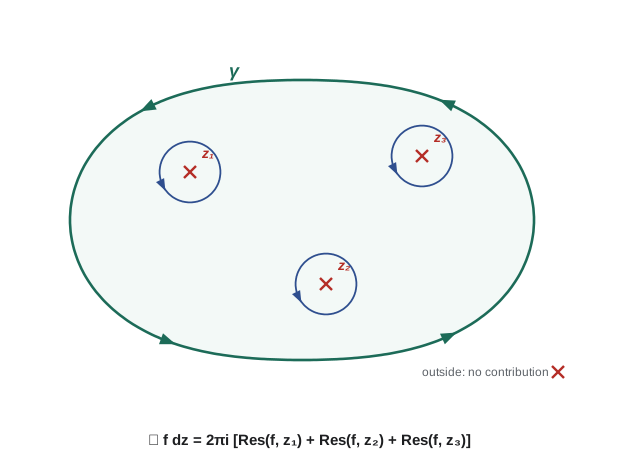
Residue theorem. Let \(\gamma\) be a positively oriented simple closed contour, and let \(f\) be analytic on and inside \(\gamma\) except at finitely many points \(z_1, \dots, z_n\) inside \(\gamma\). Then
\[\oint_\gamma f(z)\,dz = 2\pi i\sum_{k=1}^{n}\operatorname{Res}(f, z_k).\]
Proof. Surround each \(z_k\) with a small circle \(C_k\), the circles disjoint and inside \(\gamma\). By the deformation principle of lesson 7, \(\oint_\gamma f\,dz = \sum_k\oint_{C_k}f\,dz\), and each term equals \(2\pi i\operatorname{Res}(f, z_k)\). \(\square\)
The residue theorem contains Cauchy's theorem (no singularities, so the sum is empty) and the integral formula: \(\frac{f(z)}{z - z_0}\) has a simple pole at \(z_0\) with residue \(f(z_0)\), and \(\frac{f(z)}{(z - z_0)^{n+1}}\) has residue \(\frac{f^{(n)}(z_0)}{n!}\).
Worked problem
A contour integral by residues
Compute \(\oint_{|z| = 2}\frac{z\,dz}{(z^2 + 1)(z - 3)}\).
Show solution
- Singularities: \(\pm i\) (inside) and 3 (outside, ignored).
- At \(i\): \(\operatorname{Res} = \frac{i}{2i(i - 3)} = \frac{1}{2(i - 3)}\). At \(-i\): \(\frac{-i}{-2i(-i - 3)} = \frac{1}{2(-i - 3)}\).
- Sum: \(\frac{1}{2}\Big(\frac{1}{i - 3} + \frac{1}{-i - 3}\Big) = \frac{1}{2}\cdot\frac{-6}{10} = -\frac{3}{10}\).
Answer: \(2\pi i \cdot (-\frac{3}{10}) = -\frac{3\pi i}{5}\).
Worked problem
Residues from series
Find \(\operatorname{Res}\big(\frac{1}{z^2\sin z}, 0\big)\) and \(\operatorname{Res}(z^2e^{1/z}, 0)\).
Show solution
- \(\sin z = z\big(1 - \frac{z^2}{6} + \dots\big)\), so \(\frac{1}{\sin z} = \frac{1}{z}\big(1 + \frac{z^2}{6} + \dots\big)\) by the geometric series.
- Then \(\frac{1}{z^2\sin z} = \frac{1}{z^3} + \frac{1}{6z} + \dots\), a pole of order 3 whose residue is \(\frac{1}{6}\). The derivative formula would need two derivatives of \(\frac{z}{\sin z}\); the series is quicker.
- \(z^2e^{1/z} = z^2\big(1 + \frac{1}{z} + \frac{1}{2z^2} + \frac{1}{6z^3} + \dots\big)\); the \(\frac{1}{z}\) term comes from \(\frac{1}{6z^3}\).
Answer: Both residues are \(\frac{1}{6}\). The second singularity is essential, and only the series method applies.
Summing series by residues
Residues also evaluate infinite sums. The function \(\pi\cot\pi z\) has simple poles at every integer \(n\), each with residue \(\frac{\pi\cos\pi n}{\pi\cos\pi n} = 1\). So if \(f\) is a rational function, \(f(z)\pi\cot\pi z\) has residue \(f(n)\) at each integer that is not a pole of \(f\). Integrate round the square \(\Gamma_N\) with vertices \((N + \frac{1}{2})(\pm 1 \pm i)\). One can show that \(|\cot\pi z|\) is bounded on these squares independently of \(N\), so if \(|f(z)| \le \frac{K}{|z|^2}\) for large \(|z|\), the ML inequality shows that the integral tends to 0. The residue theorem then says the sum of all residues is 0:
\[\sum_{n=-\infty}^{\infty}f(n) = -\sum_{\text{poles } w \text{ of } f}\operatorname{Res}\big(f(z)\pi\cot\pi z, w\big).\]
Take \(f(z) = \frac{1}{z^2}\), which is the one case where the pole of \(f\) sits at an integer. The residue at 0 of \(\frac{\pi\cot\pi z}{z^2}\) comes from \(\pi\cot\pi z = \frac{1}{z} - \frac{\pi^2z}{3} - \dots\), so it is \(-\frac{\pi^2}{3}\). The other integers contribute \(\sum_{n \ne 0}\frac{1}{n^2} = 2\sum_{n \ge 1}\frac{1}{n^2}\). Setting the total to 0 gives Euler's famous result of 1734,
\[\sum_{n=1}^{\infty}\frac{1}{n^2} = \frac{\pi^2}{6}.\]
The same method gives \(\sum_{n \ge 1}\frac{1}{n^2 + a^2} = \frac{\pi a\coth\pi a - 1}{2a^2}\) for \(a > 0\), and many other closed forms.
Residue at infinity
For a function analytic outside some large disk, \(|z| > R\), define \(\operatorname{Res}(f, \infty) = -\frac{1}{2\pi i}\oint_{|z| = \rho}f(z)\,dz\) for \(\rho > R\). With this sign convention, if \(f\) has finitely many singularities in the plane, the sum of all its residues, including the one at infinity, is 0. This can save work: \(\oint_{|z| = 2}\frac{z^5}{z^6 - 1}\,dz\) has six poles inside, but the Laurent series at infinity is \(\frac{1}{z}\cdot\frac{1}{1 - z^{-6}} = \frac{1}{z} + \frac{1}{z^7} + \dots\), so \(\operatorname{Res}(f, \infty) = -1\) and the integral is \(2\pi i\).
The argument principle
If \(f\) is analytic near \(z_0\) with a zero of order \(m\), then \(f = (z - z_0)^mg\) with \(g(z_0) \ne 0\), and \(\frac{f'}{f} = \frac{m}{z - z_0} + \frac{g'}{g}\): a simple pole with residue \(m\). At a pole of order \(m\), the same calculation gives residue \(-m\). The residue theorem yields the argument principle: if \(f\) is analytic on and inside \(\gamma\) except for poles, and has no zeros or poles on \(\gamma\), then
\[\frac{1}{2\pi i}\oint_\gamma\frac{f'(z)}{f(z)}\,dz = Z - P,\]
the number of zeros minus the number of poles inside, counted with multiplicity. Since \(\frac{f'}{f}\) is the derivative of \(\log f\), the left side is the winding number of the image curve \(f(\gamma)\) about 0: the number of times the argument of \(f\) turns round as \(z\) traverses \(\gamma\). A consequence is Rouché's theorem: if \(|g| < |f|\) on \(\gamma\), then \(f\) and \(f + g\) have the same number of zeros inside. For example, on \(|z| = 2\), \(|3z + 1| \le 7 < 32 = |z^5|\), so \(z^5 + 3z + 1\) has all five roots in \(|z| < 2\).
import cmath, math

def circle_integral(f, z0=0, r=1.0, n=4096):
    s = 0
    for k in range(n):
        w = cmath.exp(2j*math.pi*k/n)
        s += f(z0 + r*w) * 1j*r*w
    return s * 2*math.pi/n

# Residues from small circles, compared with the formulas.
f = lambda z: cmath.exp(z) / (z*z*(z - 1))
for z0, exact in [(0, -2), (1, math.e)]:
    res = circle_integral(f, z0, r=0.3) / (2j*math.pi)
    print(f"Res at {z0}: numeric {res.real:+.10f}  formula {exact:+.10f}")
print("Res of exp(1/z) at 0:", (circle_integral(lambda z: cmath.exp(1/z), 0, 0.5) / (2j*math.pi)).real)

# The worked example: integral over |z| = 2.
g = lambda z: z / ((z*z + 1)*(z - 3))
print("contour integral:", circle_integral(g, 0, 2), " -3*pi*i/5 =", -3j*math.pi/5)

# Residue at infinity shortcut.
print("integral of z^5/(z^6-1) on |z|=2:", circle_integral(lambda z: z**5/(z**6 - 1), 0, 2))

# Argument principle: count the zeros of p(z) = z^5 + 3z + 1 inside |z| = 2 and |z| = 0.5.
p  = lambda z: z**5 + 3*z + 1
dp = lambda z: 5*z**4 + 3
for r in [2, 0.5]:
    N = circle_integral(lambda z: dp(z)/p(z), 0, r) / (2j*math.pi)
    print(f"zeros inside |z| = {r}: {N.real:.6f}")
# The single zero in |z| < 0.5 lies near -1/3, where 3z + 1 dominates.

# Euler's sum from the residue calculation, compared with a long partial sum.
print("pi^2/6 =", math.pi**2/6, " partial sum to 10^6:", sum(1/(n*n) for n in range(1, 10**6 + 1)))Res at 0: numeric -2.0000000000 formula -2.0000000000 Res at 1: numeric +2.7182818285 formula +2.7182818285 Res of exp(1/z) at 0: 0.9999999999999968 contour integral: (-1.6942793828446165e-17-1.8849555921538754j) -3*pi*i/5 = -1.8849555921538759j integral of z^5/(z^6-1) on |z|=2: (1.944549488006445e-18+6.283185307179592j) zeros inside |z| = 2: 5.000000 zeros inside |z| = 0.5: 1.000000 pi^2/6 = 1.6449340668482264 partial sum to 10^6: 1.6449330668487265
Common mistakes
Common mistakes
MistakeIncluding residues at singularities outside the contour.
InsteadOnly singular points inside the contour contribute.
MistakeUsing the simple-pole formula \(\lim(z - z_0)f(z)\) at a pole of higher order.
InsteadFor a pole of order \(m\), multiply by \((z - z_0)^m\), differentiate \(m - 1\) times and divide by \((m - 1)!\).
MistakeAssuming every zero of the denominator gives a pole.
InsteadIf the numerator also vanishes, the singularity may be removable, as for \(\frac{\sin z}{z}\) at 0.
MistakeTaking the residue to be the coefficient of \(\frac{1}{z}\) when the expansion is about \(z_0 \ne 0\).
InsteadIt is the coefficient of \(\frac{1}{z - z_0}\) in the Laurent series about \(z_0\).
MistakeForgetting the factor \(2\pi i\).
Instead\(\oint_\gamma f\,dz = 2\pi i\sum\operatorname{Res}\).
Summary and key terms
- Isolated singularities are removable, poles or essential, according as the principal part of the Laurent series is zero, finite or infinite.
- Bounded near the point means removable; \(|f| \to \infty\) means a pole; near an essential singularity \(f\) comes close to every value.
- The residue is the coefficient of \(\frac{1}{z - z_0}\); at a simple pole of \(\frac{p}{q}\) it is \(\frac{p(z_0)}{q'(z_0)}\).
- Residue theorem: \(\oint_\gamma f\,dz = 2\pi i\) times the sum of the residues inside \(\gamma\).
- The argument principle counts zeros minus poles by \(\frac{1}{2\pi i}\oint\frac{f'}{f}\,dz\); Rouché's theorem compares zero counts.
- Isolated singularity
- A point where f is not analytic but which has a punctured disk on which f is analytic.
- Pole of order m
- A singularity where \(f = \frac{g}{(z - z_0)^m}\) with \(g(z_0) \ne 0\).
- Essential singularity
- An isolated singularity whose Laurent series has infinitely many negative powers.
- Residue
- The coefficient \(a_{-1}\) of \(\frac{1}{z - z_0}\) in the Laurent series about \(z_0\).
- Argument principle
- The integral of f' over f round a contour, divided by 2 pi i, counts zeros minus poles inside.
Practice problems
Work each problem on paper first, then reveal the answer to check.
Classify the singularity at 0 of \(\frac{1 - \cos z}{z^2}\), \(\frac{1}{z\sin z}\) and \(z\sin\frac{1}{z}\).
Show answer
Removable (limit \(\frac{1}{2}\)); pole of order 2; essential.
Find \(\operatorname{Res}\big(\frac{1}{z^4 + 1}, e^{i\pi/4}\big)\).
Show answer
\(\frac{1}{4z^3}\) at \(z = e^{i\pi/4}\), which is \(\frac{1}{4}e^{-3i\pi/4}\).
Find \(\operatorname{Res}\big(\frac{\cos z}{z^3}, 0\big)\).
Show answer
The coefficient of \(z^2\) in \(\cos z\) is \(-\frac{1}{2}\).
Compute \(\oint_{|z| = 1}\frac{dz}{\sin z}\).
Show answer
Only the simple pole at 0 is inside, with residue \(\frac{1}{\cos 0} = 1\); the answer is \(2\pi i\).
Use Rouché to show \(z^4 + 6z + 3\) has exactly one zero in \(|z| < 1\).
Show answer
On \(|z| = 1\), \(|z^4 + 3| \le 4 < 6 = |6z|\), so it has as many zeros as \(6z\), namely one.
Compute \(\oint_{|z| = 4}\frac{e^z}{z(z - 2)^2}\,dz\).
Show answer
Residue at 0 is \(\frac{1}{4}\); at the double pole 2 it is \(\frac{d}{dz}\frac{e^z}{z}\big|_2 = \frac{e^2(2 - 1)}{4} = \frac{e^2}{4}\). The integral is \(\frac{\pi i}{2}(1 + e^2)\).
Use the cotangent method with \(f(z) = \frac{1}{z^2 + 1}\) to find \(\sum_{n=-\infty}^{\infty}\frac{1}{n^2 + 1}\).
Show answer
The poles \(\pm i\) of \(f\) give residues \(\frac{\pi\cot(\pi i)}{2i}\) and \(\frac{\pi\cot(-\pi i)}{-2i}\), each equal to \(-\frac{\pi}{2}\coth\pi\). So the sum is \(\pi\coth\pi \approx 3.1533\).
Lesson quiz · 5 questions
Score 60% or more to complete this lesson.
Create a free account to save your progress, take quizzes and earn a certificate.