
MATH-323 · Lesson 9 of 12 · 23 min
Field extensions and degree
The second half of the course turns from rings in general to fields, and to a single organizing question: given a field \(F\) and a polynomial over it, how do we build a larger field in which the polynomial has a root, and how do the fields between \(F\) and that larger field fit together? The answers rest on one simple idea, that a field containing \(F\) is a vector space over \(F\), and on one number, its dimension, called the degree of the extension. With the tower law for degrees, a short calculation will settle questions that resisted mathematicians for two thousand years.
Extensions as vector spaces
Definition. A field \(E\) containing a field \(F\) as a subfield is an extension of \(F\), written \(E/F\). Then \(E\) is a vector space over \(F\): elements of \(E\) can be added and multiplied by elements of \(F\), and the vector space axioms are special cases of the field axioms. The degree \([E : F]\) is the dimension of \(E\) as an \(F\)-vector space, and the extension is finite if the degree is finite.
Examples. \([\mathbb{C} : \mathbb{R}] = 2\), with basis \(\{1, i\}\). \([\mathbb{Q}(\sqrt 2) : \mathbb{Q}] = 2\), with basis \(\{1, \sqrt 2\}\). \([\mathbb{R} : \mathbb{Q}]\) is infinite, since a finite-dimensional \(\mathbb{Q}\)-vector space is countable and \(\mathbb{R}\) is not. A finite field \(E\) of characteristic \(p\) is a vector space over its prime field \(\mathbb{Z}_p\) of some finite dimension \(n\), so it has exactly \(p^n\) elements; lesson 11 proves that every prime power occurs. There is no field with 6 or 10 elements.
For \(\alpha\) in an extension \(E\) of \(F\), \(F(\alpha)\) denotes the smallest subfield of \(E\) containing \(F\) and \(\alpha\), and \(F(\alpha, \beta) = F(\alpha)(\beta)\). Such an extension, generated by one element, is called simple.
Algebraic and transcendental elements
An element \(\alpha \in E\) is algebraic over \(F\) if it is a root of some nonzero polynomial in \(F[x]\), and transcendental otherwise. \(\sqrt 2\), \(i\), \(\sqrt[3]{2}\) and \(e^{2\pi i/5}\) are algebraic over \(\mathbb{Q}\). Charles Hermite proved in 1873 that \(e\) is transcendental, and Ferdinand von Lindemann proved in 1882 that \(\pi\) is, which settled the ancient problem of squaring the circle in the negative, since lesson 10 shows that every constructible number is algebraic.
Theorem. Let \(\alpha\) be algebraic over \(F\). There is a unique monic irreducible polynomial \(m(x) \in F[x]\) with \(m(\alpha) = 0\), the minimal polynomial of \(\alpha\) over \(F\), and the polynomials vanishing at \(\alpha\) are exactly the multiples of \(m\). Moreover \(F(\alpha) \cong F[x]/(m(x))\), and if \(\deg m = n\), then \(\{1, \alpha, \ldots, \alpha^{n-1}\}\) is a basis of \(F(\alpha)\) over \(F\), so \([F(\alpha) : F] = n\).
Proof: evaluation at \(\alpha\), \(\phi : F[x] \to E\), is a homomorphism with nonzero kernel. The kernel is an ideal of \(F[x]\), so it is \((m)\) for a unique monic \(m\). It is prime, because the image is a subring of a field and hence a domain, so \(m\) is irreducible, and the ideal is maximal. By the first isomorphism theorem the image is \(F[x]/(m) \), a field, and it is clearly the smallest field containing \(F\) and \(\alpha\), so it is \(F(\alpha)\). Every element of the image is \(f(\alpha)\), and dividing \(f\) by \(m\) shows \(f(\alpha) = r(\alpha)\) with \(\deg r < n\). So \(1, \alpha, \ldots, \alpha^{n-1}\) span. They are independent, because a dependence would be a nonzero polynomial of degree less than \(n\) vanishing at \(\alpha\).
The theorem turns the computation of degrees into the computation of minimal polynomials. \(\sqrt[3]{2}\) has minimal polynomial \(x^3 - 2\), irreducible by Eisenstein, so \([\mathbb{Q}(\sqrt[3]{2}) : \mathbb{Q}] = 3\) with basis \(1, \sqrt[3]{2}, \sqrt[3]{4}\), as lesson 2 anticipated. \(\zeta = e^{2\pi i/p}\) has minimal polynomial \(\Phi_p\), so \([\mathbb{Q}(\zeta) : \mathbb{Q}] = p - 1\).
It also gives a converse construction, due to Leopold Kronecker in 1887. Given any irreducible \(p(x) \in F[x]\), the field \(E = F[x]/(p(x))\) contains a copy of \(F\) (the constants) and an element \(\alpha = x + (p)\) with \(p(\alpha) = 0\). So every polynomial has a root in some extension field, constructed out of nothing but the polynomial itself. This is how \(\mathbb{C}\) can be defined as \(\mathbb{R}[x]/(x^2 + 1)\), and how the finite fields of lesson 11 are built.
The tower law
Theorem (tower law). If \(F \subseteq K \subseteq E\) are fields with \([E : K]\) and \([K : F]\) finite, then \([E : F] = [E : K][K : F]\).
Proof: let \(\{\alpha_i\}\) be a basis of \(K\) over \(F\) (\(m\) elements) and \(\{\beta_j\}\) a basis of \(E\) over \(K\) (\(n\) elements). We show that the \(mn\) products \(\alpha_i\beta_j\) form a basis of \(E\) over \(F\). Spanning: any \(\gamma \in E\) is \(\sum_j c_j\beta_j\) with \(c_j \in K\), and each \(c_j = \sum_i a_{ij}\alpha_i\) with \(a_{ij} \in F\), so \(\gamma = \sum_{i,j} a_{ij}\alpha_i\beta_j\). Independence: if \(\sum_{i,j} a_{ij}\alpha_i\beta_j = 0\), then \(\sum_j (\sum_i a_{ij}\alpha_i)\beta_j = 0\), and since the \(\beta_j\) are independent over \(K\), each inner sum is 0; since the \(\alpha_i\) are independent over \(F\), each \(a_{ij} = 0\).
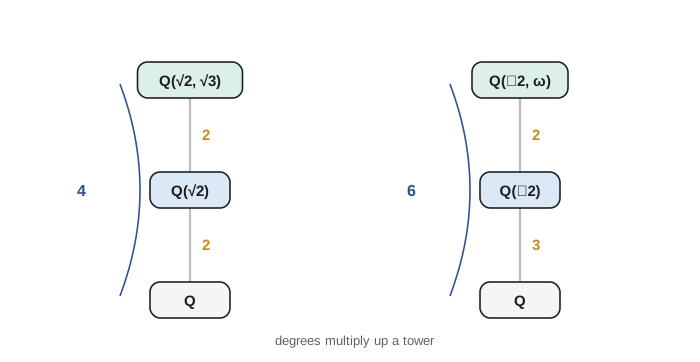
The figure shows two towers. On the left, \(\sqrt 3 \notin \mathbb{Q}(\sqrt 2)\): if \(\sqrt 3 = a + b\sqrt 2\), squaring gives \(3 = a^2 + 2b^2 + 2ab\sqrt 2\), so \(ab = 0\), and either \(3 = 2b^2\) or \(3 = a^2\), neither possible in \(\mathbb{Q}\). Hence \(x^2 - 3\) stays irreducible over \(\mathbb{Q}(\sqrt 2)\), and \([\mathbb{Q}(\sqrt 2, \sqrt 3) : \mathbb{Q}] = 4\), with basis \(1, \sqrt 2, \sqrt 3, \sqrt 6\). On the right, \(\omega = e^{2\pi i/3}\) is not real while \(\mathbb{Q}(\sqrt[3]{2}) \subset \mathbb{R}\), so adjoining \(\omega\), a root of \(x^2 + x + 1\), doubles the degree to 6.
Corollaries of the tower law are immediate and powerful. If \([E : F]\) is prime, there is no field strictly between \(F\) and \(E\). If \(\alpha \in E\) and \([E : F] = n\), then the degree of \(\alpha\) over \(F\) divides \(n\), since \(F \subseteq F(\alpha) \subseteq E\). For example \(\sqrt 2 \notin \mathbb{Q}(\sqrt[3]{2})\), because 2 does not divide 3. And sums, products and quotients of algebraic numbers are algebraic, because \(F(\alpha, \beta)\) is finite over \(F\) when \(\alpha\) and \(\beta\) are algebraic, and every element of a finite extension is algebraic: if \([E : F] = n\), the \(n + 1\) elements \(1, \gamma, \ldots, \gamma^n\) are dependent.
The algebraic numbers and algebraic closure
The last corollary has a striking consequence. The set \(\overline{\mathbb{Q}}\) of complex numbers that are algebraic over \(\mathbb{Q}\) is a field: if \(\alpha\) and \(\beta\) are algebraic, then \(\mathbb{Q}(\alpha, \beta)\) has finite degree at most \(\deg\alpha \cdot \deg\beta\), so \(\alpha \pm \beta\), \(\alpha\beta\) and \(\alpha/\beta\) all lie in a finite extension and are algebraic. This is not obvious from the definition. Knowing that \(\sqrt 2\) and \(\sqrt[3]{5}\) are roots of polynomials, it is not at all clear how to write down a polynomial for \(\sqrt 2 + \sqrt[3]{5}\), yet the tower law guarantees one of degree at most 6 exists, and the linear-algebra method of the next section, applied in a field of degree 6, would find it.
\(\overline{\mathbb{Q}}\) is countable, because there are countably many polynomials with rational coefficients and each has finitely many roots. Georg Cantor observed in 1874 that this gives a proof that transcendental numbers exist, since \(\mathbb{C}\) is uncountable, without exhibiting a single one; Joseph Liouville had constructed the first explicit examples in 1844. So almost every complex number is transcendental, even though proving that a particular number such as \(e + \pi\) is transcendental remains, in many cases, an open problem.
A field \(K\) is algebraically closed if every nonconstant polynomial over \(K\) has a root in \(K\). The fundamental theorem of algebra says that \(\mathbb{C}\) is algebraically closed; Gauss gave the first essentially complete proof in his doctoral thesis of 1799. It follows that \(\overline{\mathbb{Q}}\) is algebraically closed too, because a root of a polynomial with algebraic coefficients is itself algebraic over \(\mathbb{Q}\), by the tower law once more. Every field has an algebraic closure, a result proved by Ernst Steinitz in 1910, though the proof for uncountable fields needs the axiom of choice.
Finding minimal polynomials
To find the minimal polynomial of \(\gamma = \sqrt 2 + \sqrt 3\), express its powers in the basis \(1, \sqrt 2, \sqrt 3, \sqrt 6\) and look for the first linear dependence over \(\mathbb{Q}\). By hand: \(\gamma^2 = 5 + 2\sqrt 6\), so \((\gamma^2 - 5)^2 = 24\), and \(\gamma\) is a root of \(x^4 - 10x^2 + 1\). Since \(\gamma\) lies in a field of degree 4 and has degree dividing 4, it has degree 1, 2 or 4. The program below finds the dependence by exact linear algebra and shows that \(1, \gamma, \gamma^2, \gamma^3\) are independent, so the degree is 4 and \(\mathbb{Q}(\sqrt 2 + \sqrt 3) = \mathbb{Q}(\sqrt 2, \sqrt 3)\), a simple extension.
from fractions import Fraction as Fr

# elements of Q(sqrt2, sqrt3) as coordinates on the basis 1, r2, r3, r6
def mul(a, b):
    a1, a2, a3, a6 = a
    b1, b2, b3, b6 = b
    return (a1*b1 + 2*a2*b2 + 3*a3*b3 + 6*a6*b6,
            a1*b2 + a2*b1 + 3*a3*b6 + 3*a6*b3,
            a1*b3 + a3*b1 + 2*a2*b6 + 2*a6*b2,
            a1*b6 + a6*b1 + a2*b3 + a3*b2)

def min_poly(g, maxdeg=4):
    powers = [(Fr(1), Fr(0), Fr(0), Fr(0))]
    for _ in range(maxdeg):
        powers.append(mul(powers[-1], g))
    for n in range(1, maxdeg + 1):
        # solve c0*1 + ... + c_{n-1} g^{n-1} = -g^n by Gauss-Jordan elimination
        rows = [[powers[j][k] for j in range(n)] + [-powers[n][k]] for k in range(4)]
        piv, r = [], 0
        for c in range(n):
            pr = next((i for i in range(r, 4) if rows[i][c] != 0), None)
            if pr is None:
                continue
            rows[r], rows[pr] = rows[pr], rows[r]
            rows[r] = [x / rows[r][c] for x in rows[r]]
            for i in range(4):
                if i != r and rows[i][c] != 0:
                    rows[i] = [x - rows[i][c] * y for x, y in zip(rows[i], rows[r])]
            piv.append(c); r += 1
        if all(rows[i][n] == 0 for i in range(r, 4)) and len(piv) == n:
            coeffs = [rows[piv.index(j)][n] for j in range(n)] + [Fr(1)]
            return coeffs
    return None

def show(c):
    terms = [f"{'' if v == 1 and i else v}{'' if i == 0 else ('x' if i == 1 else f'x^{i}')}"
             for i, v in reversed(list(enumerate(c))) if v != 0]
    return " + ".join(terms).replace("+ -", "- ")

Q = lambda *t: tuple(Fr(x) for x in t)
for name, g in [("sqrt2", Q(0, 1, 0, 0)), ("sqrt2 + sqrt3", Q(0, 1, 1, 0)),
                ("sqrt6", Q(0, 0, 0, 1)), ("1 + sqrt2 + sqrt6", Q(1, 1, 0, 1)),
                ("(sqrt2 + sqrt6)/2", Q(0, Fr(1, 2), 0, Fr(1, 2)))]:
    m = min_poly(g)
print(f"{name:20} degree {len(m) - 1}: {show(m)}")sqrt2 degree 2: x^2 - 2 sqrt2 + sqrt3 degree 4: x^4 - 10x^2 + 1 sqrt6 degree 2: x^2 - 6 1 + sqrt2 + sqrt6 degree 4: x^4 - 4x^3 - 10x^2 + 28x + 1 (sqrt2 + sqrt6)/2 degree 4: x^4 - 4x^2 + 1
The program confirms \(x^4 - 10x^2 + 1\) for \(\sqrt 2 + \sqrt 3\). The elements \(\sqrt 2\) and \(\sqrt 6\) have degree 2, as they must: each lies in one of the intermediate fields \(\mathbb{Q}(\sqrt 2)\) and \(\mathbb{Q}(\sqrt 6)\). The last line is a pleasant surprise. The element \(\gamma = \frac{\sqrt 2 + \sqrt 6}{2}\) satisfies \(\gamma^2 = \frac{8 + 2\sqrt{12}}{4} = 2 + \sqrt 3\), so \(\gamma = \sqrt{2 + \sqrt 3}\). A nested radical that looks as though it needs a field of degree 4 over \(\mathbb{Q}(\sqrt 3)\) in fact lives in \(\mathbb{Q}(\sqrt 2, \sqrt 3)\), and the program finds its minimal polynomial \(x^4 - 4x^2 + 1\). Questions of this kind, which nested radicals can be simplified, are answered systematically by Galois theory in lesson 12, which also identifies exactly which elements of the field lie in which intermediate field.
Worked problem
Degree of a compositum
Find \([\mathbb{Q}(\sqrt[4]{2}, i) : \mathbb{Q}]\) and a basis.
Show solution
- \(x^4 - 2\) is irreducible over \(\mathbb{Q}\) by Eisenstein with \(p = 2\), so \([\mathbb{Q}(\sqrt[4]{2}) : \mathbb{Q}] = 4\), with basis \(1, \sqrt[4]{2}, \sqrt 2, \sqrt[4]{8}\).
- \(\mathbb{Q}(\sqrt[4]{2}) \subset \mathbb{R}\) and \(i \notin \mathbb{R}\), so \(x^2 + 1\) has no root in \(\mathbb{Q}(\sqrt[4]{2})\) and is irreducible over it. Hence \([\mathbb{Q}(\sqrt[4]{2}, i) : \mathbb{Q}(\sqrt[4]{2})] = 2\).
- By the tower law, the degree is \(4 \cdot 2 = 8\), with basis the products of \(\{1, \sqrt[4]{2}, \sqrt 2, \sqrt[4]{8}\}\) and \(\{1, i\}\).
Answer: \([\mathbb{Q}(\sqrt[4]{2}, i) : \mathbb{Q}] = 8\). This is the splitting field of \(x^4 - 2\), whose four roots are \(\pm\sqrt[4]{2}, \pm i\sqrt[4]{2}\).
Common mistakes
MistakeAssuming \([\mathbb{Q}(\alpha, \beta) : \mathbb{Q}] = \deg\alpha \cdot \deg\beta\) always.
Instead\(\mathbb{Q}(\sqrt 2, \sqrt 8) = \mathbb{Q}(\sqrt 2)\) has degree 2, not 4.
MistakeUsing a polynomial that is not irreducible as the minimal polynomial.
Instead\(\sqrt 2\) is a root of \(x^4 - 4\), but its minimal polynomial is \(x^2 - 2\).
MistakeThinking \(\mathbb{Q}(\sqrt[3]{2})\) contains all roots of \(x^3 - 2\).
InsteadIt is real, and two of the roots are not.
MistakeConfusing \(F[x]\) (polynomials) with \(F(\alpha)\) (a field).
Instead\(F[x]\) is infinite-dimensional; \(F[x]/(m)\) is the field \(F(\alpha)\).
MistakeBelieving a field with 6 elements exists.
InsteadA finite field has \(p^n\) elements.
Summary and key terms
- An extension \(E/F\) is an \(F\)-vector space; its degree \([E : F]\) is the dimension.
- An algebraic \(\alpha\) has a unique monic irreducible minimal polynomial \(m\), and \(F(\alpha) \cong F[x]/(m)\).
- \([F(\alpha) : F] = \deg m\), with basis \(1, \alpha, \ldots, \alpha^{n-1}\).
- Kronecker: every irreducible polynomial has a root in \(F[x]/(p)\).
- Tower law: \([E : F] = [E : K][K : F]\); degrees of elements divide the degree of the field.
- \(\mathbb{Q}(\sqrt 2, \sqrt 3)\) has degree 4 and equals \(\mathbb{Q}(\sqrt 2 + \sqrt 3)\).
- extension
- A field \(E\) containing \(F\), written \(E/F\).
- degree
- \([E : F] = \dim_F E\).
- algebraic element
- A root of a nonzero polynomial over the base field.
- transcendental element
- An element that is not algebraic, such as e or π over Q.
- minimal polynomial
- The monic irreducible polynomial of least degree with the element as a root.
- simple extension
- \(F(\alpha)\), generated by a single element.
- tower law
- Degrees multiply along a chain of extensions.
Practice problems
Work each problem on paper first, then reveal the answer to check.
Find \([\mathbb{Q}(\sqrt[5]{3}) : \mathbb{Q}]\).
Show answer
5, since \(x^5 - 3\) is Eisenstein at 3.
Find the minimal polynomial of \(1 + \sqrt[3]{2}\) over \(\mathbb{Q}\).
Show answer
\((x - 1)^3 = 2\), so \(x^3 - 3x^2 + 3x - 3\).
Is \(\sqrt[3]{2} \in \mathbb{Q}(\sqrt 2, \sqrt 3)\)?
Show answer
No: its degree 3 does not divide 4.
Find \([\mathbb{Q}(\sqrt 2, \sqrt[3]{2}) : \mathbb{Q}]\).
Show answer
6: both 2 and 3 divide it, and it is at most \(2 \cdot 3\).
Express \(\frac{1}{1 + \sqrt[3]{2}}\) in the basis \(1, \sqrt[3]{2}, \sqrt[3]{4}\).
Show answer
\(\frac{1 - \sqrt[3]{2} + \sqrt[3]{4}}{3}\), from \(1 + 2 = (1 + a)(1 - a + a^2)\) with \(a = \sqrt[3]{2}\).
What is the minimal polynomial of \(i\) over \(\mathbb{R}\)? Over \(\mathbb{C}\)?
Show answer
\(x^2 + 1\) over \(\mathbb{R}\); \(x - i\) over \(\mathbb{C}\).
Find \([\mathbb{Q}(\zeta_7) : \mathbb{Q}]\) for \(\zeta_7 = e^{2\pi i/7}\).
Show answer
6, the degree of \(\Phi_7\).
Lesson quiz · 5 questions
Score 60% or more to complete this lesson.
Create a free account to save your progress, take quizzes and earn a certificate.