
MATH-323 · Lesson 4 of 12 · 22 min
Ideals and quotient rings
In group theory, normal subgroups are the subgroups you can divide by: if \(N\) is normal in \(G\), the cosets of \(N\) form the quotient group \(G/N\). Rings have an analogue, and it is one of the central ideas of modern algebra. An ideal is a subring that absorbs multiplication by every element of the ring, and the ideals are exactly the subsets you can divide by to form a quotient ring. Ideals were invented to repair unique factorization in rings of algebraic integers, and they turned out to be the right language for almost everything else: congruences, polynomial equations, geometry and the construction of new fields.
Definition and first examples
Definition. An ideal of a ring \(R\) is an additive subgroup \(I\) of \(R\) such that \(ra \in I\) and \(ar \in I\) for all \(a \in I\) and all \(r \in R\).
The second condition, absorption, is much stronger than closure under multiplication: elements of \(I\) multiplied by anything at all, inside or outside \(I\), stay in \(I\). Ideal test: a nonempty subset \(I\) is an ideal if \(a - b \in I\) whenever \(a, b \in I\), and \(ra, ar \in I\) whenever \(a \in I\), \(r \in R\). In a commutative ring the two absorption conditions coincide.
- \(n\mathbb{Z}\) is an ideal of \(\mathbb{Z}\): a multiple of \(n\) times any integer is a multiple of \(n\). Since every subring of \(\mathbb{Z}\) has this form, every subring of \(\mathbb{Z}\) is an ideal, an unusual coincidence.
- \(\{0\}\) and \(R\) are ideals of every ring, the trivial ideals. An ideal containing a unit \(u\) is all of \(R\), because then \(r = (ru^{-1})u \in I\) for every \(r\).
- \(\mathbb{Z}\) is a subring of \(\mathbb{Q}\) but not an ideal: \(\frac12 \cdot 1 \notin \mathbb{Z}\). Absorption separates the two notions.
- In \(\mathbb{R}[x]\), the polynomials with constant term 0 form an ideal; so do the multiples of \(x^2 + 1\), and more generally the polynomials vanishing at a given point \(c\).
- In the ring of continuous functions on \([0, 1]\), the functions vanishing at \(\frac12\) form an ideal.
- In \(\mathbb{Z} \times \mathbb{Z}\), \(\mathbb{Z} \times \{0\}\) is an ideal.
Principal ideals and ideals generated by elements
In a commutative ring with unity, the principal ideal generated by \(a\) is \((a) = aR = \{ar : r \in R\}\), the smallest ideal containing \(a\). More generally \((a_1, \ldots, a_k) = \{a_1r_1 + \cdots + a_kr_k\}\) is the smallest ideal containing \(a_1, \ldots, a_k\).
In \(\mathbb{Z}\), every ideal is principal: an ideal is an additive subgroup, hence \(n\mathbb{Z}\). The ideal \((a, b)\) is \((\gcd(a, b))\), which is Bézout's identity in disguise: \(\gcd(a, b) = ax + by\) for some integers \(x, y\). For example \((12, 18) = (6)\). In \(\mathbb{Z}[x]\), on the other hand, the ideal \((2, x)\), consisting of polynomials with even constant term, is not principal. A generator \(f\) would divide both 2 and \(x\); dividing 2 forces \(f = \pm 1\) or \(\pm 2\), and \(\pm 2\) does not divide \(x\), while \((1) = \mathbb{Z}[x]\) contains 1, which does not have even constant term. Rings in which every ideal is principal are the subject of lesson 8.
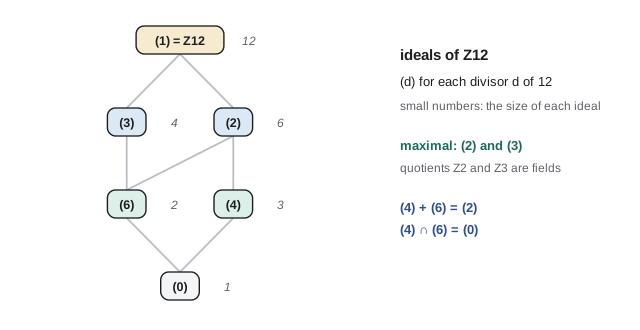
The figure shows the ideals of \(\mathbb{Z}_{12}\), one for each divisor \(d\) of 12. Larger ideals sit higher. Containment reverses divisibility: \((2) \supseteq (4)\) because 2 divides 4. Sums and intersections of ideals are again ideals, and in this lattice \((4) + (6) = (2)\), the gcd, while \((4) \cap (6) = (0)\) since \(\operatorname{lcm}(4, 6) = 12\).
Quotient rings
If \(I\) is an ideal of \(R\), then \(I\) is a normal subgroup of the abelian group \((R, +)\), so the additive cosets \(a + I\) form a group \(R/I\) with \((a + I) + (b + I) = (a + b) + I\). The absorption property is exactly what makes multiplication of cosets well defined.
Theorem. If \(I\) is an ideal of \(R\), the cosets form a ring \(R/I\) under \((a + I) + (b + I) = (a + b) + I\) and \((a + I)(b + I) = ab + I\).
Proof of well-definedness: suppose \(a + I = a' + I\) and \(b + I = b' + I\), so \(a' = a + i\) and \(b' = b + j\) with \(i, j \in I\). Then \(a'b' = ab + aj + ib + ij\). The terms \(aj\), \(ib\) and \(ij\) are all in \(I\) by absorption, so \(a'b' + I = ab + I\). The ring axioms in \(R/I\) follow immediately from those in \(R\).
Conversely, if \(I\) is only a subring and not an ideal, the multiplication rule fails. Take \(\mathbb{Z} \subset \mathbb{Q}\). The cosets \(0 + \mathbb{Z}\) and \(1 + \mathbb{Z}\) are equal, so multiplying each by \(\frac12 + \mathbb{Z}\) ought to give the same answer. It does not: \(\frac12 \cdot 0 = 0\) and \(\frac12 \cdot 1 = \frac12\) lie in different cosets. So ideals are precisely the subsets for which quotients make sense.
Examples. \(\mathbb{Z}/n\mathbb{Z}\) is \(\mathbb{Z}_n\), the ring of congruence classes; the quotient construction is the abstract form of modular arithmetic. \(\mathbb{R}[x]/(x^2 + 1)\): every polynomial is congruent to its remainder on division by \(x^2 + 1\), which has the form \(a + bx\), and in the quotient \(x^2 = -1\). So the quotient is a copy of \(\mathbb{C}\) with \(x\) playing the role of \(i\). \(\mathbb{Z}[x]/(x)\): setting \(x = 0\) leaves the constant term, and the quotient is \(\mathbb{Z}\). \(\mathbb{Z}[i]/(2 + i)\) has 5 elements and is the field \(\mathbb{Z}_5\), a fact explained in lesson 8.
Prime and maximal ideals
Two kinds of ideal mirror the two properties of lesson 3. Let \(R\) be commutative with unity.
Definition. A proper ideal \(P\) is prime if \(ab \in P\) implies \(a \in P\) or \(b \in P\). A proper ideal \(M\) is maximal if there is no ideal strictly between \(M\) and \(R\).
In \(\mathbb{Z}\), \(p\mathbb{Z}\) is prime exactly when \(p\) is prime (or \(p = 0\)), by Euclid's lemma. The name comes from this case. The prime ideals of \(\mathbb{Z}\) are \((0)\) and \((p)\); the maximal ideals are the \((p)\), since \(p\mathbb{Z} \subseteq n\mathbb{Z}\) means \(n \mid p\).
Theorem. Let \(R\) be a commutative ring with unity and \(I\) an ideal. Then (a) \(R/I\) is an integral domain if and only if \(I\) is prime; (b) \(R/I\) is a field if and only if \(I\) is maximal.
Proof of (a): \(R/I\) has a zero divisor exactly when there are \(a, b \notin I\) with \(ab \in I\), that is, \((a + I)(b + I) = I\) with neither factor equal to \(I\). Also \(1 + I \ne I\) exactly when \(I\) is proper. Proof of (b): suppose \(I\) is maximal and \(a \notin I\). The ideal \(I + (a) = \{i + ra\}\) strictly contains \(I\), so it is \(R\), and \(1 = i + ra\) for some \(i \in I\), \(r \in R\). Then \((r + I)(a + I) = 1 + I\), so \(a + I\) is a unit. Conversely, if \(R/I\) is a field and \(J \supsetneq I\) is an ideal, pick \(a \in J \setminus I\); \(a + I\) has an inverse \(b + I\), so \(1 - ab \in I \subseteq J\), and \(1 = (1 - ab) + ab \in J\), so \(J = R\).
Corollary. Every maximal ideal is prime, since every field is a domain. The converse fails: \((x)\) in \(\mathbb{Z}[x]\) is prime, because \(\mathbb{Z}[x]/(x) \cong \mathbb{Z}\) is a domain, but not maximal, because \(\mathbb{Z}\) is not a field; indeed \((x) \subsetneq (2, x) \subsetneq \mathbb{Z}[x]\).
This theorem is the engine of the second half of the course. To build a field containing a root of an irreducible polynomial \(p(x)\), we will show that \((p(x))\) is maximal in \(F[x]\) and take \(F[x]/(p(x))\).
Computing ideals and quotients
For \(\mathbb{Z}_n\) the ideals are the subgroups \((d)\) for \(d \mid n\), and \(\mathbb{Z}_n/(d) \cong \mathbb{Z}_d\). The program finds all ideals of \(\mathbb{Z}_{12}\) by brute force over subsets closed under subtraction and absorption, decides which are prime and maximal by testing the definitions directly, and prints the multiplication table of the quotient \(\mathbb{Z}_{12}/(4)\).
from itertools import combinations

n = 12
R = range(n)

def is_ideal(I):
    return 0 in I and all((a - b) % n in I for a in I for b in I) \
        and all((r * a) % n in I for a in I for r in R)

ideals = []
for size in range(1, n + 1):
    if n % size:
        continue
    for S in combinations(R, size):
        if is_ideal(set(S)):
            ideals.append(frozenset(S))

def prime(I):
    return len(I) < n and all(a in I or b in I
               for a in R for b in R if (a * b) % n in I)

def maximal(I):
    return len(I) < n and not any(I < J < frozenset(R) for J in ideals)

for I in ideals:
    gen = min(x for x in I if x) if len(I) > 1 else 0
    print(f"({gen}) = {sorted(I)}: prime={prime(I)} maximal={maximal(I)}")

I = frozenset({0, 4, 8})
cosets = sorted({frozenset((a + i) % n for i in I) for a in R}, key=min)
reps = [min(c) for c in cosets]
print("Z12/(4) has cosets with representatives", reps)
for a in reps:
print(" ", [min(c for c in reps if (a * b - c) % n in I) for b in reps])(0) = [0]: prime=False maximal=False (6) = [0, 6]: prime=False maximal=False (4) = [0, 4, 8]: prime=False maximal=False (3) = [0, 3, 6, 9]: prime=True maximal=True (2) = [0, 2, 4, 6, 8, 10]: prime=True maximal=True (1) = [0, 1, 2, 3, 4, 5, 6, 7, 8, 9, 10, 11]: prime=False maximal=False Z12/(4) has cosets with representatives [0, 1, 2, 3] [0, 0, 0, 0] [0, 1, 2, 3] [0, 2, 0, 2] [0, 3, 2, 1]
Only \((2)\) and \((3)\) are prime, and they are also maximal: the quotients are \(\mathbb{Z}_2\) and \(\mathbb{Z}_3\), fields. The quotient \(\mathbb{Z}_{12}/(4)\) has four cosets, \(0 + I, 1 + I, 2 + I, 3 + I\), and its multiplication table is the table of \(\mathbb{Z}_4\), as the general rule \(\mathbb{Z}_n/(d) \cong \mathbb{Z}_d\) predicts. The search took \(\binom{12}{k}\) subsets for each divisor size \(k\), fine for 12 elements but hopeless for large rings; the structure theory replaces it.
Where ideals came from
In 1847 Gabriel Lamé announced a proof of Fermat's last theorem that assumed unique factorization in rings of cyclotomic integers \(\mathbb{Z}[\zeta_p]\). Joseph Liouville pointed out the assumption at once, and Ernst Kummer had already found that it fails for \(p = 23\). Kummer's remedy was to introduce 'ideal numbers', invisible factors that restore unique factorization. Richard Dedekind recast these in 1871 as sets of ordinary numbers closed under addition and under multiplication by ring elements, our ideals, and proved that in every ring of algebraic integers each nonzero ideal factors uniquely into prime ideals. Emmy Noether's paper of 1921 on ideal theory in rings took the concept out of number theory and made it the foundation of commutative algebra.
Worked problem
Is the ideal prime or maximal?
Decide whether \((x^2 + 1)\) is prime or maximal in \(\mathbb{Z}_2[x]\) and in \(\mathbb{Z}_3[x]\).
Show solution
- In \(\mathbb{Z}_2[x]\), \(x^2 + 1 = (x + 1)^2\), because \((x + 1)^2 = x^2 + 2x + 1 = x^2 + 1\). So \((x + 1)(x + 1) \in (x^2 + 1)\), but \(x + 1\), having degree 1, is not a multiple of \(x^2 + 1\). The ideal is not prime, hence not maximal.
- In \(\mathbb{Z}_3[x]\), \(x^2 + 1\) has no root: \(0^2 + 1 = 1\), \(1^2 + 1 = 2\), \(2^2 + 1 = 5 \equiv 2\). A polynomial of degree 2 with no root has no linear factor, so it is irreducible.
- The quotient \(\mathbb{Z}_3[x]/(x^2 + 1)\) consists of the 9 classes \(a + bx\), with \(x^2 = -1\). It is a domain with 9 elements, hence a field; lesson 11 builds it as \(GF(9)\).
Answer: Not prime in \(\mathbb{Z}_2[x]\); maximal (and so prime) in \(\mathbb{Z}_3[x]\). The quotient is a field with 9 elements.
Common mistakes
MistakeCalling every subring an ideal.
Instead\(\mathbb{Z}\) is a subring of \(\mathbb{Q}\), but \(\frac12 \cdot 1 \notin \mathbb{Z}\).
MistakeThinking a proper ideal can contain 1 or a unit.
InsteadIf \(u \in I\) is a unit then \(I = R\).
MistakeAssuming prime ideals are always maximal.
Instead\((x)\) is prime but not maximal in \(\mathbb{Z}[x]\).
MistakeWriting the ideal \((4, 6)\) in \(\mathbb{Z}\) as \((24)\).
InsteadIt is \((\gcd(4, 6)) = (2)\); the intersection \((4) \cap (6)\) is \((12)\).
MistakeMultiplying cosets modulo a subset that is not an ideal.
InsteadThe product depends on the representatives unless \(I\) absorbs multiplication.
Summary and key terms
- An ideal is an additive subgroup that absorbs multiplication by all ring elements.
- Quotients \(R/I\) are rings exactly when \(I\) is an ideal; \(\mathbb{Z}/n\mathbb{Z} = \mathbb{Z}_n\).
- Every ideal of \(\mathbb{Z}\) is principal; \((a, b) = (\gcd(a, b))\).
- \(I\) is prime iff \(R/I\) is a domain, and maximal iff \(R/I\) is a field.
- Maximal ideals are prime; the converse fails in \(\mathbb{Z}[x]\).
- Ideals were introduced by Dedekind in 1871 to restore unique factorization, generalizing Kummer’s ideal numbers.
- ideal
- An additive subgroup \(I\) with \(rI \subseteq I\) and \(Ir \subseteq I\).
- principal ideal
- \((a) = aR\), generated by a single element.
- quotient ring
- \(R/I\), the cosets of an ideal with induced operations.
- prime ideal
- A proper ideal with \(ab \in P \Rightarrow a \in P\) or \(b \in P\).
- maximal ideal
- A proper ideal contained in no larger proper ideal.
- trivial ideals
- \(\{0\}\) and \(R\).
Practice problems
Work each problem on paper first, then reveal the answer to check.
Find all ideals of \(\mathbb{Z}_{18}\).
Show answer
\((d)\) for \(d \in \{1, 2, 3, 6, 9, 18\}\), six ideals.
Which ideals of \(\mathbb{Z}_{18}\) are maximal?
Show answer
\((2)\) and \((3)\), with quotients \(\mathbb{Z}_2\) and \(\mathbb{Z}_3\).
Express \((30, 42)\) in \(\mathbb{Z}\) as a principal ideal.
Show answer
\((6)\), since \(\gcd(30, 42) = 6\).
Is \(\{(a, 0)\}\) a prime ideal of \(\mathbb{Z} \times \mathbb{Z}\)?
Show answer
The quotient is \(\cong \mathbb{Z}\), a domain, so yes; it is not maximal.
What ring is \(\mathbb{Q}[x]/(x - 3)\)?
Show answer
\(\mathbb{Q}\), via \(f \mapsto f(3)\).
Show that a field has only the trivial ideals.
Show answer
A nonzero ideal contains a nonzero element, which is a unit, so the ideal is the field.
Is \((x^2 - 2)\) maximal in \(\mathbb{Q}[x]\)? In \(\mathbb{R}[x]\)?
Show answer
Yes in \(\mathbb{Q}[x]\), as \(x^2 - 2\) is irreducible over \(\mathbb{Q}\); no in \(\mathbb{R}[x]\), where it factors as \((x - \sqrt 2)(x + \sqrt 2)\).
Lesson quiz · 5 questions
Score 60% or more to complete this lesson.
Create a free account to save your progress, take quizzes and earn a certificate.