
MATH-323 · Lesson 5 of 12 · 23 min
Ring homomorphisms and the isomorphism theorems
A homomorphism is a map that respects structure. For groups it respects one operation; for rings it must respect two. Homomorphisms let us say precisely when two rings are 'the same', as the matrix ring of lesson 2 is the same as \(\mathbb{C}\); they explain where ideals come from, since every ideal is the kernel of some homomorphism; and the first isomorphism theorem turns the identification of quotient rings, which looks like a calculation, into the search for a suitable map. The lesson ends with the Chinese remainder theorem, which splits \(\mathbb{Z}_n\) into simpler pieces and is one of the oldest results in algebra.
Definition and examples
Definition. A ring homomorphism is a map \(\phi : R \to S\) with \(\phi(a + b) = \phi(a) + \phi(b)\) and \(\phi(ab) = \phi(a)\phi(b)\) for all \(a, b \in R\). A bijective homomorphism is an isomorphism, and we write \(R \cong S\).
When \(R\) and \(S\) both have unities we usually also ask that \(\phi(1) = 1\), and we will assume this for maps between rings with unity unless we say otherwise. Since \(\phi\) is in particular a group homomorphism of the additive groups, \(\phi(0) = 0\) and \(\phi(-a) = -\phi(a)\) automatically.
- Reduction modulo \(n\), \(\mathbb{Z} \to \mathbb{Z}_n\), \(a \mapsto a \bmod n\), is a homomorphism: this is the statement that congruences can be added and multiplied.
- For any \(c \in \mathbb{R}\), evaluation \(\operatorname{ev}_c : \mathbb{R}[x] \to \mathbb{R}\), \(f \mapsto f(c)\), is a homomorphism, because \((f + g)(c) = f(c) + g(c)\) and \((fg)(c) = f(c)g(c)\). Evaluation homomorphisms drive the theory of field extensions.
- Complex conjugation \(\mathbb{C} \to \mathbb{C}\), \(z \mapsto \bar z\), is an isomorphism of \(\mathbb{C}\) with itself, an automorphism. Galois theory is the study of such automorphisms.
- \(\mathbb{Q}(\sqrt 2) \to \mathbb{Q}(\sqrt 2)\), \(a + b\sqrt 2 \mapsto a - b\sqrt 2\), is an automorphism: it preserves sums clearly, and products because \((a + b\sqrt 2)(c + d\sqrt 2) = (ac + 2bd) + (ad + bc)\sqrt 2\) and the same formula with \(\sqrt 2\) replaced by \(-\sqrt 2\) holds for the images.
- The projection \(\mathbb{Z} \times \mathbb{Z} \to \mathbb{Z}\), \((a, b) \mapsto a\), is a homomorphism.
- The map \(\mathbb{Z} \to 2\mathbb{Z}\), \(a \mapsto 2a\), is a group isomorphism but not a ring homomorphism: \(\phi(1 \cdot 1) = 2\), while \(\phi(1)\phi(1) = 4\). Respecting multiplication is a real constraint.
For every ring \(R\) with unity there is exactly one homomorphism \(\mathbb{Z} \to R\) with \(1 \mapsto 1\), namely \(n \mapsto n \cdot 1\). Its kernel is \(m\mathbb{Z}\), where \(m\) is the characteristic of \(R\). So a ring of characteristic \(m > 0\) contains a copy of \(\mathbb{Z}_m\), and a field of characteristic \(p\) contains \(\mathbb{Z}_p\), while a field of characteristic 0 contains \(\mathbb{Z}\) and hence its field of fractions \(\mathbb{Q}\). These smallest subfields, \(\mathbb{Q}\) and \(\mathbb{Z}_p\), are the prime fields.
Kernels are ideals
The kernel of \(\phi : R \to S\) is \(\ker \phi = \{a \in R : \phi(a) = 0\}\).
Theorem. The kernel of a ring homomorphism is an ideal, and the image is a subring. Conversely, every ideal \(I\) is the kernel of the natural map \(\pi : R \to R/I\), \(a \mapsto a + I\).
Proof: the kernel is an additive subgroup because \(\phi\) is a group homomorphism. If \(a \in \ker\phi\) and \(r \in R\), then \(\phi(ra) = \phi(r)\phi(a) = \phi(r) \cdot 0 = 0\), and similarly \(\phi(ar) = 0\). For the image, \(\phi(a) - \phi(b) = \phi(a - b)\) and \(\phi(a)\phi(b) = \phi(ab)\). For the converse, \(\pi\) is a homomorphism by the definition of the operations in \(R/I\), and \(\pi(a) = I\), the zero of \(R/I\), exactly when \(a \in I\).
So ideals and kernels are the same thing, just as normal subgroups and kernels are in group theory. As there, \(\phi\) is injective exactly when \(\ker \phi = \{0\}\). One consequence is worth recording now: a homomorphism out of a field is either injective or zero, because a field has only the trivial ideals. Hence every nonzero homomorphism between fields is an embedding, which is why field theory speaks of extensions and embeddings rather than quotients.
The first isomorphism theorem
Theorem (first isomorphism theorem). If \(\phi : R \to S\) is a ring homomorphism, then \(R/\ker\phi \cong \phi(R)\), via \(a + \ker\phi \mapsto \phi(a)\).
Proof: the group version from MATH-322 gives a well-defined additive isomorphism \(\bar\phi(a + K) = \phi(a)\), where \(K = \ker\phi\). It respects multiplication: \(\bar\phi((a + K)(b + K)) = \bar\phi(ab + K) = \phi(ab) = \phi(a)\phi(b)\).
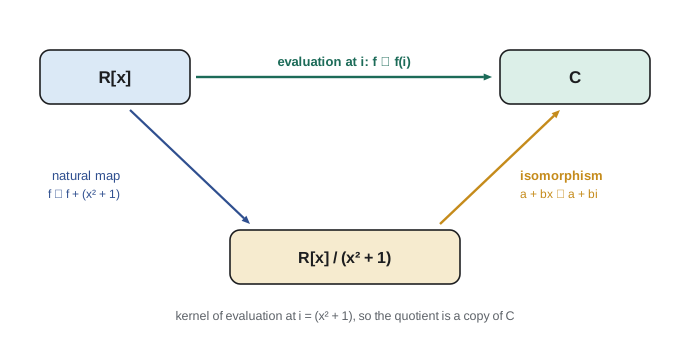
The theorem converts a question about quotients into a search for a homomorphism. To identify \(R/I\), find a surjective map out of \(R\) whose kernel is \(I\).
- \(\mathbb{R}[x]/(x^2 + 1) \cong \mathbb{C}\). Evaluation at \(i\), \(f \mapsto f(i)\), maps \(\mathbb{R}[x]\) onto \(\mathbb{C}\), since \(a + bx \mapsto a + bi\). Its kernel contains \(x^2 + 1\). Conversely, if \(f(i) = 0\), divide: \(f = q(x)(x^2 + 1) + (a + bx)\), so \(0 = f(i) = a + bi\), giving \(a = b = 0\). The kernel is \((x^2 + 1)\), as the figure shows.
- \(\mathbb{Z}[x]/(x) \cong \mathbb{Z}\) via \(f \mapsto f(0)\), and \(\mathbb{Z}[x]/(2, x) \cong \mathbb{Z}_2\) via \(f \mapsto f(0) \bmod 2\). The second quotient is a field, so \((2, x)\) is maximal, as claimed in lesson 4.
- \(\mathbb{Q}[x]/(x^2 - 2) \cong \mathbb{Q}(\sqrt 2)\) via evaluation at \(\sqrt 2\). The kernel is generated by \(x^2 - 2\) because nothing of degree 1 over \(\mathbb{Q}\) vanishes at \(\sqrt 2\).
- The matrix ring \(S\) of lesson 2 is isomorphic to \(\mathbb{C}\) via \(\begin{pmatrix} a & b \\ -b & a \end{pmatrix} \mapsto a + bi\); the kernel is zero and the map is onto.
The second and third isomorphism theorems also carry over from groups. If \(S\) is a subring and \(I\) an ideal, then \((S + I)/I \cong S/(S \cap I)\). If \(I \subseteq J\) are ideals, then \((R/I)/(J/I) \cong R/J\), and the ideals of \(R/I\) correspond to the ideals of \(R\) containing \(I\). For example, the ideals of \(\mathbb{Z}_{12} = \mathbb{Z}/12\mathbb{Z}\) correspond to ideals \(d\mathbb{Z} \supseteq 12\mathbb{Z}\), that is to divisors of 12, which is the lattice drawn in lesson 4.
Automorphisms that fix a field
Homomorphisms between fields are rigid, and that rigidity is the starting point of Galois theory. Let \(\sigma\) be any automorphism of a field \(K\) containing \(\mathbb{Q}\). Then \(\sigma(1) = 1\), so \(\sigma(n) = n\) for every integer \(n\) by additivity, and \(\sigma(m/n) = \sigma(m)\sigma(n)^{-1} = m/n\). Every automorphism fixes \(\mathbb{Q}\) pointwise. In the same way every automorphism of a field of characteristic \(p\) fixes \(\mathbb{Z}_p\).
Now suppose \(\alpha \in K\) is a root of a polynomial \(f\) with rational coefficients. Applying \(\sigma\) to \(f(\alpha) = 0\), and using that \(\sigma\) fixes the coefficients, gives \(f(\sigma(\alpha)) = 0\). So an automorphism can only move a root of \(f\) to another root of \(f\). This is why \(\mathbb{Q}(\sqrt 2)\) has exactly two automorphisms, the identity and \(\sqrt 2 \mapsto -\sqrt 2\): an automorphism is determined by the image of \(\sqrt 2\), and that image must be a root of \(x^2 - 2\). The same argument shows that the only automorphism of \(\mathbb{Q}(\sqrt[3]{2})\), a subfield of \(\mathbb{R}\), is the identity, because the other two roots of \(x^3 - 2\) are not real and so do not lie in the field.
These two examples already contain the central idea of lesson 12. The automorphisms of a field that fix a smaller field form a group, and the size and structure of that group measure how symmetric the larger field is over the smaller. \(\mathbb{Q}(\sqrt 2)\) is as symmetric as its degree allows; \(\mathbb{Q}(\sqrt[3]{2})\) is not, and adjoining the missing complex roots repairs it.
The Chinese remainder theorem
The oldest form of this theorem appears in the Sunzi Suanjing, a Chinese text of roughly the third to fifth century, which asks for a number leaving remainders 2, 3 and 2 on division by 3, 5 and 7. The answer 23 is unique modulo 105. Qin Jiushao gave a general method in 1247, and Gauss stated the modern form in the Disquisitiones Arithmeticae of 1801.
Theorem (Chinese remainder theorem). If \(\gcd(m, n) = 1\), then \(\mathbb{Z}_{mn} \cong \mathbb{Z}_m \times \mathbb{Z}_n\) as rings, via \(a \mapsto (a \bmod m, a \bmod n)\).
Proof: the map \(\phi : \mathbb{Z} \to \mathbb{Z}_m \times \mathbb{Z}_n\), \(a \mapsto (a \bmod m, a \bmod n)\), is a homomorphism, being reduction in each coordinate. Its kernel is the set of \(a\) divisible by both \(m\) and \(n\), which is \(\operatorname{lcm}(m, n)\mathbb{Z} = mn\mathbb{Z}\) since \(m\) and \(n\) are coprime. So \(\mathbb{Z}/mn\mathbb{Z}\) embeds in \(\mathbb{Z}_m \times \mathbb{Z}_n\); both have \(mn\) elements, so the embedding is onto.
The proof shows existence without computing. To compute, use Bézout: \(1 = mu + nv\). Then \(e_1 = nv\) is \(\equiv 1 \pmod m\) and \(\equiv 0 \pmod n\), while \(e_2 = mu\) is \(\equiv 0 \pmod m\) and \(\equiv 1 \pmod n\). The solution of \(x \equiv a \pmod m\), \(x \equiv b \pmod n\) is \(x = ae_1 + be_2\). The elements \(e_1, e_2\) are idempotents, \(e^2 = e\), and they explain the subrings with their own unity found in lesson 2: \(\mathbb{Z}_{12} \cong \mathbb{Z}_4 \times \mathbb{Z}_3\), with \(e_1 = 9\) and \(e_2 = 4\), the unities of \(\{0, 3, 6, 9\}\) and \(\{0, 4, 8\}\).
A consequence for units: \(U(\mathbb{Z}_{mn}) \cong U(\mathbb{Z}_m) \times U(\mathbb{Z}_n)\), since an element of a product ring is a unit exactly when each coordinate is. Counting gives \(\varphi(mn) = \varphi(m)\varphi(n)\) for coprime \(m, n\), the multiplicativity of Euler's function.
from math import gcd

def egcd(a, b):
    if b == 0:
        return a, 1, 0
    g, x, y = egcd(b, a % b)
    return g, y, x - (a // b) * y

def crt(residues, moduli):
    x, M = 0, 1
    for a, m in zip(residues, moduli):
        g, u, v = egcd(M, m)
        assert g == 1
        x = (x * m * v + a * M * u) % (M * m)
        M *= m
    return x

print("Sunzi:", crt([2, 3, 2], [3, 5, 7]), "mod", 3 * 5 * 7)

m, n = 4, 3
phi = {a: (a % m, a % n) for a in range(m * n)}
hom = all(phi[(a + b) % 12] == ((phi[a][0] + phi[b][0]) % m, (phi[a][1] + phi[b][1]) % n)
          and phi[(a * b) % 12] == ((phi[a][0] * phi[b][0]) % m, (phi[a][1] * phi[b][1]) % n)
          for a in range(12) for b in range(12))
print("Z12 -> Z4 x Z3 is a bijective homomorphism:", hom and len(set(phi.values())) == 12)
idem = [a for a in range(12) if a * a % 12 == a]
print("idempotents of Z12:", idem, "->", [phi[e] for e in idem])
units = [a for a in range(12) if gcd(a, 12) == 1]
print("units of Z12:", units, "->", [phi[u] for u in units])Sunzi: 23 mod 105 Z12 -> Z4 x Z3 is a bijective homomorphism: True idempotents of Z12: [0, 1, 4, 9] -> [(0, 0), (1, 1), (0, 1), (1, 0)] units of Z12: [1, 5, 7, 11] -> [(1, 1), (1, 2), (3, 1), (3, 2)]
The four idempotents of \(\mathbb{Z}_{12}\) are 0, 1, 4 and 9, and they correspond to \((0, 0)\), \((1, 1)\), \((0, 1)\) and \((1, 0)\) in \(\mathbb{Z}_4 \times \mathbb{Z}_3\): an idempotent in a product picks out a subset of the factors. The units correspond to pairs of units.
Worked problem
Solving a system of congruences
Find \(x\) with \(x \equiv 3 \pmod 8\) and \(x \equiv 5 \pmod{11}\).
Show solution
- Bézout for 8 and 11: \(11 = 8 + 3\), \(8 = 2 \cdot 3 + 2\), \(3 = 2 + 1\). Back-substituting, \(1 = 3 - 2 = 3 - (8 - 2 \cdot 3) = 3 \cdot 3 - 8 = 3(11 - 8) - 8 = 3 \cdot 11 - 4 \cdot 8\).
- So \(e_1 = 3 \cdot 11 = 33\) satisfies \(33 \equiv 1 \pmod 8\) and \(\equiv 0 \pmod{11}\), and \(e_2 = -4 \cdot 8 = -32\) satisfies \(\equiv 0 \pmod 8\) and \(\equiv 1 \pmod{11}\).
- Then \(x = 3 \cdot 33 + 5 \cdot (-32) = 99 - 160 = -61 \equiv 27 \pmod{88}\).
- Check: \(27 = 3 \cdot 8 + 3\) and \(27 = 2 \cdot 11 + 5\).
Answer: \(x \equiv 27 \pmod{88}\).
Common mistakes
MistakeCalling \(a \mapsto 2a\) a ring homomorphism of \(\mathbb{Z}\).
InsteadIt doubles products: \(\phi(1 \cdot 1) = 2 \ne 4 = \phi(1)^2\).
MistakeApplying the Chinese remainder theorem to \(\mathbb{Z}_4\) as \(\mathbb{Z}_2 \times \mathbb{Z}_2\).
Instead2 and 2 are not coprime; \(\mathbb{Z}_4\) has an element of additive order 4, and \(\mathbb{Z}_2 \times \mathbb{Z}_2\) does not.
MistakeThinking the image of a homomorphism is an ideal.
InsteadThe image is a subring. \(\mathbb{Z} \to \mathbb{Q}\) has image \(\mathbb{Z}\), not an ideal of \(\mathbb{Q}\).
MistakeForgetting to check that the kernel is exactly \(I\), not just that it contains \(I\).
InsteadShow both inclusions, usually with the division algorithm.
MistakeExpecting surjective homomorphisms between fields to have nontrivial kernels.
InsteadEvery nonzero homomorphism out of a field is injective.
Summary and key terms
- A ring homomorphism respects addition and multiplication; an isomorphism is a bijective one.
- Kernels are ideals, images are subrings, and every ideal is a kernel.
- First isomorphism theorem: \(R/\ker\phi \cong \phi(R)\).
- Examples: \(\mathbb{R}[x]/(x^2 + 1) \cong \mathbb{C}\), \(\mathbb{Q}[x]/(x^2 - 2) \cong \mathbb{Q}(\sqrt 2)\).
- Every field contains a prime field, \(\mathbb{Q}\) or \(\mathbb{Z}_p\).
- Chinese remainder theorem: \(\mathbb{Z}_{mn} \cong \mathbb{Z}_m \times \mathbb{Z}_n\) when \(\gcd(m, n) = 1\).
- ring homomorphism
- A map preserving sums and products.
- kernel
- \(\{a : \phi(a) = 0\}\), always an ideal.
- automorphism
- An isomorphism of a ring with itself.
- evaluation homomorphism
- \(f \mapsto f(c)\) on a polynomial ring.
- prime field
- The smallest subfield, \(\mathbb{Q}\) or \(\mathbb{Z}_p\).
- idempotent
- An element with \(e^2 = e\).
- Chinese remainder theorem
- \(\mathbb{Z}_{mn} \cong \mathbb{Z}_m \times \mathbb{Z}_n\) for coprime \(m, n\).
Practice problems
Work each problem on paper first, then reveal the answer to check.
Find the kernel of \(\mathbb{Z} \to \mathbb{Z}_6 \times \mathbb{Z}_{10}\), \(a \mapsto (a \bmod 6, a \bmod 10)\).
Show answer
\(30\mathbb{Z}\), since \(\operatorname{lcm}(6, 10) = 30\).
Is \(\mathbb{Z}_{30}\) isomorphic to \(\mathbb{Z}_2 \times \mathbb{Z}_3 \times \mathbb{Z}_5\)?
Show answer
Yes, by applying the theorem twice.
Solve \(x \equiv 1 \pmod 4\), \(x \equiv 2 \pmod 5\), \(x \equiv 3 \pmod 7\).
Show answer
\(x \equiv 17 \pmod{140}\).
Show that \(\mathbb{Q}(\sqrt 2)\) and \(\mathbb{Q}(\sqrt 3)\) are not isomorphic.
Show answer
An isomorphism fixes \(\mathbb{Q}\), so it would send \(\sqrt 3\) to some \(a\) with \(a^2 = 3\) in \(\mathbb{Q}(\sqrt 2)\); expanding \((p + q\sqrt 2)^2 = 3\) has no rational solution.
Identify \(\mathbb{Z}[i]/(1 + i)\).
Show answer
It has 2 elements and is \(\mathbb{Z}_2\), since \(2 = (1 + i)(1 - i)\) lies in the ideal and \(i \equiv 1\).
Find the idempotents of \(\mathbb{Z}_{10}\).
Show answer
0, 1, 5, 6.
Compute \(\varphi(77)\) using the Chinese remainder theorem.
Show answer
\(\varphi(7)\varphi(11) = 6 \cdot 10 = 60\).
Lesson quiz · 5 questions
Score 60% or more to complete this lesson.
Create a free account to save your progress, take quizzes and earn a certificate.