
LVT-310 · Lesson 6 of 12 · 21 min
Mass notification and life-safety interfaces
Two systems in Riverside school can speak to the whole building. One is the paging system Cobalt Line is installing, with its microphones, bells, music and lockdown message. The other is the fire alarm system, installed by a separate fire alarm contractor, which in this school includes voice messages and strobes. Both use loudspeakers in the ceilings, and both can say "leave the building" or "stay in your room". If they ever speak at the same time, nobody will understand either. Wendell's first rule for the AV crew is that the life-safety system always wins, and his second is that the AV installer never touches the life-safety side of the interface. This lesson explains the difference between AV paging and life-safety voice systems, what mass notification means, the interface that silences AV systems during an alarm, lockdown and emergency announcements on the paging system, intelligibility testing, backup power, and the installer's responsibilities and limits.
Two kinds of system that can speak
A fire alarm voice communication system, often called voice evacuation, is a life-safety system. Its control equipment, amplifiers, loudspeakers and wiring are listed for that use, it is installed and verified under the fire alarm standards, its circuits are supervised so that a broken wire raises a trouble signal, and it has its own backup batteries sized for a long standby and an alarm period. In Canada, fire alarm installation follows CAN/ULC-S524 and verification follows CAN/ULC-S537, as the building and fire codes require. In the United States, NFPA 72, the National Fire Alarm and Signaling Code, governs, with the local fire marshal as the authority having jurisdiction. Only qualified fire alarm technicians work on these systems, under the licensing or certification rules of the province or state.
A commercial AV paging system is not a life-safety system unless it is specifically listed, designed and approved as one. It is installed to the electrical code and the design, but its equipment is not listed for fire alarm use, its speaker lines are not supervised the same way, and it may run from ordinary power with a UPS. It can still carry emergency announcements that are not part of the fire alarm, such as a lockdown or a shelter-in-place message, if the owner's emergency plan uses it that way. What it must never do is compete with the fire alarm's voice messages.
| Fire alarm voice system | AV paging system | |
|---|---|---|
| Purpose | Fire evacuation and other code-required emergency messages | Pages, bells, music, owner's emergency messages |
| Equipment | Listed for fire alarm use | Commercial AV equipment |
| Standards | CAN/ULC-S524 and S537, building and fire codes | Electrical code, AV design, owner's plan |
| Supervision | Wiring and amplifiers supervised for faults | Usually not supervised |
| Who works on it | Qualified fire alarm technicians | AV installers and programmers |
| During a fire alarm | Speaks | Silent |
Mass notification
Mass notification is the broader idea of getting emergency information to everyone who needs it, by every means available: building speakers, displays, text messages, emails, desktop alerts, outdoor speakers and phone calls. In-building mass notification systems can be designed as part of the fire alarm, following NFPA 72's chapter on emergency communications systems in the United States, and in Canada using equipment listed to CAN/ULC-S576, the standard for mass notification system equipment. Those systems can give different messages for different emergencies, such as a weather warning, a hazardous material release or an active threat, with a priority scheme that the authorities approve.
Many schools and offices instead use a combination: the fire alarm for fire, and the paging system, phones, displays and an alerting app for other emergencies. Riverside's board standard does this. The lockdown message plays on the paging system, the classroom displays switch to a lockdown screen through the control system, the access control system locks the exterior doors, and the board's alerting service sends a text to staff. The AV installer's part is to make the paging, display and control pieces work exactly as the emergency plan describes, and to test them with the school.
The fire alarm interface
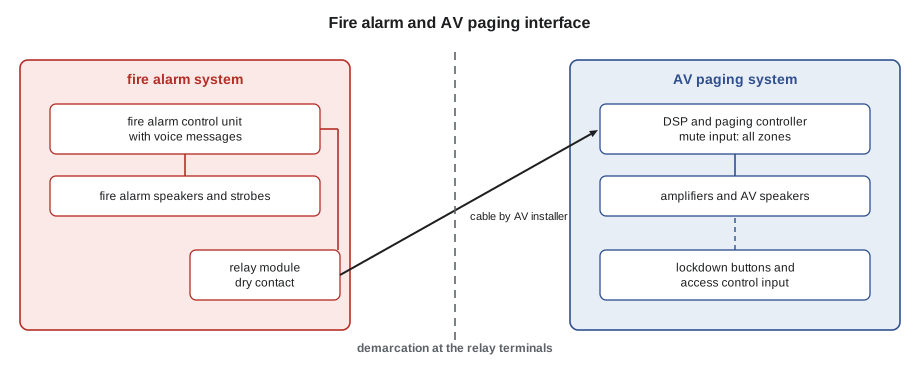
The connection that matters most is the one that silences the AV system when the fire alarm activates. The fire alarm contractor provides a relay, either in the fire alarm control unit or in an addressable relay module near the AV rack, that changes state when the alarm activates. That relay's contacts, with no voltage of their own, a dry contact, are wired to a control input on the AV system: a logic input on the DSP, an input on the paging controller, or a mute input on each amplifier. When the contact changes state, the AV system mutes every zone, including background music and any page in progress, and stays muted until the fire alarm resets.
The design and the fire alarm contractor agree on how the contact works. A normally closed contact that opens on alarm is often preferred, because a broken wire then also mutes the AV system, which fails in the safe direction. The AV programmer sets the input's logic to match, and the AV system ignores every source, including its own emergency messages, while the input is active. Some designs also mute any wireless microphone systems and local amplifiers, such as a portable PA in a gym or a DJ system in a cafeteria, through relay-controlled power or a mute input.
The demarcation point, where one contractor's responsibility ends and the other's begins, is usually the relay's output terminals. The fire alarm contractor installs, programs and tests the relay and its supervision; the AV installer runs a cable from those terminals to the AV input, lands it on the AV side and programs the AV response. Neither touches the other's equipment. The connection is shown on both systems' drawings, labelled at both ends, and tested together at commissioning with the fire alarm contractor, the AV installer and often the authority's inspector present.
# Fire alarm mute input: check the AV system's response in every state
NORMALLY_CLOSED = True        # contact closed in normal condition, opens on alarm
def av_muted(contact_closed, nc=NORMALLY_CLOSED):
    return (not contact_closed) if nc else contact_closed
cases = [("normal, contact closed", True), ("alarm, contact open", False), ("cut cable, reads open", False)]
for name, closed in cases:
    print(f"{name:26s} -> AV {'MUTED' if av_muted(closed) else 'normal'}")
print("Wired normally open by mistake:")
for name, closed in cases:
print(f" {name:24s} -> AV {'MUTED' if av_muted(closed, nc=False) else 'normal'}")normal, contact closed -> AV normal alarm, contact open -> AV MUTED cut cable, reads open -> AV MUTED Wired normally open by mistake: normal, contact closed -> AV MUTED alarm, contact open -> AV normal cut cable, reads open -> AV normal
The code shows why the normally closed arrangement is chosen: a cut cable mutes the AV system, which someone will notice and fix, whereas with a normally open contact a cut cable silently disables the mute, and the AV system would talk over the fire alarm in a real event.
Lockdown and emergency announcements on the paging system
Where the owner's emergency plan uses the paging system for non-fire emergencies, the design gives those messages the top priority within the AV system, below only the fire alarm mute. At Riverside, a lockdown starts from a button in the main office, a button at the principal's desk, or a command from the access control system. The paging system then plays a pre-recorded message to every zone, overriding classroom volume controls and mutes, repeating at a set interval until the office cancels it; the office can also speak live over it. The message wording, the trigger points and the repetition come from the board's plan, not from Cobalt Line.
The installer's part is reliability: buttons wired to supervised inputs where the DSP supports it, so a broken wire shows as a fault, message files loaded and checked, every zone confirmed to receive the message at full level with local controls turned down, and the system's response to a fire alarm during a lockdown confirmed, because the fire alarm must still silence the paging. The control system's lockdown screen on the classroom displays and the access control lockdown are tested in the same drill with the school and the security contractor.
Intelligibility and how it is measured
A message that is loud but cannot be understood fails its purpose. Speech intelligibility depends on the speech level above the noise, which lesson 2 covered, on reverberation, which smears syllables together in hard rooms, and on the frequency response of the system. It is measured with the Speech Transmission Index, STI, defined in IEC 60268-16: a number from 0 to 1, where higher is better. STIPA, a shortened version that uses a special test signal played through the system and measured with a handheld meter, makes it practical to test many points in a building.
Fire alarm voice systems in the United States are commonly tested against criteria in NFPA 72's annex: within each acoustically distinguishable space, an average STI of at least 0.50, with at least 90 per cent of measurement points at 0.45 or higher. Canadian designs and owners often adopt similar targets. AV paging systems are not bound by those rules, but Cobalt Line's designs use the same measures for their emergency zones, because a lockdown message deserves the same care. Lesson 12 measures the gym, where reverberation makes this hard.
# STIPA results for one space: average and share of points at or above the point target
AVG_TARGET, POINT_TARGET, SHARE = 0.50, 0.45, 0.90
spaces = {
    "Riverside library": [0.62, 0.58, 0.60, 0.55, 0.64, 0.57, 0.61, 0.59],
    "Riverside corridor 2": [0.56, 0.52, 0.49, 0.54, 0.47, 0.51, 0.55, 0.53],
    "Riverside gym (before tuning)": [0.41, 0.44, 0.39, 0.46, 0.43, 0.38, 0.42, 0.45, 0.40, 0.44],
}
for name, pts in spaces.items():
    avg = sum(pts) / len(pts)
    share = sum(p >= POINT_TARGET for p in pts) / len(pts)
    ok = avg >= AVG_TARGET and share >= SHARE
print(f"{name:30s} avg {avg:.2f}, {share:4.0%} of points >= {POINT_TARGET} -> {'meets' if ok else 'does not meet'} target")Riverside library avg 0.59, 100% of points >= 0.45 -> meets target Riverside corridor 2 avg 0.52, 100% of points >= 0.45 -> meets target Riverside gym (before tuning) avg 0.42, 20% of points >= 0.45 -> does not meet target
Backup power
A paging system that carries emergency messages must work during a power failure. Fire alarm systems have batteries sized by the fire alarm standards. AV paging used for emergency announcements is usually fed from an emergency power circuit, a UPS, or both, sized from the design's runtime: a period of standby with the system idle, then a period of announcements at a stated level. Class D amplifiers draw little at idle, but at full power the paging amplifiers can be the largest load in the rack, and the UPS must also carry the DSP, network switch and control processor. Lesson 11 covers rack power and heat; here the point is that the backup must be tested by switching off the normal supply and making a page.
# UPS runtime check for an emergency paging rack: idle standby then announcements
loads_idle = {"DSP": 45, "network switch": 60, "control processor": 15, "4-channel amplifier (idle)": 40}
amp_talk = 420        # watts drawn by the amplifier during announcements at the design level
battery_wh = 1100        # usable watt-hours of the UPS battery
inverter_eff = 0.88
standby_h, talk_min = 4, 30
idle = sum(loads_idle.values())
need = (idle * standby_h + (idle - loads_idle["4-channel amplifier (idle)"] + amp_talk) * talk_min / 60) / inverter_eff
print(f"Idle load {idle} W; talk load {idle - loads_idle['4-channel amplifier (idle)'] + amp_talk} W")
print(f"Energy for {standby_h} h standby + {talk_min} min announcements: {need:.0f} Wh")
print(f"UPS usable {battery_wh} Wh -> {'enough' if battery_wh >= need else 'NOT enough'}; margin {battery_wh - need:+.0f} Wh")Idle load 160 W; talk load 540 W Energy for 4 h standby + 30 min announcements: 1034 Wh UPS usable 1100 Wh -> enough; margin +66 Wh
Visual and other channels
Not everyone hears an announcement. People who are deaf or hard of hearing, people wearing hearing protection in a warehouse, and people in very loud areas need visual messages too. The fire alarm provides strobes for fire. For other emergencies, the AV and control systems can display messages on classroom and lobby screens, digital signs and desktop computers, and turn on beacons in loud areas such as Hartwell's baler. These visual channels are part of the emergency plan and are tested with the audio. The installer checks that every display listed in the plan switches to the emergency content, and that it switches back afterwards.
Worked problem
Music over the alarm
During the fire alarm verification at Juniper Point, the fire alarm technician activates the alarm and the voice message plays, but background music keeps playing in the amenity room over it. The lobby and corridors are silent as intended. The AV system's mute input reads as active in the DSP. What should Maya check?
Show solution
- The DSP sees the mute input, so the fire alarm side and the cable are working.
- The DSP mutes the zones programmed to respond; the amenity room may be on a separate local amplifier or a zone left out of the mute logic.
- She finds the amenity room music comes from a small local amplifier with its own streaming player, added by the condo board after the design, not connected to the DSP at all.
- The fix is to bring that amplifier under the mute: either feed it from the DSP so it follows the zone mute, or give it a mute input from a second relay contact provided by the fire alarm contractor.
Answer: The board agrees to replace the local player with a feed from the DSP, Maya adds the amenity room to the muted zones, and the retest with the fire alarm technician shows every AV source silent during the voice message.
Common mistakes
MistakeWorking on the fire alarm side of an interface.
InsteadStop at the demarcation point; the fire alarm contractor owns the relay and its programming.
MistakeWiring the mute with a normally open contact without thinking about failures.
InsteadUse the arrangement the design specifies, usually normally closed so a cut cable mutes the AV.
MistakeForgetting local amplifiers and portable systems.
InsteadBring every sound source in the building under the fire alarm mute.
MistakeTreating a loud message as an intelligible one.
InsteadMeasure intelligibility with STI or STIPA where emergency messages matter.
MistakeAssuming the UPS will carry the paging.
InsteadSize it for standby plus announcements and test it with the power off.
Summary and key terms
- Fire alarm voice systems are listed life-safety systems with their own standards, supervision and technicians.
- AV paging can carry the owner's non-fire emergency messages but must never compete with the fire alarm.
- Mass notification uses every channel, including listed systems, paging, displays and messages.
- A fire alarm relay contact mutes every AV source; the demarcation point is the relay's terminals.
- Lockdown messages take top AV priority below the fire alarm mute, override local controls and are tested with the owner.
- Intelligibility is measured with STI or STIPA; NFPA 72's annex uses an average of 0.50 and 90 per cent of points at 0.45.
- Emergency paging needs backup power sized for standby and announcements, and visual channels for those who cannot hear.
- Voice evacuation
- A fire alarm system that gives spoken evacuation messages through its own speakers.
- Mass notification
- Delivering emergency information to people by every available means.
- Dry contact
- Relay contacts that switch a circuit but provide no voltage of their own.
- Demarcation point
- The point where one contractor’s responsibility ends and another’s begins.
- STI
- Speech Transmission Index, a measure of speech intelligibility from 0 to 1.
- STIPA
- A shortened STI method using a test signal and a handheld meter.
- Acoustically distinguishable space
- A space treated separately for intelligibility because of its acoustics or use.
Practice problems
Work each problem on paper first, then reveal the answer to check.
Who installs and programs the relay that mutes AV paging during a fire alarm?
Show answer
The fire alarm contractor.
Why is a normally closed mute contact often preferred?
Show answer
A cut cable then mutes the AV system, failing safe.
What average STI does NFPA 72's annex use for voice systems?
Show answer
At least 0.50, with 90 per cent of points at 0.45 or more.
Name two visual channels for emergency messages.
Show answer
Classroom or lobby displays and beacons; also desktop alerts and digital signs.
Lesson quiz · 5 questions
Score 60% or more to complete this lesson.
Create a free account to save your progress, take quizzes and earn a certificate.