
LVT-310 · Lesson 12 of 12 · 23 min
Capstone: fitting out a school gym and classrooms
The last six weeks before Riverside opens bring every part of this course into one job. Cobalt Line's AV scope covers 64 classrooms, each with a 75-inch display, a teacher microphone with classroom voice reinforcement, paging speakers and a wall control panel; paging and bells across the whole school; and the gym, with its sound system for assemblies, games and physical education classes, a projector and screen, and assistive listening. Wendell leads, Maya runs the classroom crew with Teo, Sanjay is the designer of record, and the school's facilities manager, Paul Gagnon, is the owner's representative. This capstone follows the classrooms and the gym from installation through tuning, the life-safety tests, training and handover, using the methods of lessons 1 to 11.
The scope and the plan
Maya starts with the documents. The board's classroom standard sets every classroom the same: display bottom edge at 1.2 m (48 in), two ceiling speakers for voice reinforcement and paging, a teacher's wireless pendant microphone and a pass-around handheld, a DSP channel per room in the floor's rack, a wall panel by the door, and an HDMI and USB-C plate at the teacher's desk feeding an HDBaseT link to the display. The gym design adds a pair of column loudspeakers at the front wall, two delay loudspeakers over the rear bleachers, a wall-mounted rack with a DSP and amplifiers, a 12,000 lumen laser projector and motorised screen, wireless microphones, ambient noise compensation for pages during games, and an assistive listening system. The lockdown and fire alarm interfaces from lesson 6 apply everywhere.
She turns the documents into a plan: classroom device installation by floor, as the painters finish; gym installation after the floor is sealed; rack delivery from the shop already tested; control programming loaded room by room; then tuning, life-safety tests with the fire alarm contractor and the school, training, and handover. The plan's critical path runs through the gym, because the floor finish, the bleachers and the acoustic panels all have to be in before the loudspeakers can be hung and tuned.
Classrooms: installing and verifying
Each classroom follows the same sequence, which lets Maya's crew of three finish about six rooms a day. The display mount is fastened to the backing at the standard height and checked level; the display is hung, cabled with a service loop, and secured. The ceiling speakers go into the tiles nearest the design's grid positions, tapped at 1 W, and the classroom's speaker line is measured with the impedance meter before connection, as lesson 4 required. The wall panel and the desk plate are installed and the HDBaseT link from the plate to the display is certified, after classroom 3.22's sparkles in lesson 8 taught the crew not to trust an untested link. The microphone receiver is mounted, its antennas placed where the design shows, and the teacher's pendant microphone is paired.
Each room is then verified with a checklist: display on from the panel, every input shows a picture at 1080p and 4K, sound from the laptop plays through the ceiling speakers, the teacher microphone reaches a steady level around the room without feedback, a page from the office overrides program audio, and the lockdown screen appears when the test input is triggered. Rooms that pass are signed off; rooms that fail get a punch-list item and a retest.
# Classroom verification summary across the school, with the punch list by fault type
rooms = 64
fails = {  # fault: rooms affected
    "HDBaseT link marginal, reterminated": 3,
    "display energy setting blocks network wake": 5,
    "speaker tap wrong (0.25 W instead of 1 W)": 2,
    "microphone receiver on wrong frequency group": 1,
    "panel address duplicated": 1,
}
failed_rooms = sum(fails.values())          # assume one fault per failed room
print(f"First-pass result: {rooms - failed_rooms} of {rooms} rooms passed ({(rooms - failed_rooms) / rooms:.0%})")
for f, n in sorted(fails.items(), key=lambda x: -x[1]):
    print(f"  {n:2d} x {f}")
print("All punch-list rooms retested and passed before training")First-pass result: 52 of 64 rooms passed (81%) 5 x display energy setting blocks network wake 3 x HDBaseT link marginal, reterminated 2 x speaker tap wrong (0.25 W instead of 1 W) 1 x microphone receiver on wrong frequency group 1 x panel address duplicated All punch-list rooms retested and passed before training
Classroom voice reinforcement
Classroom voice reinforcement raises the teacher's voice evenly across the room, so students at the back hear it as clearly as those at the front, and the teacher does not have to strain. The aim is a modest lift, enough to put the teacher's voice about 10 to 15 dB above the classroom's background noise everywhere, not a public address system. The pendant microphone is close to the teacher's mouth, which gives plenty of gain before feedback, and the two ceiling speakers are placed toward the middle and back of the room. Maya sets the gain so the teacher's voice reaches about 57 dBA at the back row with normal speech, about 15 dB above the empty room's noise, and confirms with Paul, standing in for a teacher, that the room sounds natural rather than amplified.
# Voice lift check in classroom 2.14: teacher's level at the back row with and without reinforcement
import math
def add(a, b): return 10 * math.log10(10 ** (a / 10) + 10 ** (b / 10))
ambient = 42                      # dBA, empty classroom with ventilation
voice_1m = 66                     # dBA, a teacher's raised classroom voice at 1 m
d_back = 8.0                      # distance to back row in m
direct = voice_1m - 20 * math.log10(d_back * 1.0)
system = 57                       # dBA from the ceiling speakers at the back row with the pendant mic
print(f"Teacher alone at the back row: {direct:.1f} dBA, {direct - ambient:.1f} dB above ambient")
print(f"With reinforcement: {add(direct, system):.1f} dBA, {add(direct, system) - ambient:.1f} dB above ambient")Teacher alone at the back row: 47.9 dBA, 5.9 dB above ambient With reinforcement: 57.5 dBA, 15.5 dB above ambient
The gym: acoustics first
Riverside's gym is about 36 by 24 m (118 by 79 ft) and 9 m (30 ft) to the underside of the roof deck, with a hardwood floor, painted block walls, bleachers along one side and high windows. Rooms like this are hard for speech: sound bounces between the hard surfaces for seconds. Before any loudspeaker goes up, Wendell measures the empty gym's reverberation time with an impulse response and finds about 2.8 seconds at 1 kHz, close to what Sabine's formula predicts for the bare room. The design includes an acoustic roof deck over part of the ceiling and absorptive panels on the upper walls, to bring the reverberation time near 1.5 seconds, which is typical for a school gym that must handle speech. Those finishes were installed late, and Maya's schedule waited for them, because tuning a system in a room that is about to change would waste the work.
# Gym reverberation time before and after the acoustic finishes, and the critical distance
import math
K = 0.161
L, W, H = 36, 24, 9
V = L * W * H
floor, ceil = L * W, L * W
walls = 2 * (L + W) * H
def rt(surfaces):
    A = sum(a * s for a, s in surfaces)
    return K * V / A, A
BLEACH = 300                     # bleacher area (m2), absorption about 0.3
bare = [(floor, 0.10), (ceil, 0.20), (walls, 0.10), (BLEACH, 0.30)]
treated = [(floor, 0.10), (ceil * 0.6, 0.70), (ceil * 0.4, 0.20), (walls * 0.25, 0.80), (walls * 0.75, 0.10), (BLEACH, 0.30)]
for name, s in (("Bare gym", bare), ("With acoustic deck and wall panels", treated)):
    t, A = rt(s)
    dc = 0.057 * math.sqrt(10 * V / t)          # critical distance for a speaker with directivity factor Q = 10
print(f"{name:36s} RT60 about {t:.1f} s; critical distance for a Q=10 column about {dc:.1f} m")Bare gym RT60 about 2.7 s; critical distance for a Q=10 column about 9.6 m With acoustic deck and wall panels RT60 about 1.4 s; critical distance for a Q=10 column about 13.5 m
The critical distance is where the direct sound from a loudspeaker equals the reverberant sound. Listeners within it hear mostly direct sound and understand speech well; beyond it, the reverberation dominates. Directional column loudspeakers, with a high directivity factor, push the critical distance out, and the delay speakers over the rear bleachers put those listeners back inside a critical distance, which is why the design uses them rather than more power.
The gym: installing and tuning
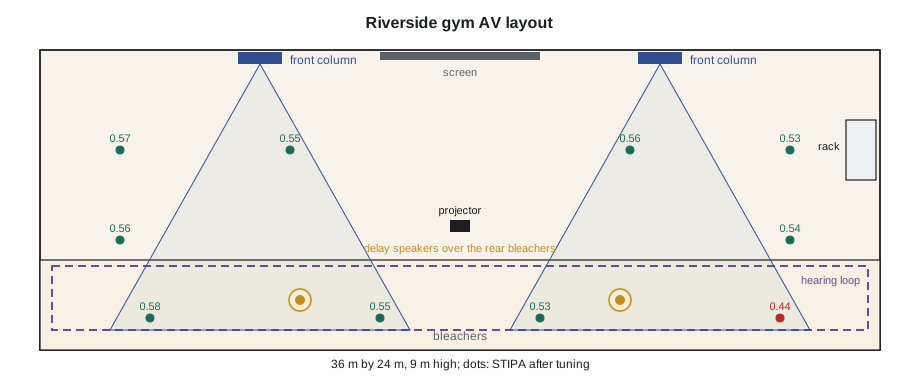
The column loudspeakers are heavy and hang high, so they go up on the rigging the structural engineer designed, with rated hardware and secondary safety cables, installed from a lift by two trained installers, as lesson 1 required. The delay speakers hang over the bleachers on the same kind of rigging. Every speaker line is measured before connection. The DSP's configuration, built by the programmer, is loaded, and the tuning follows lesson 11: polarity of every loudspeaker checked, high-pass filters set, the 250 Hz peak cut gently, the delay speakers delayed by their extra distance plus about 10 ms, and levels set for speech at around 75 dBA in the bleachers with the gym empty. The ambient noise compensation microphone is placed high on the side wall, away from the speakers' main coverage, and set to lift pages up to 12 dB during noisy games.
Then the gym is measured for intelligibility with STIPA at a grid of points across the bleachers and floor, as lesson 6 described. The first set of readings, before the delay was set, averaged 0.43; after tuning, with the finishes in place, the average is 0.55 and almost every point exceeds 0.45. The one low point is high in the corner of the bleachers, under a window; the design accepts it, because it is close to the line and the corner seats are rarely used, and records it.
# Gym STIPA results after tuning: average and share of points at or above 0.45
pts = [0.56, 0.58, 0.54, 0.57, 0.53, 0.55, 0.59, 0.52, 0.56, 0.54, 0.51, 0.57, 0.55, 0.53, 0.44, 0.58]
avg = sum(pts) / len(pts)
share = sum(p >= 0.45 for p in pts) / len(pts)
print(f"{len(pts)} points: average STI {avg:.2f}, {share:.0%} of points at or above 0.45")
print("Meets the 0.50 average and 90 % rule" if avg >= 0.50 and share >= 0.90 else "Does not meet the target")16 points: average STI 0.55, 94% of points at or above 0.45 Meets the 0.50 average and 90 % rule
Assistive listening
Assistive listening systems help people with hearing loss by sending the sound system's audio directly to their ears, past the gym's reverberation and noise. Three technologies are common: induction loops, which create a magnetic field inside a wire loop around the seating area that hearing aids with a telecoil pick up directly; radio frequency systems, with a transmitter and personal receivers with earphones or neckloops; and infrared systems, which use invisible light and suit rooms where privacy matters. Riverside's gym has a loop around the bleacher area and an RF system for the floor and stage.
The building and accessibility rules require these systems in many assembly spaces. In Ontario, the Building Code requires an assistive listening system covering the entire seating area in classrooms, auditoria, meeting rooms and theatres larger than 100 m² in assembly occupancies, and other provinces have similar requirements through their codes and CSA B651. In the United States, the 2010 ADA Standards require assistive listening in assembly areas where audible communication is integral to the use and audio amplification is provided, with a minimum number of receivers by seating capacity from Table 219.3, and at least 25 per cent of them, but no fewer than two, hearing-aid compatible. Signs with the international symbol of access for hearing loss show that the system is available.
# Assistive listening receivers by seating capacity (ADA 2010 Table 219.3 method) for comparison
import math
def receivers(seats):
    if seats <= 50: n = 2
    elif seats <= 500: n = 2 + math.ceil((seats - 50) / 25)
    elif seats <= 1000: n = 20 + math.ceil((seats - 500) / 33)
    elif seats <= 2000: n = 35 + math.ceil((seats - 1000) / 50)
    else: n = 55 + math.ceil((seats - 2000) / 100)
    hac = max(2, math.ceil(n * 0.25))
    return n, hac
for name, seats in (("Riverside gym bleachers and floor", 600), ("Library teaching area", 60), ("Drama room", 120)):
    n, hac = receivers(seats)
print(f"{name:34s} {seats:4d} seats -> {n:2d} receivers, {hac} hearing-aid compatible")Riverside gym bleachers and floor 600 seats -> 24 receivers, 6 hearing-aid compatible Library teaching area 60 seats -> 3 receivers, 2 hearing-aid compatible Drama room 120 seats -> 5 receivers, 2 hearing-aid compatible
On the Canadian site, the school board's standard adopts a similar receiver count, with neckloops for hearing aid users, because the Ontario Building Code sets coverage but not a receiver number; on the US site, the table applies directly. The loop is tested with a field strength meter at seats across the bleachers, to confirm the field is strong and even enough, and the RF receivers are tested at the far corners of the floor.
Life-safety and emergency tests
With the fire alarm contractor on site for the school's fire alarm verification, the AV interface tests from lesson 6 are run in every zone: fire alarm active, every AV source silent, including the gym's wireless microphones and program music, and the ambient noise compensation unable to raise anything; fire alarm reset, AV sources restored. The lockdown test follows, with the principal and the security contractor: the lockdown button pressed in the office, the message plays in every zone at full level with classroom volume controls turned down, the classroom displays show the lockdown screen, the exterior doors lock, and the fire alarm still silences the paging when triggered during the lockdown. The paging rack's UPS is tested by switching off its supply and making a page. Every result is signed by the parties present.
Training and handover
Training is by role, as lesson 11 described. Teachers get a fifteen-minute session in a classroom on the panel, the microphones and what to do if the display shows no picture, with a laminated quick guide by each panel. The office staff learn paging zones, bells and schedules, and the lockdown and its cancellation. The custodial and facilities team learn the gym system: how to set it up for assemblies and games, how to charge and store the wireless microphones and assistive listening receivers, and how to check the racks. The board's IT department receives the network requirements, device lists, addresses and firmware versions, and access to the management service. Paul receives the documentation set: as-built drawings, rack elevations, cable schedules, DSP and control files, test and tuning results, STIPA reports, the assistive listening test, the signed life-safety tests, warranties and a maintenance plan with a yearly check of every room and the gym.
# Handover checklist: every item present before sign-off
items = ["as-built drawings", "rack elevations", "cable schedules", "device list with addresses and firmware",
         "DSP and control program files", "classroom test sheets (64)", "gym tuning and STIPA report",
         "assistive listening test", "signed fire alarm and lockdown tests", "UPS test", "training records",
         "admin credentials sealed for the owner", "maintenance plan"]
received = set(items) - {"assistive listening test"}
missing = [i for i in items if i not in received]
print(f"{len(items) - len(missing)} of {len(items)} items received")
for m in missing:
print(f" missing: {m} -> sign-off held until it is delivered")12 of 13 items received missing: assistive listening test -> sign-off held until it is delivered
The missing item, the assistive listening field strength report, is completed the next morning, and Paul signs the handover. Maya's term on the AV crew ends where it started, at the school, with systems that the people using them barely notice, which is the point.
Worked problem
A teacher's microphone that howls
On the first day of school, a teacher in classroom 1.08 reports that her microphone squeals when she walks to the back of the room. The room passed verification. What is happening and what should Maya do?
Show solution
- The squeal is feedback: at the back of the room, the teacher is standing under a ceiling speaker, and her pendant microphone picks up its sound.
- During verification, the gain was set with the tester standing at the front, and nobody walked under the rear speaker with the microphone live.
- Maya lowers the reinforcement gain slightly, adds a narrow notch at the frequency that rings in the DSP's feedback suppressor, and checks the microphone's position on the lanyard, close to the mouth.
- She retests by walking the whole room with the microphone live, including directly under each speaker, and adds that walk to the classroom checklist for the remaining rooms.
Answer: With the walk added, two other rooms with the same layout are adjusted before any teacher notices, and the teacher in 1.08 reports no further squeals.
Common mistakes
MistakeTuning a gym before its acoustic finishes are installed.
InsteadWait for the finishes, or the tuning will have to be redone.
MistakeVerifying classroom microphones only from the front.
InsteadWalk the whole room, including under each speaker, with the microphone live.
MistakeTreating assistive listening as an extra.
InsteadProvide it where the code and standards require, with tested coverage and the right receivers.
MistakeRunning the life-safety tests without the other trades present.
InsteadTest the fire alarm and lockdown interfaces with the fire alarm and security contractors and the owner.
MistakeSigning off with missing documents.
InsteadHold sign-off until every item on the handover list is delivered.
Summary and key terms
- The capstone combines classrooms, paging, the gym, life-safety interfaces, training and handover.
- Classrooms are installed and verified to one standard with a checklist, and failures go on a punch list.
- Voice reinforcement lifts the teacher's voice about 10 to 15 dB above the background, evenly.
- Gyms need acoustic treatment first; directional and delay loudspeakers keep listeners within the critical distance.
- STIPA confirms the gym meets an average of 0.50 with nearly all points at or above 0.45.
- Assistive listening covers the seating area, with receiver numbers and hearing-aid compatibility set by the code and standards.
- Fire alarm mute, lockdown and UPS are tested with the other trades and the owner.
- Training by role and a complete documentation set finish the handover.
- Voice reinforcement
- A modest, even lift of a talker’s voice across a room.
- Critical distance
- The distance at which direct and reverberant sound are equal.
- Directivity factor
- A measure of how much a loudspeaker concentrates sound in its main direction.
- Assistive listening system
- A system that delivers audio directly to people with hearing loss.
- Induction loop
- A wire loop that creates a magnetic field picked up by hearing aid telecoils.
- Telecoil
- A small coil in a hearing aid that receives induction loop signals.
- Punch list
- The list of items still to fix before sign-off.
Practice problems
Work each problem on paper first, then reveal the answer to check.
A gym has a volume of 7,776 m3 and 830 m2 sabins of absorption. Estimate RT60.
Show answer
About 1.5 s.
How many assistive listening receivers does ADA Table 219.3 require for 600 seats?
Show answer
24, with at least 6 hearing-aid compatible.
Which rooms does the Ontario Building Code require to have assistive listening in assembly buildings?
Show answer
Classrooms, auditoria, meeting rooms and theatres over 100 m².
Why are delay speakers used over the rear bleachers?
Show answer
They put those listeners within a critical distance of a loudspeaker.
Lesson quiz · 5 questions
Score 60% or more to complete this lesson.
Create a free account to save your progress, take quizzes and earn a certificate.