
LSAT-140 · Lesson 9 of 12 · 21 min
Remote vs in-person testing
▶ Video coming soon A video version of this lesson is on the way.
The Friday session on November 13 had a guest speaker of sorts: Marcus, the day after his test at a Prometric centre in Columbus. Harriet had asked him to describe the day in detail, from the parking lot to the moment he walked out, because the other four would all be testing under the new arrangements and none had been inside a test centre for the LSAT.
The change in August 2026
From 2020 the LSAT was offered remotely, at home on a candidate's own computer with a remote proctor, and from 2023 many candidates could choose between remote testing and a test centre. Starting with the August 2026 administration, LSAC moved the multiple-choice LSAT back to in-person testing at test centres for most candidates in the United States and Canada, with remote testing kept only for specific exceptions. Reporting at the time, including in the ABA Journal, connected the change to concerns about test security after a remote cheating scandal in 2025, and named Prometric as the test centre provider.
The exceptions, as LSAC describes them, include candidates who live more than 180 miles or three hours from a test centre with available capacity, candidates with approved disability accommodations that call for remote testing, US military personnel stationed abroad and their spouses and other family members, and situations where a centre closes. Remote testing must be requested within a set window after registration closes, and some requests require proof of address. Candidates should check LSAC's current rules for their own situation, because the details can change.
LSAT Argumentative Writing is a separate matter. It remains remote for everyone, completed on the candidate's own computer within the window that opens eight days before the administration. The writing series covered that in detail.
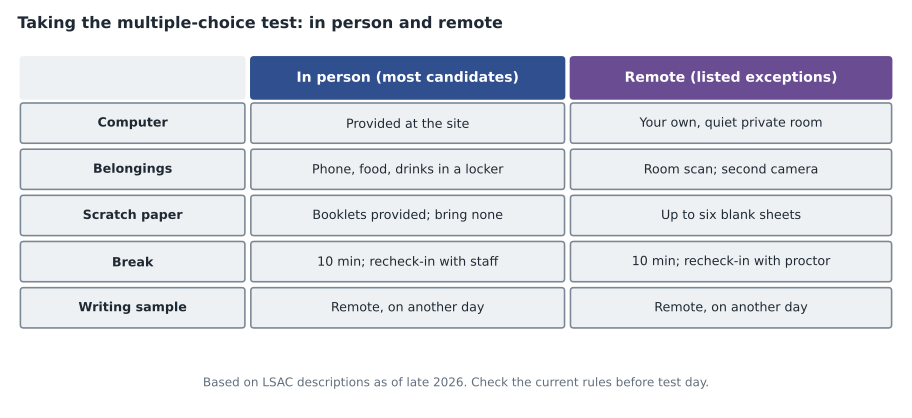
Marcus's day at the centre
Marcus had driven the route the day before, so he knew where to park. He arrived about twenty-five minutes before his appointment. LSAC tells candidates to arrive up to 30 minutes before the scheduled time, and Marcus said arriving earlier would only have meant waiting in a small lobby with other candidates for different exams.
At check-in, staff checked his ID against his registration and followed the centre's security steps, which included a photo. He was given a locker for his phone, keys, wallet, jacket and the snack and water he had brought for the intermission. Phones, food and drinks must stay in the locker during the test. He was not allowed to bring paper or pencils into the testing room. The centre provided scratch paper: LSAC says candidates at a centre receive three blank, unlined, coloured scratch paper booklets.
He needed his LawHub username and password to start, the same credentials he used to register. LSAC warns that a candidate who does not know them will have a delayed start. Marcus had memorized his, since nothing written can go into the testing room.
In the testing room, he sat at a computer in a carrel, read and agreed to a certifying statement on screen, and clicked to begin the timer. The interface was the same as LawHub practice tests, which he said was the most reassuring moment of the day. He had asked at check-in about earplugs and was given soft foam ones, which helped because other candidates were typing and coming and going for other exams. Rules on earplugs can vary, so candidates should check LSAC's current guidance or ask the centre.
The intermission at a centre
At the intermission, Marcus left the room, went to his locker, ate half a granola bar, drank some water and walked the corridor. LSAC's rules for the intermission at a centre are specific: no electronic devices, no use of the computer for anything but the test, no discussing the test with anyone and no working on scratch paper. Before the ten minutes end, the candidate must return and complete a recheck-in with centre staff, showing ID and confirming that they did not discuss the test or use electronics, before starting section 3.
Marcus said the recheck-in took about a minute, which was a minute he had not planned for. His advice to the others was to start heading back with three minutes left, not one. LSAC treats a failure to check back in after the intermission as a candidate cancellation that is reported to schools, so returning on time matters.
What surprised him
Asked what surprised him, Marcus listed three things. First, the noise: other candidates arriving and leaving at different times for other exams. Earplugs helped. Second, the temperature: the room was cool, and he was glad he wore a long-sleeved shirt, since he could not bring his jacket into the room. Third, how normal the computer felt after practising in the official interface for months.
He said the experience was calmer than his remote test in April 2025, when he had worried throughout about his internet connection, his room scan and whether a noise in the hallway would trigger a flag from the proctor. Harriet said that was a common reaction and one reason in-person testing suits many candidates, but that others find centres more stressful, particularly if they have to travel far.
Preparing for a centre
Harriet turned Marcus's report into a list for the others. Book the appointment as early as possible, because popular centres and times fill up. Do a trial trip at the same time of day as the appointment. Dress in layers that you can wear into the room without a jacket. Practise with earplugs if you plan to use them. Practise on scratch paper similar to what the centre provides: blank and unlined. Know your LawHub credentials by heart.
Élodie's situation needed extra planning. LSAC offers no in-person LSAT in Quebec, so she would cross the river to a Prometric centre in Ottawa for her 8:30 a.m. Saturday appointment on January 16. Her trial trip would happen on a Saturday morning in December, to see the traffic on the bridge and find parking. She also planned to allow for winter weather, leaving at about 7:15.
Dani planned to test at a centre in Tucson and Ji-won at a centre near Seattle, both on weekday mornings during the January window. Ji-won's approved accommodation, 50 percent extra time, would apply at the centre. Lesson 10 covers how accommodations work on test day.
Testing remotely
For candidates who qualify for remote testing, the setup matters as much as the content. LSAC requires a quiet, private room, a computer that meets its technical requirements, a webcam and microphone, and, since August 2026, a second camera such as a smartphone. A remote proctor watches during the test, and candidates complete a room scan before starting. Remote candidates may use up to six blank sheets of scratch paper. The intermission at home has its own recheck-in with the proctor.
Harriet's list for remote candidates: run LSAC's system check well before test day and again the day before; use a wired internet connection if possible; clear the desk and room of anything not allowed; tell everyone in the household when the test is; and practise in the same room, at the same desk, at the same time of day. A remote candidate also needs a backup plan for interruptions, such as knowing how to contact LSAC or the proctor if the connection drops.
Which is better?
For most candidates since August 2026 there is no choice: the multiple-choice test is taken at a centre unless an exception applies. Harriet said the more useful question is how to make whichever setting applies feel familiar. Candidates testing at a centre should practise in public settings, such as a library, with ambient noise, earplugs and blank scratch paper. Candidates testing remotely should practise in their own test room, with their own setup, at the real time.
Thomas, whose April 2027 test was further away, asked whether the rules might change again. Harriet said they might, and that everyone should read LSAC's current pages when they register and again in the final weeks. The principles would not change: know your setting, rehearse it and remove surprises.
Worked problem
Sample question (written for this course)
A candidate testing at a centre wants to use her intermission well. Which plan follows the rules described in this lesson? (A) Check her phone briefly at the locker, then return. (B) Discuss a hard passage with another LSAT candidate in the hallway. (C) Eat a snack at the locker, walk, and start back with a few minutes left to complete the recheck-in with staff. (D) Stay at her computer and review her scratch paper. (E) Leave the building to buy a coffee and return just as the ten minutes end.
Show solution
- (C) is correct. Food stays in the locker and may be eaten there if the centre allows it, and the recheck-in with staff must be completed before the break ends.
- (A) is wrong because electronic devices may not be used during the intermission.
- (B) is wrong because discussing the test is prohibited.
- (D) is wrong because working on scratch paper during the intermission is prohibited.
- (E) is wrong because returning at the last moment leaves no time for recheck-in, and failing to check back in is treated as a candidate cancellation.
Answer: (C). Recover, and leave time for the recheck-in.
Practising for a test centre at home
For candidates who will test at a centre, Harriet suggested simulating the most important differences during the last few practice tests: use blank, unlined paper rather than a lined notebook; keep your phone in another room for the whole session; put a snack and water outside the practice room, available only at the break; and set a timer to return from the break with three minutes left, as Marcus advised. Small details like these make test day feel like a repeat rather than a new experience.
Thomas, whose nearest centre was in Halifax, asked whether he should visit it before his April test. Harriet said a visit to the building and parking area was useful, since candidates cannot see inside the testing room in advance, and that he should check the centre's address on his confirmation, since some cities have more than one.
Booking an appointment
Under the in-person system, candidates choose an appointment time and centre within the administration's testing window, subject to availability. Harriet's advice was to book as early as possible after registering, because popular centres and times can fill up, and to choose a time of day that matches when the candidate concentrates best. A candidate who is sharpest in the morning should not take an afternoon appointment just because it is easier to reach.
Élodie had booked her 8:30 a.m. Saturday appointment in Ottawa soon after registering. She said she had considered an afternoon time to avoid the early drive, but her practice scores were consistently higher in the morning, so she chose the morning and planned the drive around it.
Writing and the multiple-choice test in different settings
Because LSAT Argumentative Writing is remote for everyone and the multiple-choice test is usually at a centre, most candidates now prepare for two different settings. The writing series covered the remote setup for the essay. Harriet suggested completing the writing early in its window when possible, so that it is out of the way, and treating the two as separate events with separate preparation.
Dani asked what she should do if she arrived at the centre and something went wrong, such as a technical problem with the computer. Harriet said the centre staff are there to deal with problems during the test, and that LSAC has procedures for reporting testing irregularities afterwards. A candidate who experiences a problem should tell staff at once and follow LSAC's instructions for reporting it, rather than trying to fix it alone or carrying on silently.
Ji-won said that knowing what the room would be like made her less nervous about testing in person for the first time. She planned to practise her last two full tests in a public library near her home in Seattle, with earplugs and blank paper, at her real morning time, so that the centre would feel familiar when she arrived.
Common mistakes
MistakeAssuming you can choose to test remotely.
InsteadSince August 2026, testing is at a centre unless an LSAC exception applies; check the current rules.
MistakeNot knowing your LawHub credentials at the centre.
InsteadKnow your username and password by heart; nothing written can go into the room.
MistakeReturning from the intermission with one minute to spare.
InsteadStart back with about three minutes left to complete the recheck-in.
MistakePractising only in a silent room at home.
InsteadIf testing at a centre, practise with ambient noise, earplugs and blank scratch paper.
MistakeSkipping the remote system check until test morning.
InsteadRun it well before test day and again the day before.
Summary and key terms
- Since August 2026, the multiple-choice LSAT is taken at a test centre for most US and Canadian candidates, with remote testing for listed exceptions.
- LSAT Argumentative Writing remains remote for everyone.
- At a centre: arrive up to 30 minutes early, store phones, food and drinks in a locker, use the centre's scratch booklets and know your LawHub credentials.
- At the intermission: no devices, no discussing the test, no scratch work, and complete the recheck-in before the ten minutes end.
- Remote testing needs a quiet private room, a system check, a second camera and a backup plan; practise in the setting you will test in.
- Test centre
- A secure testing location, operated for LSAC by Prometric according to 2026 reporting, where most candidates take the multiple-choice test.
- Remote testing
- Taking the test on your own computer with a remote proctor; since August 2026 available only for listed exceptions.
- Recheck-in
- The identity and rules check with centre staff or the proctor before section 3 begins.
- Candidate cancellation
- A cancellation reported to schools when a candidate does not check back in after the intermission.
- System check
- LSAC's test of a remote candidate's computer, camera and connection.
Practice problems
Work each problem on paper first, then reveal the answer to check.
Since August 2026, where do most candidates take the multiple-choice LSAT?
Show answer
At a test centre.
Name two exceptions that may allow remote testing.
Show answer
Living more than 180 miles or three hours from a centre with capacity; approved accommodations calling for remote testing (also US military abroad and families, centre closures).
What scratch paper does a centre provide?
Show answer
Three blank, unlined, coloured scratch paper booklets.
What must happen before section 3 at a centre?
Show answer
A recheck-in with centre staff, showing ID.
Why must Élodie test outside Quebec?
Show answer
LSAC offers no in-person LSAT in Quebec.
Lesson quiz · 5 questions
Score 60% or more to complete this lesson.
Create a free account to save your progress, take quizzes and earn a certificate.