
LSAT-140 · Lesson 8 of 12 · 19 min
Sleep, food and the final week
▶ Video coming soon A video version of this lesson is on the way.
The Friday session on November 6 was the last one before Marcus's test, six days later. Harriet built it around his final week, with his agreement, so that the others could watch a plan in action and adapt it for January and April. 'The last week is where good preparation is most often wasted,' she said. 'Not by doing too little. By doing too much.'
Why the last week is different
By the final week, a candidate's skill level is largely set. No amount of studying in six days will add a new question type or a large gain in reading speed. What the last week can still change is how much of that skill shows up on test day: whether the candidate arrives rested, confident and familiar with the logistics, or tired, anxious and still learning new material.
Harriet compared it to tapering before a race. Distance runners cut their training volume in the final week or two so that their bodies recover and they race fresh. The equivalent for the LSAT is fewer full tests, lighter practice and more rest, while keeping enough practice to stay sharp.
A final-week plan
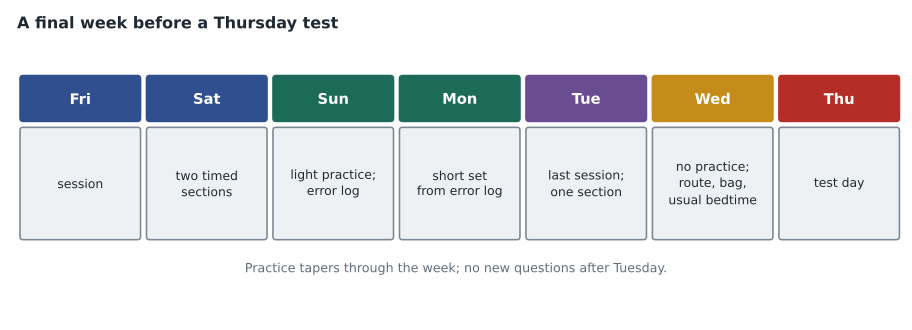
Harriet put Marcus's plan on the screen. His test was on Thursday, November 12.
- Friday, November 6: this session. Last full practice test had been the previous Saturday, reviewed on Sunday.
- Saturday, November 7: two timed sections back to back, at the time of day of his appointment, with review.
- Sunday, November 8: last Sunday clinic, light practice only. Error-log review.
- Monday, November 9: listened to the advanced reading session without doing the timed work; a short set of Logical Reasoning questions from his error log.
- Tuesday, November 10: his final workshop session, then a single timed section. Harriet's rule: no new questions after Tuesday.
- Wednesday, November 11: no practice questions. Trial check of route and parking, pack the bag, a walk, early dinner, usual bedtime.
- Thursday, November 12: test day.
Thomas asked why there was no full test in the last five days. Harriet said a full test so close to the real one costs recovery time and, if it goes badly, confidence, for almost no gain in skill. The last full test should be about five to seven days before the real one. The days after should keep the mind active with short, familiar practice and then stop.
Sleep
Sleep is the single most important variable in the final week that a candidate fully controls. Research on sleep and cognition consistently finds that losing sleep impairs attention, working memory and decision-making, which are exactly the abilities the LSAT tests. Sleep also plays a role in consolidating what was learned during the day.
Harriet's advice was practical. Keep a regular sleep schedule through the final week, going to bed and waking at about the same times each day. If the test appointment is earlier than your usual waking time, shift your schedule gradually over the week before, by fifteen to thirty minutes a day, rather than trying to change it the night before. Avoid staying up late to study; an hour of sleep is worth more than an hour of review in the last week.
Élodie, whose appointment was at 8:30 a.m. on a Saturday, planned to start shifting her weekend wake-up time two weeks before the test, since she would need to leave Gatineau by about 7:15 to allow for traffic and parking in Ottawa. Ji-won, testing in the morning as well, planned the same shift.
Marcus asked what to do if he could not sleep the night before. Harriet said that is common and less damaging than people fear. One poor night after a week of good sleep has a smaller effect than many candidates expect, and lying awake worrying about sleep tends to make it worse. Resting quietly, without screens, is better than getting up to study. Several good nights before the test matter more than the last one.
Food and caffeine
On food, Harriet's advice was to keep things familiar. Eat a normal, filling breakfast that you have eaten before practice tests, not a new or unusually heavy meal. Plan a small snack for the intermission if your test setting allows it; at test centres, food and drinks must be kept in the locker, so a snack can be eaten during the break at the locker area if the centre's rules permit. Check the rules for your setting in advance.
On caffeine, the guidance was the same: keep your usual habit. A candidate who drinks one coffee every morning should have one coffee on test morning, at the usual time. Skipping it can cause a headache and fatigue; doubling it can cause jitters and an urgent need for the washroom in the middle of section 2. A candidate who does not usually drink caffeine should not start on test day.
Dani asked about energy drinks. Harriet said the same rule applies: if you do not use them during practice, do not use them on test day. The test is a long period of calm concentration, not a short burst of energy.
Medication and health
Harriet said one sentence on medication and left it there: do not start any new medication, supplement or sleep aid in the week before the test without talking to a doctor or pharmacist, and keep taking any medication you normally take on its usual schedule. If you become unwell close to the test, LSAC's rules on rescheduling, withdrawing and absences, covered in Lesson 10, may be relevant.
What to study in the last days
The last days are for consolidation, not new material. Harriet suggested three activities: review the error log, looking at the notes on why each miss happened; do short sets of question types you know well, to build confidence and keep the routine sharp; and reread your pacing card, flag rules and test-day checklist.
What to avoid is equally important: new question types, unfamiliar prep books, new strategies read online, and full practice tests in the last two days. Each of these adds uncertainty at the moment when a candidate needs confidence. Harriet said the most common last-week mistake she saw was a candidate finding a new "trick" online two days before the test and trying it on the real thing.
The day before
The day before the test should be calm and organized. Harriet's list for the day before: confirm the appointment time and location; check the route and parking or transit, ideally with a trial trip at the same time of day; lay out acceptable ID and anything you need to bring; check the weather; plan breakfast; and do something relaxing in the evening, such as a walk, a film or a meal with someone. Lesson 11 gives the full checklist.
Marcus planned to drive the route to his test centre in Columbus on Wednesday at about the time he would drive it on Thursday, to see the traffic and find the parking. He would then put his ID and car keys in one place by the door, set two alarms and go to bed at his usual time.
The morning of the test
The morning should follow a routine practised in advance: wake at the planned time, eat the planned breakfast, have the usual caffeine, write about worries for ten minutes if that technique helps, and leave with time to spare. Arriving rushed starts the test with a burst of stress. LSAC tells in-person candidates to arrive up to 30 minutes before the scheduled time, and candidates should allow for traffic and parking on top of that.
Harriet also suggested a short warm-up: two or three Logical Reasoning questions you have already done and know well, read slowly, perhaps at home before leaving. The purpose is not practice but switching the mind into LSAT reading before section 1. Questions must not be brought into the test centre or reviewed after check-in.
Marcus's report
Marcus came to the Friday session on November 13, the day after his test, and reported on his week. He had followed the plan. He slept reasonably well on Tuesday and Wednesday nights, ate his usual oatmeal, had one coffee and arrived at the centre about twenty-five minutes before his appointment. He said the biggest difference from April 2025 was that he did not feel he was missing anything: no last-minute studying, no new strategies, nothing to look up. His score would not be released until December 2.
Thomas said that was the part he found hardest to imagine doing: stopping. Harriet said stopping is a skill too, and that the last week is a test of trust in the preparation. 'You trained for months,' she said. 'The last week is when you let the training work.'
Planning for the unexpected
Harriet asked each member to think through a few things that might go wrong in the final days and decide in advance what they would do. A cold or flu: check LSAC's rules on rescheduling and withdrawal, compare the costs and decide by the deadline rather than on the morning of the test. Bad weather: check the forecast the day before, leave earlier and know how LSAC or the centre announces closures. A family emergency: remember that a withdrawal or absence does not count toward the testing limits, while a cancelled score does.
Élodie, crossing a river in January, made the most detailed contingency plan: a second route across a different bridge, an extra thirty minutes in case of snow, and the centre's contact details written on a card in her car. Harriet said most candidates never need their contingency plans, but having one removes a source of worry.
Keeping perspective in the last week
The last week can feel like the most important week of a candidate's life. Harriet reminded the group that the outcome of a single test depends far more on the months of preparation already done than on anything that happens in the final seven days. A candidate who has prepared well will not undo that preparation by taking a rest day or skipping a practice session. A candidate who has not prepared well will not fix it by cramming.
Marcus said that understanding this made his final week calmer than his first attempt. In April 2025, he had studied for ten hours the day before the test and slept badly. This time, he spent the day before driving the route, packing his bag and watching a film. He said he walked into the centre feeling ready rather than exhausted.
Light exercise
Harriet mentioned that light physical activity in the final week, such as walking, cycling or whatever a candidate normally does, can help with sleep and stress. The guidance was the same as for food and caffeine: keep to familiar routines. The final week is not the time to start a demanding new exercise program or to run a race.
The night before
The night before the test, Harriet recommended an ordinary evening: a familiar dinner at the usual time, no alcohol, some time away from screens before bed, and the usual bedtime. Candidates who go to bed much earlier than usual often lie awake, which makes them more anxious. Going to bed at the normal time, after a calm evening, usually produces better sleep than trying to force an early night.
Marcus followed that advice on November 11. He said he slept about seven hours, a little less than usual, and felt fine the next morning, which matched what Harriet had told the group about one imperfect night after a week of good sleep.
Dani raised one more practical point: her January test fell on a weekday, and she worked full time. She arranged the day off well in advance and also took the afternoon before, so that she would not go straight from a busy shift into her final evening. Harriet said candidates who work should treat the day before as part of the test, and protect it the same way.
Common mistakes
MistakeTaking a full practice test in the last two days.
InsteadTake the last full test five to seven days before and taper after.
MistakeShifting your sleep schedule the night before an early test.
InsteadShift wake time gradually over the week or two before.
MistakeChanging caffeine or food habits on test day.
InsteadKeep your usual breakfast and caffeine, at the usual time.
MistakeLearning a new strategy or question type in the final days.
InsteadReview the error log and do short sets of familiar questions.
MistakeStaying up late to study before the test.
InsteadKeep a regular bedtime; sleep is worth more than extra review.
Summary and key terms
- In the final week skill is largely set; the goal is to arrive rested, confident and familiar with the logistics.
- Taper: last full test five to seven days before, then short, familiar practice, and no new questions in the final day or two.
- Keep a regular sleep schedule and shift gradually for an early appointment; several good nights matter more than the last one.
- Keep food and caffeine habits familiar; do not start new medication or supplements without medical advice.
- Use the day before for logistics and rest, and follow a practised routine on test morning.
- Tapering
- Reducing practice volume before the test so that the candidate arrives fresh.
- Consolidation
- Reviewing and reinforcing what is already known rather than learning new material.
- Trial trip
- Travelling the route to the test centre in advance at the same time of day.
- Warm-up
- A few familiar questions read slowly before leaving home, to switch into LSAT reading.
- Error log
- A record of missed questions with notes on why each was missed.
Practice problems
Work each problem on paper first, then reveal the answer to check.
When should the last full practice test be taken?
Show answer
About five to seven days before the real test.
How should a candidate prepare for an appointment earlier than her usual waking time?
Show answer
Shift wake time gradually, by fifteen to thirty minutes a day, over the week or two before.
What is the rule on caffeine for test day?
Show answer
Keep your usual habit, at the usual time; do not start or double it.
What should the day before the test be used for?
Show answer
Logistics, a route check, packing ID and a calm, relaxing evening.
What was Harriet's rule for Marcus after his final Tuesday session?
Show answer
No new questions after Tuesday.
Lesson quiz · 5 questions
Score 60% or more to complete this lesson.
Create a free account to save your progress, take quizzes and earn a certificate.