
LSAT-140 · Lesson 10 of 12 · 21 min
Accommodations, Score Preview and retake decisions
▶ Video coming soon A video version of this lesson is on the way.
The second half of the November 13 session moved from the test day itself to the decisions around it: accommodations before the test, and what to do after it. Marcus, with his score due on December 2, was the obvious case study. Ji-won, with an approved accommodation, was the other.
Accommodations
LSAC provides testing accommodations for candidates with documented disabilities. Common accommodations include extra testing time, extra or longer breaks, stop-the-clock breaks and approved assistive technology. Requests are made through the candidate's LSAC JD Account, with supporting documentation, and LSAC is strict about deadlines: an accommodation request must be submitted by the registration deadline for the administration, and LSAC states there are no exceptions to that deadline.
Ji-won had filed her request in September with a report from her clinician and received approval for 50 percent extra time in October. She said the process took longer than she expected, mainly because gathering the documentation took several weeks. Her advice to anyone considering a request was to start months before the registration deadline, not weeks.
Two features of LSAC's current policy reassured her. First, approved accommodations generally carry forward to later administrations, so she would not have to reapply for each test. Second, LSAC does not annotate scores earned with accommodations or tell schools that a candidate tested with accommodations. A school sees her score like anyone else's.
If a request is denied in whole or in part, LSAC has an appeal process with short deadlines, described in LSAC's current materials as a few business days to state the intention to appeal and a short period to supply further documentation. Harriet stressed that candidates should read the current rules carefully at the time, because the deadlines are short and change from time to time.
Accommodations on test day
An accommodation changes the test day, and practice should reflect it. With 50 percent extra time, each 35-minute section becomes 52 minutes and 30 seconds, and the whole day becomes longer. LSAC states that candidates approved for 100 percent or more extra time may take five-minute breaks between sections on request. Ji-won's approval did not include extra breaks, so her day would follow the standard pattern of one 10-minute intermission, with longer sections.
That meant her stamina training needed to cover longer blocks: two sections back to back took her about an hour and forty-five minutes. Harriet adjusted Ji-won's stamina ladder accordingly and scaled every checkpoint by one and a half. Ji-won said practising at her real timing from the start had been important. A candidate who practises at standard timing and then tests with extra time may not use the extra time well, either rushing out of habit or spreading thin.
Harriet added one more point: candidates with approved accommodations should confirm, well before test day, how those accommodations will be delivered in their setting, whether at a test centre or, where an exception applies, remotely. LSAC's materials explain the arrangements, and any problem is easier to fix weeks ahead than on the morning of the test.
Score Preview
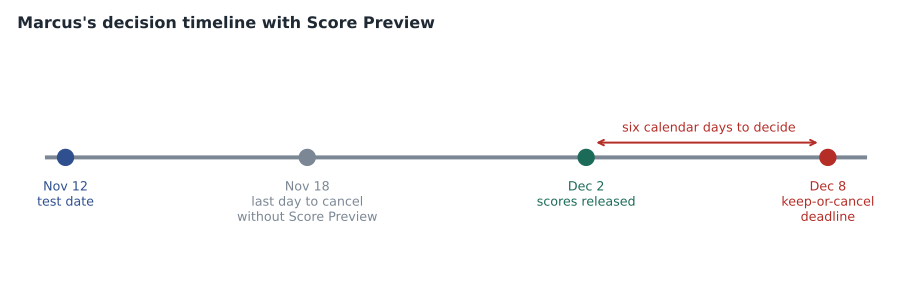
After the test, a candidate waits for the score release, which LSAC schedules for each administration. For the November 2026 administration, scores release on December 2. LSAC's Score Preview option lets a candidate see the score before deciding whether to keep it. Score Preview costs 46 US dollars if bought before the first day of testing or 87 US dollars if bought afterward. A candidate with Score Preview has six calendar days from the score release to decide whether to keep or cancel the score.
Without Score Preview, a candidate can still cancel a score, but must do so within six calendar days after the test date, before seeing it. A cancelled score is not reported to schools as a score, but the cancellation counts toward LSAC's testing limits.
Marcus had bought Score Preview before his test, at the lower price. His decision window would run from December 2 to December 8. He had set his rule in advance: keep the November score only if it was above his April 2025 score of 158; otherwise cancel it within the Score Preview window and retest later. Harriet said setting the rule before seeing the number was the most important part, because a decision made in the moment, under disappointment or relief, tends to be worse.
Testing limits
LSAC limits how often a candidate may take the LSAT. Under the current policy, a candidate may test five times within the current reportable score period, which began in July 2021, and seven times over a lifetime. A candidate who has earned a perfect score of 180 within the current reportable period may not retest. Cancelled scores count toward the limits; absences and withdrawals do not.
Schools receive a candidate's score report through LSAC, which covers the current testing year and the five previous testing years. Since 2006 the American Bar Association has required US schools to report applicants' highest LSAT score for its statistics, which has encouraged many schools to focus on the highest score, but schools can see all reported scores and policies differ. Some Canadian schools say they consider all scores within a period; the University of Toronto, for example, states that it considers all scores within five years. Candidates should read each school's stated policy.
Deciding whether to retake
A retake decision should weigh evidence, not feelings. Harriet gave the group five questions to ask.
- How does the score compare with my recent practice range? A score at or above the range suggests the test went as expected; a score well below it suggests something went wrong on the day that may not recur.
- Is there a specific, fixable reason? Timing that collapsed, illness, a distraction, or a weakness that more preparation can address are good reasons to retake. "I hoped for more" is not, on its own.
- What do my schools need? A score already above the median at the schools a candidate is targeting may not be worth retaking; a score below may be.
- What does my timeline allow? A retake must fit before application deadlines, with time to prepare properly.
- How many attempts do I have? Each cancellation and each test counts toward the limits.
Harriet also reminded the group that scores move around from one administration to the next even when ability does not change. LSAC reports a score band with each score to reflect this measurement error. A retake that aims for a gain of one or two points may produce no change at all for reasons of chance. A retake makes the most sense when the expected gain is larger, because something specific has been fixed.
Rescheduling and withdrawing
Plans change. LSAC allows candidates to change their test date, with fees that depend on timing: free up to the registration deadline, a fee for changes in the period shortly after it, and a higher fee later, according to LSAC's current fee schedule. A candidate who is unwell or unprepared close to the test should compare the cost of rescheduling with the cost of taking the test and cancelling, remembering that a cancellation counts toward the testing limits while an absence or withdrawal does not.
Thomas asked whether it was better to take the test "for practice" and cancel. Harriet said no: the test is not a practice test, it uses one of a limited number of attempts, and full official practice tests in LawHub are a better way to practise. Testing is for when you are ready.
Hand scoring
Candidates who believe a scoring error occurred can request a score audit from LSAC for a fee, which is reduced for candidates with fee waivers. Errors are rare because scoring is automated, and Harriet said she had never seen an audit change a score, but candidates should know the option exists.
Worked problem
Sample question (written for this course)
A candidate with Score Preview receives a score two points below her recent practice range. She had a cold on test day and plans to apply next fall. Which reasoning best fits this lesson? (A) Cancel only if she can name a specific, fixable reason and has time and attempts to retest, and decide within the Score Preview window. (B) Keep the score automatically because cancellations are reported as scores. (C) Cancel every score below her target regardless of timeline. (D) Wait until the next administration to decide. (E) Keep the score because illness cannot affect performance.
Show solution
- (A) is correct. Illness is a specific reason that may not recur, and a decision must weigh timeline, attempts and school needs within the six-day Score Preview window.
- (B) is wrong because a cancelled score is not reported to schools as a score.
- (C) is wrong because the decision should weigh school needs, timeline and testing limits, not a fixed target alone.
- (D) is wrong because the Score Preview decision must be made within six calendar days of the score release.
- (E) is wrong because illness can affect concentration and performance.
Answer: (A). Decide by evidence, within the window.
Understanding the score band
Every LSAT score report includes a score band, a range around the reported score that reflects the test's measurement error. The band is a reminder that a single score is an estimate of ability, not an exact measurement. Two candidates whose scores differ by a point or two may have essentially the same underlying ability, and the same candidate taking two test forms on two days could score a little differently on each.
Harriet said the score band was a useful tool for retake decisions. A candidate whose score falls well below the lower end of her practice range, by more than the width of a typical band, has stronger evidence that something went wrong on the day. A candidate whose score is within a point or two of her practice average has done about as well as could be expected, and a retake is unlikely to produce a large change unless her preparation changes substantially.
Retake preparation
A candidate who decides to retake should change something about her preparation, not simply repeat it. Harriet suggested starting with the test-day experience: what went wrong, if anything, and was it timing, nerves, logistics or knowledge? Then look at the error log for patterns that more practice could fix. A candidate whose timing collapsed needs more stamina and checkpoint work; one whose accuracy was low on a particular question type needs focused method work.
Marcus, depending on his December 2 result, planned to use the remaining months before applications to focus on parallel reasoning and principle questions, his two weakest types, and to keep his pacing routine unchanged, since it had felt right in November.
Talking to schools
Candidates sometimes wonder whether to explain a low score or a cancellation in their applications. Harriet said that depends on the school and the circumstances, and that many schools publish guidance on addenda or explanations. A brief, factual explanation of a genuine circumstance, such as illness on test day, may be appropriate where a school invites it. A long explanation of a score that simply fell within the normal range rarely helps.
Ji-won asked whether she should mention her accommodation in her applications. Harriet said that was a personal decision, and that LSAC does not tell schools about accommodations, so there was no need to explain anything about her score. Some applicants choose to write about disability in a personal statement, and some do not; either choice is legitimate, and the score report itself says nothing about it.
Harriet closed the discussion with a reminder that the rules in this lesson were LSAC's as of late 2026 and that fees, deadlines and policies change. Each member was to read the current LSAC pages on Score Preview, cancellation, testing limits and accommodations when registering and again in the final two weeks, and to note the dates that applied to their own administration in their test-week plan.
Common mistakes
MistakeStarting an accommodation request close to the registration deadline.
InsteadStart months ahead; LSAC states there are no exceptions to the deadline.
MistakePractising at standard timing when approved for extra time.
InsteadPractise at your approved timing and scale checkpoints accordingly.
MistakeDeciding whether to keep a score in the moment.
InsteadSet a keep-or-cancel rule before seeing the score.
MistakeTaking the real test "for practice" and cancelling.
InsteadUse official practice tests; each real test and cancellation counts toward the limits.
MistakeRetaking for a hoped-for gain of a point or two.
InsteadRetake when a specific, fixable problem makes a larger gain likely.
Summary and key terms
- Accommodation requests go through the LSAC JD Account with documentation, by the registration deadline with no exceptions; approvals generally carry forward and are not disclosed to schools.
- Practise at your approved timing; candidates with 100 percent or more extra time may take five-minute breaks between sections on request.
- Score Preview costs 46 or 87 US dollars and gives six calendar days after release to keep or cancel; without it, cancel within six calendar days of the test.
- Limits: five tests in the period since July 2021, seven in a lifetime; cancellations count, absences and withdrawals do not.
- Retake decisions should weigh practice range, a specific fixable reason, school needs, timeline and remaining attempts.
- Accommodation
- A change to testing conditions, such as extra time or breaks, approved by LSAC for a documented disability.
- Score Preview
- An LSAC option to see a score before deciding whether to keep or cancel it.
- Score band
- A range reported with a score to reflect measurement error.
- Testing limits
- LSAC's caps on the number of tests in the current reportable period and in a lifetime.
- Score audit
- A request, for a fee, for LSAC to check the scoring of a test.
Practice problems
Work each problem on paper first, then reveal the answer to check.
By when must an accommodation request be submitted?
Show answer
By the registration deadline for the administration; LSAC allows no exceptions.
Does LSAC tell schools that a candidate tested with accommodations?
Show answer
No; scores are not annotated or disclosed.
How long does a Score Preview buyer have to decide after the score release?
Show answer
Six calendar days.
Do cancelled scores count toward the testing limits?
Show answer
Yes; absences and withdrawals do not.
What was Marcus's keep-or-cancel rule?
Show answer
Keep the November score only if above 158; otherwise cancel within the Score Preview window.
Lesson quiz · 5 questions
Score 60% or more to complete this lesson.
Create a free account to save your progress, take quizzes and earn a certificate.