
LES-105 · Lesson 8 of 12 · 20 min
Honesty in notes, reports and testimony
▶ Video coming soon A video version of this lesson is on the way.
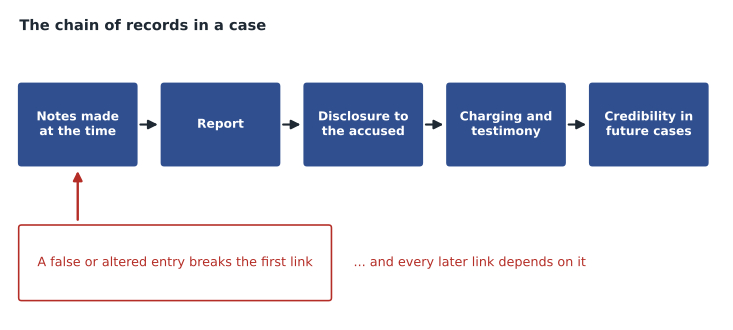
Ms. Margaret Liu, the Crown attorney the class met in LES-103, visits to talk about the part of police work that most students find least exciting: writing things down. She opens by holding up a police notebook. Everything she does as a prosecutor, she says, depends on whether she can believe what is in it. She decides whether to proceed with charges based on officers' notes and reports. She discloses them to the defence. Judges and juries weigh them against the accused's word. If an officer writes something untrue, even a small thing, and it is discovered, she may have to withdraw the case, disclose the officer's dishonesty in every future case and, in the worst cases, refer the officer for prosecution. Honesty in records, she says, is not one ethical issue among many. It is the foundation that every other part of the justice system stands on.
Why records carry so much weight
Police records are unusual documents. They are written by a trained witness close to the time of the events, often before the significance of a detail is known, and they become evidence. Courts give contemporaneous notes considerable weight because memory fades and changes over time. That weight is earned only if the notes are complete, accurate and made honestly. Notes made at the time, or as soon as practicable afterward, can be used by officers to refresh their memory when testifying, and inconsistencies between notes, reports, video and testimony are the first thing a defence lawyer looks for. An officer whose notes are thin, vague or contradicted by video will struggle in court even if everything he or she did was proper.
Records also discipline the officer. Writing down the grounds for an arrest or search forces the officer to articulate them, and if they cannot be articulated, they may not exist. Desjardins tells the class that the best notebook advice he ever received was from a sergeant who said: write it as if the person you arrested will read it aloud in court, because one day someone will. He adds that his own notes improved dramatically after the unsustained complaint described in LES-101, when he realized how little of a tense encounter he had actually recorded.
What honest records look like
Honest notes and reports share several features. They record facts, not conclusions: rather than writing that a person was aggressive, the officer writes what the person said and did, such as clenched fists, a raised voice and a step forward. They distinguish what the officer observed from what others told the officer. They include facts that do not help the case, such as an alibi offered, a witness who saw something different or the fact that a search found nothing. They are made as soon as practicable, and if made later the time is recorded truthfully. Corrections are made by striking through, not erasing or tearing out pages, so the original remains readable. And they never borrow another officer's observations as the writer's own.
Some of the most common dishonest practices are small. Officers may round times to make a response look faster, add details to a notebook after learning they are important, copy a partner's notes, describe a person's behaviour in stock phrases that appear in every report, or leave out a detail that might help the defence. Each of these can seem harmless. Each can destroy a case and an officer's credibility if it comes to light, and in the age of body cameras, dispatch logs and phone GPS, it usually does. Ms. Liu says she has watched cases collapse not because officers did anything wrong at the scene but because the report described the scene in a way the video contradicted.
Boilerplate is a quieter threat to honesty. Phrases such as furtive movements, nervous behaviour, the strong odour of an intoxicant or the area is known for drug activity appear in thousands of reports, sometimes because they are true and sometimes because officers have learned that they justify a search or detention. Judges increasingly read such phrases skeptically, and video often shows that the movement was a driver reaching for a licence or that the nervousness looked like ordinary anxiety. Ms. Liu tells the class that a report full of stock phrases tells her the officer has learned what to write, not what happened. Specific descriptions, such as the driver reached under the seat with his right hand twice while I approached and then held his hands rigidly on his thighs, are more honest and more persuasive. If an officer cannot describe specifically what made a person seem nervous, the honest conclusion may be that the grounds were weaker than the stock phrase suggests.
| Practice | Why it matters | Honest alternative |
|---|---|---|
| Recording conclusions | Conclusions cannot be tested; facts can | Describe words, actions and observations |
| Adding details later without noting it | Looks like fabrication when discovered | Add a dated, timed entry explaining the late addition |
| Copying a partner's notes | Two witnesses become one; may be inaccurate | Record only what you personally observed |
| Leaving out unhelpful facts | Breaches disclosure and misleads the court | Record everything relevant, including what helps the defence |
| Erasing or removing pages | Destroys the original record | Strike through with a single line, initial and date |
Disclosure: why every record may be seen
In R. v. Stinchcombe (1991), the Supreme Court of Canada held that the Crown must disclose to the defence all relevant information in its possession, whether it helps or hurts the case, unless it is clearly irrelevant or privileged. Police are required to provide the Crown with everything relevant, including notes, reports, videos and records of investigative steps that led nowhere. In R. v. McNeil (2009), the Court extended this to records of serious police misconduct where they are relevant to the case. The practical message for officers is that every note may be read by the defence and the court, and that withholding or destroying a relevant record is serious misconduct and may be a crime.
Disclosure also explains why officers' honesty problems follow them. Under McNeil, a finding that an officer was dishonest in a past case may have to be disclosed whenever that officer is a witness, and Crowns have declined to call officers whose credibility has been seriously compromised. Desjardins says that he has known officers who survived discipline for many kinds of mistakes, but very few whose careers survived a finding of dishonesty.
Memory, video and writing reports
Honesty is not only about avoiding lies. Human memory is reconstructive: people fill gaps with expectations, and stress narrows what they notice. After a fast, frightening encounter, an officer may sincerely remember events in an order or with details that video later contradicts. This creates ethical as well as practical questions. Should officers watch body camera footage before writing their reports? Supporters say it produces more accurate reports. Critics say it allows officers to tailor their accounts to what the camera shows and hides what the officer actually perceived, which is what matters when judging the reasonableness of force. Services take different positions, and some require an initial statement before viewing footage, followed by a supplementary statement afterward. In Wood v. Schaeffer (2013), the Supreme Court of Canada held that officers involved in incidents investigated by Ontario's Special Investigations Unit must write their notes without first having them reviewed by a lawyer, because notes must reflect the officer's own independent recollection.
The ethical core is simple: officers should record what they personally perceived and remember, should say so when they do not remember or are unsure, and should not discuss and harmonize their accounts with colleagues before writing. Admitting uncertainty is not a weakness in a witness; it is what makes the rest of the testimony believable. Officers who claim perfect recall of a chaotic event invite skepticism.
Checking records against objective data
Supervisors, Crowns and defence lawyers now routinely compare officers' reports with objective data: dispatch logs, GPS records, body camera timestamps and radio recordings. The code below shows a simple version of that comparison for a set of Port Ardent reports. It compares the arrival time written in each report with the arrival time in the dispatch log and flags differences of more than two minutes. Small differences are normal; officers often write a time from memory or a watch that differs slightly from the system clock. Large differences, especially in one direction, need an explanation.
# Compare arrival times in officers' reports with the dispatch log (minutes after midnight)
def to_min(hhmm):
    h, m = hhmm.split(":")
    return int(h) * 60 + int(m)

reports = [
    ("25-11402", "22:41", "22:52"),
    ("25-11417", "23:05", "23:06"),
    ("25-11433", "00:18", "00:17"),
    ("25-11460", "01:02", "01:11"),
    ("25-11471", "01:40", "01:41"),
]
for case, report_time, dispatch_time in reports:
    gap = to_min(dispatch_time) - to_min(report_time)
    flag = "  <- explain" if abs(gap) > 2 else ""
    direction = "report earlier" if gap > 0 else "report later" if gap < 0 else "match"
print(f"{case}: report {report_time}, dispatch {dispatch_time}, gap {gap:+d} min ({direction}){flag}")25-11402: report 22:41, dispatch 22:52, gap +11 min (report earlier) <- explain 25-11417: report 23:05, dispatch 23:06, gap +1 min (report earlier) 25-11433: report 00:18, dispatch 00:17, gap -1 min (report later) 25-11460: report 01:02, dispatch 01:11, gap +9 min (report earlier) <- explain 25-11471: report 01:40, dispatch 01:41, gap +1 min (report earlier)
Two reports differ from the dispatch log by nine or more minutes, both in the direction that makes the response look faster. One of them is the domestic call from Lesson 3 that Linh was asked to alter. The pattern does not prove deliberate dishonesty; an officer may have pressed the arrival button late. But it is exactly the kind of discrepancy that the GPS record can resolve, and that a defence lawyer or complaint investigator will find if the service does not.
Testimony
Testifying in court is the moment when all of an officer's record-keeping is tested. Ethical testimony means answering the question asked, truthfully and completely, without exaggerating, minimizing or volunteering opinions dressed as facts. It means admitting when something was not seen or is not remembered. It means treating defence counsel with the same courtesy as the Crown, because the officer's role is to assist the court, not to win. And it means correcting a mistake as soon as it is realized, even on the stand. Perjury, giving false evidence under oath with intent to mislead, is an offence under section 131 of the Criminal Code punishable by up to fourteen years. The term testilying, coined in New York's Mollen Commission report in 1994, describes officers lying in court to secure convictions, a form of noble cause corruption that the commission found had become routine in some units.
Ms. Liu ends her visit with advice for the class. Prepare by reading your notes, not by rehearsing a story. Never discuss your testimony with another witness. If you made a mistake at the scene, tell the Crown before you take the stand, because a mistake disclosed is usually manageable and a mistake hidden almost never is. And remember that the most persuasive witness in any courtroom is the one who obviously has no interest in anything except the truth.
Worked problem
The missing detail
Priya, on a ride-along with a fraud investigator, notices that the officer's report on an interview with a suspect does not mention that the suspect said he had been out of the country on the date of one of the transactions. The officer explains that he did not believe it and did not want to clutter the report.
Show solution
- Recognize the issue: an alibi, even an unbelievable one, is relevant information that must be recorded and disclosed.
- Apply the law: under Stinchcombe, all relevant information must be disclosed, whether it helps or hurts the Crown's case.
- Consider the consequences of omission: if the defence learns of the statement later, the officer's credibility and the case may be destroyed, and the omission may be treated as misconduct.
- Identify the right course: add the statement to the report with a note of when it was made and that it was added later, and check the alibi, because checking it either eliminates it or reveals a mistake.
- Act: Priya, as an observer, can ask the investigator whether the statement should be included, which gives him the chance to correct it.
Answer: The alibi must be recorded and investigated. Leaving it out to keep the report tidy turns a strong case into a vulnerable one and breaches the duty of disclosure. Checking it is good investigation: if the suspect was in the country, the alibi collapses and the case is stronger.
Common mistakes
MistakeNotes only need to record facts that support the charge.
InsteadNotes must record all relevant facts, including those that help the defence; withholding them breaches disclosure obligations.
MistakeRounding a time by a few minutes is harmless.
InsteadTimes are checked against dispatch, GPS and video. Inaccurate times can undermine credibility and look like deliberate dishonesty.
MistakeAdmitting you do not remember makes you a weak witness.
InsteadHonest uncertainty makes the rest of the testimony credible; claiming perfect recall invites skepticism.
MistakeDiscussing an incident with a partner before writing notes improves accuracy.
InsteadHarmonizing accounts contaminates independent recollection; each officer should record his or her own memory.
Summary and key terms
- Police records become evidence, and the justice system depends on their honesty.
- Honest records describe facts, separate observation from hearsay, include unhelpful facts and preserve corrections.
- Stinchcombe and McNeil require disclosure, so every note may be read by the defence and the court.
- Findings of dishonesty can end an officer's usefulness as a witness and therefore the officer's career.
- Memory is reconstructive; officers should record their own independent recollection and admit uncertainty.
- Ethical testimony is truthful, complete, courteous and corrected promptly; perjury and testilying are crimes and serious misconduct.
- Contemporaneous notes
- Notes made at the time of events or as soon as practicable afterward.
- Disclosure
- The Crown's duty, from R. v. Stinchcombe, to give the defence all relevant information.
- McNeil disclosure
- Disclosure of serious misconduct records of officers involved in a case.
- Perjury
- Giving false evidence under oath with intent to mislead, an offence under section 131 of the Criminal Code.
- Testilying
- Officers lying in court to secure convictions, a term from New York's Mollen Commission.
- Independent recollection
- An officer's own memory of events, uninfluenced by others' accounts.
Practice problems
Work each problem on paper first, then reveal the answer to check.
Why do courts give weight to contemporaneous notes?
Show answer
Because they are made close to the events, before memory fades or changes, and before the significance of details is known.
An officer adds a detail to his notebook two days after an arrest. How should it be done honestly?
Show answer
As a new, dated and timed entry stating that it was added later and why, not inserted as if written at the time.
In the code, which reports are flagged and why?
Show answer
Cases 25-11402 and 25-11460, because their report times are nine or more minutes earlier than the dispatch log.
Why should an alibi be recorded even if the officer does not believe it?
Show answer
It is relevant information that must be disclosed, and checking it either eliminates it or reveals a mistake.
Lesson quiz · 5 questions
Score 60% or more to complete this lesson.
Create a free account to save your progress, take quizzes and earn a certificate.