
LES-105 · Lesson 3 of 12 · 21 min
Ethical decision-making models for police officers
▶ Video coming soon A video version of this lesson is on the way.
Frameworks explain what kinds of reasons matter. Officers also need a method: a repeatable way of working through a decision that can be used at a kitchen table after a shift, in a patrol car before going back into a call, or in a supervisor's office when something has gone wrong. Desjardins tells the class that the officers who get into ethical trouble are rarely people who sat down, considered the frameworks and chose evil. They are people who did not recognize that a decision was an ethical one, decided quickly under pressure, or talked themselves into it with a rationalization that sounded fine at the time. A decision model guards against all three. This lesson presents a five-step model, a set of quick tests for situations with little time, and the psychological traps that make good people decide badly.
Step 1: recognize that there is an ethical issue
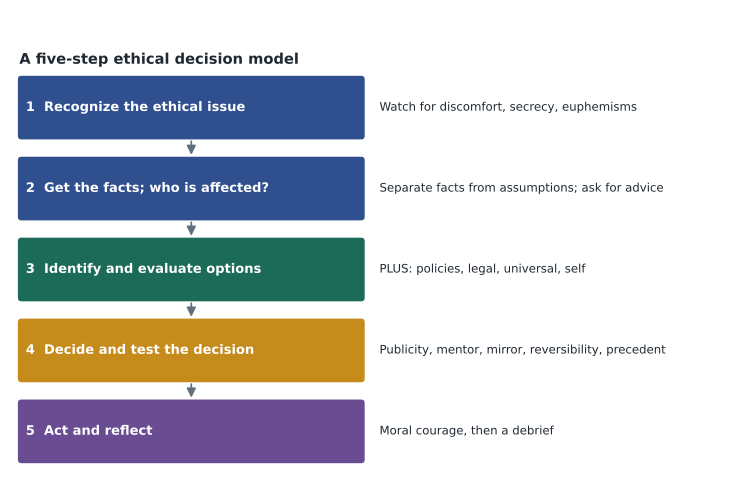
The first and most important step is noticing. Psychologists use the term ethical fading for the process by which the ethical dimension of a decision drops out of view, so that a choice about honesty is experienced as a choice about paperwork, or a choice about fairness is experienced as a choice about efficiency. Euphemisms speed the fading. Officers who talk about tuning someone up, cleaning up a report or giving a ticket to make the numbers have already reframed an ethical choice as a technical one. Signs that a decision has an ethical dimension include feeling uncomfortable, wanting to keep the decision quiet, hoping a supervisor will not ask, imagining how it would look on video, and noticing that someone stands to gain or lose something important.
Desjardins gives an example from his own career. As a new detective he was asked by a senior colleague to sign a statement saying he had been present for an interview that he had actually joined halfway through. The colleague said it was just a formality. It took Desjardins several seconds to realize that he was being asked to sign something untrue under the colleague's authority, and that the word formality was doing the work of making that feel ordinary. He declined, and the colleague rewrote the statement. Recognizing the issue was the hard part; deciding was easy once he saw it.
Step 2: get the facts and identify who is affected
Many ethical mistakes come from acting on assumptions. Before deciding, officers should ask what is actually known, what is assumed, and what could be checked. Who is affected by the decision: the person in front of the officer, victims, colleagues, the service, the wider community? What laws, policies and duties apply? Who has authority to decide, and is it the officer? Sometimes getting the facts dissolves the problem; the gift turns out to be an approved community event, or the colleague's apparent misconduct turns out to have an explanation. Sometimes it sharpens the problem, which is also useful.
Getting the facts can include getting advice. Officers are not expected to solve hard ethical questions alone. Most services have people whose job includes answering them: a trusted supervisor, the professional standards bureau, a legal adviser, a training officer and, for questions about conflicts of interest or outside work, a designated ethics or human resources contact. The police association can advise on rights and process. Asking for advice is not a sign of weakness. Desjardins tells the class that in twenty-eight years he never saw an officer disciplined for asking whether something was allowed, and he saw many disciplined for not asking.
Step 3: identify and evaluate the options
Officers under pressure tend to see two options: do it or do not. There are almost always more. A colleague's misconduct can be addressed by speaking to the colleague, by asking a supervisor for advice, by making a formal report, or by a combination. A suspicious gift can be refused, accepted and reported, or redirected to a charity under policy. Generating options before evaluating them makes better choices possible. Each option can then be tested against the frameworks from Lesson 2 and against a widely used checklist called the PLUS model, developed by the Ethics Resource Center. PLUS asks four questions: does the option fit the organization's Policies, is it Legal, does it fit Universal principles such as honesty, fairness and respect, and does it satisfy my personal definition of right, good and fair, the Self?
Step 4: decide and test the decision
Once an option is chosen, it should be tested before it is carried out. Several quick tests have stood up well in professional ethics training. The publicity test asks whether the officer would be comfortable seeing the decision described accurately on the front page or played in court from body camera footage. The mentor test asks what the most respected officer the person knows would think. The mirror test asks whether the officer could look at himself or herself in the mirror and feel the decision was right. The reversibility test asks how the officer would feel if the decision were made about him or her or a family member. The precedent test asks whether the officer would be willing to make the same decision every time the same facts arose. A decision that fails any of these tests deserves a second look.
The tests work because they bring in perspectives that pressure tends to exclude. Under stress, attention narrows to the immediate problem and the people present. The publicity test brings in the community, the mentor test brings in the profession, the reversibility test brings in the person affected, and the precedent test brings in consistency, which is the core of fairness. Marco says the body camera test is the one he expects to use most, because footage is now part of almost every serious encounter. Desjardins agrees but warns against the cynical version, in which the question becomes whether anyone will find out. The test is meant to imagine an honest audience, not to estimate the risk of being caught.
Step 5: act and reflect
Deciding is not the same as acting. Officers often know what is right but find it hard to do, especially when it means disappointing a colleague or a supervisor. Researchers call the gap between knowing and doing moral courage, and later lessons return to it in the context of reporting misconduct. After acting, reflection closes the loop. What happened? Would the officer make the same choice again? What made the decision hard, and what would make it easier next time? Many services now encourage debriefs after critical incidents that include not only tactical questions but ethical ones. Reflection is also where virtue is built: the habits of noticing, slowing down and choosing well grow stronger each time they are used.
The quick version: deciding with little time
Many police decisions cannot wait for five steps. A use-of-force decision may have to be made in seconds. Ethics does not disappear in those moments; it is carried in training, habits and values that were formed earlier. This is why services invest in scenario-based training that builds good responses into instinct, and why the slower decisions matter so much: they shape the instincts officers rely on when there is no time. When there are a few seconds or minutes, a compressed version still helps: is this lawful, is it within policy, is it fair, and would I be comfortable explaining it? Decisions about reports, gifts, colleagues and complaints almost always allow time for the full model, and officers should take it.
The code below turns the PLUS questions and the quick tests into a simple checklist and applies it to three options in a common situation: a restaurant owner on Malhotra's beat offers him free meals whenever he is on shift. The point is not that a program can make ethical decisions. It is that writing the questions down forces them to be answered explicitly, and an option that fails any of them stands out.
# PLUS questions and quick tests applied to responses to an offer of free meals
questions = ["policy", "legal", "universal", "self", "publicity", "reversibility", "precedent"]
options = {
    "accept free meals every shift": {
        "policy": False, "legal": True, "universal": False, "self": False,
        "publicity": False, "reversibility": False, "precedent": False},
    "decline politely and pay full price": {
        "policy": True, "legal": True, "universal": True, "self": True,
        "publicity": True, "reversibility": True, "precedent": True},
    "accept once, then report it to a supervisor": {
        "policy": False, "legal": True, "universal": True, "self": True,
        "publicity": True, "reversibility": True, "precedent": False},
}
for name, answers in options.items():
    failed = [q for q in questions if not answers[q]]
    verdict = "passes every test" if not failed else "fails: " + ", ".join(failed)
print(f"{name:45s} {verdict}")accept free meals every shift fails: policy, universal, self, publicity, reversibility, precedent decline politely and pay full price passes every test accept once, then report it to a supervisor fails: policy, precedent
The output shows that only declining and paying passes every test. Accepting once and reporting it is honest, but it fails the policy question at a service, such as Port Ardent, whose policy prohibits accepting gratuities, and the precedent question because it cannot become the routine. Lesson 7 looks at gratuities in more detail, including why some services allow token items and others ban them entirely.
Traps that distort decisions
Even with a model, decisions can go wrong because of predictable psychological traps. Groupthink is the pressure to agree with a team, strongest in close-knit groups facing outside criticism, which describes many police platoons. Obedience to authority, demonstrated in Stanley Milgram's experiments in the 1960s, leads people to follow instructions they would otherwise refuse. Confirmation bias leads investigators to notice evidence that supports their theory and discount evidence against it, a pattern found in many wrongful convictions. Moral licensing is the tendency to feel entitled to a lapse after doing something good, as when an officer who worked a double shift feels he has earned a free meal. Fatigue, anger and fear all narrow attention and make rationalization easier.
Rationalizations deserve special attention because they are the words people use to make wrong feel right. Common ones in policing include: everyone does it; no one gets hurt; they deserve it; the system is broken anyway; it is not my job to report it; and I will only do it this once. Desjardins asks the class to write each one on an index card and keep the cards for the rest of the course. Whenever a case study involves misconduct, the class will look for the rationalization the officer used. By the end of the term, he says, students will hear these phrases in their own heads before they say them aloud, and that is the moment a decision model is meant for.
| Rationalization | What it claims | Question that exposes it |
|---|---|---|
| Everyone does it | Common practice makes it acceptable | Would it be acceptable if it were described honestly in public? |
| No one gets hurt | There is no victim | What happens to trust, to the courts and to the officer? |
| They deserve it | The target has forfeited fair treatment | Who decided, and by what process? |
| The system is broken | Rules can be bent to get justice | What happens when every officer decides which rules to follow? |
| It is not my job | Someone else is responsible | What does the code of conduct say about reporting? |
| Just this once | One exception does not matter | Would I make the same decision every time? |
Worked problem
A request from a supervisor
Linh, now working part-time as a call-taker in the Port Ardent communications centre, notices that the computer-aided dispatch log for a call shows a unit arriving at 10:52 p.m., but the officer's report, which she happens to see when it is attached to the file, says 10:41 p.m. The difference matters because a complainant has alleged that officers took too long to respond to a domestic call. A shift supervisor asks her to amend the dispatch log to match the report because the officer probably forgot to press the arrival button.
Show solution
- Recognize the issue: changing an official record to match another record, in a matter under complaint, is an honesty question, not a clerical one.
- Get the facts: the dispatch log is created automatically; the report was written later from memory. The radio recording and GPS data can show the actual arrival time.
- Identify options: amend the log, refuse, refuse and suggest checking GPS and radio data, or ask the communications manager for direction.
- Test the options: amending a record to fit the officer's account fails policy, universal principles, publicity and precedent. Checking objective data passes every test.
- Act and reflect: decline politely, suggest that the GPS and radio records be retrieved and attached, and note the request in writing.
Answer: Linh should not change the log. The right course is to preserve the original record, point to objective data that can settle the question and document the request. If the officer's time is correct, the GPS will show it; if not, the discrepancy is exactly what the complaint process needs to see.
Common mistakes
MistakeEthical decisions only arise in dramatic situations.
InsteadMost ethical decisions are ordinary: how to write a report, whether to accept a gift, how to treat a difficult person. Recognizing them is the first step.
MistakeIf there is no time, ethics does not apply.
InsteadFast decisions rely on habits and training built by slower decisions. Most ethical choices about reports, gifts and colleagues allow time to use the full model.
MistakeThe body camera test means asking whether anyone will find out.
InsteadThe test imagines an honest audience judging the decision, not the risk of being caught.
MistakeThere are only two options: do it or do not.
InsteadGenerating several options, such as speaking to a colleague, consulting a supervisor or reporting formally, often reveals a better choice.
Summary and key terms
- Ethical trouble usually comes from not recognizing an ethical issue, deciding under pressure or rationalizing.
- A five-step model: recognize the issue, get the facts, evaluate options, decide and test, then act and reflect.
- The PLUS model asks whether an option fits policies, the law, universal principles and the officer's own sense of right.
- Quick tests include the publicity, mentor, mirror, reversibility and precedent tests.
- Groupthink, obedience, confirmation bias, moral licensing and fatigue predictably distort decisions.
- Learning to hear rationalizations such as everyone does it or just this once is a key defence against misconduct.
- Ethical fading
- The process by which the ethical dimension of a decision drops out of view, often through euphemism.
- PLUS model
- A decision checklist asking about Policies, Legal requirements, Universal principles and the Self.
- Moral courage
- The willingness to act on ethical judgment despite personal risk or social pressure.
- Confirmation bias
- The tendency to notice evidence that supports one's belief and discount evidence against it.
- Moral licensing
- Feeling entitled to a lapse after doing something good.
- Rationalization
- A justification that makes a wrong action feel acceptable.
Practice problems
Work each problem on paper first, then reveal the answer to check.
List the five steps of the decision model in order.
Show answer
Recognize the ethical issue; get the facts and identify who is affected; identify and evaluate options; decide and test the decision; act and reflect.
What do the letters in PLUS stand for?
Show answer
Policies, Legal, Universal principles and Self.
Give two warning signs that a decision has an ethical dimension.
Show answer
Feeling uncomfortable or wanting to keep it quiet; also hoping a supervisor will not ask, or imagining how it would look on video.
Why is changing a dispatch time to match an officer's report a problem even if the officer is probably right?
Show answer
It alters an official record without evidence, in a matter under complaint; objective data such as GPS should settle the question instead.
Lesson quiz · 5 questions
Score 60% or more to complete this lesson.
Create a free account to save your progress, take quizzes and earn a certificate.