
LES-105 · Lesson 10 of 12 · 20 min
The code of silence, reporting misconduct and the duty to intervene
▶ Video coming soon A video version of this lesson is on the way.
Desjardins begins this class differently. He describes, without naming anyone, a night early in his career when he watched a senior officer slap a handcuffed teenager in the back of a cruiser after a long foot chase. The teenager was not hurt badly. Desjardins said nothing that night and wrote nothing. A week later another officer asked him, casually, whether he had seen anything, and he said no. He tells the class that he has thought about that night more than about almost anything else in twenty-eight years, and that it was not the slap that stayed with him but his silence. This lesson is about that silence: why it happens, what it costs, and what officers are required and able to do about misconduct by colleagues.
The code of silence
The code of silence, sometimes called the blue wall, is the informal norm that officers do not report or testify against each other. It is reinforced by real features of police work: officers depend on each other for physical safety, they share experiences outsiders do not understand, they often feel unfairly criticized by the public and the media, and they fear that a colleague who reports misconduct cannot be trusted to back them up in danger. Research has found the code to be widespread. A national survey of American officers conducted for the Police Foundation and published in 2000 found that about half agreed it was not unusual for officers to turn a blind eye to improper conduct by other officers, and a substantial minority said they would not report a colleague's serious misconduct. Carl Klockars and colleagues, using scenario-based integrity surveys in several countries, found that willingness to report depended heavily on how serious officers judged the misconduct to be and on whether they expected discipline to be fair.
The code of silence does real harm. It allows misconduct to continue and escalate. It leaves victims without remedy. It exposes the officers who stay silent to discipline and, in serious cases, prosecution. It damages public trust when, as often happens, the misconduct and the silence come out together. And it harms the many officers who would never commit misconduct themselves but are tarred by colleagues they protected. Desjardins tells the class that the most damaging thing about the slap he witnessed was not the teenager's injury but what his silence taught the senior officer, the teenager and himself.
Why officers stay silent
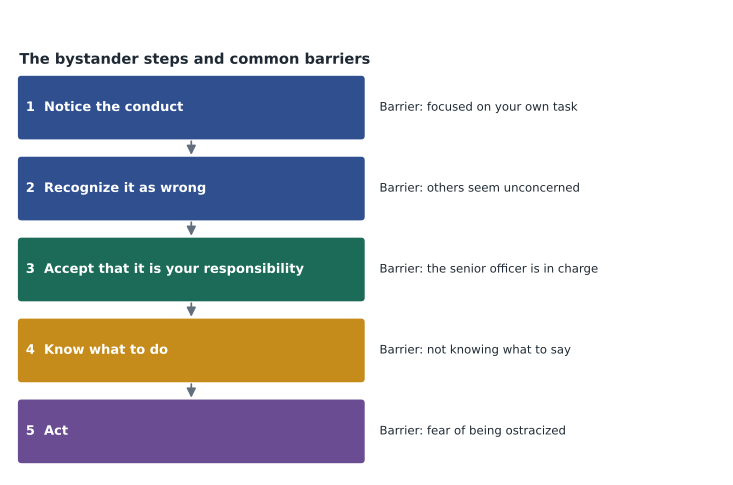
Social psychologists Bibb Latané and John Darley, studying why bystanders fail to help in emergencies, described a sequence of steps a bystander must pass through: notice the event, interpret it as a problem, accept responsibility, know how to help and decide to act. Failure at any step produces inaction. Each step has a police version. Officers may not notice misconduct because they are focused on their own tasks. They may interpret it as acceptable because others seem unconcerned. They may assume responsibility lies with the senior officer or the supervisor. They may not know what to say or do, especially to a superior. And they may fear the consequences: ostracism, poor assignments, a reputation as a rat, or no backup when they need it. Rank and seniority make each step harder, which is why junior officers, who are often the ones present, find intervening so difficult.
The duty to intervene
Officers have a duty to intervene when a colleague is using excessive force or committing other serious misconduct in their presence. The duty has become far more explicit since 2020. In Canada, police codes of conduct and service policies require officers to report misconduct and, increasingly, to intervene to prevent excessive force, and an officer who stands by while another commits an assault may face discipline and, in some circumstances, criminal liability as a party to the offence. Services' conduct and use-of-force policies in Ontario and elsewhere set out these expectations, and failing to act on them is treated as misconduct.
The duty to intervene recognizes that the best moment to stop misconduct is while it is happening, and that the people best placed to stop it are the other officers present. Intervention can take many forms short of physical action: a word, such as I've got this, or a hand on a colleague's shoulder; stepping between a colleague and a person; calling a supervisor; or later, reporting and giving an honest account. The aim is to prevent harm to the person and also to protect the colleague from doing something that will end his or her career.
Active bystandership training
Because knowing the duty is not enough, services have begun training officers in how to intervene. The New Orleans Police Department developed a peer intervention program called EPIC, for Ethical Policing Is Courageous, in 2016, drawing on the work of psychologist Ervin Staub, who had studied why bystanders intervene or fail to intervene in atrocities. Georgetown University's Law Center built on EPIC to launch the Active Bystandership for Law Enforcement project, known as ABLE, in 2020, which trains officers in many agencies, including some in Canada. The training teaches officers to recognize warning signs, practise short intervention phrases, intervene early before situations escalate, and accept intervention from colleagues gracefully. It treats intervention as a sign of loyalty rather than betrayal: the officer who stops a colleague from using excessive force has saved that colleague's career.
The training also emphasizes the receiving side. If officers know that a colleague's intervention is expected and welcomed, they are less likely to resist it in the moment. Marco, who served in the military, says the idea reminds him of how good units handle mistakes: the person who catches a safety error is thanked, not resented. Desjardins agrees and adds that culture changes when senior officers model accepting intervention, such as a sergeant who thanks a constable at a briefing for stepping in.
Reporting misconduct after the fact
Many situations do not call for intervention in the moment but for reporting afterward: a colleague who falsifies a report, steals property, misuses a database or harasses a member of the public. Codes of conduct generally require officers to report misconduct they become aware of, and failing to report can itself be misconduct. Reporting channels usually include the supervisor, the professional standards bureau and, in some cases, external bodies. In Ontario, the Law Enforcement Complaints Agency and the Inspector General of Policing provide routes for raising concerns outside the service, and collective agreements, human rights law and service policies prohibit reprisals against members who report in good faith.
Officers who report misconduct have historically faced retaliation, from social isolation to threats. Frank Serpico, who reported corruption in the New York Police Department in the late 1960s, was shot in the face during a drug raid in 1971 in circumstances that led him to believe his colleagues had failed to back him up. Services that want honest reporting must protect those who report: by keeping their identity confidential where possible, by treating retaliation as serious misconduct and by visibly supporting them. Desjardins tells the class that the ethics of reporting are not abstract for most officers; they are about real colleagues, often friends. The decision model from Lesson 3 still applies, and so do the options: speak to the colleague first if the misconduct is minor and correctable, seek advice, and report formally when the conduct is serious, ongoing or involves harm to the public.
The role of supervisors and leaders
Whether officers intervene and report depends heavily on what their supervisors and leaders do. Research on police integrity has consistently found that officers' willingness to report misconduct is higher in agencies where they believe discipline is fair, consistent and proportionate, and lower where they believe it is arbitrary or political. If officers think a colleague will be fired for a minor lapse, or that well-connected officers escape consequences for serious ones, the code of silence grows stronger. Sergeants matter most, because they are the leaders officers see every shift. A sergeant who shrugs off a rough arrest teaches the platoon that it is acceptable; a sergeant who asks questions, reviews body camera footage and follows up teaches the opposite.
Desjardins describes the best sergeant he worked for, who began each night shift briefing with a short story about something an officer had done well the night before, often a moment of restraint or kindness rather than an arrest. Over months, he says, the platoon's idea of what counted as good police work shifted. When the same sergeant learned that an officer had slammed a prisoner into a cell door, he dealt with it immediately and openly, without humiliating the officer, and the platoon understood that both kinds of conduct were noticed. Leaders also matter because they decide how the service responds when misconduct is reported: whether the person reporting is protected and thanked, or quietly moved and isolated. Every officer in the service watches what happens to the first person who speaks up.
Early intervention systems
Services also try to catch problems before they become serious misconduct through early intervention systems, which track indicators such as complaints, use-of-force reports, vehicle collisions, sick leave and lawsuits, and flag officers whose patterns stand out from peers doing similar work. Samuel Walker's research found that such systems, if well designed, can reduce problems, but that they work only if supervisors respond with support, such as coaching, training or wellness help, rather than treating a flag as a finding of guilt. The code below shows the basic logic using Port Ardent patrol data. It flags officers whose counts of use-of-force reports and complaints are well above the platoon median for officers with similar call volumes.
# Early intervention: flag officers well above peers on force reports and complaints (12 months)
from statistics import median
officers = {
    "P-101": {"calls": 610, "force": 3, "complaints": 1},
    "P-102": {"calls": 590, "force": 2, "complaints": 0},
    "P-103": {"calls": 640, "force": 11, "complaints": 4},
    "P-104": {"calls": 600, "force": 4, "complaints": 1},
    "P-105": {"calls": 575, "force": 3, "complaints": 2},
    "P-106": {"calls": 620, "force": 5, "complaints": 1},
}
def per100(o, key):
    return 100 * o[key] / o["calls"]
for key in ("force", "complaints"):
    med = median(per100(o, key) for o in officers.values())
    print(f"{key}: platoon median {med:.2f} per 100 calls")
    for badge, o in officers.items():
        rate = per100(o, key)
        if rate > 2 * med and o[key] >= 3:
print(f" {badge}: {rate:.2f} per 100 calls -> supervisor review")force: platoon median 0.59 per 100 calls P-103: 1.72 per 100 calls -> supervisor review complaints: platoon median 0.17 per 100 calls P-103: 0.62 per 100 calls -> supervisor review
One officer, P-103, is flagged on both measures. The review that followed found that P-103 had been working nights for eighteen months without a break, had gone through a divorce and had stopped attending fitness and defensive tactics refreshers. The supervisor arranged a move to days, a wellness referral and refresher training. Six months later the officer's rates were close to the platoon median. Not every flag ends so well, and some reveal misconduct that requires discipline. But the example shows the purpose of early intervention: to help officers before they hurt someone or themselves.
Worked problem
The colleague who goes too far
Malhotra and a senior officer, Constable Brandt, arrest a man for assault after a bar fight. The man is handcuffed and seated on the curb, swearing at the officers. Brandt, who was punched during the arrest, grabs the man's hair and pulls his head back hard, then raises his fist. Malhotra is five metres away.
Show solution
- Observe and interpret: a handcuffed, seated person who is only swearing poses no threat that justifies force. Pulling his hair and raising a fist is excessive force.
- Accept responsibility: Malhotra is the only other officer present, so the duty to intervene falls on him regardless of Brandt's seniority.
- Act early: step in, using a calm phrase such as I've got him, Brandt, go get checked out, and position himself between Brandt and the man.
- Care for the person: check the man for injury and call for medical assessment if needed.
- Report: inform the sergeant as soon as possible and record what he observed accurately in his notes, including Brandt's actions and his own intervention.
Answer: Malhotra must intervene immediately and report what happened. Stepping in protects the man from harm and protects Brandt from criminal charges and the end of his career. Staying silent would make Malhotra complicit and expose him to discipline as well.
Common mistakes
MistakeReporting a colleague is disloyal.
InsteadLoyalty to colleagues does not include protecting misconduct. Intervening or reporting often protects the colleague from worse consequences and protects the public and the service.
MistakeThe duty to intervene applies only to supervisors.
InsteadEvery officer present has the duty, regardless of rank, and junior officers are often the ones present.
MistakeIntervening always means physical action.
InsteadIntervention ranges from a word or a hand on the shoulder to stepping between people, calling a supervisor and reporting afterward.
MistakeAn early intervention flag means the officer is guilty of misconduct.
InsteadFlags identify patterns that need a supervisor's attention; the purpose is support and prevention, not punishment.
Summary and key terms
- The code of silence is the informal norm against reporting colleagues, reinforced by dependence and solidarity.
- The bystander model explains why officers fail to intervene: they must notice, interpret, accept responsibility, know how and act.
- Officers have a duty to intervene in excessive force and serious misconduct in their presence; codes and policies make this explicit.
- Active bystandership training such as EPIC and ABLE teaches officers how to intervene and accept intervention.
- Codes require reporting misconduct, and protection for those who report depends on service policy, human rights law and external routes such as the Inspector General.
- Early intervention systems flag concerning patterns so supervisors can offer support before misconduct occurs.
- Code of silence
- The informal norm that officers do not report or testify against each other.
- Duty to intervene
- The obligation of officers present to stop a colleague's excessive force or serious misconduct.
- Bystander effect
- The tendency of individuals to fail to act when others are present or responsibility seems to lie elsewhere.
- Active bystandership
- Training officers to intervene early and effectively to prevent harm and misconduct.
- Whistleblower
- A person who reports wrongdoing within an organization.
- Early intervention system
- A system that tracks indicators such as complaints and use of force to identify officers who may need support.
Practice problems
Work each problem on paper first, then reveal the answer to check.
List the five steps in the bystander model.
Show answer
Noticing the event, interpreting it as a problem, accepting responsibility, knowing how to help, and deciding to act.
Give two forms of intervention short of physical force.
Show answer
Saying a short phrase such as I've got this and stepping between the colleague and the person; also calling a supervisor.
In the code example, why was P-103 flagged?
Show answer
P-103's use-of-force and complaint rates per 100 calls were more than twice the platoon median, with at least three of each.
Why does early intervention depend on how supervisors respond?
Show answer
Because systems work only if flags lead to support such as coaching, training or wellness help rather than being treated as findings of guilt.
Lesson quiz · 5 questions
Score 60% or more to complete this lesson.
Create a free account to save your progress, take quizzes and earn a certificate.