
LES-104 · Lesson 8 of 12 · 24 min
Taking written and recorded statements
▶ Video coming soon A video version of this lesson is on the way.
Three days after the break-in, Ruth Lindqvist comes to the Port Ardent police station to give a formal statement. She has run Lakeshore Hardware for twenty-two years and has never been inside a police interview room before. She is nervous and slightly annoyed: she has already told the story four times, to the night officer, to her insurer, to her staff and to her husband. The detective explains why this time is different. 'This is the version that goes to court,' he says. 'If anything in it is wrong, or different from what you told us before, I'd rather we find out now than have a lawyer find it for us in a year.'
A statement is a formal record of what a person says about an incident, made in a way that allows it to be used later in court. This lesson covers statements from witnesses and victims and, more briefly, the special rules that apply to statements from suspects. It explains the difference between notes of what someone said and a formal statement, the main ways statements are taken, what makes a statement reliable and admissible, and how statements are checked against each other.
Notes of what was said versus formal statements
An officer's notes often record what witnesses and suspects said, sometimes word for word. Those notes are evidence of what the officer heard. A formal statement is different: it is the person's own account, adopted by them, usually by signing a written document or by swearing or affirming to its truth on a recording. The difference matters in court. A witness can be asked whether a formal statement is accurate and can be confronted with it if their testimony differs. Notes made by an officer can show what the officer heard, but the witness may say the officer misheard or misunderstood.
Formal statements are taken when an incident is serious enough that the witness or victim will probably testify, when the account is complex, or when there is a risk the witness will later change the story, become unavailable or be pressured. For minor incidents, many agencies rely on the officer's notes and report. For the Lakeshore Hardware case, formal statements are taken from the owner, Ruth Lindqvist, and the neighbour, Mira Osei. The taxi driver and the restaurant patrons gave brief accounts recorded in officers' notes.
Ways of taking a statement
Statements can be taken in several ways, and agencies' policies specify which method to use for which kinds of case. The trend in both countries has been strongly toward audio and video recording, because a recording captures the exact words, the questions asked, the person's demeanour and the conditions of the interview, and removes disputes about what was said.
| Method | How it works | Strengths | Weaknesses |
|---|---|---|---|
| Witness writes it | The witness writes the account in their own words and signs it | Clearly the witness's own words | Often incomplete or disorganized; depends on literacy |
| Officer writes it (question and answer or narrative) | The officer writes down what the witness says, reads it back, and the witness corrects and signs it | More complete and organized | Risk that the officer's words replace the witness's; questions may not be recorded |
| Audio recording | The interview is recorded and later transcribed | Exact words and questions preserved | No visual record of demeanour or exhibits |
| Video recording | The interview is recorded on video, often in a dedicated room | Most complete record; shows demeanour, gestures and conditions | Requires equipment and a suitable room; must be retained and disclosed |
When an officer writes the statement, the greatest danger is that it ends up in the officer's words rather than the witness's. A witness who said 'I saw a guy run out' should not be recorded as saying 'I observed a male exiting the premises.' The statement should use the witness's vocabulary, including slang and uncertainty: 'I think he had a bag, maybe.' Questions the officer asked should be recorded too, either in question-and-answer form or by noting where a passage was prompted by a question. Otherwise a reader cannot tell which details the witness offered freely and which came in response to a suggestion.
In Canada, a recorded statement can be given special weight if it meets the conditions set out by the Supreme Court in R. v. B. (K.G.) (1993). If the witness is told about the importance of telling the truth and the consequences of lying, swears an oath or makes a solemn affirmation, and the statement is video recorded in full, the statement may later be admitted for the truth of its contents if the witness recants at trial. Such statements are commonly called KGB statements, and many services take them from key witnesses in serious cases. Section 715.1 of the Criminal Code allows a video-recorded statement of a witness under eighteen, made within a reasonable time after the offence, to be admitted if the witness adopts it while testifying.
Taking a statement step by step
Whatever the method, the process of taking a formal statement from a witness or victim follows similar steps. It overlaps with the PEACE interview model from lesson 7, because a statement is normally the product of an interview.
- Prepare: review what is already known, decide on the method, arrange an interpreter or support person if needed, and choose a quiet, private place.
- Introduce: explain who you are, why the statement is being taken, how it will be used and that the person may be called to testify. Record the person's full identifying details and how they were confirmed.
- Free account: let the person tell what happened in their own words, without interruption, as in the free recall phase of an interview.
- Questions: probe each part of the account with open questions, then clarify details with closed questions, avoiding leading questions.
- Record: write down or record the account in the person's words, including the questions asked.
- Review: read the statement back, or have the person read it, and invite corrections. Corrections are made by drawing a single line through the error and having the person initial the change, as in a notebook.
- Adopt: the person signs each page and the end of the statement, or confirms the recording is true, and the officer records the date, time, place and the names of everyone present.
Two things should never happen. The officer should never write a statement from the notes and ask the witness to sign it without reading it, and should never leave out information the witness gave because it does not fit the investigation's theory. Both have contributed to wrongful convictions. A statement that the witness has read, corrected and adopted, in their own words, with the questions recorded, is far stronger evidence, and far harder to attack, than one that reads as if the officer wrote it.
Statements from suspects
Statements from people suspected of a crime raise legal issues that this course can only introduce; the criminal procedure and investigations courses cover them in depth. The central concerns are that a suspect's statement must be voluntary and that the suspect's constitutional rights must be respected. A statement obtained by threats, promises, oppression or trickery that would shock the community, or in violation of the right to counsel, may be excluded from evidence, and the whole case may collapse with it.
In Canada, the common law confessions rule requires the Crown to prove beyond a reasonable doubt that a statement by an accused to a person in authority was voluntary; the Supreme Court set out the modern test in R. v. Oickle (2000). Section 10(b) of the Charter gives a detained person the right to retain and instruct counsel without delay and to be told of that right. Officers give a caution that the person is not obliged to say anything and that anything said may be given in evidence, and a secondary caution if the person has already spoken to other officers. The time each caution and rights advisement was given, the exact words used and the person's response must be recorded.
The probationary officer arrested Kyle Brandt at 2:29 a.m. Her notes record that she informed him of the reason for his arrest and his right to counsel at 0236 hrs and cautioned him at 0237 hrs, and that he said, 'I want a lawyer. I'm not saying anything.' She stopped there and asked no questions about the break-in. In the cruiser, on the way to the station, he said without being asked, 'That old lady's tools aren't even worth that much.' She wrote the words down exactly, with the time, and noted that the remark was unprompted. Whether it can be used will be decided by the court, but it can only be considered if it was recorded accurately and the circumstances were documented.
Comparing statements
Investigators routinely compare a witness's different accounts: the first account at the scene, the formal statement, any later statements and eventually the testimony. Some differences are normal: a later account may be fuller because the witness had time to think, or less detailed because memory has faded. Other differences are significant, such as a detail that appears for the first time after the witness read about the case on social media, or a key fact that changes. All differences must be disclosed. Identifying them early allows investigators to ask the witness about them and to understand the evidence before the defence does.
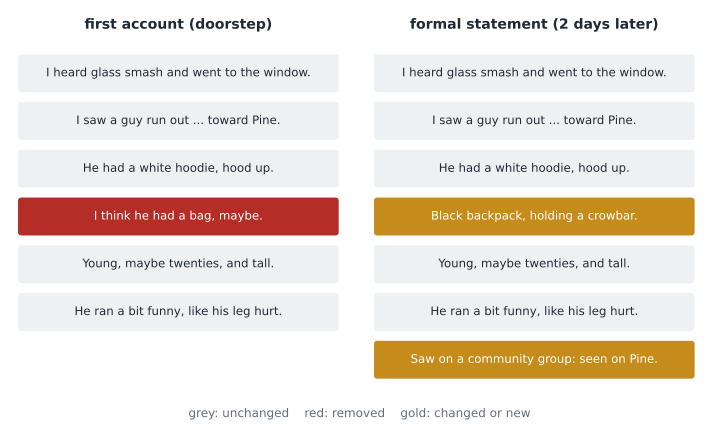
The detective compares Mira Osei's first account, from the doorstep recording, with her formal statement given two days later. The program below uses Python's difflib module, which compares two texts line by line, to show which statements were removed, added or kept between the two versions.
import difflib

first = """I heard glass smash and went to the window.
I saw a guy run out of the store and go toward Pine.
He had a white hoodie with the hood up.
I think he had a bag, maybe.
He was young, maybe twenties, and tall.
He ran a bit funny, like his leg hurt.""".splitlines()

formal = """I heard glass smash and went to the window.
I saw a guy run out of the store and go toward Pine.
He had a white hoodie with the hood up.
He had a black backpack and was holding a crowbar.
He was young, maybe twenties, and tall.
He ran a bit funny, like his leg hurt.
I saw on the community group online that someone saw him on Pine.""".splitlines()

for line in difflib.ndiff(first, formal):
    if line.startswith(("- ", "+ ")):
        print(line)
same = sum(1 for line in difflib.ndiff(first, formal) if line.startswith("  "))
print(f"{same} of {len(first)} first-account lines unchanged")- I think he had a bag, maybe. + He had a black backpack and was holding a crowbar. + I saw on the community group online that someone saw him on Pine. 5 of 6 first-account lines unchanged
The comparison shows that most of the account is unchanged, but two differences need attention. In her first account Ms. Osei said she thought the man had 'a bag, maybe'; in her formal statement she says he had a black backpack and was holding a crowbar. On the doorstep, the probationary officer had asked her the leading question 'He had a crowbar, didn't he?', to which she replied that she was not sure. The crowbar may now be a genuine memory, or it may be the product of that question and of what she has heard since. The new final line shows that she has read a social media post about the case, a likely source of contamination. The detective does not try to resolve these differences. He records them, asks her about them neutrally, documents her answers and ensures that both versions and the doorstep recording are disclosed.
Statements and the people who give them
Giving a statement can be stressful, especially for victims. Officers should explain the process, allow breaks, offer water and, for victims of violent or sexual crimes, offer a support person and information about victim services. People have the right to a copy of their statement in most circumstances, although agencies may delay providing it during an active investigation. Witnesses should be told that they may be contacted by the defence, that they may choose whether to speak with defence counsel, and that they should not discuss their evidence with other witnesses.
Officers should also be careful about what they tell witnesses. Telling a witness that the suspect has confessed, that other witnesses saw the same thing or that the suspect has a long record can change the witness's account and confidence. Promises should never be made about the outcome of the case. And no one should ever be offered a benefit in exchange for a statement without the involvement of a supervisor and, usually, the prosecutor, because inducements can make a statement unreliable and must be disclosed.
Worked problem
Writing a statement in the witness's words
Ruth Lindqvist tells the detective: 'When I got there the door was all smashed in, there was glass everywhere outside, and the drill display was pretty much cleaned out. I keep the serial numbers of everything in the receiving binder, so I could tell you exactly which ones. Nobody has permission to be in the store after we close at six. Only me and my manager have keys.' Write the passage of her statement.
Show solution
- Keep her words: 'When I got there the door was all smashed in, there was glass everywhere outside, and the drill display was pretty much cleaned out.'
- Record the time she arrived if she gives it, and clarify with an open question if she does not: 'Q: What time did you get there? A: About half past three. The officer called me at quarter to three.'
- Record the facts that prove ownership and lack of permission in her words: 'I own Lakeshore Hardware. We close at six. Nobody has permission to be in the store after we close. Only me and my manager, Tom Reyes, have keys.'
- Record the basis for identifying the property: 'I keep the serial numbers of everything in the receiving binder. I checked the binder and gave the officer the serial numbers of the four drills and the saw that were missing.'
Answer: The statement keeps her vocabulary, records the question that produced the time, and captures in her own words the facts the prosecution needs: ownership, lack of permission and how the stolen property was identified. She will read it, correct any errors with her initials and sign each page.
Common mistakes
MistakeOfficers should write statements in proper police language so they sound professional.
InsteadStatements must be in the witness's own words, including slang and uncertainty.
MistakeOnly the answers matter in a statement, not the questions.
InsteadRecord the questions so readers know which details the witness volunteered and which were prompted.
MistakeIf a witness's later account differs, use the more helpful version.
InsteadRecord and disclose every version and the differences; ask the witness about them neutrally.
MistakeOnce a suspect asks for a lawyer, officers should keep talking casually until he changes his mind.
InsteadRespect the right to counsel: hold off questioning until the person has had a reasonable opportunity to consult counsel, and record everything said.
Summary and key terms
- A formal statement is the person's own account, adopted by signing or by oath or affirmation on a recording; notes record what the officer heard.
- Statements can be written by the witness, written by the officer, or recorded on audio or video; recording gives the most complete record.
- A KGB statement, under oath, warned and video recorded, may be admitted for its truth if the witness recants; s. 715.1 covers video statements of young witnesses.
- Take statements by preparing, introducing, obtaining a free account, questioning, recording, reviewing with initialled corrections and having the person adopt it.
- Suspects' statements must be voluntary and respect the right to counsel; record cautions, rights advisements, exact words and times.
- Compare a witness's accounts, record and disclose every difference, and avoid telling witnesses things that could change their accounts.
- Formal statement
- A person's account of an incident, adopted by them in writing or on a sworn or affirmed recording.
- Adopting a statement
- Confirming that a statement is true and accurate, by signing it or affirming it.
- Recant
- To withdraw or contradict an earlier statement.
- Voluntariness
- The requirement that a suspect's statement not be obtained by threats, promises, oppression or other improper means.
- Caution
- A warning to a suspect that he or she need not say anything and that what is said may be used in evidence.
- Inducement
- A promise or benefit offered in exchange for a statement.
Practice problems
Work each problem on paper first, then reveal the answer to check.
What is the difference between an officer's notes of what a witness said and a formal statement?
Show answer
Notes record what the officer heard; a formal statement is the witness's own account, adopted by the witness.
Why should the questions asked be recorded in a statement?
Show answer
So that readers can tell which details the witness offered freely and which were prompted, which affects reliability.
How should a correction in a written statement be made?
Show answer
With a single line through the error, the correction written in, and the witness's initials beside it.
A witness's first account mentions a bag; her formal statement mentions a backpack and a crowbar. What should the investigator do?
Show answer
Record both versions, ask her neutrally about the difference and how she knows, record her answer and disclose everything.
Give one advantage of video recording a statement.
Show answer
It preserves the exact words, questions, demeanour and conditions, removing disputes about what was said.
Lesson quiz · 5 questions
Score 60% or more to complete this lesson.
Create a free account to save your progress, take quizzes and earn a certificate.