
LES-104 · Lesson 3 of 12 · 26 min
Observation and memory: getting the facts right
▶ Video coming soon A video version of this lesson is on the way.
Professor Desjardins starts the third class with a trick. Halfway through his introduction, a man in a grey jacket walks into the room, takes a laptop bag from the desk at the front, says 'Sorry, wrong room' and leaves. The whole thing takes about eight seconds. The professor carries on talking for ten minutes and then asks the class to write down everything they can about the man. The results are humbling. Estimates of his height range across a hand's width. Two students say he had a beard; he did not. Marco DiSanto, who served in the military and prides himself on noticing things, is sure the jacket was black. Only Linh Tran noticed that the man wore a lanyard with a visitor's badge, which turns out to matter: he was a technician from the college's IT department, playing his part in an exercise the professor runs every year.
Notes and reports can only be as accurate as the observations and memories that go into them. This lesson explains how perception and memory work, why both are far less reliable than people believe, and what officers can do to observe more accurately, record more faithfully and avoid contaminating their own memories and those of witnesses. Much of what follows comes from decades of psychological research on eyewitness memory, research that has changed how police around the world conduct interviews and identification procedures.
Perception: we see less than we think
Perception is not a camera. The eyes take in far more information than the brain can process, so attention selects a small part of it and the brain fills in the rest from experience and expectation. One famous demonstration, by the psychologists Daniel Simons and Christopher Chabris in 1999, asked viewers to count basketball passes in a short video. About half failed to notice a person in a gorilla suit who walked through the middle of the game, stopped, thumped its chest and walked off. The effect is called inattentional blindness: when attention is focused on one task, even striking events outside that focus can go unseen.
Officers are especially vulnerable to this effect because their attention is so often focused. An officer watching a suspect's hands for a weapon may not notice what the suspect is wearing on his feet, the licence plate of the car behind him or a second person standing in a doorway. This is not a failure of training or character; it is how human attention works. The practical lesson is that an officer should never assume that because something was not noticed, it was not there, and should be honest in notes and in court about what was and was not observed.
Expectation shapes perception too. People are more likely to see what they expect to see and to interpret ambiguous information in line with their expectations. An officer told that a suspect is armed may perceive a phone or a wallet as a weapon, especially in poor light and under stress. An officer who expects a domestic call to involve a male aggressor may misread who is the primary aggressor. Being aware of expectation does not eliminate its effect, but it encourages officers to separate what they saw from what they assumed and to record the difference.
Stress and perception
Many of the events officers must later describe happen under intense stress: a fight, a pursuit, a weapon drawn, a serious collision. Stress triggers physiological changes that help a person survive a threat but distort perception and memory. Officers who have been involved in critical incidents commonly report tunnel vision, a narrowing of visual attention to the threat; auditory exclusion, in which loud sounds such as gunshots seem muted or go unheard; and time distortion, in which events seem to happen in slow motion or extremely fast. Many also report memory gaps for parts of the incident and, sometimes, clear memories of things that did not happen.
Researchers who have interviewed officers after shootings, and those who have studied officers in realistic training scenarios, have found that accuracy for peripheral details drops sharply under high stress, that officers often misjudge the number of shots fired and the time elapsed, and that memory for the sequence of events is often confused. These findings explain why policies on writing notes after critical incidents matter, why some agencies recommend a rest period before a full interview, and why an officer who cannot remember part of an incident should say so rather than fill the gap with a guess. A report that admits a gap is far more credible than one that describes, with false confidence, details the officer could not have perceived.
How memory works
Memory is usually described in three stages. Encoding is the process of taking in information and forming a memory; it depends on attention, so details that were never attended to are never encoded. Storage is the retention of the memory over time; memories fade and change during storage. Retrieval is the process of recalling the memory; it can be helped or hindered by the way a person is asked about it. Errors can enter at every stage, and police procedures can either reduce or increase them.
The most important single finding about storage is that forgetting is fast at first and then slows. In the 1880s the German psychologist Hermann Ebbinghaus showed that people forget a large share of newly learned material within the first hour and the first day, after which the rate of forgetting levels off. Later research on real events has found the same pattern for many details, although emotionally significant events and their central features are often remembered better than trivial ones. The lesson for police is simple: record details as soon as possible, and interview witnesses as early as practicable, before the details fade.
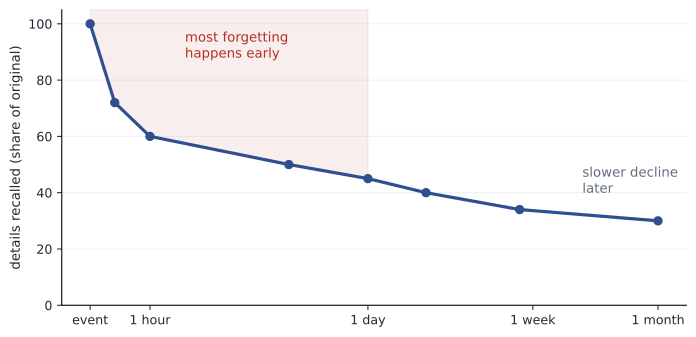
Memory is also reconstructive. Rather than replaying a stored recording, people rebuild a memory each time they recall it, using fragments of what they encoded along with knowledge, expectations and information learned afterward. The rebuilt memory feels like an original, and people cannot reliably tell which parts came from the event and which came from somewhere else. This is why repeated questioning, conversations with other witnesses and media reports can change what a witness remembers, sincerely and without any intention to deceive.
The misinformation effect
In a famous 1974 experiment, the psychologists Elizabeth Loftus and John Palmer showed students a film of a car collision and asked how fast the cars were going when they 'hit' or when they 'smashed into' each other. Students asked with the word 'smashed' estimated higher speeds. A week later, they were also more likely to report seeing broken glass, although there was none in the film. A single word in a question had changed both the estimate and the memory itself. Hundreds of later studies have confirmed the misinformation effect: information introduced after an event, through leading questions, conversations or photographs, can be absorbed into the memory of the event.
For police, the misinformation effect has direct consequences. An officer who asks a witness, 'Was the knife in his right hand?' has introduced the idea of a knife. An officer who tells a witness that the suspect has been caught and has a record has given the witness a reason to be more confident. Witnesses who talk to each other at the scene can merge their memories, so that a detail one witness mentioned appears in another's statement. The remedies are taught in later lessons: separate witnesses as soon as possible, ask open questions, avoid suggesting details and record exactly what each witness said and what each was asked.
Officers are subject to the same effect. Two officers who discuss a fight before writing their notes may each end up with a more similar, and less accurate, account than either had alone. Courts and oversight bodies view collaborative note writing with deep suspicion for this reason. Officers may share basic information needed for safety and to continue the investigation, but each officer's notes should record his or her own observations, and if an officer learns something from a colleague, the notes should say so: 'Cst. Malhotra told me the suspect had discarded a crowbar in the alley,' not 'The suspect discarded a crowbar in the alley.'
Factors that affect eyewitness accuracy
Researchers divide the factors affecting eyewitness memory into two groups. Estimator variables are features of the event and the witness that the justice system cannot control but can take into account when weighing evidence. System variables are features of how police gather the evidence, which the justice system can control. Both matter, but system variables are where police practice makes the greatest difference.
| Type | Factor | Effect on accuracy |
|---|---|---|
| Estimator | Viewing conditions: distance, lighting, duration, obstructions | Accuracy falls with distance, darkness and brief views |
| Estimator | Stress and the presence of a weapon | High stress and weapon focus reduce memory for faces and peripheral details |
| Estimator | Cross-race effect | People are less accurate at recognizing faces of a different race or ethnicity |
| Estimator | Delay between event and recall | Details fade and become more vulnerable to change |
| Estimator | Alcohol and drugs | Intoxication impairs encoding |
| System | How questions are asked | Leading or suggestive questions introduce misinformation |
| System | Contact between witnesses | Witnesses who talk to each other can merge memories |
| System | Identification procedures | Biased lineups and showups increase mistaken identifications |
| System | Feedback to witnesses | Telling a witness they chose the suspect inflates later confidence |
Weapon focus deserves special mention. When a weapon is present, witnesses tend to look at it, and their memory for the person holding it is poorer as a result. The cross-race effect is also well established: people are, on average, better at recognizing faces of their own racial or ethnic group than those of other groups. Neither effect means a witness is lying or careless. They are reasons to look for other evidence that can confirm or contradict an identification.
Perhaps the most important finding concerns confidence. Jurors and police naturally trust a confident witness more than an uncertain one. Research shows that a witness's confidence at the time of a first, fair identification does carry useful information about accuracy. But confidence expressed later, after feedback, repeated questioning and preparation for trial, often grows while accuracy does not. Mistaken eyewitness identification has been a factor in a large share of wrongful convictions later overturned by DNA evidence in both countries. In Canada, the inquiry into the wrongful conviction of Thomas Sophonow in Manitoba, reported in 2001, made detailed recommendations on identification procedures, including that lineups be conducted by an officer who does not know who the suspect is and that a witness's level of confidence be recorded at once. Identification procedures are covered in more depth in the investigations course.
Estimating height, weight, distance and time
People are poor at estimating physical measurements, and their errors are not random. Witnesses tend to overestimate short durations, especially stressful ones, so a robbery that took thirty seconds may be described as lasting several minutes. Height and weight estimates are pulled toward the witness's own height and weight and toward the average. Distances are often misjudged, particularly at night. Ages of people much older or younger than the witness are often estimated poorly.
Officers can improve their own estimates, and those they collect from witnesses, by using reference points. An officer who knows his or her own height can compare a suspect's height to it. A witness asked 'How tall was he compared to me?' or 'compared to the door frame?' usually gives a better estimate than one asked for a number. Distances can be measured afterward from where the witness stood, and durations can be checked against video, phone records or computer-aided dispatch time stamps. When recording an estimate, officers should record how it was obtained: 'Witness said he was about my height; I am 178 cm' gives the court far more than 'Suspect approx. 178 cm.'
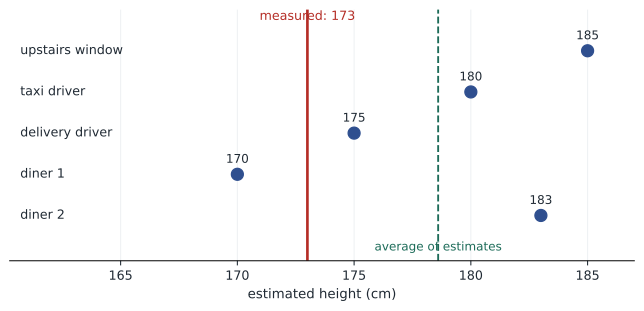
The Lakeshore Hardware investigation gives the class a chance to see this in practice. Five people saw the man who ran from the store, at different distances and in different light: the neighbour in the upstairs apartment, a taxi driver waiting at the corner, a delivery driver and two people leaving a restaurant. Their estimates of his height were recorded, and the man later arrested was measured at the station. The code below compares the estimates with his actual height.
# Height estimates (cm) for the man seen running from Lakeshore Hardware
actual = 173
estimates = {
    "neighbour, upstairs window, 25 m": 185,
    "taxi driver, at corner, 15 m": 180,
    "delivery driver, across road": 175,
    "diner 1, restaurant doorway": 170,
    "diner 2, restaurant doorway": 183,
}
errors = {who: est - actual for who, est in estimates.items()}
for who, err in errors.items():
    print(f"{who:34s} {estimates[who]} cm  error {err:+d}")
mean_est = sum(estimates.values()) / len(estimates)
mean_abs = sum(abs(e) for e in errors.values()) / len(errors)
print(f"mean estimate {mean_est:.1f} cm (actual {actual})")
print(f"mean absolute error {mean_abs:.1f} cm; range {min(estimates.values())}-{max(estimates.values())} cm")
print("overestimates:", sum(e > 0 for e in errors.values()), "of", len(errors))neighbour, upstairs window, 25 m 185 cm error +12 taxi driver, at corner, 15 m 180 cm error +7 delivery driver, across road 175 cm error +2 diner 1, restaurant doorway 170 cm error -3 diner 2, restaurant doorway 183 cm error +10 mean estimate 178.6 cm (actual 173) mean absolute error 6.8 cm; range 170-185 cm overestimates: 4 of 5
The estimates varied widely, and four of the five witnesses overestimated the man's height, the neighbour looking down from an upstairs window by the most. This is typical: people seen running, at night and from a distance, are often judged taller than they are, and viewing from above distorts height. The average of the estimates was closer to the truth than most individual estimates, which is one reason investigators collect descriptions from every witness rather than relying on the first. None of the witnesses was wrong in any blameworthy sense, but a description broadcast as 'tall male' on the strength of the neighbour's estimate alone could have led officers to stop the wrong man.
Observing like a professional
Officers cannot eliminate the limits of perception and memory, but they can work with them. Experienced officers develop habits that improve what they notice and what they keep. They scan a scene systematically when they arrive, from near to far and from one side to the other, rather than letting their eyes go wherever movement draws them. They describe people in a fixed order, which lesson 6 covers in detail, so that nothing is forgotten. They say important details aloud on the radio or into a body-worn camera as they observe them, creating an immediate record. And they write notes as soon as safety allows.
Professionals also distinguish carefully between sources. Every fact in a set of notes came from somewhere: the officer's own senses, a named witness, a database check, a document or another officer. Recording the source of each fact protects the officer in court and helps investigators judge how much weight to give it. A useful habit is to write 'I saw', 'I heard' or 'I smelled' for personal observations and to name the source for everything else. Marco DiSanto, after the grey-jacket exercise, writes his own rule in the margin of his notes: 'Black jacket? I thought so. Did I see it? Apparently not.'
Worked problem
Separating observation, information and assumption
Constable Malhotra's draft notes for 2:20 a.m. read: 'Suspect broke front door of Lakeshore Hardware with crowbar, took tools, fled E on foot. Tall W/M, 20s, white hoodie.' Rewrite the entry so that each fact shows its source, assuming she saw the broken door, the neighbour told her about the man running and the crowbar was found later by another officer.
Show solution
- What she saw: '0219 Arrived. I saw the glass in the front door of Lakeshore Hardware smashed; glass on the sidewalk outside the door. Tool display inside disturbed.'
- What she was told: '0221 Mira Osei, apartment above 410 Harbour St, told me: “I heard glass break, looked out and saw a guy run out and go east toward Pine. He had a white hoodie up. He looked young, maybe twenties, and tall.” She viewed him from her front window, about 25 m away, under the streetlight.'
- What others reported: '0233 Cst. Okoro told me he found a crowbar in the alley east of the store.'
- What she did not see: she should not write that 'the suspect broke the door' or 'took tools'; no one saw that yet.
Answer: The rewritten notes say who saw what and from where. They avoid assuming that the man the neighbour saw is the person who broke the door, which still has to be proven, and they record the conditions of the neighbour's view, which the court will need to judge her description.
Common mistakes
MistakeA trained officer sees and remembers everything accurately.
InsteadOfficers are subject to the same limits of attention and memory as everyone else, especially under stress; honest notes acknowledge what was not observed.
MistakeA confident witness is an accurate witness.
InsteadConfidence at a first, fair identification carries some information, but later confidence often grows without any gain in accuracy.
MistakeTalking with other officers before writing notes helps get the facts straight.
InsteadDiscussing events before writing can merge memories; each officer should record his or her own observations and name the source of anything learned from others.
MistakeWitnesses who disagree on details must be lying.
InsteadHonest witnesses often differ because of viewing conditions, stress and memory; disagreement is normal and should be recorded, not resolved by the officer.
Summary and key terms
- Perception is selective: inattentional blindness and expectation mean people miss events outside their focus and see what they expect.
- Stress causes tunnel vision, auditory exclusion, time distortion and memory gaps; officers should admit gaps rather than fill them.
- Memory involves encoding, storage and retrieval; forgetting is fastest in the first hours and days, and memory is rebuilt each time it is recalled.
- The misinformation effect shows that leading questions and conversations can change memories; separate witnesses and ask open questions.
- Estimator variables, such as lighting and the cross-race effect, cannot be controlled; system variables, such as questioning and lineups, can.
- Use reference points for estimates, record how each estimate was obtained and the source of every fact.
- Inattentional blindness
- Failure to notice an unexpected event when attention is focused on something else.
- Tunnel vision
- A narrowing of visual attention to a threat under high stress.
- Reconstructive memory
- The rebuilding of a memory from fragments, knowledge and later information each time it is recalled.
- Misinformation effect
- The distortion of a memory by information encountered after the event.
- Weapon focus
- The tendency of witnesses to look at a weapon, reducing memory for the person holding it.
- Estimator variable
- A factor affecting eyewitness accuracy that the justice system cannot control.
- System variable
- A factor affecting eyewitness accuracy that police procedures can control.
Practice problems
Work each problem on paper first, then reveal the answer to check.
Name the three stages of memory.
Show answer
Encoding, storage and retrieval.
Why should officers interview witnesses as soon as practicable?
Show answer
Because forgetting is fastest in the first hours and days, and delay leaves memories more open to change from later information.
Rewrite the leading question 'Was he wearing a red jacket?' as an open question.
Show answer
For example: 'Tell me what he was wearing.'
Five witnesses estimate a suspect's height as 170, 175, 180, 185 and 190 cm, and he is 175 cm. What is the mean absolute error?
Show answer
Errors are -5, 0, 5, 10 and 15; their absolute values sum to 35, so the mean absolute error is 7 cm.
Give one estimator variable and one system variable.
Show answer
For example lighting or the cross-race effect (estimator) and the wording of questions or the lineup procedure (system).
Lesson quiz · 5 questions
Score 60% or more to complete this lesson.
Create a free account to save your progress, take quizzes and earn a certificate.