
LES-104 · Lesson 4 of 12 · 24 min
Writing occurrence reports: structure and narrative
▶ Video coming soon A video version of this lesson is on the way.
By 4:30 on the morning of the Lakeshore Hardware break-in, the probationary officer riding with Constable Malhotra has eleven pages of notes, a dozen photographs, a seized crowbar, a backpack full of power tools and a man in a cell. None of that is yet a case. It becomes one when she sits down at the computer in the report room and writes the occurrence report, the formal record that will carry the investigation forward. Dev Malhotra pulls up a chair beside her. 'Your notes are for you,' she says. 'This is for everyone else. Tell it so that someone who was not there can see it.'
This lesson explains what police reports are for, the main types of report, how they are structured and how to write the narrative, the part of the report that tells the story in the officer's own words. Lesson 5 then concentrates on the language of reports: plain words, accuracy and objectivity. Lesson 6 covers the description of people, vehicles, property and scenes. Together they form the core of police writing.
What a report does
A police report has several jobs at once. It is the official record that an incident occurred and of what police did about it. It starts or continues an investigation by recording leads, witnesses and evidence. It supports decisions about charges: a Crown attorney in most provinces, or the police themselves in provinces where officers lay charges subject to later Crown review, will rely on it. It provides data for crime statistics, analysis and planning. It may be used by victims for insurance claims or applications for compensation. And it is a record of the officer's own conduct, read by supervisors and, if there is a complaint, by those who investigate it.
Because reports do so many jobs, agencies use a combination of structured fields and free text. The structured fields, completed through drop-down menus and forms in the records management system, capture the information that must be counted and searched: the type of offence, the date, time and location, the people involved and their roles, the property taken and its value, and the outcome. The narrative, written in full sentences, captures everything that does not fit in a box: what happened, in what order, what the officer observed and why the officer acted. In Canada, the structured fields feed Statistics Canada's Uniform Crime Reporting Survey, which classifies each incident by its most serious violation.
Types of police reports
Agencies use many types of report, and names vary from one service to another, but most fall into a few families. New officers should learn their own agency's forms and policies, which specify when each report is required and what it must contain.
| Report | Purpose |
|---|---|
| General occurrence report | The main record of an incident, written by the investigating officer |
| Supplementary report | Additional information added by the same or another officer after the original report: follow-up interviews, lab results, new evidence |
| Arrest report | Details of an arrest: grounds, time, location, rights given, search, injuries and transport |
| Witness statement | A witness's account in his or her own words, signed or recorded |
| Property and evidence report | Each item seized or found, where it went and who handled it |
| Collision report | A traffic collision, usually on a standard provincial or state form with a diagram |
| Use-of-force report | Any force used, the reasons for it and any injuries, as required by policy |
| Crown brief | The package of reports, statements and evidence prepared for the Crown when a charge is laid |
For the Lakeshore Hardware call, the probationary officer will write the main occurrence report, an arrest report and a property report for the crowbar and the tools. Constable Okoro, who found the crowbar, will write a supplementary report. Later, a detective will add supplementary reports about the suspect's interview and about a second break-in that may be linked. Each report stands on its own, but each refers to the others by number so that a reader can follow the whole file.
The structure of a report
Most agencies' report formats follow a similar structure, even when the headings differ. The report opens with a short summary that tells the reader at once what the incident was and how it ended. It then sets out the details in chronological order, followed by the investigation, the evidence and the outcome. Some services prescribe headings; others leave the officer to organize the narrative. Either way, a reader should be able to find the key facts quickly and follow the story from start to finish without having to guess.
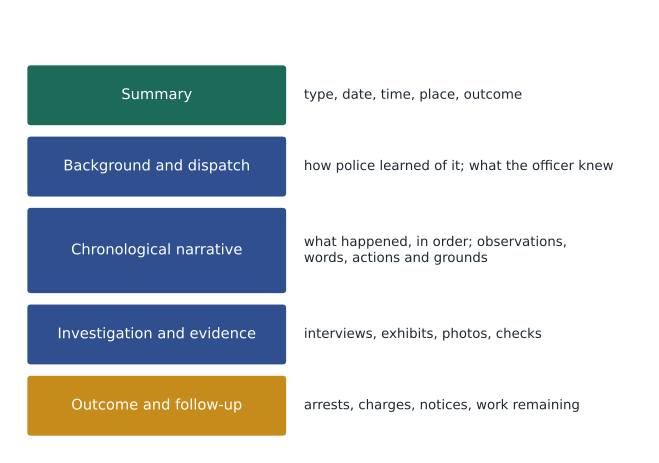
- Summary: one or two sentences giving the type of incident, the date, time and place, and the outcome. 'On Saturday, March 14, at about 0214 hrs, Lakeshore Hardware at 412 Harbour Street was broken into. A suspect was arrested at 0229 hrs on Pine Street with property taken from the store.'
- Background and dispatch: how police learned of the incident and what information the officer had on arrival. This matters because it explains why the officer acted as he or she did.
- Chronological narrative: what happened, in the order it happened, from the officer's arrival to the end of the officer's involvement, including observations, conversations, actions and the grounds for each decision.
- Investigation and evidence: interviews conducted, evidence collected and its handling, photographs taken, database checks and any other steps.
- Outcome and follow-up: arrests, charges or recommended charges, release conditions, notifications, referrals to victim services and any work still to be done.
The summary is often the only part read by busy people, such as a duty inspector scanning the night's reports or an analyst looking for patterns, so it must be accurate on its own. The narrative is read by those who need the full story. A common mistake is to put conclusions in the summary that the narrative does not support. If the summary says the suspect was 'caught in the act' but the narrative shows he was found three blocks away twelve minutes later, a defence lawyer will notice.
Writing the narrative
The narrative is the heart of the report. Professor Desjardins calls it 'the movie in words': a reader should be able to see the events as they unfolded. Most agencies now ask officers to follow a few basic conventions, which lesson 5 develops further.
- Write in the first person. 'I arrived at 0219 hrs' is clearer and more honest than 'the writer arrived' or 'this officer arrived', older conventions that some agencies have dropped.
- Write in the past tense, because the report describes events that have already happened.
- Use the active voice. 'Osei told me she saw a man run east' says who did what. 'It was reported that a man was seen running east' hides both the witness and the observer.
- Write in chronological order. Jumping back and forth in time confuses readers. If something learned later explains something earlier, say so explicitly: 'I later learned from the owner that the display had held cordless drills.'
- Use short paragraphs, one for each step or topic, so that the report is easy to follow and to quote.
- Name people consistently. Introduce each person with full name and role, then refer to them the same way throughout: 'the witness Mira Osei', then 'Osei'. Avoid switching between 'the complainant', 'the female' and 'Ms. Osei'.
The narrative must also show the officer's reasoning. Every significant decision, to detain, to search, to arrest, to use force, to release, requires legal grounds, and the report is where those grounds are recorded. An arrest without a warrant under section 495 of the Criminal Code requires reasonable grounds to believe the person has committed an indictable offence, and a court will look for those grounds in the report. It is not enough to write 'I had grounds to arrest the suspect.' The report must set out the facts that made up those grounds, so that a reader can judge them: the description broadcast, the time and distance from the store, what the man was wearing, what he was carrying and what he said.
Proving the elements
An experienced officer writes with the elements of the offence in mind. Every criminal offence is made up of elements that the prosecution must prove, and a report that leaves an element out may leave the prosecutor unable to proceed. For break and enter under section 348 of the Criminal Code, the Crown must prove, among other things, that the accused broke and entered a place and did so with intent to commit an indictable offence there, or committed one there. Identity, date and place must always be proved too.
The probationary officer's first draft describes the broken door, the neighbour's account and the arrest, but it says nothing about who owns the store or whether anyone gave the man permission to be there, and it does not describe the property found on the man in enough detail to link it to the store. Dev Malhotra points this out. The owner, Ruth Lindqvist, must be named as the owner, and the report must record that she gave no one permission to enter. The tools must be described by brand, model and, where possible, serial number, and the report must say how they were identified as the store's: the owner recognized the price labels and the serial numbers matched the store's inventory. Without those facts, the prosecutor would have a man with some tools and a broken door, but not a break-in.
Building the timeline
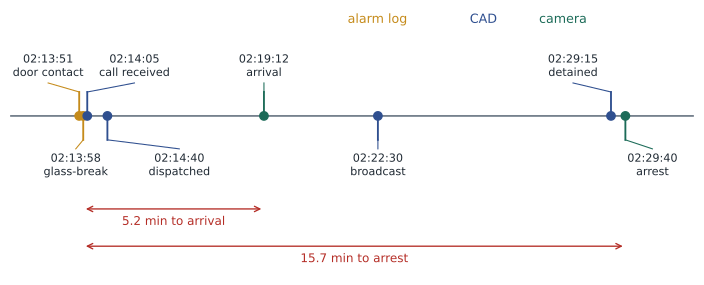
Times are among the most important facts in any report, and they come from several sources that rarely agree to the minute: the officer's notes, the computer-aided dispatch system, the alarm company's records, body-worn camera time stamps, phone records and witnesses' own estimates. A good report gives times precisely and says where they came from when it matters. The probationary officer assembles the main times for the Lakeshore Hardware call from three sources and uses a short program to merge them in order and calculate the intervals between key events.
# Merge time stamps from three sources into one timeline
events = [
    ("CAD", "02:14:05", "alarm call received from monitoring company"),
    ("CAD", "02:14:40", "unit 12 dispatched"),
    ("alarm log", "02:13:51", "front door contact opened"),
    ("alarm log", "02:13:58", "glass-break sensor triggered"),
    ("BWC", "02:19:12", "unit 12 arrives, door glass broken"),
    ("notes", "02:21", "witness Osei describes male running east"),
    ("CAD", "02:22:30", "description broadcast to all units"),
    ("CAD", "02:29:15", "unit 14: male detained on Pine Street"),
    ("BWC", "02:29:40", "arrest by unit 12"),
]
def secs(t):
    parts = [int(p) for p in t.split(":")] + [0]
    return parts[0] * 3600 + parts[1] * 60 + parts[2]
events.sort(key=lambda e: secs(e[1]))
start = secs(events[0][1])
for src, t, what in events:
    m, s = divmod(secs(t) - start, 60)
    print(f"{t:8s} +{m:2d}:{s:02d}  [{src:9s}] {what}")
alarm = secs("02:13:58"); arrive = secs("02:19:12"); arrest = secs("02:29:40")
print(f"break-in to arrival: {(arrive - alarm) / 60:.1f} min")
print(f"break-in to arrest: {(arrest - alarm) / 60:.1f} min")02:13:51 + 0:00 [alarm log] front door contact opened 02:13:58 + 0:07 [alarm log] glass-break sensor triggered 02:14:05 + 0:14 [CAD ] alarm call received from monitoring company 02:14:40 + 0:49 [CAD ] unit 12 dispatched 02:19:12 + 5:21 [BWC ] unit 12 arrives, door glass broken 02:21 + 7:09 [notes ] witness Osei describes male running east 02:22:30 + 8:39 [CAD ] description broadcast to all units 02:29:15 +15:24 [CAD ] unit 14: male detained on Pine Street 02:29:40 +15:49 [BWC ] arrest by unit 12 break-in to arrival: 5.2 min break-in to arrest: 15.7 min
The merged timeline shows that the door opened at 2:13:51 and the glass-break sensor triggered seven seconds later, before the alarm company had even called police. The first unit arrived just over five minutes after the break-in and the arrest followed about fifteen and a half minutes after it. These intervals matter in court. The shorter the time between the break-in and the arrest, and the closer the man was found to the store, the stronger the inference that he is the person the neighbour saw. The report should therefore give the exact times and their sources, rather than writing 'shortly after' or 'a few minutes later.'
Note also that the alarm log shows the door contact opening seven seconds before the glass-break sensor triggered. That detail might mean the door was forced open and the glass broke as it swung, or it might reflect a small difference between the two sensors' clocks. The officer should not guess. The report should record both times and the source, and leave the interpretation to investigators, who may ask the alarm company about the sensors.
Before you submit
Every report should be reviewed before it is submitted, first by the officer and then, in most agencies, by a supervisor. Dev Malhotra teaches her trainees to read a report three times. The first reading checks completeness: are the five Ws and H answered, are all the elements of the offence covered, are all people, times and evidence recorded? The second checks accuracy: does every fact match the notes, the photographs and the time stamps? The third checks clarity: would a reader who was not there understand it? Reading the report aloud, or asking a colleague to read it, catches problems that the writer's eye skips over.
Supervisors return reports that are incomplete, unclear or inconsistent with other records, and new officers sometimes take this personally. Sergeant Haddad tells them it is the cheapest correction they will ever receive. A weakness found by a supervisor costs an hour of rewriting. The same weakness found by a defence lawyer in cross-examination can cost a case and an officer's reputation.
Worked problem
Turning notes into a narrative
The probationary officer's notes for 0219 to 0225 read: '0219 arr. Front glass door smashed, glass on sidewalk. 0221 Osei, apt above 410 Harbour: heard glass, saw male run out going E, white hoodie up, young, tall. Viewed from window under streetlight. 0222 broadcast.' Write the corresponding paragraphs of the narrative.
Show solution
- Start with the officer's own observation, in the first person and past tense: 'At 0219 hrs I arrived at Lakeshore Hardware, 412 Harbour Street. I saw that the glass in the front door was smashed. Pieces of glass lay on the sidewalk outside the door.'
- Introduce the witness fully and report her words, with the conditions of her view: 'At 0221 hrs I spoke with Mira Osei, who lives in the apartment above 410 Harbour Street, next door to the store. She told me she heard glass breaking, looked out of her front window and saw a man run out of the store and east toward Pine Street. She said he wore a white hooded sweatshirt with the hood up and appeared young, “maybe twenties”, and tall. She said the area was lit by the streetlight in front of the store.'
- Record the action and its time: 'At 0222 hrs I broadcast the description to all units.'
Answer: The narrative turns abbreviations into full sentences, keeps the order of events, separates what the officer saw from what the witness said, keeps the witness's own words where they matter and records the conditions of her view, all of which a reader will need.
Common mistakes
MistakeThe summary can say what probably happened.
InsteadThe summary must be accurate on its own and must not state conclusions the narrative does not support.
Mistake'I had reasonable grounds to arrest' is enough.
InsteadThe report must set out the specific facts that made up the grounds, so a reader can judge them.
MistakeTimes can be approximate in a report.
InsteadGive exact times and their sources; intervals between events often decide questions of identity and grounds.
MistakeOnce the main report is written, new information can be added by editing it.
InsteadNew information is added in a supplementary report, so the original remains as written and the file shows when each fact was recorded.
Summary and key terms
- A report records the incident and police action, carries the investigation forward, supports charging decisions, feeds crime statistics and documents the officer's conduct.
- Reports combine structured fields for counting and searching with a written narrative for everything else.
- A typical structure runs from summary, through background and a chronological narrative, to investigation, evidence and outcome.
- Write in the first person, past tense and active voice, in chronological order, with consistent names and short paragraphs.
- Record the facts that make up the grounds for every decision and cover every element of the offence.
- Give exact times with their sources, review every report three times and add later information in supplementary reports.
- Narrative
- The part of a report that tells what happened in full sentences, in the officer's own words.
- Supplementary report
- A report adding information to an existing file after the original report.
- Elements of an offence
- The facts the prosecution must prove to establish a particular crime.
- Grounds
- The facts that justify a police decision such as a detention, search or arrest.
- Active voice
- A sentence form in which the subject performs the action: "Osei told me", not "I was told".
- Uniform crime reporting
- Standard systems for counting crimes reported to police, which report fields feed.
Practice problems
Work each problem on paper first, then reveal the answer to check.
Give three purposes of a police report.
Show answer
For example: recording the incident, continuing the investigation, supporting a charging decision, producing statistics, supporting insurance claims and documenting the officer's conduct.
Rewrite in the active voice: 'The suspect was observed by this writer fleeing the scene.'
Show answer
'I saw the suspect run from the scene.'
An alarm triggers at 02:13:58 and an arrest is made at 02:29:40. How many minutes passed?
Show answer
15 minutes 42 seconds, about 15.7 minutes.
Why should new information be added in a supplementary report rather than by editing the original?
Show answer
So the original stays as written and the file shows when each fact was learned and recorded, which protects its integrity.
A report says the officer 'had grounds to arrest.' What should it say instead?
Show answer
The specific facts: the description broadcast, where and when the man was found, what he wore and carried, and anything he said.
Lesson quiz · 5 questions
Score 60% or more to complete this lesson.
Create a free account to save your progress, take quizzes and earn a certificate.