
LES-101 · Lesson 10 of 12 · 20 min
Wellness, stress and the realities of police work
▶ Video coming soon A video version of this lesson is on the way.
Professor Desjardins opens week ten in a way the students do not expect. He tells them about a night in his sixth year on patrol, when he was the first officer at a collision in which a young child died. He did his job: he secured the scene, comforted the parents, handled the other driver and wrote the report. He went home at 7 a.m., slept badly and went back to work two nights later as though nothing had happened, because that was what officers did then. For months he had trouble sleeping, snapped at his family and avoided the road where it happened. It was years before he talked to anyone about it. He tells the class that he is sharing the story because each of them may face a night like that, and because the culture of policing has changed enough that they will not have to face it alone. Today's lesson is about the human cost of police work and what officers and services can do about it.
Why policing is stressful
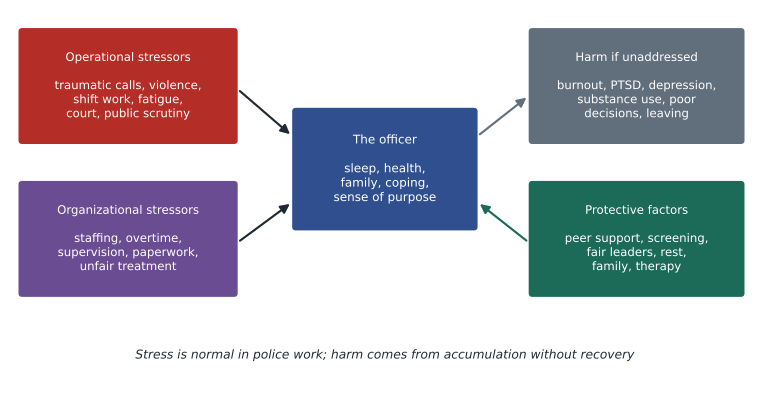
All jobs involve stress, and stress in moderate amounts can sharpen performance. Police work combines several kinds of stress that are unusual in their intensity and their mix. Researchers often divide them into two groups. Operational stressors arise from the work itself: exposure to death, injury, violence and human suffering; the risk of being assaulted or killed; the need to make split-second decisions with life-or-death consequences; shift work and fatigue; court appearances; and public criticism, now often amplified by video shared online. Organizational stressors arise from the workplace: staffing shortages, mandatory overtime, heavy paperwork, inconsistent supervision, perceived unfairness in promotion and discipline, and a culture that may treat asking for help as weakness.
A surprising finding of research is that officers often rate organizational stressors as more troubling than operational ones. Canadian researchers Donald McCreary and Megan Thompson developed widely used questionnaires that measure the two separately, and studies using them have repeatedly found high scores for organizational stress, especially lack of resources, staff shortages and feeling that supervisors and the public do not understand the job. This matters because organizational stress is something police leaders can directly change. A service can do little about the violence officers encounter, but it can fix scheduling, staffing, fairness and support.
Trauma and mental health
Over a career, a patrol officer may attend hundreds of incidents that most people never see once: sudden deaths, suicides, fatal collisions, child abuse, serious assaults. Most officers cope well with most of these events, especially with good support. But repeated exposure accumulates. A national survey of Canadian public safety personnel, published in 2018 by Nicholas Carleton and colleagues, found that about 44% screened positive for at least one mental disorder, such as post-traumatic stress disorder (PTSD), depression, anxiety or alcohol use disorder, far above the rate in the general population. Rates among RCMP members were especially high. Ontario law has since 2016 presumed that PTSD diagnosed in police officers and other first responders is caused by their work, making it easier to receive workers' compensation without having to prove the link, and the federal government adopted a national framework on PTSD in 2019.
Post-traumatic stress disorder involves symptoms such as intrusive memories and nightmares, avoiding reminders of the event, negative changes in mood and thinking, and being constantly on edge, lasting more than a month and interfering with daily life. Not every officer with symptoms has PTSD, and many recover with time and support. Other harms are less dramatic but more common. Burnout is a state of emotional exhaustion, cynicism and a sense that one's work no longer matters. Moral injury is the distress that comes from witnessing or taking part in events that violate one's sense of right and wrong, such as being unable to help a victim because of a system failure. Officers under chronic stress may drink more, sleep less, withdraw from family and become more irritable and less patient, which affects how they treat the public. Wellness is therefore not only an issue for officers; it is part of public safety and of fair policing.
Physical risks
Police work carries physical risks that range from the dramatic to the mundane. Canada loses a small number of officers each year in the line of duty, from assaults, vehicle collisions and accidents, and assaults on officers are far more common than deaths. Officers are injured in struggles with resisting people, in collisions and in falls. Less visible risks build up over years: back and hip problems from long hours in a car wearing a heavy duty belt, which has led many services to adopt load-bearing vests; poor diet on night shifts; and higher rates of cardiovascular disease. The International Agency for Research on Cancer classifies night shift work as probably carcinogenic to humans, because disrupting the body's internal clock affects hormones and cell repair.
Shift work and fatigue
Fatigue is one of the most underrated hazards in policing. Officers on night shifts must sleep during the day, when the body expects to be awake, and daytime sleep is usually shorter and lighter. Court appearances, family obligations and overtime cut into sleep further. Research has shown that being awake for 17 to 19 hours impairs performance about as much as a blood alcohol concentration of 0.05%, and that tired officers make more errors, have more collisions and are more likely to lose their temper. In a study of shift lengths carried out with American police departments and published in 2011, officers on ten-hour shifts got more sleep than those on eight-hour shifts, while officers on twelve-hour shifts reported more sleepiness and lower alertness. The code below models how sleep debt builds up over Port Ardent's 2-2-4 cycle.
# Sleep debt over an 8-day 2-2-4 cycle (illustrative model)
need = 7.5                     # hours of sleep needed per day
plan = [("day 1", 7.0), ("day 2", 6.5), ("night 1", 6.0), ("night 2", 5.0),
        ("off 1", 5.5), ("off 2", 8.5), ("off 3", 8.5), ("off 4", 8.0)]
debt = 0.0
for label, slept in plan:
    debt += need - slept       # positive means sleep owed
    debt = max(debt, 0.0)      # extra sleep cannot bank more than the debt
    print(f"{label:8s} slept {slept:4.1f} h  cumulative sleep debt {debt:4.1f} h")
worst = 0.0; d = 0.0
for label, slept in plan:
    d = max(d + need - slept, 0.0); worst = max(worst, d)
print(f"largest debt in the cycle: {worst:.1f} h, reached after the first day off")day 1 slept 7.0 h cumulative sleep debt 0.5 h day 2 slept 6.5 h cumulative sleep debt 1.5 h night 1 slept 6.0 h cumulative sleep debt 3.0 h night 2 slept 5.0 h cumulative sleep debt 5.5 h off 1 slept 5.5 h cumulative sleep debt 7.5 h off 2 slept 8.5 h cumulative sleep debt 6.5 h off 3 slept 8.5 h cumulative sleep debt 5.5 h off 4 slept 8.0 h cumulative sleep debt 5.0 h largest debt in the cycle: 7.5 h, reached after the first day off
The model shows debt building through the night shifts and peaking after the first day off, when officers often sleep only a few hours after coming home in the morning so that they can switch back to a normal day. In this example the days off repay only part of the debt: the officer starts the next cycle still owing five hours, and any overtime, court date or sick child pushes the debt higher. That is why many services now limit consecutive hours, require rest periods between shifts and court appearances, and train officers in sleep habits such as dark, quiet bedrooms and consistent routines. Marco notes that with two young children, his days off may not be as restful as the model assumes.
Protective factors and support
Officers do not have to accept harm as part of the job. Several protective factors reduce the risk of lasting damage. Social support from family, friends and colleagues is among the strongest. Peer support programs train officers to listen to colleagues after difficult events and connect them with professional help; officers are often more willing to talk first to someone who understands the work. Access to psychologists who know policing, confidentially and without fear of losing one's job, is essential. Many Canadian services use the Road to Mental Readiness program, adapted from the Canadian Armed Forces, which teaches officers to recognize the stages of mental health from healthy to ill and to use practical skills such as goal-setting, self-talk and tactical breathing. Some services require annual check-ins with a psychologist for all officers, or for those in high-exposure units such as child exploitation, so that seeking help becomes routine rather than a mark of weakness.
Evidence matters here as elsewhere. Single-session psychological debriefing immediately after a traumatic event, once standard in many services, has not been shown to prevent PTSD and may even harm some people by forcing them to relive events before they are ready. Current practice favours psychological first aid, practical support, monitoring over the following weeks and referral to evidence-based treatment, such as trauma-focused therapy, for those whose symptoms persist. Fair and supportive leadership is itself a protective factor: officers who trust that their supervisors will treat them fairly report less stress and less burnout. Linh points out that this means the organizational stressors from the start of the lesson are also the place to begin fixing things.
The realities of the job
None of this means policing is a miserable career. Surveys of officers consistently find high levels of meaning: the sense that their work protects people and makes a difference. Officers describe the satisfaction of finding a missing child, calming a dangerous situation without anyone being hurt, getting a violent person off the street or seeing a young person they once arrested turn their life around. The camaraderie of a good platoon is something many retirees miss more than anything else. Professor Desjardins says that the best years of his career were his last ones, running the community response unit, because he could finally see the long-term results of his work.
Jesse raises a reality specific to small communities: in Nimkii Bay, he will police people he grew up with, including relatives, and he will never really be off duty. Officers in small and Indigenous communities face particular stresses, including isolation, lack of backup and the weight of community expectations, alongside particular rewards. Amara reflects on her ride-along, where she watched Dev comfort a teenage cyclist who had been hit by a car and then, two hours later, laugh with a group of skateboarders at a plaza. She realizes that switching emotions so quickly is a skill, and probably a costly one. Priya asks how officers keep their families out of the darkness of the job. Professor Desjardins says that the honest answer is that they do not always succeed, and that the officers who do best are the ones who let their families in rather than shutting them out.
Worked problem
Recognizing warning signs in a colleague
Two months after a fatal shooting call, a member of Dev's platoon is arriving late, has had two collisions in the patrol car, has stopped joining colleagues for meals and snapped at a member of the public during a minor call. What should Dev, as a peer, do?
Show solution
- Recognize the pattern: changes in behaviour, irritability, withdrawal and errors after a traumatic event are recognized signs of stress injury.
- Approach privately and without judgment: ask how the colleague is doing, mention specific changes observed and listen rather than lecture.
- Offer concrete help: suggest the peer support team or the service's psychologist, offer to go with them and remind them that help is confidential.
- If there is any sign of risk of suicide, do not leave the person alone; ask directly about suicidal thoughts and involve a supervisor and professional help immediately.
Answer: Dev should speak to his colleague privately, describe what he has noticed, listen and connect him with peer support or professional help. Most stress injuries respond well to early support, and colleagues are often the first to notice that something is wrong.
Common mistakes
MistakeStress means an officer is not suited to policing.
InsteadStress is a normal response to the job; harm comes from accumulation without recovery, and support helps most officers recover.
MistakeThe danger of violence is the main source of police stress.
InsteadOrganizational stressors such as staffing, overtime and unfair treatment are often rated as more troubling.
MistakeTalking through a traumatic event immediately in a group prevents PTSD.
InsteadSingle-session debriefing has not been shown to prevent PTSD; monitoring, practical support and evidence-based treatment are preferred.
MistakeFatigue is just part of the job.
InsteadFatigue impairs performance like alcohol; services can limit hours, require rest and improve schedules.
Summary and key terms
- Police stress comes from operational sources, such as trauma and danger, and organizational sources, such as staffing and unfair treatment; the latter are often rated as worse.
- Canadian public safety personnel screen positive for mental disorders at high rates; Ontario presumes that PTSD in first responders is work-related.
- Burnout, moral injury and PTSD affect officers' health and the quality of their decisions and treatment of the public.
- Physical risks include assaults and collisions as well as long-term back, heart and sleep problems from shift work.
- Fatigue builds over shift cycles; schedule design, rest rules and sleep habits reduce it.
- Peer support, confidential psychological care, routine check-ins, fair leadership and family support protect officers.
- Operational stressor
- A source of stress arising from the work itself, such as trauma or danger.
- Organizational stressor
- A source of stress arising from the workplace, such as staffing, overtime or unfair treatment.
- Post-traumatic stress disorder
- A mental disorder after trauma involving intrusive memories, avoidance, negative mood and hyperarousal lasting more than a month.
- Burnout
- Emotional exhaustion, cynicism and a sense that one's work no longer matters.
- Moral injury
- Distress from witnessing or taking part in events that violate one's sense of right and wrong.
- Peer support
- A program in which trained officers support colleagues and connect them with professional help.
Practice problems
Work each problem on paper first, then reveal the answer to check.
Give two examples each of operational and organizational stressors.
Show answer
Operational: traumatic calls, risk of assault, shift work. Organizational: staffing shortages, mandatory overtime, unfair promotion.
Why does it matter that officers rate organizational stress so highly?
Show answer
Because leaders can directly change organizational conditions, even though they cannot remove the dangers of the work.
In the sleep model, why does debt peak after the first day off?
Show answer
Officers sleep only a few hours after the last night shift so that they can return to a normal daytime schedule.
Name three protective factors against harm from stress.
Show answer
Social support, peer support programs, confidential psychological care, fair leadership, adequate rest.
Lesson quiz · 5 questions
Score 60% or more to complete this lesson.
Create a free account to save your progress, take quizzes and earn a certificate.