
ITIL-130 · Lesson 5 of 12 · 33 min
Engage
Engage is the value chain activity that faces outward. It is where the organization listens to customers and users, works with suppliers and partners, and maintains the relationships through which value is co-created. Lesson 3 described engage as the main interface between the value chain and its stakeholders. This lesson looks at what engage involves in practice: understanding needs, consolidating demand, communicating transparently, managing relationships across different stakeholder groups, and turning feedback into action.
The purpose of engage
In plain terms, the engage activity provides a good understanding of stakeholder needs, transparency, continual engagement and good relationships with all stakeholders. Each part of that purpose matters. Understanding needs means going beyond the literal request to the outcome the stakeholder wants. Transparency means stakeholders can see what is happening with their requests and why decisions were made. Continual engagement means the relationship does not stop when a request is closed. Good relationships mean trust on both sides, which makes co-creation of value possible.
Engage applies to all stakeholders, not only customers. Users, sponsors, suppliers, partners, regulators, employees and the wider community all interact with the organization. Each group needs a different kind of engagement.
| Stakeholder group | What engage seeks to understand | Typical channels |
|---|---|---|
| Customers | Business outcomes, priorities, budgets, future plans | Account reviews, planning workshops, steering meetings |
| Users | Day-to-day needs, problems, experience | Service desk, portals, chat, surveys, user research |
| Sponsors | Investment rationale, expected value, risk appetite | Business cases, portfolio reviews |
| Suppliers and partners | Capabilities, roadmaps, constraints, performance | Supplier reviews, joint planning, contract meetings |
| Regulators | Requirements, expectations, upcoming changes | Consultations, reporting, inspections |
| Employees | Skills, workload, ideas, concerns | Team meetings, staff surveys, idea portals |
Inputs and outputs of engage
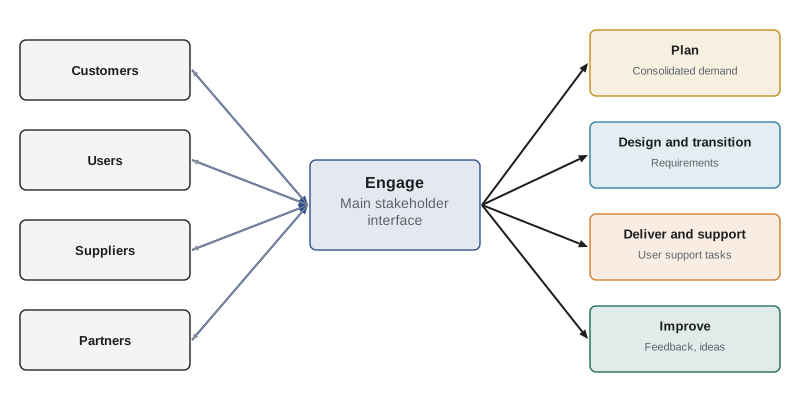
Engage receives demand and opportunities from outside the value chain, along with feedback from customers and users, information about third-party components from suppliers, and inputs from the other activities: plans and portfolio decisions from plan, product and service descriptions from design and transition, knowledge and information about components from obtain/build, and information about service performance from deliver and support.
Its outputs include consolidated demands and opportunities for plan; product and service requirements for design and transition; user support tasks for deliver and support; improvement initiatives and feedback for improve; change or project initiation requests; contract and agreement requirements; and knowledge and information about third-party services for the other activities.
From request to requirement
A stakeholder rarely states a requirement in a form that can be designed and built. A sales manager might ask for "a dashboard". The underlying need might be to spot deals at risk of slipping before the quarter ends. Engage translates the request into the outcome sought, the users involved, the constraints and the measures of success. That translation is what design and transition needs.
Worked problem
Turning a request into requirements
A clinic manager asks IT for "an app so patients can book online". Write three questions engage should ask and an outcome-focused requirement.
Show solution
- Question 1: What problem does online booking solve? (Answer: phone lines are busy and 15 % of callers hang up.)
- Question 2: Which patients and appointment types should it cover? (Answer: follow-up visits only; new patients still need a phone intake.)
- Question 3: What constraints apply? (Answer: health information privacy rules and integration with the existing scheduling system.)
- Requirement: Returning patients can book, change or cancel follow-up appointments online at any time, reducing abandoned calls by at least half within six months, in compliance with privacy requirements.
Answer: The requirement states the users, the outcome, a measure of success and the constraints, not just "an app".
Consolidating demand
Demand arrives through many channels from many stakeholders. Engage consolidates it so that plan can see the whole picture. Without consolidation, the same need may be requested five times by five departments and fulfilled five different ways, or conflicting requests may be accepted by different teams. Consolidation involves grouping similar requests, identifying common underlying needs and presenting them to plan with their sources and value.
Worked problem
Spotting duplicated demand
In one quarter, engage receives these requests: finance wants a supplier spending report; procurement wants a dashboard of purchase orders by supplier; operations wants to know which suppliers cause delivery delays; the audit committee wants supplier risk ratings. What consolidated demand should engage present to plan?
Show solution
- All four requests concern supplier information: spending, orders, performance and risk.
- A single supplier analytics capability, drawing on the same data, could meet all four needs.
- Engage should present one consolidated demand ("supplier analytics") listing the four stakeholders, their specific needs and the combined value.
- Plan can then decide whether to fund one shared solution instead of four separate reports.
Answer: Present one consolidated supplier analytics demand with four stakeholder needs. Consolidation avoids duplication and increases value.
Transparency and communication
Transparency builds trust. Stakeholders should be able to see the status of their requests, understand why priorities were set as they were, and know what to expect. Practical tools include self-service portals showing request status, published service catalogues, clear service level agreements, regular reports and honest communication during incidents. Engage also communicates decisions that stakeholders may not like: deferrals, rejections and changes in scope.
Transparency does not mean overwhelming stakeholders with data. A customer usually wants a short, meaningful summary: Are we getting the outcomes we need? What is changing? What do you need from us? Engage tailors communication to each audience.
Worked problem
Measuring transparency with a simple survey
A provider asks 80 customer representatives whether they agree that "I understand the status and priority of our requests". Responses: 18 strongly agree, 30 agree, 12 neutral, 14 disagree, 6 strongly disagree. What share agrees, and what is the net agreement score (agree minus disagree)?
Show solution
- Agree (strongly agree + agree): 18 + 30 = 48, or 48 ÷ 80 = 60 %.
- Disagree (disagree + strongly disagree): 14 + 6 = 20, or 25 %.
- Net agreement: 60 % − 25 % = +35 points.
- A quarter of customers do not feel informed, which is an improvement opportunity for engage.
Answer: 60 % agree and the net score is +35. The 25 % who disagree point to a transparency gap worth investigating.
Relationship management
The relationship management practice supports engage by establishing and nurturing links between the organization and its stakeholders at strategic and tactical levels. ITIL-110 introduced the spectrum of relationships from basic through cooperative to partnership. Engage adapts its approach to the relationship type. A basic relationship with a commodity supplier may need little more than contract monitoring. A partnership with a strategic customer needs joint planning, shared goals and regular senior-level conversations.
| Relationship type | Engagement style | Example |
|---|---|---|
| Basic | Transactional; focus on agreed service levels and prices | Buying standard cloud storage on published terms |
| Cooperative | Regular reviews; some joint problem solving | A managed service provider with quarterly service reviews |
| Partnership | Shared goals, joint planning, mutual investment, trust | A provider and customer co-developing a new digital service |
Engaging users and their experience
Users are the people who actually use services. Their experience shapes whether value is realized. Engage gathers user feedback through surveys, interviews, usability testing and analysis of support contacts. It also recognizes that users may not be the customers who pay or define requirements. A hospital's IT customer may be the chief operating officer, but the users are nurses at 3 a.m. Engage must hear both voices.
Worked problem
Using customer effort scores to find friction
After each service request, users rate how easy it was on a scale of 1 (very hard) to 7 (very easy). Average scores by request type: password reset 6.4; software install 4.1; access to shared drive 3.2; new laptop 5.8. Which request type should engage investigate first, and why?
Show solution
- The lowest score indicates the most friction: access to shared drive at 3.2.
- Next is software install at 4.1.
- Engage should interview users and observe the shared-drive access journey to find the cause, for example unclear forms or long approval chains.
- The findings become improvement initiatives for improve and requirements for design and transition.
Answer: Investigate shared-drive access first (3.2), then software installs (4.1). Low effort scores reveal journeys that need redesign.
Engaging suppliers and partners
Engage is not only about consumers. The organization is itself a consumer of supplier services, and engage handles that side of the relationship too: understanding supplier capabilities and roadmaps, communicating requirements, and managing the relationship alongside the supplier management practice. When a supplier's change will affect customers, engage connects the two conversations so that the impact is understood and communicated. Lesson 11 examines partners and suppliers in depth.
Feedback loops
Engage closes the loop between delivery and improvement. Feedback from users and customers is an input to improve; information about changes and improvements is communicated back to stakeholders. When stakeholders see that their feedback leads to visible change, they give more and better feedback. When feedback disappears without trace, they stop giving it. A simple practice is to tell stakeholders what was changed because of their input, often summarized as "you said, we did".
In Canada, federal services must engage clients in both official languages under the Official Languages Act, and the Policy on Service and Digital expects departments to involve clients in service design. A provider supporting a federal client therefore plans bilingual communication and user research from the start.
Engage in ITIL (Version 5)
Version 5 places strong emphasis on experience, which makes the work of engage even more central. Published course outlines list discover as the first lifecycle activity, which overlaps heavily with what engage does when it explores stakeholder needs and opportunities. Whichever edition you study, the core skills are the same: understanding needs, consolidating demand, communicating transparently and managing relationships.
Engagement during incidents and changes
Engage is especially visible when something goes wrong or something important changes. During a major incident, stakeholders want to know what is affected, what is being done and when to expect an update, even if the cause is not yet known. Regular, honest updates at predictable intervals reduce the volume of calls to the service desk and preserve trust. After the incident, a short summary of what happened and what will be done to prevent recurrence closes the loop.
Planned changes need engagement too. Users affected by a change to a familiar system should hear in advance what will change, when, why and where to get help. A change that is technically perfect but poorly communicated can still create a flood of contacts and a sense that the provider does not care.
Worked problem
Effect of proactive incident communication
During past major incidents without status updates, the service desk received about 300 calls per hour of outage. After introducing a status page updated every 30 minutes, calls fell to about 90 per hour. For an outage lasting 2.5 hours, how many calls are avoided, and at 4 minutes per call, how much agent time is freed?
Show solution
- Calls avoided per hour: 300 − 90 = 210.
- Over 2.5 hours: 210 × 2.5 = 525 calls.
- Agent time freed: 525 × 4 = 2,100 minutes, or 35 hours.
Answer: About 525 calls and 35 agent hours are avoided, which agents can use to help the users who still need them.
Common mistakes
MistakePassing stakeholder requests directly to design without clarifying the outcome.
InsteadTranslate requests into outcome-focused requirements with users, constraints and measures of success.
MistakeEngaging only with paying customers.
InsteadEngage all stakeholder groups, including users, suppliers, partners, regulators and employees.
MistakeTreating each request in isolation.
InsteadConsolidate demand to find common needs and avoid duplicated solutions.
MistakeCommunicating only good news.
InsteadCommunicate deferrals, rejections and incidents honestly to maintain trust.
MistakeCollecting feedback without acting on it or reporting back.
InsteadClose the loop by showing stakeholders what changed because of their input.
Summary and key terms
- Engage provides understanding of stakeholder needs, transparency, continual engagement and good relationships.
- It covers all stakeholder groups, each with its own needs and channels.
- Engage turns requests into outcome-focused requirements for design and transition.
- Consolidating demand reveals common needs and prevents duplicated effort.
- Transparency builds trust, but communication must be tailored to each audience.
- Relationship management helps engage adapt to basic, cooperative and partnership relationships.
- Feedback loops, such as "you said, we did", keep stakeholders engaged and drive improvement.
- Stakeholder
- A person or organization with an interest in or influence over the organization's products and services.
- Requirement
- A statement of what a product or service must do or achieve, including constraints and measures.
- Consolidated demand
- Demand grouped by underlying need, with its sources and value, presented to plan.
- Transparency
- Stakeholders' ability to see status, priorities and the reasons for decisions.
- Relationship management
- The practice of establishing and nurturing links with stakeholders.
- Customer effort score
- A measure of how easy users found it to get something done.
- User research
- Methods such as interviews and usability tests used to understand users' needs.
- Net agreement score
- The share agreeing minus the share disagreeing with a statement.
- Feedback loop
- A cycle in which feedback leads to action that is reported back to stakeholders.
- Service catalogue
- A structured list of services and offerings available to consumers.
Practice problems
Work each problem on paper first, then reveal the answer to check.
State the purpose of engage in your own words.
Show answer
To understand stakeholder needs, provide transparency, keep engaging continually and maintain good relationships.
Name four stakeholder groups engage must consider.
Show answer
Customers, users, suppliers and partners (also sponsors, regulators and employees).
Which activity receives product and service requirements from engage?
Show answer
Design and transition.
Why consolidate demand?
Show answer
To reveal common needs, avoid duplicated solutions and give plan the whole picture.
30 of 60 respondents agree and 12 disagree. What is the net agreement score?
Show answer
50 % − 20 % = +30 points.
What does "you said, we did" achieve?
Show answer
It shows stakeholders their feedback led to change, encouraging more feedback.
How should engagement differ for a basic and a partnership relationship?
Show answer
Basic is transactional and focused on agreed terms; partnership involves shared goals and joint planning.
A request type has the lowest customer effort score. What should engage do?
Show answer
Investigate the journey with users to find and remove the friction.
Which practice most directly supports engage?
Show answer
Relationship management (with service desk and service level management also contributing).
Give an example of translating a request into an outcome.
Show answer
"A dashboard" becomes "spot deals at risk of slipping before quarter end".
Lesson quiz · 5 questions
Score 60% or more to complete this lesson.
Create a free account to save your progress, take quizzes and earn a certificate.