
ITIL-110 · Lesson 6 of 12 · 30 min
Utility and warranty
A service must do the right thing, and it must do it well enough. ITIL captures these two requirements with the terms utility and warranty. A banking app that lets you transfer money has utility; a banking app that lets you transfer money at 2 a.m. on payday without crashing or leaking your data also has warranty. This lesson defines both terms, explains why both are needed for value, breaks warranty into availability, capacity, security, continuity and performance, and works through the arithmetic of availability targets, service credits and capacity headroom.
Utility: what the service does
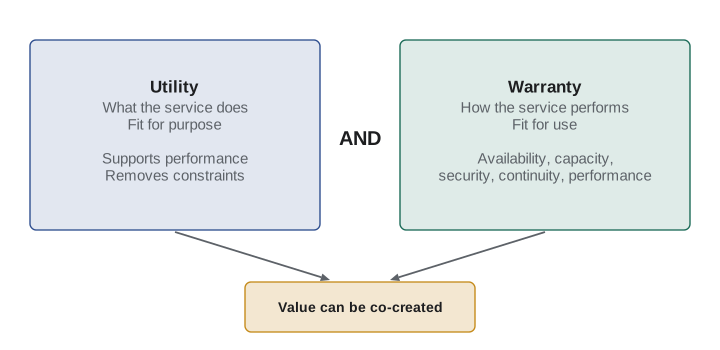
ITIL defines utility as the functionality offered by a product or service to meet a particular need. Utility is often summarized as "what the service does" and described as fitness for purpose. A service has utility if it either supports the performance of the consumer, by helping them do something better, or removes constraints from the consumer, by taking away something that was holding them back.
- Supporting performance: a reporting service that helps managers make faster, better decisions.
- Removing constraints: a remote access service that lets staff work from home, removing the constraint of being in the office.
Utility is about features and functions. If a payroll service cannot handle overtime rules for your industry, it lacks utility for you, however reliable it is.
Warranty: how the service performs
ITIL defines warranty as the assurance that a product or service will meet agreed requirements. Warranty is often summarized as "how the service performs" and described as fitness for use. It is usually expressed through agreed service levels in areas such as:
- Availability: the service is there when consumers need it.
- Capacity: the service can handle the volume of demand, now and in the future.
- Security: confidentiality, integrity and availability of information are protected.
- Continuity: the service can recover from serious disruption within acceptable time and data loss.
- Performance: the service responds quickly enough, for example pages load in a few seconds.
Warranty is about assurance. Consumers need confidence that the functions they rely on will be there, at the speed and scale they need, safely.
Why both are needed
A service with utility but no warranty is like a powerful car that will not start on cold mornings: impressive in theory, useless when you need it. A service with warranty but no utility is like a perfectly reliable car that cannot carry the load you need to move: dependable but pointless for you. Value requires both.
| Utility | Warranty | Result | Example |
|---|---|---|---|
| Yes | Yes | Value can be co-created | Reliable app with the features users need |
| Yes | No | Value at risk | Feature-rich booking site that crashes on launch day |
| No | Yes | Little value | Always-available system that cannot handle a key process |
| No | No | No value | Unreliable system without needed features |
Worked problem
Diagnosing a failing service
A province launches an online appointment booking system for driver's tests. It has all the features requested: choosing a location, picking a time, paying the fee and receiving reminders. On launch day demand is ten times higher than forecast, pages take over a minute to load and many payments fail. Does the system lack utility, warranty or both?
Show solution
- Utility: the features meet the need (book, pay, remind). Utility is present.
- Warranty: capacity was insufficient for demand; performance was unacceptable; availability for completing payments was poor.
- Consumers could not achieve the outcome (a confirmed booking) despite the features existing.
Answer: The system has utility but lacks warranty, especially capacity and performance. Value is lost until warranty is restored.
Availability in numbers
Availability is usually expressed as a percentage of agreed service time. The difference between targets that sound similar can be large in practice. The table shows how much downtime each level allows in a year of 8,760 hours (365 days of 24 hours).
| Availability | Downtime per year | Downtime per 30-day month |
|---|---|---|
| 99 % | 87.6 hours (about 3.65 days) | 7.2 hours |
| 99.5 % | 43.8 hours | 3.6 hours |
| 99.9 % | 8.76 hours | 43.2 minutes |
| 99.95 % | 4.38 hours | 21.6 minutes |
| 99.99 % | 52.6 minutes | 4.3 minutes |
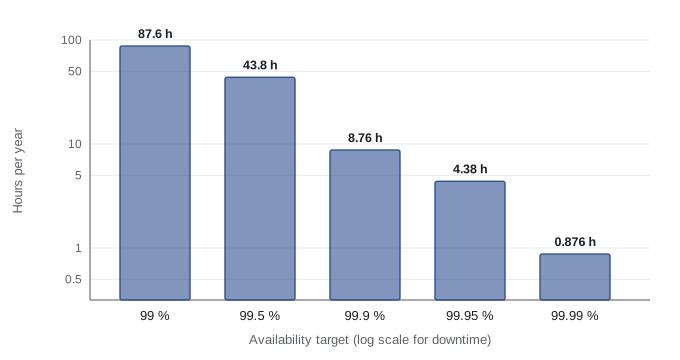
Higher availability costs more, because it needs redundant components, automated failover, more monitoring and faster response. The right target is the one that matches the consumer's needs and willingness to pay. An internal reporting tool used during office hours may need far less than a payment service that customers use around the clock.
Agreed service time also matters. A service agreed to be available Monday to Friday, 08:00 to 18:00, has 10 × 5 × 52 = 2,600 hours a year of agreed time, not 8,760. At 99.5 %, that allows 13 hours of downtime during business hours, while maintenance at night does not count.
Worked problem
Calculating a service credit
A contract promises 99.9 % monthly availability for a hosted service in a 30-day month (720 hours). If availability falls below target, the consumer receives a 10 % credit on the monthly fee of $8,000; below 99 %, the credit rises to 25 %. This month the service was down for 3 hours. What was the availability, and what credit applies?
Show solution
- Availability = (720 − 3) ÷ 720 = 717 ÷ 720 ≈ 0.99583, or 99.58 %.
- That is below 99.9 % but above 99 %.
- Credit = 10 % × $8,000 = $800.
Answer: Availability was about 99.58 %, so the 10 % credit of $800 applies. Note that the credit is small compared with the cost of 3 hours of lost business for many consumers; service credits encourage good performance but rarely compensate fully.
Capacity and performance
Capacity means the service can handle demand. Performance means it responds quickly enough while doing so. They are closely linked: as load approaches capacity, response times usually rise sharply. Providers therefore plan for headroom, a margin of spare capacity above expected peak demand.
Worked problem
Checking capacity headroom
An online enrolment service can handle 1,200 requests per second before response times become unacceptable. Last year's peak was 700 requests per second, and enrolment is expected to grow 30 % this year. The provider wants at least 25 % headroom above expected peak. Is capacity sufficient?
Show solution
- Expected peak: 700 × 1.30 = 910 requests per second.
- Required capacity with 25 % headroom: 910 × 1.25 = 1,137.5 requests per second.
- Available capacity: 1,200, which is above 1,137.5.
- Actual headroom: (1,200 − 910) ÷ 910 ≈ 0.32, or about 32 %.
Answer: Capacity is sufficient, with about 32 % headroom. If growth were 40 %, the expected peak of 980 would need 1,225 with headroom, exceeding capacity.
Security and continuity
Security warranty assures consumers that information is protected: kept confidential, accurate and available to authorized people. For many services, especially those handling personal, financial or health information, security is the first warranty consumers ask about. Continuity assures that the service can recover from serious events such as data centre failures, cyberattacks or natural disasters. Two common continuity measures are:
- Recovery time objective (RTO): the maximum acceptable time to restore the service after a disruption.
- Recovery point objective (RPO): the maximum acceptable amount of data loss, measured in time. An RPO of 15 minutes means backups or replication must ensure no more than 15 minutes of data is lost.
| Warranty area | Typical measure | Example target |
|---|---|---|
| Availability | Percentage of agreed time available | 99.9 % monthly |
| Capacity | Peak transactions handled with headroom | 1,200 requests per second |
| Performance | Response time | 95 % of pages in under 2 seconds |
| Security | Controls and incidents | Multi-factor authentication; no unresolved critical vulnerabilities over 14 days |
| Continuity | RTO and RPO | RTO 4 hours, RPO 15 minutes |
Experience and sustainability alongside utility and warranty
ITIL (Version 5) places experience and sustainability next to utility and warranty as key considerations. A service may be fit for purpose and fit for use but still be unpleasant to use, which lowers perceived value (lesson 9 covers experience). It may also meet every service level while using far more energy than necessary. Many organizations now include sustainability measures, such as energy use per transaction or hardware lifespan, in how they judge services. For the exam, know utility and warranty precisely, and be aware that Version 5 treats experience and sustainability as essential parts of the value picture.
Agreeing utility and warranty with consumers
Utility and warranty requirements should be agreed with consumers, not guessed by the provider. Utility requirements usually come from conversations about outcomes: what consumers need to be able to do. Warranty requirements come from asking how much disruption consumers can tolerate, when they need the service most, how much demand they expect and what information is sensitive. The answers often differ by consumer group. Finance may need near-perfect availability during the last three days of each month and very little at other times; a sales team may need speed during business hours in several time zones.
Over-specifying warranty is as wasteful as under-specifying it. Moving from 99.9 % to 99.99 % availability can require redundant data centres, extra staff on call and more expensive suppliers. If consumers cannot perceive the difference, the extra cost destroys value rather than creating it. Good providers present options with their costs, such as "99.5 % at the current price, 99.9 % for an extra $2,000 a month", and let the customer and sponsor choose.
Worked problem
Is the extra nine worth it?
An online store earns about $3,000 of profit per hour of trading, around the clock. Moving its checkout from 99.9 % to 99.95 % availability would cost an extra $1,500 a month. Using expected downtime, is the upgrade worth it?
Show solution
- Downtime per year at 99.9 %: 8.76 hours. At 99.95 %: 4.38 hours.
- Hours saved per year: 8.76 − 4.38 = 4.38 hours.
- Profit protected: 4.38 × $3,000 ≈ $13,140 a year.
- Upgrade cost: 12 × $1,500 = $18,000 a year.
Answer: On these numbers the upgrade costs about $4,860 more than it protects, so it is not worth it unless outages also harm reputation or happen at the busiest times, which they often do.
A final point concerns how warranty is reported. Averages can hide problems: a monthly availability of 99.9 % may conceal one four-hour outage during the busiest morning of the month. Reporting the timing and impact of outages, not just the percentage, gives consumers a truer picture of the warranty they actually received.
Utility and warranty together describe what consumers can rely on; neither alone is a promise of value.
Common mistakes
MistakeConfusing utility with warranty.
InsteadUtility is what the service does (fit for purpose); warranty is how it performs (fit for use).
MistakeThinking features alone create value.
InsteadValue needs both utility and warranty.
MistakeTreating 99.9 % and 99.99 % as nearly the same.
InsteadThe second allows one tenth of the downtime.
MistakeCalculating availability against 24 hours a day when the agreement covers business hours.
InsteadUse the agreed service time.
MistakePlanning capacity for last year's peak.
InsteadPlan for expected peak plus headroom.
Summary and key terms
- Utility is the functionality offered by a product or service to meet a particular need: what it does, fit for purpose.
- Warranty is the assurance that a product or service will meet agreed requirements: how it performs, fit for use.
- Utility either supports consumer performance or removes constraints.
- Warranty covers availability, capacity, security, continuity and performance.
- Value requires both utility and warranty.
- Each extra nine of availability cuts allowed downtime by a factor of ten.
- ITIL (Version 5) treats experience and sustainability as key alongside utility and warranty.
- Utility
- The functionality offered by a product or service to meet a particular need.
- Warranty
- Assurance that a product or service will meet agreed requirements.
- Fit for purpose
- Having the functions needed; a summary of utility.
- Fit for use
- Performing reliably enough to be used; a summary of warranty.
- Availability
- The ability of a service to perform its agreed function when required.
- Capacity
- The maximum throughput a service can deliver.
- Headroom
- Spare capacity above expected peak demand.
- Service credit
- A payment or discount owed when agreed service levels are missed.
- RTO
- Recovery time objective: maximum acceptable time to restore a service.
- RPO
- Recovery point objective: maximum acceptable data loss, measured in time.
Practice problems
Work each problem on paper first, then reveal the answer to check.
Summarize utility in three words.
Show answer
What it does, or fit for purpose.
Summarize warranty.
Show answer
How it performs, or fit for use.
Name the five warranty areas covered in this lesson.
Show answer
Availability, capacity, security, continuity and performance.
Allowed yearly downtime at 99.9 %?
Show answer
8.76 hours.
Allowed downtime at 99.5 % over 2,600 business hours?
Show answer
0.005 × 2,600 = 13 hours.
Availability with 6 hours down in 720 hours?
Show answer
714 ÷ 720 ≈ 99.17 %.
Expected peak 800, desired headroom 20 %. Capacity needed?
Show answer
800 × 1.2 = 960.
What does an RPO of 1 hour mean?
Show answer
No more than one hour of data may be lost.
A booking site has every feature but crashes under load. Utility or warranty problem?
Show answer
Warranty.
Which two considerations does Version 5 place alongside utility and warranty?
Show answer
Experience and sustainability.
Lesson quiz · 5 questions
Score 60% or more to complete this lesson.
Create a free account to save your progress, take quizzes and earn a certificate.