
ITIL-110 · Lesson 11 of 12 · 30 min
Service management in practice: public sector and cloud services
The key concepts of this course apply everywhere, but they look different depending on the setting. This lesson applies them to two settings that most learners will meet: public-sector services, where consumers often cannot choose another provider and services are shaped by law and public policy, and cloud services, where many organizations now get most of their technology. It uses examples from government digital services and cloud contracts to show value, roles, offerings, utility, warranty, relationships and experience in action.
What makes public services different
Government services share the basic shape of any service: a provider facilitates outcomes for consumers while taking on specific costs and risks. Yet several features make them distinctive:
- Limited choice: residents cannot usually switch to another passport office or tax authority, so poor services can persist without losing "customers".
- Legal mandate: many services exist because a law requires them, and their rules are set by legislation and policy, not only by consumer demand.
- Universal access: services must work for everyone eligible, including people with disabilities, limited literacy, no internet access or complex circumstances.
- Many stakeholders: taxpayers, elected officials, oversight bodies, the media and the public all have an interest in how services perform.
- Public value: success includes fairness, trust in government and social outcomes, not only efficiency.
These features make the consumer roles especially interesting. A resident applying for a benefit is a user. The legislature that funds the program acts much like a sponsor. The department accountable for the program's outcomes plays the customer role on behalf of the public. Balancing these roles is a central challenge of public service management.
Government digital services
In Canada, the federal government sets direction for service and digital through the Treasury Board's Policy on Service and Digital, in effect since April 2020, which requires departments to design services around clients, manage information and data as strategic assets and use technology securely. The Government of Canada Digital Standards set out ten principles: design with users; iterate and improve frequently; work in the open by default; use open standards and solutions; address security and privacy risks; build in accessibility from the start; empower staff to deliver better services; be good data stewards; design ethical services; and collaborate widely. Service Canada provides many services directly to residents, such as Employment Insurance and passports, and the Canadian Digital Service, which became part of Employment and Social Development Canada in 2023, helps departments build user-centred digital services. Shared Services Canada, created in 2011, is an internal shared services provider that consolidates email, data centres and networks for federal departments.
Whatever the country, government digital programs have pushed the ideas in this course into the mainstream: design with users, measure outcomes and experience, iterate in small steps, and treat services end to end rather than as separate departmental systems.
Worked problem
Channel shift and cost per transaction
A licensing agency processes 500,000 renewals a year: 60 % in person at $24 each, 25 % by phone at $12 and 15 % online at $2. A redesign aims to move the mix to 30 % in person, 20 % phone and 50 % online, without forcing anyone online. What is the annual cost before and after?
Show solution
- Before: in person 300,000 × $24 = $7,200,000; phone 125,000 × $12 = $1,500,000; online 75,000 × $2 = $150,000.
- Total before: $8,850,000, or $17.70 per renewal.
- After: in person 150,000 × $24 = $3,600,000; phone 100,000 × $12 = $1,200,000; online 250,000 × $2 = $500,000.
- Total after: $5,300,000, or $10.60 per renewal.
- Saving: $3,550,000 a year.
Answer: Annual cost falls from about $8.85 million to $5.3 million. Keeping in-person and phone options protects access for those who need them, which is part of public value.
Shared services as internal providers
Shared services organizations, in government and in large companies, are a clear example of the provider role inside one organization. They consolidate common services such as email, networks, data centres, payroll or procurement and provide them to many departments. The promise is lower cost and better quality through scale. The risk is that departments, which cannot easily choose another provider, feel the shared service ignores their needs. The concepts from lessons 3 and 7 apply directly: identify customers, users and sponsors in each department; describe offerings in a catalogue; agree service levels; and invest in relationship management so that consolidation does not cost the trust of consumers.
Cloud services and the key concepts
Cloud computing is now the main way many organizations get technology. In ITIL terms, a cloud offering is largely access to resources (computing, storage and software owned by the provider), combined with service actions (support, managed operations) and sometimes goods (hardware appliances for on-site use). The three common service models divide responsibilities differently between provider and consumer:
| Layer | Infrastructure as a service (IaaS) | Platform as a service (PaaS) | Software as a service (SaaS) |
|---|---|---|---|
| Physical data centre and hardware | Provider | Provider | Provider |
| Virtualization and network | Provider | Provider | Provider |
| Operating system and runtime | Consumer | Provider | Provider |
| Application | Consumer | Consumer | Provider |
| Data and user access | Consumer | Consumer | Consumer |
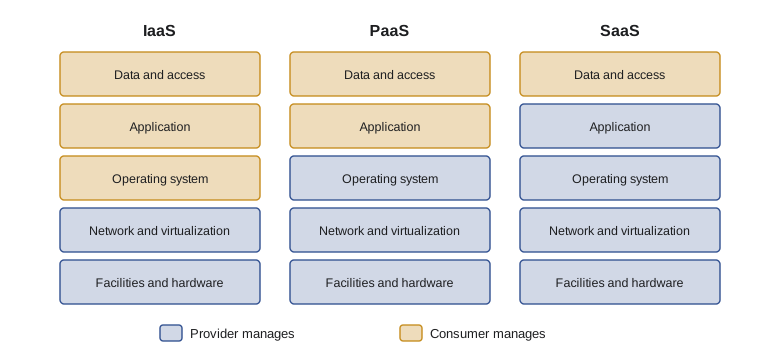
The shared responsibility model is a practical form of the provision and consumption split from lesson 7. Many cloud security failures happen not because the provider failed, but because the consumer misconfigured storage, left default passwords in place or gave too many people access. Understanding which side is responsible for what is essential.
Utility, warranty and cost in the cloud
Cloud providers publish service level agreements, usually for availability, with service credits when targets are missed. As lesson 6 showed, credits rarely compensate for lost business, so consumers design for warranty themselves, for example by running across several availability zones or regions. Cloud also changes costs: instead of buying hardware up front (capital expense), consumers pay for what they use (operating expense). This flexibility removes the cost and risk of idle hardware but imposes the risk of unexpected bills if usage is not controlled. The discipline of managing cloud spending is often called FinOps.
Worked problem
On-demand versus committed pricing
A team runs a workload on cloud servers costing $0.40 per hour on demand. It needs 10 servers running all the time. The provider offers a one-year commitment at $0.26 per hour per server. What does each option cost for a year of 8,760 hours, and what is the risk of committing?
Show solution
- On demand: 10 × $0.40 × 8,760 = $35,040.
- Committed: 10 × $0.26 × 8,760 = $22,776.
- Saving with commitment: $35,040 − $22,776 = $12,264, or 35 %.
- Risk: if the workload shrinks or moves, the commitment must still be paid.
Answer: Committing saves about $12,264 a year (35 %), but imposes the risk of paying for capacity no longer needed. A common approach is to commit for the steady base load and use on-demand for peaks.
Cloud and public sector together
Governments use cloud services too, under rules that reflect the sensitivity of public data.
In Canada, federal departments use cloud services under Treasury Board direction and guidance on data residency and security, and the Canadian Centre for Cyber Security assesses cloud providers' security controls so that departments can use them for protected information. Provinces and municipalities set their own rules, and privacy laws such as those in British Columbia and Nova Scotia have historically placed limits on storing certain public-sector personal information outside Canada. Public bodies should check the current rules in their jurisdiction.
Worked problem
Mapping a cloud offering
A city buys a SaaS service for managing building permits. The vendor hosts the software, applies updates, provides 24/7 monitoring and a help desk, and supplies two public kiosks for residents without home internet. City staff configure workflows, manage user accounts and own the permit data. Map the offering using the vocabulary of this course.
Show solution
- Access to resources: the hosted permit software and the vendor's infrastructure.
- Service actions: updates, monitoring and help desk support.
- Goods: the two kiosks, if ownership transfers to the city.
- Consumer responsibilities (consumption): configuring workflows, managing accounts, owning and protecting data.
- Utility: managing permits end to end; warranty: availability, security, continuity commitments in the SLA.
Answer: The offering combines access, service actions and possibly goods. The city keeps responsibility for data and access, and should check that the SLA's warranty commitments match residents' needs.
Common lessons from public and cloud services
Experience across many government and cloud programs points to a few recurring lessons that connect back to the key concepts. First, start with users: services designed around the structure of the organization rather than the needs of the people using them tend to fail, however good the technology. Second, measure outcomes and experience, not just outputs: a website launched on time is an output; residents completing a task easily is the outcome. Third, mind the supply chain: many high-profile service failures came from dependencies, such as an overloaded identity verification step or a supplier's outage, rather than from the main system. Fourth, keep humans in the loop: automated and digital services need clear routes to a person when something unusual happens.
| Lesson | Key concept | Practical step |
|---|---|---|
| Start with users | Value co-creation and experience | Research and test with real users before and after launch |
| Measure outcomes | Outputs versus outcomes | Track task completion and satisfaction, not just launch dates |
| Mind the chain | Service relationship model | Map dependencies and test peak loads end to end |
| Keep humans in the loop | Service actions and experience | Provide assisted channels and clear escalation |
Worked problem
Peak load in a public launch
A new online benefit application expects 400,000 applications in its first week, with 30 % arriving on the first day, concentrated in 10 busy hours. If each application takes an average of 20 minutes online, roughly how many people will be using the service at once during those hours?
Show solution
- First-day applications: 0.30 × 400,000 = 120,000.
- Per busy hour: 120,000 ÷ 10 = 12,000 applications started each hour.
- Average time in the system: 20 minutes = 1/3 hour.
- Concurrent users ≈ arrival rate × time = 12,000 × 1/3 = 4,000.
Answer: About 4,000 people at once, before allowing for spikes within the hour. Capacity, including dependencies such as identity checks and payment, should be tested well above this level.
Keeping these lessons in mind helps practitioners in any sector avoid repeating well-known mistakes.
Whichever sector you work in, these patterns repeat, which is why the key concepts are worth learning well.
Common mistakes
MistakeAssuming public services need no service management because consumers have no choice.
InsteadApply service thinking even more carefully when consumers cannot switch.
MistakeBelieving the cloud provider is responsible for everything.
InsteadCheck the shared responsibility model; data and access stay with the consumer.
MistakeRelying on cloud service credits as protection.
InsteadDesign for warranty with redundancy and continuity plans.
MistakeForcing everyone onto a digital channel to cut costs.
InsteadShift channels while keeping access for those who need other options.
MistakeTreating details of government digital organizations as fixed.
InsteadCheck current structures; they changed significantly in 2025.
Summary and key terms
- Public services involve limited choice, legal mandates, universal access and many stakeholders.
- Government digital programs promote user-centred design, iteration and outcome measurement.
- Shared services organizations are internal providers that must manage relationships with departments.
- Cloud offerings are mostly access to resources plus service actions.
- The shared responsibility model divides provision and consumption; data and access stay with the consumer.
- Cloud shifts costs from capital to operating expense and imposes cost-control risks.
- Public bodies use cloud under specific security and data rules that vary by jurisdiction.
- Public value
- The value a service creates for society, including fairness and trust.
- Shared services organization
- An internal provider that consolidates common services for many departments.
- Channel shift
- Moving service transactions from costly channels to cheaper ones while keeping access.
- IaaS
- Infrastructure as a service: the consumer manages operating systems and applications.
- PaaS
- Platform as a service: the provider also manages operating systems and runtimes.
- SaaS
- Software as a service: the provider manages the application too.
- Shared responsibility model
- A description of which security and operations duties belong to the cloud provider and which to the consumer.
- Availability zone
- An isolated location within a cloud region used for redundancy.
- FinOps
- The practice of managing and optimizing cloud spending.
- Data residency
- Requirements about where data is physically stored.
Practice problems
Work each problem on paper first, then reveal the answer to check.
Name two features that make public services different.
Show answer
For example limited choice and legal mandates.
In SaaS, who manages the application?
Show answer
The provider.
Who is always responsible for data and user access in the cloud?
Show answer
The consumer.
Is a hosted software licence goods or access to resources?
Show answer
Access to resources.
Annual cost of 4 servers at $0.50 per hour running all year?
Show answer
4 × 0.50 × 8,760 = $17,520.
Cost of 100,000 transactions at $3 online and 50,000 at $20 in person?
Show answer
$300,000 + $1,000,000 = $1,300,000.
What is FinOps?
Show answer
Managing and optimizing cloud spending.
Why are cloud service credits not enough protection?
Show answer
They rarely cover the real cost of lost business.
What risk does a one-year cloud commitment impose?
Show answer
Paying for capacity that may no longer be needed.
Why keep non-digital channels when shifting services online?
Show answer
To ensure universal access for people who cannot use digital channels.
Lesson quiz · 5 questions
Score 60% or more to complete this lesson.
Create a free account to save your progress, take quizzes and earn a certificate.