
ITIL-110 · Lesson 2 of 12 · 29 min
Value and value co-creation
Value is the word ITIL uses more than any other, and for good reason. Every service exists to enable value, every practice should contribute to it, and every improvement should be judged by whether it increases it. Yet value is also one of the easiest terms to misuse. This lesson gives the ITIL definition, explains why value is perceived rather than fixed, shows how value is co-created by providers and consumers working together, and introduces the idea that value can be created for many stakeholders, not only paying customers.
Defining value
ITIL defines value as the perceived benefits, usefulness and importance of something. Three features of that definition matter:
- Perceived: value exists in the mind of a stakeholder. Two customers can use the same service and judge its value very differently.
- Benefits, usefulness and importance: value is not only about money. A service can be valuable because it saves time, reduces anxiety, supports a legal obligation or simply makes work more pleasant.
- Of something: value attaches to a thing in a context. The same mobile banking feature may be very valuable to a commuter and of little value to someone who prefers branch visits.
Because value is perceived, a provider cannot declare that its service is valuable. It can only design and operate the service so that consumers are likely to perceive value, and then check whether they do. This is why feedback, measurement and conversation with consumers sit at the heart of service management.
| Type of value | Example for a staff laptop service |
|---|---|
| Financial | Lower total cost than each department buying its own devices |
| Time | New starters productive on day one because laptops arrive configured |
| Risk reduction | Encrypted disks and managed patches reduce the chance of a data breach |
| Compliance | Asset records support audits and privacy obligations |
| Experience | Staff choose from a small menu of models they like |
| Sustainability | Refurbishment and recycling reduce electronic waste |
Value is subjective and changes over time
Perception depends on context, expectations and alternatives. A video-calling service that seemed miraculous in 2015 now feels ordinary; the same features are perceived as less valuable because expectations have risen. A sudden outage can lower perceived value for months even if the service is reliable afterwards. Competitors, social media and personal experience all shape what consumers expect.
Different stakeholders in the same organization may also perceive value differently. For a hospital scheduling system:
- Clinicians value fast, accurate access to appointment lists.
- Patients value short waits and convenient reminders.
- Finance values lower administration costs and fewer missed appointments.
- Privacy officers value strict control of personal health information.
A good service balances these perceptions. Optimizing for one group at the expense of all others rarely produces the most value overall.
From value delivery to value co-creation
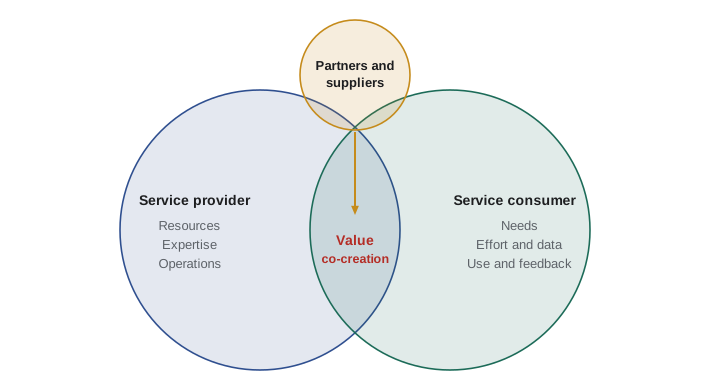
Older thinking described providers as delivering value to passive consumers, rather like a factory shipping goods. ITIL 4 replaced this with value co-creation: value is created through active collaboration between providers and consumers, and often other organizations in a wider network. ITIL (Version 5) keeps this idea at its centre.
Consider an online course. The provider designs lessons, runs the platform and answers questions. The learner sets aside time, works through lessons, does the practice questions and applies what they learn. If the learner never logs in, no value is created, however good the course is. If the platform is down at the learner's only free hour, value is lost even though the learner is willing. Value comes from both parties doing their part.
| Value delivery view | Value co-creation view |
|---|---|
| Provider creates value and hands it over | Provider and consumer create value together |
| Consumer is passive | Consumer contributes effort, information and resources |
| Success measured at hand-over | Success measured by outcomes the consumer achieves |
| One-way communication | Ongoing feedback and collaboration |
| Focus on outputs | Focus on outcomes, costs, risks and experience |
The consumer's contribution
What does the consumer contribute? It depends on the service, but common contributions include:
- Information: accurate requirements, correct personal details, clear descriptions of problems.
- Effort and time: learning to use the service, following procedures, testing new features.
- Resources: their own devices, network connections, data or staff.
- Behaviour: using the service as intended, keeping credentials secure, reporting issues promptly.
- Feedback: telling the provider what works and what does not, so the service can improve.
When providers design services, they should make these contributions as easy as possible. A form that asks for the same information three times, or a help page written in jargon, increases the consumer's effort and lowers perceived value. Much of good service design is about reducing the work consumers must do to achieve their outcomes.
Worked problem
Who contributes what?
A municipality offers an online service for booking recreation programs. Identify two contributions made by the municipality, two by residents and one by a supplier, and explain how value could be lost if any party failed to contribute.
Show solution
- Municipality: designs and schedules programs; runs the booking website and payment processing.
- Residents: create accounts with correct details; choose programs and pay on time.
- Supplier: the payment processor authorizes card transactions.
- If the website is down on registration day, residents cannot book (provider failure).
- If residents enter wrong contact details, they miss cancellation notices (consumer failure).
- If the payment processor fails, bookings cannot be completed even when both other parties are ready (supplier failure).
Answer: Value depends on all three parties. A failure by any one of them can prevent the outcome residents want: a confirmed place in a program.
Value for many stakeholders
A service usually affects more people than the person paying for it. ITIL encourages providers to consider value for all stakeholders: consumers, the provider organization itself, its employees, partners and suppliers, investors or funders, regulators and society. ITIL (Version 5) puts more emphasis on this wider view, including environmental and social value, reflecting the growing importance of sustainability in how organizations are judged.
| Stakeholder | Example of value from a well-run courier service |
|---|---|
| Customer (sender) | Parcels arrive on time; tracking reduces worry |
| Recipient | Convenient delivery windows and pickup points |
| Courier company | Revenue, reputation and repeat business |
| Drivers | Predictable routes, fair pay and safe working conditions |
| Investors | Profit and growth |
| Society | Fewer emissions through route optimization and electric vans |
Sometimes value for one stakeholder conflicts with value for another. Cutting driver numbers may raise investor returns in the short term while lowering service quality and harming drivers. Mature organizations make these trade-offs openly, guided by governance and by an understanding of what value means to each group.
Value includes costs and risks
Value is not just about benefits. A consumer weighs what they gain against what they give up and what might go wrong. A service that delivers useful outcomes but is very expensive, or that exposes the consumer to unacceptable risk, may have low overall value. Lesson 5 examines outcomes, costs and risks in detail; for now it is enough to see that value results from the balance between them.
This is not a formula you compute. It is a reminder that value depends on several factors that consumers weigh together, often without thinking about it consciously.
Worked problem
Comparing two offers
A small accounting firm is choosing between two cloud file-sharing services for 12 staff. Service A costs $8 per user per month and has had two widely reported data breaches. Service B costs $12 per user per month, offers stronger encryption and has a clean record. Both provide the features the firm needs. Compare the annual cost difference and explain why the firm might still choose B.
Show solution
- Service A annual cost: 12 × $8 × 12 months = $1,152.
- Service B annual cost: 12 × $12 × 12 months = $1,728.
- Difference: $1,728 − $1,152 = $576 a year, or $48 a month.
- The firm holds confidential client financial data. A breach could cost far more than $576 in notification costs, lost clients and regulatory trouble.
- Both services provide the same outcomes, so the deciding factors are cost and risk.
Answer: B costs $576 more a year, but its lower risk may give it higher overall value for a firm handling confidential data.
Recognizing value in practice
How can a provider tell whether value is being co-created? Some useful signals include:
- Consumers keep using the service, and use grows without heavy promotion.
- Consumers achieve the outcomes they set out to achieve, measured directly where possible.
- Feedback and satisfaction scores are stable or improving.
- Consumers recommend the service to others.
- The provider's own goals, such as revenue, efficiency or public mandate, are met.
- Stakeholders such as regulators and the community are not harmed and ideally benefit.
No single signal is enough. A service with high usage may be used only because consumers have no alternative. A high satisfaction score may hide a small group of users who are badly served. Lesson 10 introduces measures that help build a balanced picture.
Worked problem
Reading the signals
An internal expense-claim app has 100 % adoption because it is mandatory. A survey finds average satisfaction of 2.1 out of 5, and the finance team reports that 30 % of claims are returned for corrections. Is the app creating value?
Show solution
- Adoption is meaningless as a value signal because use is mandatory.
- Low satisfaction suggests a poor experience for staff.
- A 30 % return rate means staff and finance spend extra effort fixing claims, adding cost.
- Some value exists (claims are processed digitally), but much is being lost.
Answer: The app creates limited value. Mandatory use hides the problem; satisfaction and rework show that redesigning the claim process could unlock more value.
Value in the Foundation exam
Exam questions on value usually test three ideas. First, that value is perceived by stakeholders rather than fixed by the provider. Second, that value is co-created through collaboration, so a question describing a passive consumer receiving "delivered value" is describing the older view. Third, that value involves outcomes, costs and risks together, so the cheapest or most feature-rich option is not automatically the most valuable. When a scenario asks which option creates the most value, look for the answer that balances outcomes, costs and risks for the stakeholders described, and that involves the consumer actively. Distractors often mention only price, only technology or only the provider's view.
Finally, remember that value can be destroyed as well as created. A service that wastes consumers' time, exposes them to risk or damages trust reduces value, even if it produces outputs on schedule. Providers should watch for signs of value leakage, such as rework, complaints and workarounds, as carefully as they track signs of success.
Common mistakes
MistakeDefining value only in money.
InsteadInclude benefits, usefulness and importance, such as time saved and risk reduced.
MistakeBelieving the provider decides how valuable a service is.
InsteadRemember value is perceived by stakeholders.
MistakeSaying the provider "delivers value" to passive consumers.
InsteadUse the language of value co-creation.
MistakeTreating adoption of a mandatory service as proof of value.
InsteadLook at outcomes, satisfaction and rework as well.
MistakeConsidering only the paying customer.
InsteadConsider value for all stakeholders, including staff, partners and society.
Summary and key terms
- Value is the perceived benefits, usefulness and importance of something.
- Value is subjective, depends on context and changes as expectations change.
- Value is co-created through active collaboration between providers and consumers.
- Consumers contribute information, effort, resources, behaviour and feedback.
- Services create or destroy value for many stakeholders, including society.
- Overall value reflects outcomes, costs, risks and experience together.
- Several signals, not just usage, are needed to judge whether value is co-created.
- Value
- The perceived benefits, usefulness and importance of something.
- Value co-creation
- Creating value through active collaboration between providers and consumers.
- Stakeholder
- A person or organization that has an interest or involvement in an organization, product, service, practice or other entity.
- Perception
- The way a stakeholder understands and judges something.
- Consumer contribution
- Information, effort, resources and behaviour the consumer brings to a service.
- Value delivery
- The older view that providers create value and hand it over.
- Sustainability
- Meeting present needs without harming future generations; given prominence in ITIL (Version 5).
- Trade-off
- A choice that increases value for one stakeholder at some cost to another.
- Feedback
- Information from stakeholders about their experience of a service.
- Social value
- Benefits a service creates for communities and society.
Practice problems
Work each problem on paper first, then reveal the answer to check.
State the ITIL definition of value.
Show answer
The perceived benefits, usefulness and importance of something.
Why can two customers value the same service differently?
Show answer
Value is perceived and depends on each customer's context and expectations.
What replaced the idea of value delivery in ITIL 4?
Show answer
Value co-creation.
Name three things a consumer contributes to value co-creation.
Show answer
For example information, effort and feedback.
Give an example of social or environmental value from a service.
Show answer
For example lower emissions from optimized delivery routes.
Annual cost of 20 users at $10 per user per month?
Show answer
20 × 10 × 12 = $2,400.
Why is high usage of a mandatory tool a weak value signal?
Show answer
People must use it whether or not it helps them.
Name two stakeholders other than the customer.
Show answer
For example employees and regulators.
How can a provider make the consumer's contribution easier?
Show answer
For example simpler forms, clear guidance and fewer repeated steps.
Which two value themes does ITIL (Version 5) give extra prominence?
Show answer
Experience and sustainability.
Lesson quiz · 5 questions
Score 60% or more to complete this lesson.
Create a free account to save your progress, take quizzes and earn a certificate.