
HSE-407 · Lesson 2 of 12 · 21 min
Lagging indicators: rates and how to calculate them
Nina Castillo started where any analyst would: by trying to reproduce last year's total recordable injury frequency (TRIF) from the raw records. She could not. The report said 5.4, but depending on which spreadsheet she used and which hours she counted, she got anything from 4.9 to 6.0. One site counted agency workers' injuries but not their hours. Another excluded a case that the injured worker's doctor had treated with prescription medication. A third had used scheduled hours rather than hours actually worked. None of these choices was dishonest, but together they made the company's headline number unreliable.
Lagging indicators are the foundation of most safety reporting, and they will remain part of Harrowgate Foods Ltd.'s framework. This lesson explains how to calculate them correctly and consistently: what to count, what to divide by and why the common rates use the bases they do.
Counts and rates
A count, such as '33 recordable injuries', is easy to understand but hard to compare. A site with 600 workers will usually have more injuries than a site with 60, even if it is safer. A rate solves this by dividing the count by a measure of exposure, usually hours worked, and multiplying by a fixed base so the result is a convenient size.
The most widely used base in North America is 200,000 hours. It represents the hours that 100 full-time workers would work in a year at 40 hours a week for 50 weeks. A rate on this base can therefore be read as 'injuries per 100 full-time workers per year'. Some international companies and industry associations use a base of 1,000,000 hours instead, which gives numbers five times larger. Neither is wrong, but comparing a rate on one base with a rate on the other is a common and embarrassing mistake.
The same formula gives different rates depending on which cases are counted:
- Total recordable injury frequency (TRIF): all recordable cases, meaning deaths, lost-time cases, restricted work or transfer cases, and cases needing medical treatment beyond first aid.
- Lost-time injury frequency (LTIF): cases where the worker could not work on a day after the day of injury. Some companies include restricted work in a broader rate.
- Severity rate: days lost, and sometimes days restricted, per 200,000 hours, which shows how serious injuries were rather than how many.
- WCB time-loss claims rate: accepted time-loss claims per 100 covered workers. This is the basis the WCB uses, and it counts workers rather than hours.
Nationally comparable figures are hard to find in Canada. Each province's board publishes its own claims statistics, and the Association of Workers' Compensation Boards of Canada reported 348,747 accepted lost-time claims across the country in 2024. For reference, WCB Nova Scotia reported a provincial injury rate of 1.21 per 100 covered workers for 2025, the lowest it has recorded. That figure counts accepted claims per worker covered, not recordable injuries per hours worked, so it cannot be compared directly with Harrowgate Foods Ltd.'s TRIF.
What counts as a case
In Canada there is no national legal definition of a 'recordable' injury. Employers must report injuries to the provincial board when a worker needs medical attention or loses time, and the board decides whether to accept a claim. Many Canadian companies, including Harrowgate Foods Ltd., therefore adopt the company's own recordable definitions, borrowed from the OSHA criteria so its numbers compare with peers. Under those criteria a case is counted if it is work-related, is new, and results in death, time away from work, restricted work or transfer, medical treatment beyond first aid, loss of consciousness, or a significant injury or illness diagnosed by a physician or licensed health care professional.
The line between first aid and medical treatment is where most disagreements arise. First aid is a defined, closed list. It includes using a non-prescription medication at non-prescription strength, cleaning and covering wounds with bandages or butterfly strips, hot or cold therapy, non-rigid supports such as elastic bandages, removing splinters or foreign bodies from the eye by irrigation or a swab, and drinking fluids for heat stress. Anything beyond the list, such as stitches, prescription medication, rigid splints for immobilization or physical therapy, is medical treatment. The test is what treatment was given or recommended, not who gave it.
Nina found that the Truro plant had excluded a case in which a worker with a sprained wrist was prescribed an anti-inflammatory and chose not to fill the prescription. Under the criteria, the recommendation of prescription medication makes the case recordable whether or not the worker takes it. The case went back in.
Counting days
Lost-time and severity measures depend on counting days consistently. The usual rules are that the day of injury is not counted, that days are counted as calendar days rather than scheduled workdays, and that the count stops at 180 days for any one case. Calendar days are used so that a worker injured on a Friday who cannot work over a weekend is not treated differently from one injured on a Monday. Restricted work days are counted separately from days away. If a doctor says a worker should stay home and the worker comes in anyway, the days still count as days away.
Hours: the half of the formula everyone forgets
A rate is only as good as its denominator. Nina's checks showed that the hours Harrowgate Foods Ltd. had used came from three sources: payroll at Truro, scheduled shift hours at Kentville, and a mixture at Dartmouth that left out agency workers. She set three rules for the new framework:
- Use hours actually worked, from timekeeping or payroll, including overtime and excluding vacation, sick leave, holidays and other paid time off.
- Include the hours of temporary and agency workers whose day-to-day work the company supervises, and count their injuries too, so the numerator and denominator cover the same people.
- Report contractor injuries and hours separately, as HSE-406 described, rather than mixing them into employee rates.
The agency rule matters in Canada for a particular reason. An agency worker's WCB claim is usually charged to the agency's account, not the host's, so the host's WCB statements never show it. Harrowgate Foods Ltd. counts those injuries in its own rates anyway, because the hazards that caused them were on its site.
When actual hours are not available, for example for a small group of salaried managers, an estimate based on the number of people and their usual working hours is acceptable, as long as the method is written down and applied consistently.
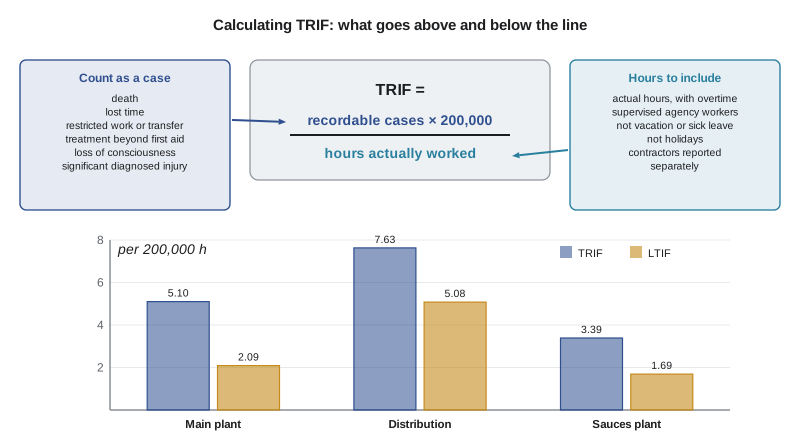
Last year's numbers, recalculated
With the rules settled, Nina rebuilt the previous year's figures from the original incident reports and payroll data. The script below repeats her calculation for the three sites and for the company as a whole.
# Recalculate last year's lagging indicators by site
sites = {
    # site: (hours worked, recordable cases, lost-time cases, days lost)
    "main plant":    (862_000, 22, 9, 214),
    "distribution":  (236_000,  9, 6, 131),
    "sauces plant":  (118_000,  2, 1,  12),
}
BASE = 200_000
def rate(n, hours, base=BASE):
    return n * base / hours

print(f"{'site':<14}{'hours':>10}{'rec':>5}{'rec rate':>10}{'lost rate':>11}{'severity':>10}")
tot = [0, 0, 0, 0]
for site, (h, rec, lt, days) in sites.items():
    print(f"{site:<14}{h:>10,}{rec:>5}{rate(rec, h):>10.2f}{rate(lt, h):>11.2f}{rate(days, h):>10.1f}")
    tot = [a + b for a, b in zip(tot, (h, rec, lt, days))]
h, rec, lt, days = tot
print(f"{'company':<14}{h:>10,}{rec:>5}{rate(rec, h):>10.2f}{rate(lt, h):>11.2f}{rate(days, h):>10.1f}")
print(f"company recordable rate per 1,000,000 hours: {rate(rec, h, 1_000_000):.1f}")site hours rec rec rate lost rate severity main plant 862,000 22 5.10 2.09 49.7 distribution 236,000 9 7.63 5.08 111.0 sauces plant 118,000 2 3.39 1.69 20.3 company 1,216,000 33 5.43 2.63 58.7 company recordable rate per 1,000,000 hours: 27.1
The recalculated company rate was 5.43, close to the 5.4 that had been reported. The similarity was a coincidence. The Dartmouth site's rate had been understated, because its agency injuries had been left out, and the Truro plant's rate had been slightly overstated because scheduled hours were lower than actual hours worked during a busy autumn. The errors happened to cancel. The site figures, which managers had been compared on, had been wrong in both directions.
Worked problem
Calculating the distribution centre's rates
Show solution
- The Dartmouth site worked 175,000 employee hours and 61,000 agency hours last year, a total of 236,000 hours. It had 9 recordable cases, including 3 among agency workers.
- The recordable rate is \(9 \times 200\,000 / 236\,000 = 7.63\) per 200,000 hours.
- The old report had counted only the 6 employee cases and the 175,000 employee hours, giving \(6 \times 200\,000 / 175\,000 = 6.86\).
- With 6 lost-time cases and 131 days lost, the LTIF is \(6 \times 200\,000 / 236\,000 = 5.08\) and the severity rate is \(131 \times 200\,000 / 236\,000 = 111.0\) days per 200,000 hours.
Answer: The full rate is 7.63, not 6.86. Leaving agency workers out of both the numerator and the denominator still understated the rate, because agency workers had a higher injury rate than employees.
The last point surprised the site manager, Grace Whitfield. She had assumed that leaving out both agency injuries and agency hours would make no difference. It would have made no difference only if agency workers were injured at the same rate as employees. In fact their rate was \(3 \times 200\,000 / 61\,000 = 9.84\), well above the employee rate, which matched what HSE-401 and HSE-403 had found about newer and temporary workers.
Other lagging indicators
Injury rates are not the only lagging measures worth keeping. Elena's list for the new framework also included:
- Serious injuries and fatalities: counted separately, with a written definition, because they are the outcomes the framework most wants to prevent. Lesson 4 sets out the definition.
- Occupational illness cases: such as noise-induced hearing loss, dermatitis from sanitation chemicals and musculoskeletal disorders, which develop slowly and are easily missed.
- Claims costs and experience rating: the WCB's experience rating, which adjusts the assessment rate up or down from the industry rate according to the company's claims costs. These matter to the finance team but react slowly and depend on claim management as much as safety.
- Process safety events: ammonia releases and other losses of containment, classified by severity, which Lesson 4 also discusses.
- Regulatory orders and citations: a measure of compliance failures found by others.
- Property damage and vehicle collisions: forklift strikes on racking, doors and product often precede strikes on people.
Each of these needs the same discipline as the injury rate: a written definition, a consistent data source and an owner. Lesson 9 returns to the records and data quality checks that keep them reliable.
Rates for small sites and short periods
The Kentville sauces plant shows why rates need care at small sites. Its 2 recordable cases in 118,000 hours give a rate of 3.39, the lowest in the company. One more case would have raised it to 5.08, and one fewer to 1.69. With so few cases, the rate can swing by more than half from a single event, and a monthly rate at a site of that size is close to meaningless: most months it is zero, and in a month with one case it jumps to about 20.
Nina adopted three habits for small numbers. She reported counts alongside every rate, so that readers could see when a rate rested on two or three cases. She used rolling twelve-month rates rather than monthly rates for trend lines, which smooths out single events without hiding a real change for long. And she showed company and site rates together, so that a small site's swings could be seen against the larger picture. Lesson 10 adds the statistical tools to say how much of a change is chance.
Rates per worker and per unit of output
Hours are the usual denominator, but not the only one. The WCB's claims rate uses covered workers, which suits a board that knows payrolls but not hours. Some food companies also track injuries per million kilograms of product, or per thousand pallets shipped at a distribution site. These output-based rates can be useful for comparing similar operations, but they mix safety with productivity: a site that becomes more efficient will look safer even if the risk to each worker is unchanged. Harrowgate Foods Ltd. uses hours for its main rates and keeps output-based rates only as background.
Common mistakes
MistakeComparing a rate on a 200,000-hour basis with one on a 1,000,000-hour basis.
InsteadState the base with every rate and convert before comparing.
MistakeUsing scheduled hours instead of hours actually worked.
InsteadUse timekeeping or payroll hours, including overtime and excluding paid time off.
MistakeCounting agency workers' injuries but not their hours, or the reverse.
InsteadMake the numerator and denominator cover the same people.
MistakeDeciding first aid versus medical treatment by who gave the treatment.
InsteadUse the closed first aid list and judge by the treatment given or recommended.
MistakeCounting lost days as scheduled workdays.
InsteadCount calendar days, not including the day of injury, capped at 180 days per case.
Summary and key terms
- Rates divide a count of cases by hours worked and multiply by a base, usually 200,000 hours, equal to 100 full-time workers for a year.
- TRIF, LTIF and severity rates count different cases; WCB claims rates use workers rather than hours.
- Recordable cases include deaths, lost time, restricted work or transfer, medical treatment beyond first aid, loss of consciousness and significant diagnosed injuries.
- First aid is a closed list, and recommended prescription medication makes a case recordable.
- Days are counted as calendar days after the day of injury, capped at 180 per case.
- Hours must be actual hours worked and must cover the same people as the injury count, including supervised agency workers.
- TRIF
- Total recordable injury frequency: recordable cases per 200,000 hours worked.
- LTIF
- Lost-time injury frequency: lost-time cases per 200,000 hours worked.
- Severity rate
- Days lost, and sometimes days restricted, per 200,000 hours worked.
- First aid
- A defined list of minor treatments that do not by themselves make a case recordable.
- Denominator
- The measure of exposure, usually hours worked, that a count is divided by to give a rate.
Practice problems
Work each problem on paper first, then reveal the answer to check.
What does the 200,000-hour base represent?
Show answer
One hundred full-time workers working 40 hours a week for 50 weeks.
A site has 4 recordable cases in 160,000 hours. What is its recordable rate?
Show answer
4 × 200,000 / 160,000 = 5.0 per 200,000 hours.
Convert a recordable rate of 2.5 per 200,000 hours to a rate per 1,000,000 hours.
Show answer
12.5 per 1,000,000 hours.
A worker is told to take a prescription painkiller but does not fill it. Is the case recordable?
Show answer
Yes. A recommendation of prescription medication is medical treatment beyond first aid.
Why did leaving out both agency hours and agency injuries understate the rate at the distribution site?
Show answer
Agency workers had a higher injury rate than employees, so removing them lowered the overall rate.
Lesson quiz · 5 questions
Score 60% or more to complete this lesson.
Create a free account to save your progress, take quizzes and earn a certificate.