
HSE-403 · Lesson 6 of 12 · 23 min
Interviewing witnesses and the people involved
Jordan Reid came to the distribution centre training room two days after the collision, at two in the afternoon, after a night's sleep and a call from the agency to say he was still being paid. He brought his partner as a support person. He sat with his arms folded and his jacket on. Before Elena had asked a single question, he said, 'I looked. I always look. I don't know where she came from.' Then he stopped, as if waiting to be told he was lying.
Interviews are often the richest source of evidence in an investigation and the most fragile. People remember things no camera recorded: what they were thinking, what they expected, what they had been told, what had happened the week before, what everybody on the shift knew but nobody had written down. But memory is reconstructive, easily influenced, and quick to fade. And people who fear blame protect themselves. This lesson covers how to plan and conduct interviews that get accurate, complete accounts while treating people fairly.
Who to interview
Start with a list wider than seems necessary. The obvious people are those directly involved and those who saw the incident. Just as important are people who know how the work is normally done, people who made decisions that shaped the conditions, and people who reported earlier problems. For aisle 14, Elena's list had fourteen names.
- Directly involved: Jordan, the driver; Marie, the injured picker.
- Eyewitnesses and responders: Nadia Haddad, the picker who ran to help; the first aid attendant; the lead hand who set up the tape.
- Supervision and dispatch: Ken Albright, the night supervisor; Colin Fraser, the night dispatcher who sent the 'clear lane 14' message.
- People who know the work: two other night drivers and three pickers who work the freezer.
- Decision-makers and earlier reports: the day-shift driver who reported the light; Bev Thibault, the maintenance planner; Derek Lyle, the night operations manager who proposed the staging lane; the agency coordinator; and Grace Whitfield, who had approved the staging lane by email.
That last name raised a problem. Grace was on the investigation team as the manager with authority over the site, and the investigation would now examine a decision she had made. Elena raised it with her directly. Grace agreed that she would continue to help with access, records and corrective actions, but that Elena and Sam would interview her about the staging lane decision like any other witness, and that she would step out of the team's analysis of that decision. Handling a conflict of interest openly, as soon as it appears, protects both the investigation and the person involved.
When and where
Interview eyewitnesses as soon as is reasonable, ideally within a day or two, before memories fade and before they have heard many other versions. On the night itself, Elena asked each witness only to write a short account in their own words and not to discuss it. She left the full interviews until people had slept. Exhausted, shocked people give poorer accounts, and an interview at 4 a.m. after a traumatic event can feel like an interrogation.
The setting matters. Choose a quiet, private room away from the incident area and away from managers' offices. Sit at the corner of a table rather than across it. Offer water or coffee. Keep the number of interviewers to two: one to ask questions and one to take notes. Allow the person to bring a support person or, where there is one, a union representative, and explain that person's role: to support, not to answer for them. Elena and Sam did all the frontline interviews together, because workers were more comfortable with a worker representative in the room.
Interview people one at a time. Group conversations are useful later, in learning teams (lesson 10), but in the early fact-finding stage they cause people to converge on a shared story and drop the details that only one person noticed.
Opening the interview
The first few minutes set the tone. Elena opens every interview in the same way. She introduces everyone and their role. She explains that the purpose is to understand what happened and prevent it from happening again, not to find someone to blame, and that the investigation is separate from any discipline process. She says that the person can take a break at any time. She explains that notes will be taken, that the person will see a summary and can correct it, and who will see the final report. And she asks how they are.
With Jordan, she added something more. 'I want you to know that we've already found a lot of things in that area that weren't right,' she said. 'The light on your truck had failed. The walkway was blocked. Nobody told you about either of those. We need your help to understand what it was like to do that job that night, because you're the only person who knows.' Jordan unfolded his arms. It took another ten minutes before he took his jacket off.
Open questions and the free account
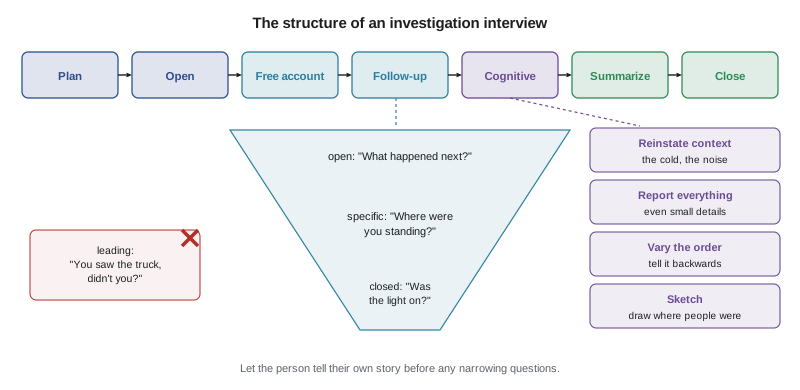
The single most important technique is to let the person give their own account first, without interruption. Start with a wide, open question, such as 'Tell me about your shift that night, from when you arrived', and then listen. Do not interrupt, do not correct, and do not jump to the moment of the incident. Silence is a tool: people often add important details after a pause that an interviewer would have filled with the next question.
Only after the free account should the interviewer ask follow-up questions, and these should start open and gradually narrow. 'Tell me more about the replenishment task' comes before 'How many pallets were left?', which comes before 'Did you see the dispatcher's message?' Closed questions, which can be answered with yes or no, are useful for confirming specific details but poor for discovering anything new. Leading questions, which suggest the answer, should be avoided altogether: 'You were in a hurry because of the 3:00 truck, weren't you?' puts the investigator's theory into the witness's mouth.
Questions that start with 'why' can also cause trouble, because they often sound like an accusation. 'Why didn't you look to your left?' implies the person should have. 'Talk me through what you were looking at as you reversed' asks for the same information without judgement, and usually gets a more useful answer. Jordan's answer to that question was the most important thing he said: he had been looking over his right shoulder at the pallet stack and the corner of the staging lane, because that was where he had been told the blind spot was, and he was watching for the blue dot on the floor to tell him whether anyone was behind him. He had never seen the blue dot fail. He did not know it could.
The cognitive interview
Psychologists developed the cognitive interview in the 1980s to help witnesses recall more accurately, and versions of it are now widely used by police and safety investigators. Research suggests it increases the amount of accurate information people recall without a large increase in errors, provided interviewers avoid leading questions. Its main techniques are simple.
- Reinstate the context. Ask the person to picture the scene before describing it: where they were, the cold, the noise, the light, what they were feeling and thinking. Mental context helps memory.
- Report everything. Ask them to mention every detail, however small or unimportant it seems, because they cannot know what matters.
- Vary the order. After a chronological account, ask them to go through it backwards, or starting from a different point. This brings out details that a well-rehearsed sequence skips.
- Use their own words and drawings. Ask them to sketch where things were. A drawing often reveals positions and sightlines that words leave vague.
When Elena asked Nadia, the picker who helped, to picture the aisle as she ran toward the noise, Nadia remembered something she had not written in her first statement: the warning beeper on the truck had been sounding, but she had only noticed it after she reached Marie, because the freezer fans were so loud that the beepers 'just blend in, you stop hearing them'. When Elena asked her to sketch the aisle, Nadia drew the pallet stack without being prompted and said, 'That's been there for ages. We all walk round it.'
Interviewing the injured person
The person who was hurt is often the most important witness and the one who needs the most care. Never interview someone who is in pain, medicated or still in shock, and always ask for their consent. A short first conversation can wait days or weeks. Elena visited Marie in hospital on the second day, but only to bring flowers from the crew, explain that the investigation was under way, and ask whether Marie would be willing to talk when she felt ready. Marie said she would.
The interview took place at Marie's home ten days after the collision, with her husband present, and lasted forty minutes. Marie had no memory of seeing the truck. She remembered scanning a label, thinking about the next pick, and then lying on the floor. She explained that the freezer pickers had stopped walking on the far walkway when the pallets were stacked there, because going around the stack meant stepping into the aisle anyway, and the travel aisle was shorter. She said she always listened for beepers and watched for the blue dot. 'I didn't hear it over the fans,' she said. 'And there was no blue light. If there's no blue light, there's no truck. That's what we all think.'
That sentence changed the investigation. The blue spotlight had been fitted to warn pedestrians, but over the year since, pickers had come to rely on it so completely that its absence meant safety. When it failed silently, it did not just remove a warning. It gave a false all-clear.
Interviewing supervisors and decision-makers
Supervisors and managers often feel the most exposed in an investigation, because they made decisions that now look wrong. The same principles apply: explain the purpose, start open, avoid hindsight. Ken explained that he had closed the two near misses with 'drivers reminded' because the near-miss form gave him no other options he could act on quickly, he had no authority to change the layout, and the operations manager had told him the staging lane was temporary. He had seen the pallet stack but thought the pallet return area would be emptied 'any day'. Derek, the night operations manager, said the staging lane had solved a real capacity problem and that nobody had suggested a safety review because 'it was just a lane, not equipment'. Grace confirmed she had approved the change by email between other meetings, assuming that operations had considered traffic flow.
Each of those answers made sense from where the person stood. None of them was evidence of carelessness. Together, they pointed to a gap in the system: there was no process that made anyone look at traffic, pedestrians and sightlines when the layout changed.
Notes, summaries and follow-up
Take notes in the person's own words where possible, especially for important points. At the end, read back a short summary and invite corrections. Ask whether there is anything else they think the investigators should know, and whether anyone else should be spoken to. Tell them what will happen next, and thank them. Afterwards, write up a summary, give the person a chance to review it, and file it with the evidence. Some organizations record interviews with consent; Harrowgate Foods Ltd. does not, because it found people speak more freely without a recorder on the table.
Witnesses will disagree. Jordan was sure he had reversed slowly; the logger agreed. Ken thought the pallet stack had been there for a few days; Nadia said 'ages', and the camera footage showed at least seven nights. Disagreement is normal and does not mean anyone is lying. It is a reason to check against physical evidence and data, and to treat each account as one view of the event.
Checking question quality
Sam, new to investigations, asked Elena how to tell whether his questions were good. She gave him a rough rule and wrote a small script to illustrate it on his draft question list.
# Rough classification of draft interview questions.
draft = [
    "Tell me about your shift that night.",
    "Did you see the dispatcher's message?",
    "You were rushing for the 3:00 truck, weren't you?",
    "Why didn't you look to your left?",
    "Talk me through what you were watching as you reversed.",
    "Is it true the walkway was always blocked?",
]
openers = ("tell me", "talk me through", "describe", "walk me through", "what happened")
for q in draft:
    s = q.lower()
    if s.endswith(("weren't you?", "didn't you?", "wasn't it?")) or s.startswith("is it true"):
        kind = "leading: rewrite"
    elif s.startswith("why"):
        kind = "why: may sound like blame"
    elif s.startswith(openers):
        kind = "open: good start"
    else:
        kind = "closed: use to confirm details"
print(f"{kind:<28} {q}")open: good start Tell me about your shift that night. closed: use to confirm details Did you see the dispatcher's message? leading: rewrite You were rushing for the 3:00 truck, weren't you? why: may sound like blame Why didn't you look to your left? open: good start Talk me through what you were watching as you reversed. leading: rewrite Is it true the walkway was always blocked?
The script is crude, and no interviewer should rely on keyword rules. But it made a useful point for Sam: two of his six draft questions put the answer in the witness's mouth, and one sounded like an accusation. He rewrote them before his next interview.
Worked problem
Rewriting questions without blame or hindsight
Show solution
- Draft: 'Why did you walk in the travel aisle instead of the walkway?' This implies she was wrong and invites a defensive answer.
- Rewrite: 'Describe the route you usually take from the pick face to the dock.'
- Draft: 'You knew the light was broken, didn't you?' This is leading and accusatory.
- Rewrite: 'What did you notice about the truck's lights and alarms that night?'
- Follow-up, only after the open answer: 'Did anyone mention a problem with the blue light before that shift?'
Answer: Start open and neutral, ask what the person saw and did, and narrow only after the free account.
Common mistakes
MistakeInterviewing witnesses together to save time.
InsteadInterview people one at a time so details are not lost to a shared story.
MistakeInterrupting the free account to ask about the key moment.
InsteadLet the person tell their story in full first, then ask follow-up questions.
MistakeAsking leading questions that contain your theory.
InsteadAsk open, neutral questions and let the evidence test your theory.
MistakeInterviewing the injured person in hospital while in pain or medicated.
InsteadWait until they are well, ask for consent, and keep it short and supportive.
MistakeTreating disagreement between witnesses as lying.
InsteadExpect differences and check accounts against physical evidence and data.
Summary and key terms
- Interview widely: those involved, eyewitnesses, people who know the work, decision-makers and those who reported earlier problems.
- Handle conflicts of interest openly as soon as they appear.
- Interview one at a time, soon but not while people are exhausted or in shock, in a private setting with a support person allowed.
- Explain the purpose, invite a free account, then move from open to closed questions; avoid leading and accusatory 'why' questions.
- Cognitive interview techniques help recall: reinstate context, report everything, vary the order, sketch.
- Read back a summary, follow up, and check differing accounts against evidence.
- Free account
- The witness's own uninterrupted description of events.
- Open question
- A question that invites a full answer, such as "Tell me about...".
- Leading question
- A question that suggests the answer the interviewer expects.
- Cognitive interview
- An interview method using memory techniques such as context reinstatement and varied order.
- Support person
- Someone the interviewee brings for support, who does not answer for them.
- Conflict of interest
- A situation where an investigator's own decisions or interests are under review.
Practice problems
Work each problem on paper first, then reveal the answer to check.
Why did Grace step out of part of the analysis?
Show answer
The investigation examined her own decision to approve the staging lane.
Why interview witnesses one at a time?
Show answer
Group discussion makes accounts converge and loses details only one person saw.
Give a better version of "Why didn't you look left?"
Show answer
For example: "Talk me through what you were watching as you reversed."
Name the four main cognitive interview techniques.
Show answer
Reinstate the context, report everything, vary the order, and use drawings or own words.
What did Marie's interview reveal about the blue light?
Show answer
Pickers relied on it so much that its absence meant no truck, so its silent failure gave a false all-clear.
Lesson quiz · 5 questions
Score 60% or more to complete this lesson.
Create a free account to save your progress, take quizzes and earn a certificate.