
HSE-403 · Lesson 1 of 12 · 23 min
Why investigate and what makes an investigation good
At 2:15 a.m. on a Tuesday in February, in the freezer section of Harrowgate Foods Ltd.'s distribution centre in Dartmouth, a forklift reversing out of a staging lane struck an order picker walking along the main travel aisle. The rear wheel of the truck rolled over Marie Doucet's left foot. She was taken to hospital by ambulance with fractures to her foot and ankle and was admitted for surgery the next morning. The driver, Jordan Reid, was an agency worker in his sixth week on the site. He had not seen her.
By 7 a.m., three people had already offered an explanation. The night supervisor said Marie had been walking in the wrong place. The agency coordinator said Jordan had been trained and should have looked behind him. A picker on the same shift said the pedestrian walkway on that side of the aisle had been blocked by stacked empty pallets for more than a week, so everyone walked in the travel lane. Each explanation was partly true. None of them, on its own, told the company what to change so that the next picker would not be hurt.
This course follows Elena Novak, the health and safety manager for Harrowgate Foods Ltd., as she leads the investigation of that collision from the first phone call to the final report, with help from Grace Whitfield, the distribution centre manager, and Sam Pellerin, a forklift operator and the worker co-chair of the joint occupational health and safety committee at the site. Along the way it covers the legal duties to report and investigate, how to secure a scene and gather evidence, how to interview people without blaming them, how human error really works, the main root cause methods, and how to choose corrective actions that actually prevent a repeat. The last lesson applies everything to a second incident, a chemical splash at the Kentville sauces plant.
What an investigation is for
An incident investigation is a structured effort to understand what happened, why it happened, and what should change so that it does not happen again. That last part is the whole point. An investigation that produces a clear account of events but no effective changes has failed, however thorough it was. An investigation that produces sensible, lasting changes has succeeded, even if some details of the event remain uncertain.
There are several reasons organizations investigate. The most important is prevention: every incident is evidence that a hazard got past the controls that were supposed to stop it, and the investigation is the chance to find out how. A second reason is legal. Many incidents must be reported to a regulator, and employers in most jurisdictions are expected to investigate serious incidents and keep records of what they found and did. A third reason is fairness to the people involved, who deserve an honest account of what happened rather than a rushed judgement. A fourth is learning across the organization: the same weaknesses that caused one incident are often present at other sites, on other shifts and in other tasks.
Investigations also serve purposes they should not. They are sometimes used to find someone to discipline, to protect the company in a lawsuit, or to close a file as quickly as possible. Those motives distort the result. When people expect an investigation to end in blame, they stop telling the truth, and the investigation loses access to the information it needs most. Lesson 6 on interviews and lesson 7 on human factors come back to this problem in detail.
Incidents, near misses and potential
Different organizations use different words, but most distinguish between three kinds of event. An injury or illness is an event in which someone was hurt. Property damage covers events where equipment, product or buildings were damaged but nobody was injured. A near miss, sometimes called a close call or near hit, is an event that could have caused harm but did not, often by luck: the pallet fell where nobody was standing, or the driver stopped a metre short. Many companies use 'incident' as the umbrella word for all three, and this course does the same.
Near misses matter because they share causes with injuries. In the two months before Marie was hurt, pickers at the distribution centre had reported two near misses at the same aisle end: a forklift reversing out of a staging lane had stopped just short of a picker. Both reports were logged and closed with the note 'drivers reminded to look behind'. Neither was investigated. Had either one been treated as seriously as an injury, the blocked walkway, the poor sightline and the faulty warning light might all have been found before anyone was hurt.
It is tempting to decide how deeply to investigate based on how badly someone was hurt. That is a mistake. Whether a forklift misses a picker by ten centimetres or runs over her foot is often a matter of chance. A better approach is to set the depth of the investigation by the worst outcome that could reasonably have happened, which safety professionals call the potential severity. A near miss with serious injury potential deserves a deeper investigation than a minor cut from a box cutter, even though the cut is the only one that drew blood.
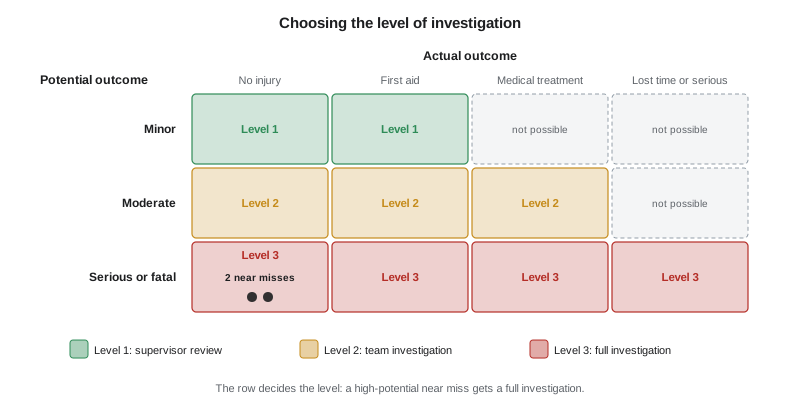
Levels of investigation
Harrowgate Foods Ltd. uses three levels. A level 1 review is done by the area supervisor within the shift for events with minor potential, such as a small cut or a dropped carton, and takes a few minutes on a short form. A level 2 investigation is done by a small team, usually the supervisor, a worker from the area and the safety coordinator, for events with moderate potential, and is completed within a week. A level 3 investigation is led by the health and safety manager, with a trained team that includes a worker representative, for any event with serious injury or fatality potential, whether or not anyone was hurt. Level 3 investigations get a formal report reviewed by the site leadership team.
The collision in aisle 14 was clearly level 3. In reviewing the earlier records, Elena found that the two near misses at the same spot should also have been level 3, because a forklift striking a pedestrian is one of the most common causes of serious injury and death in warehouses. Classifying them by the outcome rather than the potential was the first of several weaknesses the investigation would uncover.
What makes an investigation good
Investigation experts disagree on methods, but they broadly agree on what separates a good investigation from a poor one. Elena uses a short list of qualities with every team she leads.
- Timely. It starts quickly, while memories are fresh and evidence is intact, and it finishes within a set time so that fixes are not delayed.
- Fact-based. It separates what is known from what is assumed, and it tests explanations against evidence.
- Systemic. It looks beyond the people closest to the event to the equipment, environment, procedures, training, supervision, scheduling and decisions that shaped what they did.
- Fair. It treats the people involved with respect, avoids hindsight bias, and does not start from the question 'whose fault was it?'
- Participative. It involves workers who do the job, including a worker representative, because they know how the work is really done.
- Action-oriented. It ends with specific corrective actions, each with an owner and a date, and checks later that they worked.
- Shared. Its lessons reach the people who can use them, at other sites and on other shifts.
Note that 'finding the cause' is not on the list as a single item. Serious incidents almost never have one cause. They usually result from several conditions lining up at the same time, most of which had existed for days or months without anyone being hurt. A good investigation looks for all of them.
The problem with blame
When something goes wrong, people naturally look for someone who did the wrong thing. It is quick, it feels satisfying, and it closes the question. In the aisle 14 collision, Jordan reversed without seeing Marie, and Marie walked in the travel aisle instead of the walkway. Both statements are true. But if the investigation stopped there, the company would discipline or retrain two workers and change nothing else. The next agency driver would meet the same blocked walkway, the same frosted mirror, the same dead warning light and the same pressure to beat the 3 a.m. truck.
Safety researchers often describe this as the difference between seeing human error as a cause and seeing it as a symptom. When a trained, well-meaning person makes a mistake, the useful question is not 'why did they fail?' but 'why did it make sense to them at the time, and what in the system set them up to fail?' Lesson 7 covers the research behind that approach. For now, the practical rule is simple: an investigation that ends with 'worker error' or 'worker did not follow procedure' as its main finding has almost always stopped too early.
This does not mean nobody is ever accountable. Deliberate recklessness and sabotage are rare, but they happen, and organizations deal with them through their discipline process. HSE-401 described just culture, which draws the line between honest mistakes, at-risk shortcuts and reckless choices. The investigation's job is to understand and prevent. Discipline, where it is truly warranted, is a separate decision made through a separate process, and most good investigation procedures say so explicitly.
Who investigates
Investigations are stronger when the team includes people with different views. A typical level 3 team at Harrowgate Foods Ltd. includes the health and safety manager as lead, a manager from the area who has authority to make changes, a worker from the area who knows the job, the worker co-chair of the joint occupational health and safety committee or another worker member, and specialists as needed, such as maintenance or engineering. In Nova Scotia, the joint occupational health and safety committee has a role in investigations: committees and representatives are expected to take part in or be informed about the investigation of serious incidents, and their participation is one of the clearest signs that the internal responsibility system is working.
The team for aisle 14 was Elena as lead, Grace Whitfield as the manager with authority over the distribution centre, Sam Pellerin as the worker representative, and Luis Ortega from maintenance for the forklift and lighting questions. Elena deliberately left out the night supervisor, Ken Albright, from the team. He would be an important witness, and he had already offered an explanation that blamed the picker. Including him on the team would have made it harder for others to speak freely about supervision on the night shift.
Independence matters for another reason. People who designed a system, or who made the decisions under review, find it hard to see its weaknesses. That is why serious incidents are often investigated by someone from outside the department, and sometimes from outside the company. A good rule is that no one should investigate their own decisions, and the lead investigator should be able to report findings to senior management without fear for their job.
The investigation process at a glance
Most investigation procedures follow the same broad stages, though the names vary. The rest of this course works through them in order.
- Respond and secure. Care for the injured, make the area safe, preserve the scene and notify the right people (lessons 2 and 3).
- Gather evidence. Physical evidence, documents, data, photographs, measurements and sketches (lessons 4 and 5).
- Interview. Witnesses, the people involved and others who know the work (lesson 6).
- Analyse. Build a timeline, understand the human factors, and use structured methods to find causes and failed barriers (lessons 7 to 10).
- Act. Choose corrective actions that address the causes, assign owners and dates, and verify that they work (lesson 11).
- Report and share. Write a clear report and share the lessons widely (lesson 12).
These stages overlap. Interviews often send investigators back to look for new evidence, and analysis often raises questions that need more interviews. The process is a loop more than a line, and the team should expect to revisit its early conclusions more than once.
Tracking whether investigations work
Elena wanted to know whether the site's investigations had been doing their job before the collision. She pulled the incident log for the previous twelve months and looked at each event's potential severity, the level of investigation it received and the quality of its corrective actions.
# Incident log for the distribution site, previous 12 months (simplified).
# potential: 1 minor, 2 moderate, 3 serious or fatal; level: investigation level actually done.
log = [
    ("box cutter cut",            1, 1, "replace blade"),
    ("forklift near miss, aisle 14", 3, 1, "drivers reminded"),
    ("pallet fell from rack",     3, 2, "rack beam replaced"),
    ("slip on dock ice",          2, 1, "salt applied"),
    ("forklift near miss, aisle 14", 3, 1, "drivers reminded"),
    ("strain lifting tote",       2, 2, "lift assist ordered"),
    ("dock plate struck foot",    2, 1, "worker retrained"),
]
weak = ("reminded", "retrained", "told", "be careful")
under = [e for e in log if e[2] < e[1]]
print(f"events: {len(log)}  investigated below their potential: {len(under)}")
for name, pot, lvl, action in under:
    flag = "weak action" if any(w in action for w in weak) else ""
print(f" {name:<30} potential {pot}, level {lvl} {action} {flag}")events: 7 investigated below their potential: 5 forklift near miss, aisle 14 potential 3, level 1 drivers reminded weak action pallet fell from rack potential 3, level 2 rack beam replaced slip on dock ice potential 2, level 1 salt applied forklift near miss, aisle 14 potential 3, level 1 drivers reminded weak action dock plate struck foot potential 2, level 1 worker retrained weak action
The result showed a pattern. Four of the seven events had been investigated below their potential, and three of those four ended with an action that relied on telling workers to try harder. Lesson 11 explains why reminders and retraining are among the weakest corrective actions. For the site leadership team, the table made a simple point: the aisle 14 collision had been signalled twice, and the investigation system had not been set up to hear the signal.
Worked problem
Choosing the investigation level
Show solution
- Event: a pallet of frozen meals slides off the forks of a reach truck at the second rack level and lands in an empty aisle. Nobody is nearby.
- Actual outcome: product damage worth about 600 dollars. No injury.
- Potential outcome: a falling pallet of about 500 kg could kill a person in the aisle. Potential severity is serious or fatal.
- Level: a level 3 investigation led by the health and safety manager, with a worker representative and maintenance.
- Reason for the choice: the level follows the potential, not the luck of nobody being in the aisle.
Answer: Treat it as a level 3 investigation because of the potential severity.
Common mistakes
MistakeDeciding how deeply to investigate based only on the injury that occurred.
InsteadSet the investigation level by the potential severity of the event.
MistakeClosing near misses with a reminder to be careful.
InsteadInvestigate high-potential near misses as seriously as injuries; they share the same causes.
MistakeStopping at 'worker error' or 'did not follow procedure'.
InsteadAsk why the action made sense at the time and what in the system set the person up to fail.
MistakeLetting people investigate their own decisions.
InsteadBuild an independent team with a worker representative and a manager who can make changes.
MistakeTreating the investigation as a step toward discipline.
InsteadKeep investigation and any discipline decision separate, and say so in the procedure.
Summary and key terms
- An investigation exists to understand what happened, why, and what must change to prevent a repeat.
- Near misses share causes with injuries and deserve investigation when their potential is serious.
- Set the depth of an investigation by potential severity, using defined levels.
- Good investigations are timely, fact-based, systemic, fair, participative, action-oriented and shared.
- Serious incidents rarely have a single cause; several conditions usually line up.
- Blame stops learning; investigation and discipline should be separate processes.
- Incident
- Any unplanned event that caused or could have caused injury, illness or damage.
- Near miss
- An event that could have caused harm but did not.
- Potential severity
- The worst outcome that could reasonably have resulted from an event.
- Level 3 investigation
- Harrowgate Foods Ltd.'s term for a full investigation led by the health and safety manager for serious-potential events.
- Systemic investigation
- An investigation that looks at equipment, environment, procedures, organization and decisions, not only individual actions.
- Hindsight bias
- The tendency to see an outcome as obvious and predictable once it is known.
Practice problems
Work each problem on paper first, then reveal the answer to check.
What is the main purpose of an incident investigation?
Show answer
To understand what happened and why, and to make changes that prevent a repeat.
Why should high-potential near misses be investigated?
Show answer
They share causes with injuries, and whether harm occurs is often luck.
How should the depth of an investigation be set?
Show answer
By the potential severity of the event, not only the actual outcome.
Why did Elena leave the night supervisor off the investigation team?
Show answer
He was a key witness who had already blamed the picker, and his presence could stop others speaking freely about supervision.
Why is "worker error" a poor final finding?
Show answer
It describes a symptom; it does not explain why the error made sense or what in the system set the person up to fail.
Lesson quiz · 5 questions
Score 60% or more to complete this lesson.
Create a free account to save your progress, take quizzes and earn a certificate.