
HSE-403 · Lesson 3 of 12 · 22 min
Responding to an incident and securing the scene
Elena reached the distribution centre at 3:20 a.m., a little over an hour after the collision. Marie was already in the ambulance on the way to hospital. The forklift was where Jordan had stopped it, keyed off, with a pallet of frozen lasagna still on the forks. Someone had strung yellow caution tape across the end of aisle 14 between two rack uprights. Ken was at the tape, directing the other drivers around through aisle 12. A pair of trauma shears and the remains of a cut-open freezer boot lay on the floor beside a dark stain where the paramedics had worked.
The first hour after an incident decides much of what an investigation can later find out. Some evidence lasts for weeks. Some disappears within minutes: a light that someone switches back on, frost that melts from a mirror once the door is propped open, a security camera recording that overwrites itself after a few days, a memory that blends with what other people say over coffee. This lesson covers the immediate response, how to secure a scene, how to decide what evidence to protect first, and how to hand the scene back to normal use.
The response sequence
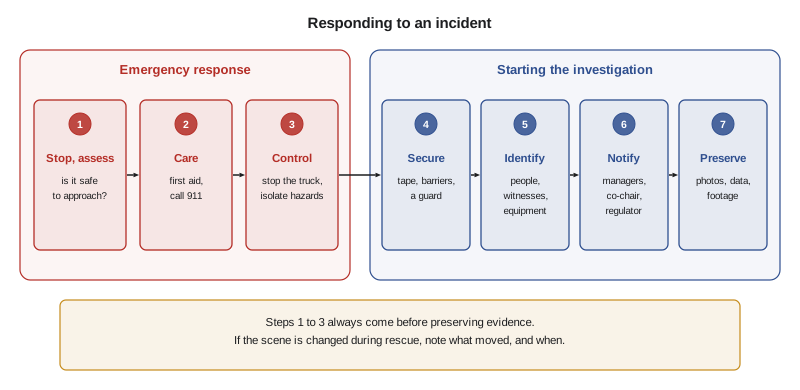
Every site should have a written emergency response plan, practised in drills, that covers the first minutes after an injury. Investigation procedures usually begin where the emergency plan leaves off, but the two have to fit together. Harrowgate Foods Ltd. teaches supervisors a simple sequence for any serious incident, in priority order.
- Stop and assess. Make sure you will not become a second victim. Is the forklift still moving? Is the energy still on? Is there a chemical, fire or atmosphere hazard?
- Care. Give first aid and call emergency services. Send someone to meet the ambulance at the door and guide it in.
- Control. Stop the hazard: shut down the machine, isolate the energy, park and key off the vehicle, stop traffic in the area.
- Secure. Set up a perimeter to keep people out of the scene, except those who need to be there.
- Identify. Note who was present, who saw or heard what happened, and who arrived afterwards.
- Notify. Start the call tree from lesson 2.
- Preserve. Protect evidence, especially evidence that will not last.
The first three steps belong to the emergency response and override everything else. If preserving the scene would delay care or leave a hazard live, care and safety win. Paramedics cutting off Marie's boot, moving pallets aside to reach her and kneeling in the aisle all changed the scene, and nobody should hesitate to let them. The investigation's job is to record what was changed, by whom and why, not to stop it.
Setting a perimeter
A scene perimeter should be larger than seems necessary at first. It is easy to make a perimeter smaller later and hard to make it bigger once people have walked through the area. Elena widened Ken's tape to take in the whole staging lane the forklift had reversed out of, the end of the walkway on the far side of the aisle, and the corner where the convex mirror was mounted. She also asked Luis to tag the forklift out of service so that nobody would drive it away in the morning by mistake.
Someone should control access to the scene and keep a short log of everyone who enters, when and why. At 3:20 a.m. Ken handed that job to a lead hand, who wrote the names on the back of a pick list: the first aid attendant, the two paramedics, Ken himself, the picker who helped, and now Elena and Luis. The log matters for two reasons. It shows later who might have changed something, and it keeps curious coworkers out. In the hour before Elena arrived, at least four people had wandered up to look. One of them had picked up Marie's scanner gun and put it on a shelf, a small act of tidiness that later took an hour to untangle.
In a warehouse, a perimeter often means rerouting traffic, which costs time and creates its own risks. Ken had done the right thing by sending drivers around through aisle 12. Elena checked that the detour did not create a new conflict point with pickers and asked Ken to put a lead hand at the far end of aisle 12 for the rest of the night. Securing one scene should never move the hazard somewhere else.
Protecting the investigators
Investigators are exposed to the same hazards that caused the incident, and sometimes new ones. The freezer section of the distribution centre runs at about minus 25 degrees Celsius. Workers there wear insulated suits and take warm-up breaks on a schedule. Elena and Luis put on freezer suits before going past the tape and agreed to step out to the warm dock every 30 minutes. Forklift traffic in nearby aisles continued, so they stayed inside the taped area and kept a spotter at the aisle end. A scene is not safe just because the incident is over.
Fragile evidence first
Investigators often group evidence into four types, sometimes called the four Ps: people, position, parts and paper. People means witnesses and those involved. Position means where things and people were: the forklift, the pallet, Marie, the scanner, the mirror. Parts means physical items: the forklift and its features, the warning light, the boot, the stacked empty pallets. Paper, which today mostly means electronic records, covers procedures, training records, maintenance logs, schedules, scanner data and video. Lesson 4 looks at each in detail. In the first hour, the question is which of them will be lost if nobody acts now.
Elena's quick list for aisle 14 looked like this. The security camera system kept recordings for seven days and then overwrote them, so the footage covering the staging lane and aisle 14 had to be saved that night. The forklift's blue warning spotlight, which projects a blue dot on the floor behind a reversing truck, was not lit; she needed to know whether it had failed or been switched off, before anyone touched it. The convex mirror at the aisle end was frosted over, and frost changes as doors open and close and as the defrost cycle runs. The stacked empty pallets on the walkway would almost certainly be cleared by the morning shift. And the witnesses would go home within the hour, talk to their families, and come back the next night with memories that had already started to change.
So, in that order, she asked the security contractor to export and save all camera footage from 1:30 a.m. to 3:00 a.m. for the freezer section and dock; photographed the warning light, the mirror and the pallets before touching anything; asked Luis to read the forklift's on-board data logger, which records impacts, speed and operator log-in; asked the warehouse system administrator to save the scanner and pick data for aisle 14 for the whole shift; and asked each witness to write a short account in their own words before leaving, without discussing it with each other.
Recording the scene before it changes
Before anything is moved, investigators should record the scene as found. Photographs come first because they are quick and capture much more than notes, but they are not enough on their own. A rough sketch with key measurements shows distances and relationships that photographs can distort. Notes record what cannot be seen: the temperature, the noise level, the smell, which lights were on, which doors were open, what the floor felt like. Lesson 5 covers photographs, sketches and timelines in detail. In the first hour, the goal is a fast, complete record, even if it is rough.
Elena took about 80 photographs in twenty minutes, starting from the four corners of the taped area and working inward. She drew a quick sketch on a clipboard showing the forklift, the staging lane, the travel aisle, the walkway, the stacked pallets, the mirror and the stain where Marie had lain, and Luis held a tape measure for the key distances. She noted that the lighting in the aisle was on its night setting, that the freezer fans were running loudly, and that the floor had a thin dusting of frost near the dock door. Each of these details turned out to matter later.
What was changed, and by whom
No scene survives an emergency response untouched, so the investigation must reconstruct what was moved. Elena asked the first aid attendant and the picker who helped to show her, before they left, where Marie had been lying when they reached her, what they had moved and why. The picker had dragged two cartons out of the way to kneel beside her. The paramedics had moved the pallet jack that stood near the staging lane entrance to bring in the stretcher. The lead hand had picked up the scanner gun. Each change went into Elena's notes with the name of the person, the time and the reason. Without that list, the team might later have drawn wrong conclusions from where things lay.
This is also why the people who respond first should be told, gently, not to tidy up. First responders often feel an urge to put things back in order. A good supervisor tells them clearly: help the injured, make it safe, and then leave everything else exactly as it is.
Using a triage list
Elena keeps a small evidence triage list for her teams, which ranks typical evidence by how quickly it is lost. It is a reminder, not a rule: every scene is different.
# Typical evidence at a warehouse vehicle incident, with how long it usually lasts
# before being lost or changed (hours) and how important it tends to be (1 to 3).
evidence = [
    ("witness memories, uncontaminated",   2, 3),
    ("state of lights, alarms and switches", 1, 3),
    ("frost, ice or spills on surfaces",     1, 2),
    ("camera footage (7-day overwrite)",   168, 3),
    ("forklift data logger records",       720, 3),
    ("position of vehicle and load",         4, 3),
    ("housekeeping: stacked pallets",        6, 2),
    ("training and maintenance records",  8760, 2),
]
# Act first on evidence that is both short-lived and important.
ranked = sorted(evidence, key=lambda e: (e[1] / e[2]))
for i, (what, hours, weight) in enumerate(ranked, 1):
print(f"{i}. {what:<38} lost in about {hours:>4} h importance {weight}")1. state of lights, alarms and switches lost in about 1 h importance 3 2. frost, ice or spills on surfaces lost in about 1 h importance 2 3. witness memories, uncontaminated lost in about 2 h importance 3 4. position of vehicle and load lost in about 4 h importance 3 5. housekeeping: stacked pallets lost in about 6 h importance 2 6. camera footage (7-day overwrite) lost in about 168 h importance 3 7. forklift data logger records lost in about 720 h importance 3 8. training and maintenance records lost in about 8760 h importance 2
The ranking matched what Elena did that night. Witness memories, the state of the lights and switches, and the frost came first, then the positions of the truck and load, then the housekeeping. Camera footage seems to have a week, but systems fail, settings vary and people forget, so she treats it as urgent anyway. Records that will exist for years, like training files, can wait until the next day.
Releasing the scene
A scene should be released only when the investigation team has everything it needs from it and, for incidents reported to the Department, when the officer has given permission or indicated that they will not attend. Release should be a deliberate decision, recorded with the time and the name of the person who made it, not something that happens because the morning shift needs the aisle. At Harrowgate Foods Ltd., the lead investigator releases the scene after a final walk-through, and a supervisor confirms that any hazard found has been made safe before normal work resumes.
Releasing the scene is not the same as returning to normal. The conditions that allowed the collision were still there at 6 a.m.: the blocked walkway, the frosted mirror, the reversing route out of the staging lane. Elena made three interim changes before releasing aisle 14. The stacked empty pallets were removed from the walkway and a lead hand was told to keep it clear for every shift until a permanent fix was in place. The staging lane at aisle 14 was closed, with its loads redirected to a lane where trucks could pull out forwards. And every forklift's blue warning light was checked at the start of the day shift, which turned up a second truck with a dead light. Interim controls like these buy time for the investigation to find and fix the deeper causes.
Worked problem
Securing a different scene
Show solution
- A maintenance mechanic at the Truro plant is cut on the hand by a conveyor sprocket during a repair. He is treated in hospital and released.
- Stop and assess: confirm the conveyor is stopped and locked out, and that nobody else is near moving parts.
- Secure: tape off the conveyor section and post someone at the line to keep it from restarting.
- Fragile evidence first: photograph the position of the guard, the lockout point and the controls before anyone resets them, and save the line controller's fault log.
- Record changes and release: note what the first aiders moved, document the scene, then release it with the guard and lockout confirmed in place.
Answer: Make it safe, secure the area, capture short-lived evidence first, record changes, then release deliberately.
Common mistakes
MistakeHolding back paramedics to protect the scene.
InsteadCare and safety always come first; record what responders changed afterwards.
MistakeTaping off a small area right around the vehicle.
InsteadSet a wide perimeter first; it is easy to shrink and hard to expand.
MistakeLeaving camera footage for later.
InsteadSave video and electronic data immediately, before automatic overwriting.
MistakeSwitching the warning light on to see if it works.
InsteadPhotograph and document the state of lights, switches and controls before touching them.
MistakeReleasing the scene because production needs the aisle.
InsteadRelease deliberately once evidence is captured, with interim controls in place.
Summary and key terms
- Respond in order: stop and assess, care, control, secure, identify, notify, preserve.
- Emergency care overrides scene preservation; record what responders changed and why.
- Set a wide perimeter, control access and log everyone who enters.
- Protect investigators from the same hazards, including cold, traffic and energy.
- Capture fragile evidence first: memories, the state of lights and controls, surface conditions and video.
- Release the scene deliberately and put interim controls in place before work resumes.
- Perimeter
- The boundary around an incident scene that keeps out people who do not need to be there.
- Access log
- A record of everyone who enters a scene, with times and reasons.
- Four Ps
- People, position, parts and paper: the main types of evidence.
- Fragile evidence
- Evidence that will be lost or changed quickly if not captured.
- Data logger
- An on-board device that records a vehicle or machine's operating data.
- Interim control
- A temporary measure to reduce risk while the investigation finds permanent fixes.
Practice problems
Work each problem on paper first, then reveal the answer to check.
What are the first three steps of the response sequence?
Show answer
Stop and assess, care, and control.
Why should a perimeter start large?
Show answer
It is easy to make smaller later and hard to expand once people have walked through.
Name three kinds of fragile evidence at the aisle 14 scene.
Show answer
Witness memories, the state of the warning light, the frost on the mirror, camera footage or the stacked pallets.
Why did Elena record what the first responders moved?
Show answer
So the team would not draw wrong conclusions from where things lay.
Name one interim control put in place before the scene was released.
Show answer
Clearing the walkway, closing the staging lane, or checking every forklift's warning light.
Lesson quiz · 5 questions
Score 60% or more to complete this lesson.
Create a free account to save your progress, take quizzes and earn a certificate.