
HSE-403 · Lesson 2 of 12 · 22 min
Reporting and notification duties in Nova Scotia
At 2:22 a.m., seven minutes after the collision in aisle 14, the night supervisor, Ken Albright, phoned Elena Novak at home. Her first questions were about Marie: was she breathing, was she conscious, was the bleeding controlled, had an ambulance been called? Her next questions were about the scene: was the forklift parked and keyed off, was anyone else at risk, had anything been moved? Only then did she start the list that every safety manager keeps in their head: who must be told, by when, and in what form.
This lesson covers that list. It explains which incidents must be reported to the Department of Labour, Skills and Immigration and to the Workers' Compensation Board of Nova Scotia, what the law expects about preserving the scene and investigating, and how internal notifications should work. HSE-402 covered these duties from the supervisor's legal point of view; this lesson looks at them as the first step of an investigation.
Care comes first
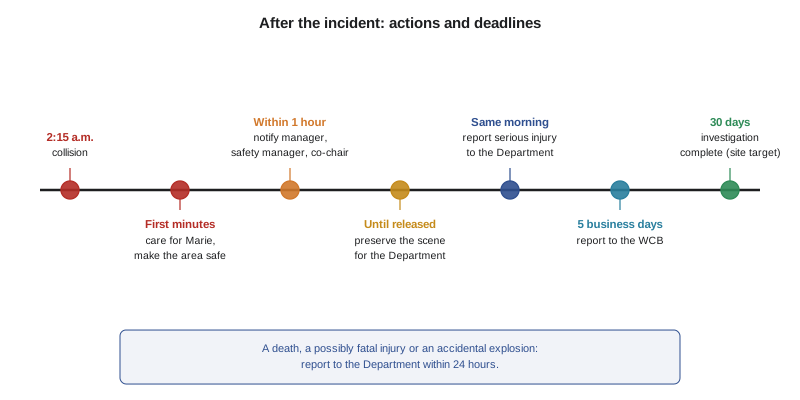
No reporting duty comes before the injured person. The first priorities at any incident are to make sure the area is safe for responders, give first aid, call emergency services when needed, and stop anyone else from being hurt. Every jurisdiction's reporting rules assume this. Elena's procedure lists the first five minutes as care and control: help the injured, stop the energy, keep others away. Reporting begins once those are under way, and in a serious incident it usually begins within the first hour.
At 2:15 a.m., the picker working the next aisle heard Marie scream and ran to her. Jordan had stopped the truck immediately, set the parking brake and switched it off, which kept the rear wheel from moving again. The site's first aid attendant was there within three minutes, and Ken called the ambulance at 2:19. Paramedics arrived at 2:31. Those quick actions mattered more to Marie than anything else in this course.
Reporting to the Department
Nova Scotia's Occupational Health and Safety Act requires employers to report certain incidents to the Occupational Health and Safety Division of the Department of Labour, Skills and Immigration. The Division's guidance sets out the main categories. A death from any cause at the workplace, an injury that might prove fatal, such as a worker in critical condition in hospital, and an accidental explosion, whether or not anyone is hurt, must be reported within 24 hours. A serious injury caused by an accident or fire, meaning an injury that needs treatment by a doctor or paramedic, must also be reported, within a slightly longer window that the Division's guidance gave as seven days at the time of writing. Reports can be made by phone to the Division's toll-free line, or in writing as the Division's guidance describes.
Marie's injuries clearly met the serious injury definition: she was treated by paramedics and admitted to hospital for surgery. Her condition was not critical, so the 24-hour category did not strictly apply, but Elena reported by phone at 7:40 a.m. anyway. Her rule, written into Harrowgate Foods Ltd.'s procedure, is to report serious injuries the same day. Early reporting costs nothing, builds trust with the regulator, and removes any doubt about whether a deadline was met.
The report itself is short: the employer's name and address, the location of the incident, the date and time, the name of the injured worker, a brief description of what happened and of the injury, and a contact person. Elena gave facts only. She did not offer causes, because at 7:40 a.m. nobody knew them yet, and anything said in the first report can be quoted later. 'Forklift reversing from a staging lane struck a pedestrian order picker in the travel aisle; foot and ankle fractures; admitted to hospital' was enough.
Reporting to the WCB
Reporting to the Department and reporting to the Workers' Compensation Board are separate duties with separate purposes. The Department enforces safety law; the WCB pays compensation and supports recovery and return to work. An employer registered with the WCB must report a workplace injury to the WCB within five business days of learning about it when the injury needs medical treatment or causes time away from work. Marie's injury needed both. The WCB report also asks for a description of what happened, and Elena kept it consistent with the report to the Department: facts only, no speculation.
Jordan was an agency worker. In Nova Scotia, as in most provinces, a temporary help agency is usually the worker's employer for compensation purposes, while the host company that directs the work still has full occupational health and safety duties at its site. In this incident, the injured person was a Harrowgate Foods Ltd. employee, so the WCB report was Harrowgate Foods Ltd.'s. But Elena also notified the agency the same morning, because Jordan was involved, would be interviewed, and might need support after a traumatic event.
Preserving the scene
Nova Scotia's law expects the scene of a death or serious accident to be left undisturbed, except to rescue someone, prevent further injury or prevent serious damage to property, until an officer gives permission to resume or the Department indicates it does not need to attend. Disturbing a scene without a good reason can obstruct the Department's investigation, which is itself an offence. Elena asked Ken to tape off the end of aisle 14, leave the forklift where it stopped, and route traffic around the area until she arrived. When she reported to the Division at 7:40 a.m., she asked whether an officer would attend. The officer arrived at 10:15 a.m., took her own photographs and measurements, and released the scene shortly after noon.
Internal notifications
The legal reports are only part of the notification picture. Inside the company, a serious incident should trigger a defined call tree so that the right people know quickly and nobody learns about it from a rumour or the news. Harrowgate Foods Ltd.'s procedure requires the supervisor to call the health and safety manager and the site manager immediately for any level 3 event. The site manager informs the vice-president of operations, Rachel Okoye, within two hours. Human resources contacts the injured worker's family if the worker cannot, and arranges support. The worker co-chair of the joint occupational health and safety committee is informed the same day.
Elena also thinks about notifications people forget. The insurer and the agency, as described above. Customers, if a delivery would be delayed. The employee assistance program, because witnesses to a serious injury can be badly shaken. Other sites, if the hazard might exist there too: before noon, Elena emailed the managers of the Truro and Kentville plants to ask them to check their own forklift and pedestrian traffic routes that day. That last step is easy to skip and is often where the most injuries are prevented.
Who speaks for the company
A serious incident draws attention. Workers talk among themselves, families call, and sometimes local media ask questions. Harrowgate Foods Ltd. has one rule: only the site manager or a person they name speaks outside the company about an incident, and only facts that have been confirmed. Inside the company, Elena prefers short, factual updates over silence. A brief note posted at the distribution centre by the start of the day shift said that a picker had been injured by a forklift in aisle 14 overnight, that she was in hospital and receiving care, that an investigation was under way with Sam Pellerin as the worker representative, and that the end of aisle 14 was closed until further notice. That note did more to stop rumours than any amount of 'no comment'.
Checking deadlines
Elena keeps a small script that turns the time she learns of an incident into a list of deadlines, so that nothing is missed when several people are handling different reports.
from datetime import datetime, timedelta

def add_business_days(start, days):
    d = start
    while days:
        d += timedelta(days=1)
        if d.weekday() < 5:      # Monday to Friday
            days -= 1
    return d

learned = datetime(2026, 2, 10, 2, 22)   # Tuesday, when Elena was called
deadlines = [
    ("Department: death, possibly fatal injury or explosion", learned + timedelta(hours=24)),
    ("Department: serious injury (site rule: same day)", learned.replace(hour=17, minute=0)),
    ("WCB injury report (5 business days)", add_business_days(learned, 5)),
    ("Investigation report (site target 30 days)", learned + timedelta(days=30)),
]
for what, when in deadlines:
print(f"{what:<55} {when:%a %d %b %H:%M}")Department: death, possibly fatal injury or explosion Wed 11 Feb 02:22 Department: serious injury (site rule: same day) Tue 10 Feb 17:00 WCB injury report (5 business days) Tue 17 Feb 02:22 Investigation report (site target 30 days) Thu 12 Mar 02:22
The script is trivial, but it removes arithmetic from a stressful morning. More importantly, the last line reminds everyone that the investigation has its own deadline. Harrowgate Foods Ltd. sets a 30-day target for level 3 reports, with interim actions expected within days, because an investigation that drags on for months loses momentum and leaves the hazard in place.
Worked problem
Which reports are needed?
Show solution
- A sanitation worker at the Kentville plant gets a splash of cleaning chemical in one eye. The plant's eyewash is used for 15 minutes, and the worker is taken to the emergency department, treated by a doctor and sent home that evening with drops.
- Department: the injury needed treatment by a doctor, so it is a serious injury under the Division's guidance and must be reported; under Harrowgate Foods Ltd.'s rule, report it the same day.
- WCB: the injury needed medical treatment, so it is reported within five business days.
- Internal: call the safety manager and plant manager now, inform the joint occupational health and safety committee co-chair today, and alert the other sites if the same chemical and task exist there.
- Scene: preserve the chemical container, hose and area until the team has documented them.
Answer: Report to the Department and the WCB, notify internally, preserve the scene.
Supporting the people involved
A serious incident affects more people than the one who was injured. Jordan, the driver, had felt the truck roll over something and heard Marie scream. The picker who ran to help had knelt beside her in the freezer for fifteen minutes while they waited for the ambulance. Ken, the supervisor, had made the emergency call. All three were shaken, and all three were also key witnesses. Elena's procedure treats their wellbeing as part of the response, not an afterthought.
In practice that meant several small, deliberate steps. Nobody involved was asked to finish the shift; Ken arranged for them to be driven home and paid for the rest of the night. Elena phoned each of them later that morning, not to ask what happened, but to ask how they were and to explain what would happen next. Human resources gave them the number for the employee assistance program and checked in again a few days later. Jordan was told clearly that the investigation was not a disciplinary process, that he would be interviewed in a day or two with a support person of his choice if he wanted one, and that the agency had been informed so he would not lose pay while he was off.
These steps are humane, and they also make for a better investigation. People who feel supported are more willing to talk openly. People who feel suspected protect themselves, and investigators then get careful, incomplete accounts. The way the first day is handled sets the tone for everything that follows.
What not to do in the first hour
Elena keeps a short list of first-hour mistakes, drawn from investigations she has seen go wrong. None of them is illegal on its own, but each one makes the investigation harder or the next incident more likely.
- Restarting work in the area before it is safe and documented. The pressure to clear a blocked aisle is strong, especially with trucks waiting. Rerouting traffic is almost always possible.
- Letting witnesses compare stories. People who talk it over together start to share one version, and details that only one person saw get lost. Ask witnesses to write or record their own account before they leave, without discussing it.
- Repairing or replacing equipment. A faulty light, a damaged mirror or a forklift with a defect is evidence. Tag it out and leave it until the team has examined it.
- Announcing a cause. A supervisor who tells the shift 'she was in the wrong place' has decided the outcome before anyone has looked. It also tells every witness what answer is expected.
- Posting on social media. Photographs of an injured coworker or a damaged scene shared outside the company can hurt the family and compromise the investigation. Harrowgate Foods Ltd.'s procedure asks workers not to share images, and Ken reminded the shift before they went home.
Each of these points ties back to a legal duty as well. In Nova Scotia, disturbing a scene without reason can obstruct the Department, and the internal responsibility system depends on workers trusting that concerns will be dealt with fairly.
Common mistakes
MistakeCalling the Department before the injured worker has help.
InsteadCare and control come first; reporting follows within the required time.
MistakeAssuming the WCB report covers the Department report.
InsteadThey are separate duties to separate bodies with different purposes.
MistakeClearing the scene to get production running again.
InsteadLeave the scene undisturbed, except to rescue or prevent harm, until the Department allows it.
MistakeOffering likely causes in the first report.
InsteadReport facts only; causes come from the investigation.
MistakeForgetting the agency when an agency worker is involved.
InsteadNotify the agency the same day and coordinate support and duties.
Summary and key terms
- Care for the injured and control the hazard before any reporting.
- Deaths, possibly fatal injuries and accidental explosions go to the Department within 24 hours; serious injuries needing a doctor or paramedic must also be reported.
- The WCB report is separate and is due within five business days for injuries needing medical treatment or time off.
- The scene of a death or serious accident must stay undisturbed, except to rescue or prevent harm, until the Department allows otherwise.
- Report facts only, notify internally through a defined call tree, and alert other sites with the same hazard.
- With agency workers, the host has safety duties at its site and should notify the agency the same day.
- Occupational Health and Safety Division
- The part of the Department of Labour, Skills and Immigration that enforces safety law in Nova Scotia.
- Serious injury
- For reporting purposes in the Division's guidance, an injury from an accident or fire that needs treatment by a doctor or paramedic.
- Scene preservation
- Leaving an incident scene undisturbed so that evidence is not lost.
- Call tree
- A defined list of who notifies whom, and how quickly, after an incident.
- Host employer
- The company where an agency worker is placed and whose work they perform.
- WCB
- The Workers' Compensation Board of Nova Scotia, which handles injury compensation and return to work.
Practice problems
Work each problem on paper first, then reveal the answer to check.
Which incidents must be reported to the Department within 24 hours?
Show answer
A death, an injury that might prove fatal, and an accidental explosion.
What makes an injury a serious injury for reporting in the Division's guidance?
Show answer
It is caused by an accident or fire and needs treatment by a doctor or paramedic.
Within what time is an injury needing medical treatment reported to the WCB?
Show answer
Within five business days of the employer learning about it.
When may a serious accident scene be disturbed before the Department releases it?
Show answer
To rescue someone, prevent further injury or prevent serious property damage.
Why did Elena email the other plant managers on the first day?
Show answer
So they could check for the same forklift and pedestrian hazard at their sites.
Lesson quiz · 5 questions
Score 60% or more to complete this lesson.
Create a free account to save your progress, take quizzes and earn a certificate.