
HSE-403 · Lesson 12 of 12 · 23 min
Writing the report, sharing lessons and a capstone investigation
Six weeks after the collision in aisle 14, Elena had a folder of evidence, three analysis charts, a learning team summary and a fourteen-item action plan. None of it would change anything until people who were not in the room understood it. Rachel Okoye would read the summary and decide on the capital money. The night shift would hear about it at a crew talk. The other distribution centres would get a one-page safety alert. And Marie Doucet, home in a cast, would want to know what had been found and what was being done. Each of these readers needed something different from the same investigation.
This final lesson covers writing the investigation report, sharing lessons so they reach people who can use them, and tracking actions to completion. It ends with a capstone: a second incident at another Harrowgate Foods Ltd. site, which you will work through using the methods from the whole course.
What an investigation report is for
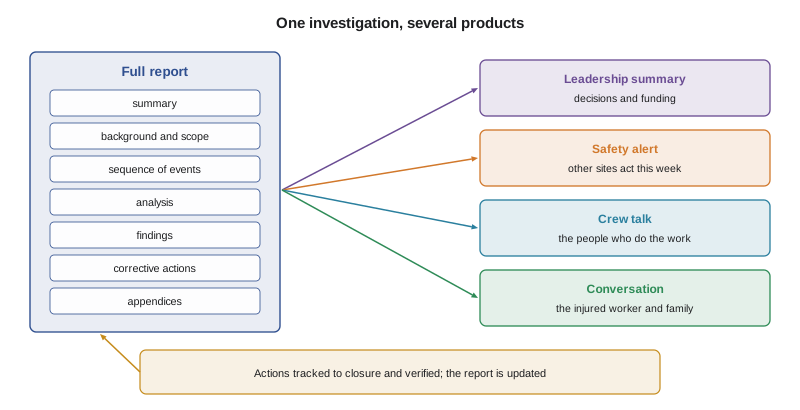
A report has three jobs. It records what was found, so that the reasoning can be checked later, by the joint occupational health and safety committee, by a regulator, by an insurer or by the next investigation team. It persuades decision makers to approve and fund the corrective actions. And it teaches, so that people who were not involved can learn from the event without repeating it. A report that does only the first job is filed and forgotten. A report that tries to do all three at once, in one long document, often does none of them well. That is why good investigations usually produce one full report and several shorter products drawn from it.
The structure of the full report
Most organizations use a standard template, and Harrowgate Foods Ltd. was no exception. The structure Elena used is common across industries.
- Summary. One page: what happened, the consequences, the main causes and the main actions. Many readers will read nothing else, so it must stand alone.
- Background and scope. The site, the area, the work being done, the people involved by role, the investigation team and the level of investigation chosen.
- Sequence of events. The timeline, written in plain language, with times and sources. Facts only, no analysis.
- Analysis. How the team got from the facts to the causes: the methods used, the causal factors, the root causes, and the conditions that shaped the decisions people made. Charts and diagrams go here.
- Findings. A numbered list of conclusions, each supported by evidence in the report.
- Corrective actions. Each action linked to the finding it addresses, with owner, due date, interim measures and the effectiveness check.
- Appendices. Photographs, the sketch, interview summaries, records, maintenance history, data from the truck logger and the cameras.
Writing the sequence and the findings
The sequence of events is where blame most easily creeps in, through word choice. 'Jordan failed to look behind him' is a judgment. 'Jordan checked the mirror, which was aimed down the aisle and did not show the walkway, and began reversing at 2:14:31' is a fact. 'Marie ignored the walkway' is a judgment. 'The walkway was blocked by an empty pallet stack; Marie walked in the aisle, as pickers routinely did when the walkway was blocked' is a fact. The second version of each sentence is longer, but it tells the reader what was actually there, and it lets them reach their own conclusions.
Some phrases signal hindsight bias and are worth searching for before a report goes out: 'failed to', 'should have', 'neglected', 'did not bother', 'lack of attention', 'carelessly', 'human error' used as a cause on its own. Each one usually hides a question the investigation has not answered: why did it make sense at the time? If the report cannot answer that, the analysis is not finished.
Findings should be written as statements of fact supported by evidence, not as accusations. 'Finding 4: The staging lane was created five weeks before the incident without a management of change review. The procedure applied only to equipment and processes, not to layouts. (Evidence: email of approval, MOC procedure revision 3, interview with Grace Whitfield.)' The evidence reference matters: it lets a reader check the claim, and it disciplines the writer to make only claims the evidence supports.
Plain language and length
Investigation reports are often written for the writer's protection rather than the reader's understanding. They fill with passive voice, jargon and hedges. A useful standard is that a new worker on the night shift should be able to read the summary and the sequence of events and understand exactly what happened. Short sentences, active voice, names of roles rather than people where privacy matters, and diagrams wherever a picture is clearer than words. The full report for aisle 14 ran to fourteen pages plus appendices. The summary fit on one page.
Privacy and the people involved
A report circulates far beyond the investigation team, so it needs care about personal information. Medical details are limited to what is needed: 'fractures to the right foot and ankle requiring surgery', not a medical history. Names usually appear only in the restricted full report; summaries and alerts use roles such as 'the driver' and 'the picker'. Interview summaries go in a restricted appendix. Nothing in the report should discipline, diagnose or speculate about any person's character.
Before the report was finalized, Elena did two things that are often skipped. She asked Jordan and Marie each to read the sequence of events and tell her if anything was wrong or missing. Marie pointed out that she had heard a truck somewhere, but not where, because of the fan noise, which sharpened one of the findings. Jordan asked that the report say he had checked the mirror, because the first draft only said what he had not done. Both changes made the report more accurate. Both also made it more likely that the people involved, and the people who worked with them, would trust it.
Sharing lessons
The aisle 14 investigation produced four products from the one report.
- A leadership summary. Two pages for Rachel and the operations leadership team: what happened, the five systemic causes, the actions needing capital, the cost and the risk of not acting. It asked for decisions, and got them.
- A safety alert. One page for every Harrowgate Foods Ltd. site with forklifts and pedestrians: what happened in a few sentences, a photo of the blocked walkway and the dark freezer suit, the three questions every site should ask itself this week (do staging lanes or temporary layouts cross pedestrian routes, can trucks run with failed safety devices, are near misses being closed with reminders), and a contact for questions. Two other sites found staging lanes that crossed walkways within the week.
- A crew talk. Ken and Sam ran short sessions with each shift at the distribution centre, walking through the timeline at the actual lane exit, explaining what was changing and why, and asking what else people had seen. Three more hazards came out of those sessions.
- A conversation with Marie. Elena and Grace visited Marie at home, explained what had been found, gave her a copy of the summary, and told her what was being changed. Marie said the most important thing for her was hearing that nobody blamed Jordan, who had been visiting her.
A safety alert works best when it is short, specific and asks a question the reader can act on. 'Be careful around forklifts' teaches nothing. 'Walk your site tonight and find every place a truck reverses across a pedestrian route' gives a manager something to do before the end of the shift.
Tracking actions to closure
Many investigations end with the report, and the actions quietly drift. The person who owned an action changes jobs. The capital request is deferred to next year. The interim measure becomes permanent without anyone deciding it should. Good organizations track corrective actions in a single register, review overdue items at a regular meeting, usually the joint occupational health and safety committee and the site leadership meeting, and do not close an investigation until its actions are verified as effective, not just completed.
Elena's tracker for aisle 14 was a simple list with a due date, status and verification date for each action. Each week before the joint occupational health and safety committee meeting she ran a short script that flagged anything overdue or completed but not yet verified.
from datetime import date
today = date(2026, 5, 20)
actions = [
    # id, action, owner, due, status, verified
    (1,  "Barrier and gate at lane exits",           "Grace",  date(2026, 4, 10), "done",        True),
    (2,  "Drive-through staging lanes",              "Grace",  date(2026, 6, 12), "in progress", False),
    (3,  "Pick routing exclusion zones",             "WMS lead", date(2026, 4, 24), "in progress", False),
    (4,  "Walkway rail and no-storage zones",        "Grace",  date(2026, 5, 8),  "done",        False),
    (5,  "Cold-rated connectors on all lights",      "Luis",   date(2026, 4, 17), "done",        True),
    (6,  "Light on checklist, out-of-service rule",  "Luis",   date(2026, 4, 17), "done",        True),
    (7,  "Heated mirrors aimed at lane exits",       "Facilities", date(2026, 5, 15), "in progress", False),
    (8,  "Change review extended to layouts",        "Elena",  date(2026, 5, 15), "done",        False),
    (9,  "Near-miss routing to level 3",             "Elena",  date(2026, 5, 15), "not started", False),
    (10, "Practical evaluation before solo driving", "Grace",  date(2026, 4, 3),  "done",        True),
]
overdue, unverified = [], []
for i, what, who, due, status, verified in actions:
    if status != "done" and due < today:
        overdue.append((i, what, who, (today - due).days))
    elif status == "done" and not verified:
        unverified.append((i, what, who))
print(f"Report date {today}: {len(actions)} actions, {sum(v for *_, v in actions)} verified")
print("Overdue:")
for i, what, who, days in overdue:
    print(f"  #{i:<2} {what:<42} {who:<10} {days} days late")
print("Done, awaiting verification:")
for i, what, who in unverified:
print(f" #{i:<2} {what:<42} {who}")Report date 2026-05-20: 10 actions, 4 verified Overdue: #3 Pick routing exclusion zones WMS lead 26 days late #7 Heated mirrors aimed at lane exits Facilities 5 days late #9 Near-miss routing to level 3 Elena 5 days late Done, awaiting verification: #4 Walkway rail and no-storage zones Grace #8 Change review extended to layouts Elena
The output gave the committee its agenda. The pick routing change was nearly four weeks late because the warehouse system vendor had a backlog, so the committee asked Rachel to escalate it with the vendor, and kept the interim rule that pickers wait at the aisle end until the staging lane is clear. The heated mirrors were five days late, waiting on a delivery. The near-miss routing change had not started, and the committee assigned Sam to help Elena draft it. The two completed but unverified items were scheduled for the ninety-day effectiveness check.
When the investigation is closed
The aisle 14 investigation was closed four months after the collision, when every action was complete and the ninety-day checks showed the changes were working: no pedestrians in the lane exits in the sampled footage, walkways clear on every random check, two failed lights caught by the checklist and tagged out, and a follow-up learning team in which drivers and pickers said the night work was calmer. The final report was updated with the verification results and filed. A one-line entry went into the company's incident database so that future investigations could search for similar events. And the story of aisle 14 became part of the training for every new driver and picker at the distribution centre, told by people who had been there.
Capstone investigation: the caustic splash at the Kentville plant
Use the methods from the whole course to work through this case. The questions after it follow the order of the course.
At 4:40 a.m. on a Tuesday, at Harrowgate Foods Ltd.'s sauces plant in Kentville, sanitation worker Hannah Lee was running a clean-in-place (CIP) cycle on the cooking kettle line. The cycle pumps hot caustic cleaning solution, about 2 percent sodium hydroxide at 75 °C, through the kettles and pipework. Partway through the cycle, Hannah disconnected a flexible hose at a transfer panel to move it to the next circuit. The line was still under pressure. Hot caustic sprayed across her left forearm and neck. She was wearing goggles and a face shield, but her sleeve had ridden up and the shield did not cover her neck. A co-worker took her to the emergency shower within about ten seconds; she rinsed for twenty minutes and was taken to hospital, where she was treated for chemical burns and released the same day. She was off work for nine days.
Owen Price, the plant's health and safety coordinator, led the investigation, with the night sanitation supervisor, a worker member of the joint occupational health and safety committee, and a process engineer. Their early findings included these facts.
- The CIP system had been upgraded four months earlier. The new control screen showed the cycle as 'paused' when a circuit finished, but the pump continued to hold pressure in the line until the next circuit was selected.
- On the old system, 'paused' had meant the pump was off.
- The transfer panel had no pressure gauge and no bleed valve at the hose connection.
- The written procedure, updated after the upgrade, said to 'confirm the line is depressurized' but did not say how.
- Three of the five night sanitation workers had learned the new system from each other; the vendor's training session had been held on day shift.
- One worker said she had felt the hose stiffen when disconnecting it 'once or twice' since the upgrade, but had not reported it because nothing happened.
- Sanitation had to be finished by 6:00 a.m. for production start; on the night of the incident the crew was one person short.
- The long-sleeved chemical apron issued for CIP work was stored in a room at the far end of the plant, and the workers usually wore a short apron kept at the panel.
Worked problem
Working the capstone: from facts to a strong action
Show solution
- Causal factor: the hose was disconnected while the line was under pressure.
- Why did it make sense? The screen said 'paused', which on the old system meant the pump was off.
- Why was that not caught? The upgrade went through as a like-for-like equipment change, so no change review checked how the controls would be read.
- Barrier view: no pressure gauge, no bleed valve and no interlock at the panel, so nothing stopped or warned the worker.
- Strong actions: interlock the pump so it stops and the line vents before a hose can be moved; fit a gauge and bleed valve at each connection; change the screen so 'paused' means pump off.
- Supporting actions: train the night crew on the system, store the long apron at the panel, and review staffing against the sanitation window.
Answer: The root causes are in the design and the change process, not in Hannah's choice; the strongest fix is an engineering interlock.
Common mistakes
MistakeWriting the sequence of events with words like 'failed to' and 'should have'.
InsteadDescribe what people saw and did, and why it made sense at the time.
MistakeProducing one long report and expecting everyone to read it.
InsteadDraw a summary, an alert and a crew talk from the full report.
MistakeSharing names and medical details widely.
InsteadUse roles in summaries, keep personal details in the restricted report.
MistakeClosing the investigation when the report is filed.
InsteadTrack actions to completion and verify effectiveness before closing.
MistakeLeaving the injured worker to hear the findings through rumour.
InsteadMeet them, explain what was found and what is changing.
Summary and key terms
- A report records findings, persuades decision makers and teaches others.
- The full report has a stand-alone summary, a factual sequence, analysis, evidenced findings and linked actions.
- Words such as 'failed to' and 'should have' signal hindsight bias and unfinished analysis.
- Protect privacy: roles in summaries, personal details only where needed.
- Share lessons through several short products aimed at what each reader can do.
- Track actions in one register, review overdue items regularly, and close only after verification.
- Investigation report
- The full written record of an investigation, its findings and its actions.
- Executive summary
- A one-page, stand-alone account of what happened, why, and what will change.
- Finding
- A conclusion of the investigation supported by referenced evidence.
- Safety alert
- A short notice sharing the lessons of an incident with other sites or teams.
- Action register
- A single list of corrective actions with owners, dates, status and verification.
- Clean-in-place (CIP)
- Cleaning process equipment by circulating cleaning solutions without taking it apart.
Practice problems
Work each problem on paper first, then reveal the answer to check.
Name the three jobs of an investigation report.
Show answer
Record the findings, persuade decision makers, and teach others.
Rewrite 'Marie ignored the walkway' as a fact.
Show answer
The walkway was blocked by an empty pallet stack; Marie walked in the aisle, as pickers routinely did.
Why did Elena ask Jordan and Marie to read the sequence of events?
Show answer
To correct errors and gaps, and to build trust in the report.
In the capstone, why did disconnecting the hose make sense to Hannah?
Show answer
The screen said 'paused', which on the old system meant the pump was off.
What is the strongest action for the capstone?
Show answer
An interlock that stops the pump and vents the line before a hose can be disconnected.
Lesson quiz · 5 questions
Score 60% or more to complete this lesson.
Create a free account to save your progress, take quizzes and earn a certificate.