
HSE-403 · Lesson 11 of 12 · 22 min
Corrective actions that work
The first draft of the corrective action list for aisle 14 had six items. Retrain all drivers on reversing. Remind pickers to use the walkway. Repair the blue light on truck FT-12. Clear the pallets. Add the light to the checklist. Hold a safety talk on forklift awareness. Elena read it twice, then asked the team a question. 'If we do all six of these and nothing else, how sure are we that this won't happen again in six months?' Nobody wanted to answer.
An investigation is only as good as the changes it produces. Many investigations find the right causes and then choose weak fixes, because weak fixes are quick, cheap and easy to tick off. This lesson covers how to choose corrective actions that actually prevent recurrence: matching actions to causes, using the hierarchy of controls and the idea of action strength, writing actions so they get done, managing the risks of the changes themselves, and checking afterwards that the actions worked.
Matching actions to causes
Every root cause and causal factor needs at least one corrective action, and every corrective action should trace back to a cause. That two-way link is the simplest quality check there is. An action with no cause behind it is a guess. A cause with no action is a known hazard left in place. Elena's team listed the causes from the analysis down one side of the whiteboard and the draft actions down the other, and drew lines between them.
The exercise exposed the problem with the first draft. Four of the six actions addressed the two workers' behaviour: retraining, reminders and a safety talk. None addressed the unreviewed staging lane, the near-miss process, the out-of-service rule, the pallet return capacity, the pick routing or the missing practical evaluation. The draft fixed the most visible symptoms and left almost every root cause in place.
The hierarchy of controls
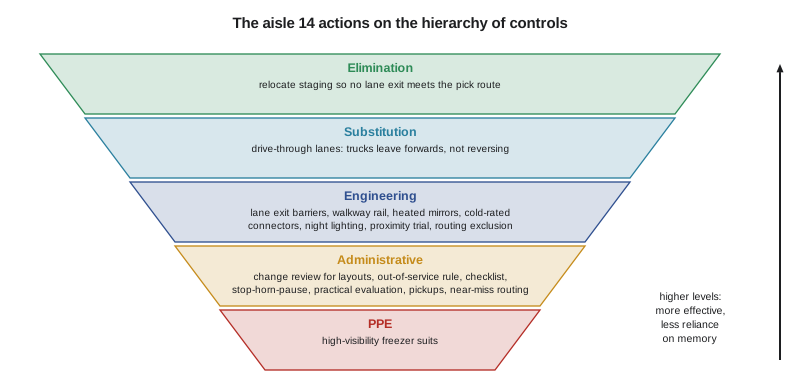
The hierarchy of controls, familiar from earlier safety courses, ranks ways of controlling a hazard from most to least effective. Elimination removes the hazard altogether. Substitution replaces it with something less hazardous. Engineering controls isolate people from the hazard or reduce it at the source, through design, barriers, guards, interlocks and automation. Administrative controls change the way people work, through procedures, training, signs, schedules and supervision. Personal protective equipment protects the individual when other controls cannot do enough.
The higher a control sits in the hierarchy, the less it depends on people remembering and choosing to do the right thing every time. A barrier at the staging lane exit works at 2:15 a.m. on a cold, noisy, rushed night shift with a new driver and a distracted picker. A rule telling pickers to stay on the walkway works only when the walkway is clear, the picker remembers, and nothing more urgent is competing for attention. That is why investigators are taught to look for controls as high in the hierarchy as reasonably practicable, and to treat administrative controls and PPE as supplements, not substitutes.
Action strength
Health care safety organizations, notably the United States Department of Veterans Affairs National Center for Patient Safety, developed a related idea for investigation teams: an action hierarchy that classifies corrective actions as stronger, intermediate or weaker. Stronger actions include physical changes to the environment, forcing functions that make the error impossible, simplifying a process, and standardizing equipment. Intermediate actions include checklists and cognitive aids, redundancy, increased staffing, software changes and reducing distractions. Weaker actions include double checks, warnings and signs, new procedures or policies, training, and memos. The idea has spread well beyond health care because it gives teams a quick way to see whether their action list leans too heavily on the weak end.
Training deserves a special note, because it is the most common corrective action in incident reports. Training is essential when people lack knowledge or skill, and it was part of the answer at aisle 14: Jordan had not had his practical evaluation and had never been told the blue light could fail. But training cannot fix a blocked walkway, a blind lane exit or a light that fails silently. Retraining someone who already knew what to do, and then sending them back into the same conditions, is one of the weakest actions there is. A useful test: if the person involved had been the best-trained worker on the site, would the incident still have happened? At aisle 14, it would.
The aisle 14 action plan
The revised plan had fourteen actions, grouped by the cause they addressed. Each had an owner, a due date and a way to check it. The main ones were these.
- Separate trucks from pickers at staging lanes (engineering, stronger). Relocate outbound staging to the dock area as drive-through lanes that trucks enter and leave forwards; until that is built, keep lane 14S closed and fit a barrier with a gate at every remaining lane exit. Owner: Grace. Interim done; permanent in ten weeks.
- Change pick routing (engineering through software, intermediate). Add exclusion zones to the warehouse system so pick routes never pass a staging lane exit. Owner: warehouse systems lead. Four weeks.
- Protect the walkway (engineering and administrative). Install a low kerb rail along the walkway so pallets cannot be stacked on it, mark 'no storage' zones, resize the pallet return area and double the pallet pickups to four a week. Owner: Grace. Six weeks; pickups immediate.
- Make the warning light reliable and checked (engineering and administrative). Fit sealed, cold-rated connectors to every light in the fleet, add the light to the pre-use checklist, and adopt a rule that a truck with a failed safety device is taken out of service until repaired. Owner: Luis. Two weeks.
- Improve visibility and warning (engineering and PPE). Restore night lighting in travel aisles to the day level, replace mirrors with heated mirrors aimed at lane exits, issue freezer suits with high-visibility panels, and trial a proximity warning system with tags worn by pickers. Owner: facilities and Elena. Lighting immediate; others six to twelve weeks.
- Spread the safe practice (administrative). Paint a stop line at every lane exit and add stop, horn and pause to the driving rules, taught by experienced drivers. Owner: Ken. Two weeks.
- Fix the onboarding gap (administrative). No driver, employee or agency, drives solo until the practical evaluation on site trucks and routes is signed off; update the agency contract to match. Owner: Grace with the agency. Immediate.
- Close the system gaps (administrative, organizational). Extend the management of change procedure to warehouse layouts, routes and storage, with a traffic review and joint occupational health and safety committee involvement; route every high-potential near miss to the health and safety manager as a level 3 investigation and remove 'reminded' as a closure option. Owner: Elena. Six weeks.
The remaining actions came from the learning team: a noise assessment of the freezer fans, a request to blank the pick screen while the picker is moving, and a review of how outbound truck slots were booked so that night-shift deadlines were realistic.
Several of the first draft's actions survived in a changed form. Repairing truck FT-12's light became fitting cold-rated connectors to the whole fleet. Adding the light to the checklist stayed, joined by the out-of-service rule that gives the checklist teeth. Retraining all drivers became the stop-horn-pause practice and the practical evaluation, both specific to the hazard. Reminding pickers to use the walkway was dropped altogether, because the kerb, the pallet capacity and the routing change made the walkway the easy route instead of the virtuous one.
Writing actions so they get done
A corrective action that is vague, unowned or undated usually does not happen. Many organizations use the SMART test: an action should be specific, measurable, achievable, relevant and time-bound. 'Improve housekeeping' fails the test. 'Install a kerb rail along the aisle 14 walkway and mark no-storage zones by 15 April; owner Grace Whitfield; complete when photographed and confirmed by the worker co-chair' passes it.
Each action should have a single named owner, even if several people help. It should have a due date that reflects the risk: high-risk gaps get interim measures within days. It should say what 'done' looks like, so that closing it is a fact, not an opinion. And it should have the resources it needs. Two of the aisle 14 actions needed capital money for the barriers and the drive-through lanes; Rachel approved them at the leadership review, which was the moment the plan stopped being a list of good intentions and became a commitment.
Managing the risks of the fix
Every change creates new conditions, and some corrective actions create new hazards. A barrier at a lane exit can create a pinch point or force trucks into a tighter turn. A proximity warning system that beeps constantly can teach people to ignore it, which is the over-reliance problem from lesson 7 in a new form. A drive-through staging lane moves truck traffic closer to the dock doors, where other pedestrians work.
The irony was not lost on the team: the incident had been caused partly by a layout change made without review. So every physical change in the action plan went through the newly extended management of change procedure, including a walk-through with drivers and pickers before installation, a check of turning paths, and a review by the joint occupational health and safety committee. The barrier design changed twice as a result. The first design left a gap at the gate hinge where a picker's foot could be caught.
Interim and permanent actions
Some fixes take weeks or months, but the hazard exists now. Interim actions bridge the gap: they are usually lower in the hierarchy, such as closing a lane, posting a lead hand, or adding a daily check, but they reduce risk immediately. At aisle 14, the interim actions from lesson 3 had been in place since the first morning: lane 14S closed, the walkway cleared and checked each shift, and every truck's light checked at the start of each shift. The danger with interim actions is that they quietly become permanent. Each one in the plan had an end condition, such as 'until the barrier is installed', and an owner responsible for replacing it with the permanent fix.
Verifying effectiveness
Completing an action and the action working are two different things. Verification has two steps. First, check that the action was implemented as intended: the barrier is installed, the routing change is live, the checklist has the new line, the evaluation records are signed. Second, check that it is achieving its purpose: are trucks and pickers still meeting at lane exits, are walkways staying clear, are failed lights being caught?
For aisle 14, Elena set specific checks for ninety days after the last action closed. Review one hour of camera footage from lane exits each week and count pedestrian–truck interactions. Walk the walkways at a random time each week and photograph them. Check the pre-use checklists for the light line and the maintenance system for out-of-service tags on failed safety devices. Track high-potential near misses and how they were investigated. Ask the night shift, in a short follow-up learning team, whether the changes had made the work safer and easier or created new problems.
Scoring the action plan
To show the leadership team the difference between the first draft and the final plan, Elena scored both with a simple strength rating.
# Strength: 3 = stronger (elimination, substitution, engineering, forcing functions),
# 2 = intermediate (checklists, software, staffing), 1 = weaker (training, reminders, signs, memos).
first_draft = [
    ("retrain all drivers", 1), ("remind pickers to use walkway", 1),
    ("repair light on FT-12", 2), ("clear the pallets", 1),
    ("add light to checklist", 2), ("safety talk", 1),
]
final_plan = [
    ("drive-through staging, barrier at lane exits", 3), ("pick routing exclusion zones", 2),
    ("walkway rail and no-storage zones", 3), ("pallet capacity and pickups doubled", 2),
    ("cold-rated connectors on all lights", 3), ("light on checklist plus out-of-service rule", 2),
    ("restore night lighting", 3), ("heated mirrors aimed at exits", 3),
    ("high-visibility freezer suits", 1), ("proximity warning trial", 2),
    ("stop line with horn and pause", 2), ("practical evaluation before solo driving", 1),
    ("change review for layouts", 2), ("near-miss routing to level 3", 2),
]
def report(name, plan):
    counts = {3: 0, 2: 0, 1: 0}
    for _, s in plan:
        counts[s] += 1
    avg = sum(s for _, s in plan) / len(plan)
    print(f"{name:<12} actions {len(plan):>2}  stronger {counts[3]}  intermediate {counts[2]}  weaker {counts[1]}  average {avg:.2f}")
report("first draft", first_draft)
report("final plan", final_plan)first draft actions 6 stronger 0 intermediate 2 weaker 4 average 1.33 final plan actions 14 stronger 5 intermediate 7 weaker 2 average 2.21
The first draft had no stronger actions and an average strength of 1.3. The final plan had five stronger actions and an average above 2.2. The scoring is crude, and some weaker actions, such as the practical evaluation, were still essential. But the comparison made the point Elena had been trying to make since she read the first draft: the question is not how many actions a plan has, but how much they change the conditions people work in.
Worked problem
Strengthening an action
Show solution
- Cause: at the Kentville plant, a sanitation worker was splashed when a caustic hose connection came apart under pressure.
- Weak draft action: 'Remind sanitation staff to check hose connections before use.'
- Ask: can the hazard be eliminated or engineered out? Fit locking connectors that cannot open under pressure, and a pressure relief valve upstream.
- Support it: add the connector type to the purchasing specification, and the check to the start-of-task list.
- Verify: inspect connectors monthly and review any splash or near-miss reports for six months.
Answer: Replace the reminder with an engineering control, supported by a specification and a check, and verify it.
Common mistakes
MistakeWriting actions that do not trace back to any cause.
InsteadLink every action to a cause and every cause to at least one action.
MistakeRelying on retraining and reminders as the main fixes.
InsteadSeek controls as high in the hierarchy as reasonably practicable.
MistakeWriting vague actions such as 'improve housekeeping'.
InsteadMake actions specific, owned, dated and with a clear definition of done.
MistakeInstalling fixes without checking the hazards they create.
InsteadPut corrective actions through change review with the workers affected.
MistakeClosing actions as soon as they are completed.
InsteadVerify both implementation and effectiveness over a defined period.
Summary and key terms
- Every cause needs an action, and every action should trace back to a cause.
- Choose controls as high in the hierarchy as reasonably practicable; administrative controls and PPE supplement, not replace, stronger controls.
- Action strength ranks physical changes and forcing functions above checklists and software, and those above training, warnings and memos.
- Write actions that are specific, measurable, achievable, relevant and time-bound, with one owner and resources.
- Put fixes through change review, and replace interim measures with permanent ones on schedule.
- Verify that actions were implemented and that they are working.
- Corrective action
- A change made to remove or control a cause found by an investigation.
- Hierarchy of controls
- Elimination, substitution, engineering controls, administrative controls and PPE, in order of effectiveness.
- Action strength
- A rating of how likely an action is to prevent recurrence, from weaker to stronger.
- Forcing function
- A design feature that makes an error impossible or immediately obvious.
- SMART
- Specific, measurable, achievable, relevant and time-bound.
- Effectiveness check
- Verification, after implementation, that an action is achieving its purpose.
Practice problems
Work each problem on paper first, then reveal the answer to check.
What was wrong with the first draft action list?
Show answer
Most actions addressed worker behaviour; almost none addressed the root causes.
Why do higher controls in the hierarchy work better?
Show answer
They depend less on people remembering and choosing to act correctly every time.
What test shows whether training alone is enough?
Show answer
Ask whether the incident would still have happened if the person had been the best-trained worker on site.
Why did the barrier design go through change review?
Show answer
Fixes create new conditions; the review found a pinch point at the gate hinge.
Name two ways Elena planned to verify effectiveness.
Show answer
Weekly footage review of lane exits, random walkway checks, checklist and out-of-service audits, near-miss tracking, or a follow-up learning team.
Lesson quiz · 5 questions
Score 60% or more to complete this lesson.
Create a free account to save your progress, take quizzes and earn a certificate.