
HSE-403 · Lesson 10 of 12 · 22 min
Learning from normal work: learning teams and Safety-II investigations
Two weeks after the collision, at 11 p.m. on a Thursday, seven night-shift workers sat around a table in the distribution centre break room with Elena, Sam and a box of doughnuts: three drivers, three pickers and the lead hand. Nobody had been asked what went wrong. Elena had asked a different question. 'Every night, dozens of trucks come out of staging lanes and dozens of pickers walk past them, and almost every time, nothing happens. We want to understand how you make that work. What do you actually do?'
Most of this course has been about understanding failure: what happened, what caused it, which defences did not work. This lesson looks at the other side. It introduces the idea that safety is also something people create every day by adapting to messy, changing conditions, and that investigations become much richer when they study how normal work succeeds as well as how it occasionally fails. HSE-408 covers human and organizational performance and learning teams in depth; this lesson focuses on how these ideas strengthen an incident investigation.
Safety-I and Safety-II
The researcher Erik Hollnagel and colleagues proposed the terms Safety-I and Safety-II in the early 2010s to describe two ways of thinking about safety. Safety-I defines safety as the absence of harm. It focuses on what goes wrong, counts failures, and tries to remove their causes by adding barriers and rules and by reducing human variability, which it sees mainly as a source of error. Most traditional investigations are Safety-I activities.
Safety-II defines safety as the ability to succeed under varying conditions. It focuses on why things usually go right, and it sees human variability as a source of strength: people constantly adjust what they do to cope with conditions that procedures did not anticipate, such as a broken light, a blocked aisle or a late truck. From this view, incidents happen when the same everyday adjustments that usually work happen to combine badly. To prevent incidents, organizations need to understand and support those adjustments, not only remove failures.
The two views are not enemies. A forklift–pedestrian collision clearly needs Safety-I thinking: find the failed barriers and fix them. But Safety-II adds something a failure-only investigation can miss. It asks how the work is really done, what makes it hard, and what people already do to keep it safe, so that fixes support those practices instead of accidentally destroying them.
Work as imagined and work as done
A central idea in this way of thinking is the gap between work as imagined and work as done. Work as imagined is how planners, managers, procedure writers and investigators believe the work happens. Work as done is what actually happens on the floor, shaped by real conditions, real equipment and real pressures. The gap is normal. Procedures cannot anticipate everything, and workers fill the gaps with judgement and experience. Problems arise when the gap grows large and nobody with authority knows about it.
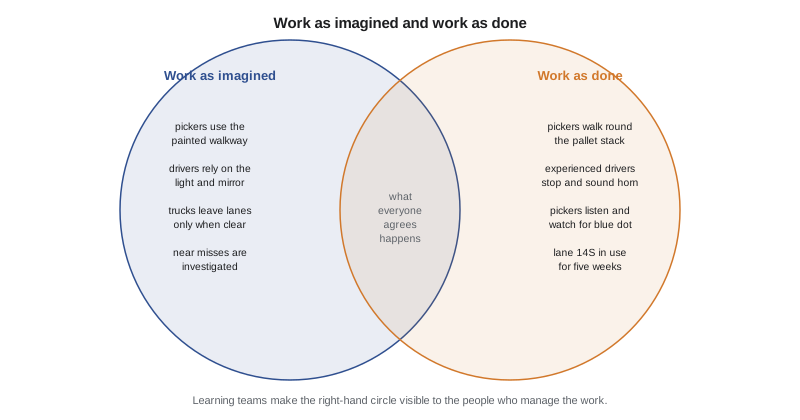
At Harrowgate Foods Ltd., work as imagined said that pickers used the painted walkway, drivers checked the mirror and relied on the blue light, the staging lane was temporary, and near misses were followed up. Work as done was different in almost every respect, and the investigation had already uncovered much of it. What the earlier interviews had not revealed was how people coped, and that was what the learning team was for.
What a learning team is
A learning team is a small group of workers who do the job, brought together with a facilitator to talk about how the work really happens, what makes it difficult, and what could make it safer and easier. The approach was popularized by the safety practitioner Todd Conklin and others in the human and organizational performance movement. Learning teams can be held after an incident, after a near miss, or with no event at all, simply to understand a risky task.
A typical format has two or three sessions. In the first, the facilitator asks open questions about the work, not the event: how the task is done, what gets in the way, what workers do when conditions are not ideal. Participants write ideas on sticky notes and talk them through. The facilitator listens, asks for stories and examples, and avoids judging. Between sessions, sometimes called soak time, everyone, including the facilitator, has time to think, and new ideas often surface. In the second session, the group reviews what it learned, groups the ideas into themes, and suggests fixes. Managers are often invited only to the last part, to hear the findings and commit to actions.
Facilitating well is a skill. The facilitator must make it clear that nothing said will be used to discipline anyone, keep managers out of the early sessions so workers can speak freely, resist the urge to correct people or explain what the procedure says, and treat every adaptation as information, not as a confession.
What the night shift said
The first session lasted ninety minutes and filled a wall with sticky notes. Several things came out that had not appeared in the formal interviews.
The most experienced driver on nights, a man who had worked the freezer for eleven years, said he always stopped at the mouth of any staging lane, sounded his horn twice and waited a second before reversing out. He had started doing it after a close call years earlier at another site. Two other drivers had picked up the habit from him. Jordan, on nights for only a few weeks and trained by the agency and a day-shift trainer, had never been shown it. The practice was effective, cheap and invisible to management. It was written in no procedure.
The pickers described how they coped with the noise. They could rarely hear beepers over the fans, so they watched for the blue dot and for headlight reflections on the shrink-wrap, and they slowed down at aisle ends. Several said they had stopped wearing their hoods up at aisle ends to hear better, then put them back up because their ears hurt in the cold. One picker said the pick devices made it nearly impossible to keep your eyes up while walking, because the next location appeared on screen the moment you scanned, and the pick rate display was always visible.
The lead hand explained the pallet stack. When the return area filled up, he moved empty pallets to the walkway because it was the only clear floor space near the dock that would not block a truck. He meant it to be temporary, for an hour or two, until he had time to restack them. With the new customer's volume, he never had time. He had mentioned it to Ken twice. 'Everyone knew,' he said. 'It just became part of the building.'
Finally, the group described how the staging lane felt. To drivers, it was a relief: it cut travel time and helped them meet the outbound trucks. To pickers, it was a new hazard that appeared on their route without explanation. Nobody had asked either group about it before it was created.
Using learning team findings in the investigation
The learning team did three things for the investigation. It confirmed, from the workers' own experience, the conditions the evidence had already shown. It filled gaps that interviews had not reached, such as the pick device's effect on attention and how the pallet stack came to be there. And it revealed a safe practice that already existed but had never spread: the horn and pause at lane exits.
That last finding changed one of the corrective actions. The team's first draft had included 'retrain drivers on reversing'. After the learning team, it became something more specific and more useful: build the stop, horn and pause at every staging lane exit into the site's driving rules, mark a stop line on the floor at each exit, and have experienced drivers show new drivers how they do it during the practical evaluation. The fix supported what the best drivers were already doing instead of inventing something new.
Elena also noted what the learning team could not do. It did not replace the evidence; it added to it. It did not decide the corrective actions; it suggested them, and the investigation team and management made the decisions. And it depended on trust that had been built in the first two weeks: the way the night shift had been treated after the collision, the clear separation from discipline, and Sam's presence as a worker representative.
Language that helps learning
Investigation reports often use language that slips back into blame, even when the authors mean well. Phrases such as 'failed to', 'should have', 'neglected to' and 'did not follow' describe what did not happen, measured against an ideal that the person may not have known about or been able to meet. These are sometimes called counterfactuals. They are useful in the analysis, as in the causal factor test, but in descriptions of what people did, they hide the most important information: what they actually did, and why.
Compare two sentences. 'The driver failed to ensure the path was clear before reversing.' And: 'The driver checked the right-hand blind spot, as he had been trained, and watched for the blue warning dot, which he did not know had failed.' The first sentence invites discipline. The second explains the event and points to fixes. Elena edits every draft report for counterfactual language before it goes to the leadership team, and she asked Sam to help, because he caught phrases that sounded like blame to a worker that she had stopped noticing.
Learning from success as well as failure
Safety-II thinking also suggests studying work when nothing goes wrong. A learning team on a risky task, a short walk-through with an experienced worker, or a review of what went right on a busy shift can uncover hazards and good practices before an incident forces the question. After aisle 14, Harrowgate Foods Ltd. began holding a short learning team on one high-risk task each quarter at each site, with no incident required. The first one, at the Truro plant, looked at sanitation of the spiral conveyor from HSE-401 and HSE-402, and found that the new floor-level disconnect was working well but that the sanitation crew had started leaving their locks on a hook near the spiral to save time, a small adaptation worth a conversation before it became a shortcut.
Grouping the sticky notes
After the second session, Sam typed up every sticky note and tagged each with a theme. Elena wrote a quick tally to see which themes had the most notes and which already had a matching corrective action.
# Sticky notes from the learning team, tagged with a theme.
notes = [
    ("can't hear beepers over the fans", "noise"), ("hood up, can't hear", "noise"),
    ("pick screen keeps eyes down", "pick device"), ("pick rate always showing", "pick device"),
    ("stacked pallets on walkway", "pallets"), ("return area always full", "pallets"),
    ("no time to restack", "pallets"), ("staging lane appeared, no warning", "layout"),
    ("lane exit is blind", "layout"), ("horn and pause at lane exits", "safe practice"),
    ("watch for blue dot", "warning light"), ("blue dot not on some trucks", "warning light"),
    ("vests don't fit freezer suits", "visibility"), ("dark suits in dim light", "visibility"),
    ("3 a.m. trucks always rushed", "time pressure"),
]
actions = {"pallets", "layout", "warning light", "visibility", "safe practice"}
tally = {}
for _, theme in notes:
    tally[theme] = tally.get(theme, 0) + 1
for theme, n in sorted(tally.items(), key=lambda kv: -kv[1]):
    flag = "" if theme in actions else "  <- no corrective action yet"
print(f"{theme:<14} {n}{flag}")pallets 3 noise 2 <- no corrective action yet pick device 2 <- no corrective action yet layout 2 warning light 2 visibility 2 safe practice 1 time pressure 1 <- no corrective action yet
The tally showed three themes with no matching corrective action: noise, the pick device and time pressure. None of them had been causal factors in the formal analysis, but all three were preconditions that made errors more likely, and all three affected every picker on every night. Elena added actions for each: a noise assessment of the freezer evaporator fans with options for quieter fans or alarms in a frequency range that carries better, a request to the warehouse system team to blank the pick screen while the picker is walking, and a review of how outbound truck times were booked. Lesson 11 explains how those actions were chosen and ranked.
Worked problem
Turning a learning team insight into a fix
Show solution
- Insight: experienced drivers stop, sound the horn twice and pause at staging lane exits; newer drivers do not know to.
- Question: is the practice effective? It gives pickers an audible and visible cue at the most dangerous point, at almost no cost.
- Question: why has it not spread? It was never written down, and new drivers are trained by day-shift trainers who do not use staging lanes.
- Fix: add the stop, horn and pause to the site driving rules, paint a stop line at each exit, and include it in every driver's practical evaluation.
- Check: watch footage of lane exits a month later to see how often the practice is used.
Answer: Support and spread a safe adaptation that already works, rather than inventing a new rule.
Common mistakes
MistakeSeeing every adaptation by workers as a violation to stop.
InsteadAsk whether the adaptation keeps work safe, and support the ones that do.
MistakeInviting managers to the first learning team session.
InsteadLet workers speak freely first; bring managers in to hear findings and commit to action.
MistakeUsing a learning team instead of gathering evidence.
InsteadUse it alongside evidence to fill gaps and test findings.
MistakeWriting reports full of 'failed to' and 'should have'.
InsteadDescribe what people actually did and why it made sense to them.
MistakeStudying work only after something goes wrong.
InsteadHold learning teams on high-risk tasks with no incident required.
Summary and key terms
- Safety-I focuses on what goes wrong; Safety-II on how work usually goes right despite changing conditions.
- The gap between work as imagined and work as done is normal; danger grows when managers cannot see it.
- Learning teams bring workers together to describe how the work is really done, with soak time between sessions.
- Learning teams fill gaps, confirm findings and reveal safe practices that can be spread.
- Counterfactual language such as 'failed to' hides what people actually did and why.
- Studying normal work on high-risk tasks can find hazards and good practices before an incident.
- Safety-I
- Defining safety as the absence of harm and focusing on removing causes of failure.
- Safety-II
- Defining safety as the ability to succeed under varying conditions and studying why work usually goes right.
- Work as imagined
- How planners and managers believe work is done.
- Work as done
- How work is actually done in real conditions.
- Learning team
- A facilitated group of workers who discuss how work really happens and how to improve it.
- Counterfactual
- A description of what someone did not do, measured against what they "should" have done.
Practice problems
Work each problem on paper first, then reveal the answer to check.
How do Safety-I and Safety-II define safety?
Show answer
Safety-I as the absence of harm; Safety-II as the ability to succeed under varying conditions.
What safe practice did the learning team reveal?
Show answer
Experienced drivers stopping, sounding the horn twice and pausing at staging lane exits.
Why were managers kept out of the first learning team session?
Show answer
So workers could speak freely about how the work is really done.
Rewrite "The driver failed to ensure the path was clear."
Show answer
For example: "The driver checked the right-hand blind spot, as trained, and watched for the blue dot, which he did not know had failed."
Which three themes had no corrective action until the learning team?
Show answer
Noise, the pick device and time pressure.
Lesson quiz · 5 questions
Score 60% or more to complete this lesson.
Create a free account to save your progress, take quizzes and earn a certificate.