
HSE-382 · Lesson 2 of 12 · 17 min
Fire codes for commercial kitchens
▶ Video coming soon A video version of this lesson is on the way.
Two days after the February fire, a fire prevention officer from Victoria Fire Department walked through Juniper Street with Elena Varga, the owner, and Daniel Okafor, the general manager. She asked to see the certificate from the last hood cleaning, the service tag on the suppression system, the extinguisher tags, the fire safety plan and the record of the last fire drill. Some of these were in the office binder. Some were not. The hood cleaning certificate showed the duct had been cleaned on schedule, but the officer pointed out that the filters are the restaurant's own job, and nobody could show her when they had last been washed. The line stayed closed until the system was recharged, the hood was cleaned again and the filter routine was written down.
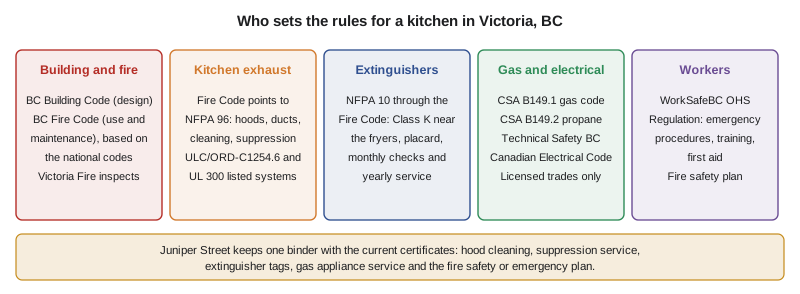
This lesson maps the rules that sit behind those questions. A restaurant kitchen is covered by several overlapping sets of rules: building and fire codes, standards for exhaust systems, suppression systems and extinguishers, gas and electrical codes, and occupational health and safety law. Each has its own enforcer. Kitchen workers do not need to read the codes, but supervisors need to know which ones exist, what they ask of the restaurant day to day, and who will come to check.
Codes, standards and who enforces them
A code is a set of rules adopted into law by a government, such as a provincial or state fire code. A standard is a detailed technical document written by an expert body, such as the National Fire Protection Association (NFPA), CSA Group or UL. Standards become legally binding when a code adopts them by reference, which is how a document like NFPA 96 ends up deciding how often a restaurant in Victoria or Savannah must have its exhaust system inspected. The official who enforces a code is called the authority having jurisdiction, often shortened to AHJ: for fire safety in a restaurant that is usually the local fire department's fire prevention or fire marshal's office.
Codes come in editions, and governments adopt new editions on their own schedules, often several years after publication. A standard referenced in a code means the edition the code names, not necessarily the newest one. For a manager, the practical rule is to ask the local fire department and the restaurant's contractors which editions apply, and to follow the newer edition where it is stricter and the contractor recommends it.
The building and fire codes in BC
Canada has model codes written at the national level, the National Building Code and the National Fire Code, which provinces adopt with their own changes. British Columbia publishes its own BC Building Code and BC Fire Code based on the national models. The Building Code governs how a building and its systems are designed and built: the hood, duct and suppression system Juniper installed when it opened were approved under the Building Code. The Fire Code governs how the building is used and maintained afterwards, which makes it the code that matters most from day to day. Local fire departments enforce the Fire Code, and the City of Victoria's fire prevention officers inspect restaurants on a regular cycle and after any fire.
The BC Fire Code has a short article on commercial cooking equipment that reaches a long way. It says that the exhaust and fire protection systems for commercial cooking equipment are designed and installed under the Building Code, and that their use, inspection and maintenance must follow NFPA 96, the standard on ventilation control and fire protection of commercial cooking operations. It adds four points of its own: hoods, grease removal devices, fans and ducts must be cleaned often enough that surfaces do not become heavily contaminated with grease; flammable cleaning solvents must not be used to clean exhaust systems; instructions for operating the fire protection system manually must be posted in the kitchen as part of the fire safety plan; and certified cooking equipment must be installed and maintained according to its certification.
The Fire Code also requires a written fire safety plan for buildings like Juniper's. The plan sets out who does what in a fire, how the alarm is raised, how people are evacuated, how the fire department is met, and how fire protection equipment is maintained and checked. Lesson 11 covers the plan in detail.
The NFPA standards behind the kitchen
Four NFPA standards come up again and again in this course. They are the same documents in both countries, because Canadian and American fire codes adopt them by reference.
- NFPA 96, Ventilation Control and Fire Protection of Commercial Cooking Operations, covers hoods, grease filters, ducts, fans, clearances to combustible materials, the requirement for a suppression system, inspection and cleaning schedules, and special rules for solid fuel cooking. Lessons 3, 4 and 10 rely on it.
- NFPA 17A, Wet Chemical Extinguishing Systems, covers the design, installation, inspection and maintenance of the pre-engineered wet chemical systems found in nearly every restaurant hood. Lesson 5 covers it.
- NFPA 10, Portable Fire Extinguishers, sets the rules for choosing, placing, inspecting and maintaining extinguishers, including the Class K extinguisher by the fryers. Lesson 6 covers it.
- NFPA 54 and NFPA 58 cover fuel gas and propane in the United States; in Canada the CSA B149 codes play that role. Lesson 7 covers them.
Equipment must also be listed or certified, meaning a recognized testing organization has tested it to a standard and it carries that organization's mark. Kitchen fire suppression systems in Canada are tested to ULC/ORD-C1254.6 and in the United States to UL 300; most systems on the market carry both listings. Hoods, filters, fryers, ranges and other appliances carry certification marks from bodies such as CSA, ULC, UL or Intertek, and BC law expects them to be installed and used as their certification describes.
Gas and electrical rules
Gas and electrical work are regulated separately from the fire code. In BC, Technical Safety BC administers the Safety Standards Act, which adopts the CSA B149.1 Natural Gas and Propane Installation Code, the CSA B149.2 Propane Storage and Handling Code and the Canadian Electrical Code. A new edition of the B149 codes was published in 2025, and provinces adopt it on their own schedules. In practice, these rules mean three things for a restaurant: only a licensed gas fitter can install, alter or repair gas piping and appliances, only a licensed electrical contractor can do electrical work, and most of that work needs a permit and an inspection.
Lessons 7 to 9 cover what kitchen staff can do safely themselves, which is mostly daily checks, safe use and knowing when to stop and call a licensed trade.
Occupational health and safety
WorkSafeBC's Occupational Health and Safety Regulation protects the workers rather than the building. Part 4 requires employers to assess the emergencies their workers could face, to write emergency procedures, to train workers in them and to run drills. Other parts cover fire hazards, first aid, the use of flammable and combustible materials, and the electrical safety of equipment. Fire prevention officers and WorkSafeBC prevention officers look at different things, but a serious kitchen fire with an injury can bring both.
Insurance and the landlord
Two other parties care about the kitchen's fire safety records as much as any inspector: the insurer and, where the restaurant leases its space, the landlord. Commercial property insurers routinely require proof of hood cleaning on schedule and semi-annual suppression service, and some will deny a claim if the records are missing after a fire. Juniper's insurer asked for both before paying for the February cleanup and recharge.
The fire safety binder
After the inspection, Daniel set up one binder that holds every record an inspector or insurer is likely to ask for, with the newest document at the front of each tab. A program checks it each month against the required intervals. The intervals below are the ones Juniper uses. They are taken from the standards covered in later lessons, and in some cases Juniper's own rules are stricter than the minimum.
# Check the fire safety binder: is each record within its required interval?
from datetime import date

today = date(2026, 4, 1)
binder = [
    # (record, date of last entry, maximum days between entries)
    ("Hood and duct cleaning certificate", date(2026, 2, 23), 92),
    ("Suppression system service tag", date(2026, 2, 23), 183),
    ("Extinguisher annual service tags", date(2025, 6, 10), 365),
    ("Extinguisher monthly checks", date(2026, 3, 2), 31),
    ("Filter washing log (nightly)", date(2026, 3, 31), 1),
    ("Fire drill record", date(2025, 3, 14), 365),
    ("Emergency lighting monthly test", date(2026, 2, 26), 31),
    ("Gas appliance service report", date(2025, 9, 18), 365),
    ("Fire alarm annual inspection", date(2025, 11, 5), 365),
]

for record, last, limit in binder:
    age = (today - last).days
    due_in = limit - age
    if due_in < 0:
        status = f"OVERDUE by {-due_in} days"
    elif due_in <= 14:
        status = f"due in {due_in} days"
    else:
        status = "ok"
print(f"{record:38s} last {last} {status}")Hood and duct cleaning certificate last 2026-02-23 ok Suppression system service tag last 2026-02-23 ok Extinguisher annual service tags last 2025-06-10 ok Extinguisher monthly checks last 2026-03-02 due in 1 days Filter washing log (nightly) last 2026-03-31 due in 0 days Fire drill record last 2025-03-14 OVERDUE by 18 days Emergency lighting monthly test last 2026-02-26 OVERDUE by 3 days Gas appliance service report last 2025-09-18 ok Fire alarm annual inspection last 2025-11-05 ok
Two items stand out. The fire drill is overdue by a couple of weeks, and the emergency lighting test was due a few days ago. Neither would have been noticed without the check, and both are quick to fix. The program is deliberately simple: each record has a date and a maximum gap, and the output is sorted in the order the binder tabs are arranged so that the office manager can work down it.
What the inspector looks for
A fire inspection of a restaurant kitchen usually covers the same ground every time. Knowing the list helps a supervisor keep the kitchen ready on any day, not only on the day an inspection is announced.
- Hood, filters and duct: filters in place and reasonably clean, no gaps, a current cleaning certificate posted, no grease dripping from the hood.
- Suppression system: a service tag less than six months old, nozzles and caps in place, the manual pull station visible and unobstructed, and appliances that match the system's design.
- Extinguishers: the right type in the right place, mounted, with a current tag, a monthly check record and a placard by the Class K unit.
- Exits and alarms: exit doors unlocked and clear, exit signs lit, emergency lighting tested, the fire alarm serviced.
- Housekeeping: no combustible storage near cooking equipment, clear space around the electrical panel and gas shut-off, no extension cords used as permanent wiring.
- Paperwork: the fire safety or emergency plan, drill records and staff training.
Juniper's response
Elena treated the inspection as a free audit. The kitchen reopened with a written filter routine posted on the hood, a new tab in the binder for filter washing, a fire drill scheduled for the next month, and a list of the codes and standards the restaurant follows, with the contractor responsible for each. The rest of this course works through that list one system at a time.
Summary and key terms
- A restaurant kitchen is covered by building and fire codes, NFPA and other standards, gas and electrical codes, and occupational health and safety law, each with its own enforcer.
- The BC Fire Code requires commercial cooking exhaust and fire protection systems to be used, inspected and maintained according to NFPA 96, and adds rules on cleaning, solvents and posted instructions.
- NFPA 96, NFPA 17A and NFPA 10 set the details for exhaust systems, wet chemical suppression systems and portable extinguishers in both countries.
- Only licensed trades may install or repair gas and electrical systems, and most of that work needs a permit and an inspection.
- A single, up-to-date fire safety binder lets a restaurant answer an inspector's or insurer's questions on any day.
- Code
- A set of rules adopted into law by a government, such as a provincial or state fire code.
- Standard
- A detailed technical document written by an expert body; it becomes binding when a code adopts it.
- Authority having jurisdiction (AHJ)
- The official or office that enforces a code, such as the local fire department.
- NFPA 96
- The standard on ventilation control and fire protection of commercial cooking operations.
- Listed equipment
- Equipment tested by a recognized laboratory to a standard and marked to show it.
When a new appliance or renovation is planned
Most code problems in restaurants are built in, not worn in. A new fryer, a second charbroiler, a moved wall or a patio extension can change what the hood must capture, what the suppression system must cover, how much gas the line draws and how people leave the building. Before any change to the cooking line or the layout, Juniper now asks four questions: does it need a permit, does the hood and suppression contractor need to review it, does the gas or electrical supply need to change, and does the fire safety plan need updating? A call to the fire department's plan review office at the start costs nothing and has saved many restaurants from tearing out work after an inspector has seen it.
Common mistakes
MistakeThe hood cleaning company is responsible for keeping the whole exhaust system clean.
InsteadThe contractor cleans the hood and duct on schedule; washing the filters and wiping the hood between visits is the restaurant's own job.
MistakeIf the kitchen passed its last inspection, the records can wait until the next one.
InsteadInspections can happen at any time, including after a fire; keep the binder current every month.
MistakeA cook can reconnect a gas fryer after moving it, since it is just a hose.
InsteadGas connections are licensed work; staff reconnect only the quick-disconnect and restraint the appliance was designed for, and anything else needs a licensed gas technician.
Practice problems
Work each problem on paper first, then reveal the answer to check.
Why does NFPA 96 apply to a restaurant even though it was written by a private organization?
Show answer
Because the fire code adopts it by reference, which makes its requirements legally binding where the code applies.
Name three records an inspector is likely to ask for after a kitchen fire.
Show answer
Any three of: the hood and duct cleaning certificate, the suppression system service tag, extinguisher service tags and monthly checks, the fire safety or emergency plan, fire drill records, and filter washing records.
Juniper's binder program shows the gas appliance service report is 195 days old with a 365-day limit. What is its status?
Show answer
It is within its interval, with 170 days to go, so no action is needed yet.
Lesson quiz · 5 questions
Score 60% or more to complete this lesson.
Create a free account to save your progress, take quizzes and earn a certificate.