
HSE-382 · Lesson 11 of 12 · 17 min
Emergency shut-off and evacuation
▶ Video coming soon A video version of this lesson is on the way.
When the hood system fired in February, Olivia Brooks was standing at the host stand with a party of six waiting for a table. She heard the alarm, saw the haze through the pass, and said the words she had practised at every fire drill: "Everyone, please leave by the front door now. Leave your things." The servers each swept their own section, the bartender cleared the bar and the washrooms, Kofi checked the basement, and within about three minutes 140 guests and 22 staff were standing in the parking lot across the back lane while Daniel counted the staff against the schedule. When the first fire truck arrived, Daniel met the captain at the curb and told him what had happened, where the fire was, that the hood system had fired, and that everyone was accounted for.
That smooth evacuation did not happen by luck. It came from a written plan, a few people with clear jobs, and drills that made those jobs automatic. This lesson covers the emergency controls in a restaurant kitchen, the fire safety or emergency plan, the evacuation of staff and guests, meeting the fire department, and keeping exits and drills up to standard.
Emergency controls
A cook who can act fast in the first seconds of a kitchen fire can stop it from growing. That means every cook should know, without thinking, where these controls are:
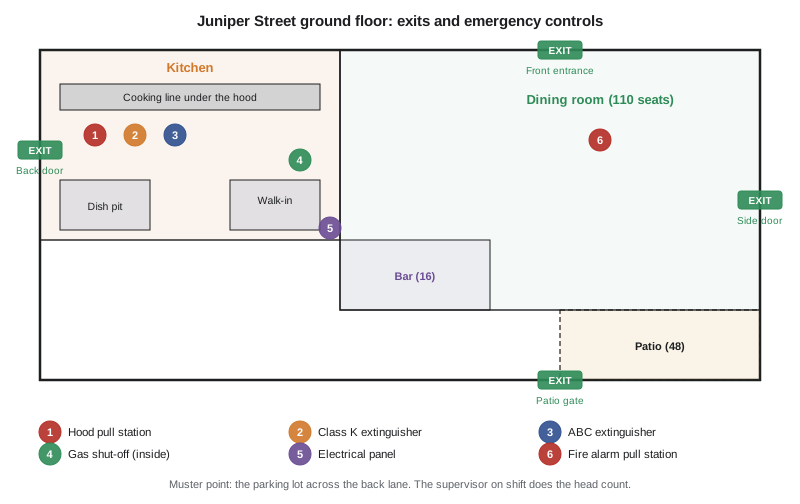
- The hood system's manual pull station, on the path to the back door. Pulling it fires the suppression system, shuts off the gas and electric power to the appliances under the hood and, at Juniper, sounds the building fire alarm.
- The building fire alarm pull stations, one by the back door and one in the dining room near the front entrance. Pulling one sounds the alarm throughout the building and, through the monitoring company, calls the fire department.
- The Class K extinguisher near the fryers and the ABC extinguishers by the back door and at the bar.
- The manual gas shut-off for the cooking line, inside the kitchen near the end of the line, and the main gas shut-off at the meter outside.
- The electrical panel by the walk-in, with labelled breakers for the kitchen appliances.
The order in a kitchen fire is: activate the hood system if the fire is on the line; make sure the alarm is sounding; call 911; leave. The gas and power shut-offs matter most when the hood system has not fired or when the fire is somewhere else, such as an electrical fire in the prep area, and only if they can be reached on the way out. Nobody goes back into a smoky kitchen to close a valve.
The plan
The BC Fire Code requires a written fire safety plan for buildings like Juniper's, and WorkSafeBC requires written emergency procedures for the workplace. Juniper combines both in one document, reviewed by Victoria Fire Department. It includes:
- How to report a fire or other emergency: pull the alarm, call 911, and tell the manager on duty.
- The roles of the manager on duty, who leads the response, and of each position during an evacuation.
- The evacuation routes, the exits, and the assembly point, with the floor plan posted at each exit.
- How guests are moved, including guests who need help.
- How staff are accounted for at the assembly point.
- The emergency controls, who may use them and when.
- How the fire department is met and what they are told.
- The fire protection equipment, who maintains it and how often, with the records kept in the fire safety binder.
- The procedures for other emergencies covered in earlier lessons: gas leaks, carbon monoxide alarms, and electrical incidents.
- Training and drills.
The plan is only useful if people know it, so Juniper keeps it short, with a one-page summary posted in the staff room and at the host stand, and a checklist card at the manager's station.
Roles during an evacuation
In a restaurant, guests take their cues from staff. If staff are calm and direct, guests leave quickly; if staff hesitate, guests finish their drinks. Juniper assigns clear roles by position, so that whoever is working that shift knows their job without being told:
- The manager on duty leads: confirms the alarm is sounding and 911 has been called, directs the evacuation, collects the staff list from the schedule, and meets the fire department.
- The host or front-of-house manager gives the announcement and holds the front door open, directing guests to the assembly point.
- Each server sweeps their own section, telling guests to leave now by the nearest exit, and checks the washrooms nearest their section.
- The bartender clears the bar and the patio.
- The kitchen staff leave by the back door after activating the hood system or other controls if that is their role; the kitchen manager or senior cook checks the dish pit and walk-ins on the way out.
- A designated staff member checks the basement storeroom and office, if it is safe to do so.
Guests who need help are a particular concern. A guest using a wheelchair, an older guest with a walker, a parent with small children or a guest who is deaf and does not hear the alarm may need a staff member to guide them. Juniper's servers are trained to notice these guests when they seat them, so that during an evacuation they know who to help first. Juniper's dining room is on the ground floor with level exits, which makes this easier; in a restaurant with stairs, the plan would also say where people who cannot use stairs wait for firefighters, and the elevator is never used in a fire.
The announcement should be short, calm and specific. "Please leave by the front door now. Leave your things" works better than "There may be a small problem in the kitchen." Staff do not stop to collect bills, and nobody goes back for belongings.
At the assembly point
The assembly point at Juniper is the parking lot across the back lane, away from the building and clear of the route fire trucks will use. Staff gather there with the manager on duty, who takes a head count against the schedule. Guests are directed there or, if they want to leave, allowed to go. Anyone who is missing is reported to the fire department immediately, with where they were last seen. Nobody goes back into the building until the fire department says it is safe.
Meeting the fire department
Firefighters arriving at a restaurant fire need answers to a few questions fast, and the manager on duty should be ready with them:
- Is everyone out? Who is missing and where were they last seen?
- Where is the fire, and what is burning?
- Has the hood suppression system fired?
- Is the gas off? Where are the main gas shut-off and the electrical panel?
- Are there any special hazards, such as propane cylinders, the CO2 cylinders for the beer system, or chemicals?
Juniper keeps a laminated card with this information and a copy of the floor plan in a lockbox by the front door, which the fire department can open.
Exits
An evacuation depends on exits that work. Fire codes in both countries require that exits are kept unobstructed, that exit doors can be opened from the inside without a key or special knowledge whenever the building is occupied, that exit signs are lit, and that emergency lighting works when the power fails. Restaurants are notorious for breaking these rules in small ways: a back door chained shut at night to stop theft, a stack of empty kegs in the corridor, a side door used as overflow storage, a patio gate padlocked to keep people from leaving without paying.
Juniper's daily opening check includes walking every exit route and opening every exit door. The posted maximum occupant load, set by the fire department based on the floor area and exits, is respected even on busy nights; the host tracks covers against it when the patio is closed in bad weather and everyone moves inside.
Emergency lighting and exit signs are tested monthly by pressing the test button on each unit, and given a longer duration test once a year, usually by the fire protection company. The results go in the binder.
Drills
Fire drills turn the plan into habits. The BC Fire Code requires fire drills at intervals set out in the fire safety plan and the code, and WorkSafeBC expects workers to be trained in emergency procedures. Juniper runs a full drill at least once a year, scheduled with the fire department, and short walk-through drills with each new group of hires. Because restaurants have high turnover, a large share of the staff in any month may never have been in a drill, which is why the walk-throughs matter.
A drill is also a test. After each one, Juniper writes down how long the evacuation took, which exits were used, what went wrong and what will change. At the spring drill after the fire, the main finding was that the side door, which most guests did not know about, was barely used, so the front entrance became crowded. The servers whose sections are nearest the side door now direct their guests to it.
How long should it take?
Evacuation planners estimate how quickly people can leave through each exit from the width of the exit and a typical flow rate of people through a doorway. The program below uses a simple version of that method, with a conservative flow rate, to estimate how long it would take to clear Juniper's ground floor if guests were spread across the exits as the drill showed. Real evacuations also include the time it takes people to notice the alarm and decide to move, which is often longer than the time spent walking.
# Estimate how long each exit takes to clear, from its width and the people using it.
FLOW = 60          # people per minute per metre of clear door width (conservative)

exits = {          # exit: (clear width in m, people using it)
    "front entrance": (1.8, 96),
    "side door": (0.9, 18),
    "patio gate": (1.2, 26),
    "back door (staff)": (0.9, 22),
}

def clear_time(width_m, people):
    return people / (FLOW * width_m)

for name, (w, n) in exits.items():
    print(f"{name:18s} {n:3d} people  {w:.1f} m  about {clear_time(w, n):.1f} min")
worst = max(exits, key=lambda e: clear_time(*exits[e]))
print(f"Slowest exit: {worst}")

# Move 20 guests from the front entrance to the side door, as servers now direct
exits["front entrance"] = (1.8, 76)
exits["side door"] = (0.9, 38)
print("After rebalancing:")
for name, (w, n) in exits.items():
print(f"{name:18s} {n:3d} people about {clear_time(w, n):.1f} min")front entrance 96 people 1.8 m about 0.9 min side door 18 people 0.9 m about 0.3 min patio gate 26 people 1.2 m about 0.4 min back door (staff) 22 people 0.9 m about 0.4 min Slowest exit: front entrance After rebalancing: front entrance 76 people about 0.7 min side door 38 people about 0.7 min patio gate 26 people about 0.4 min back door (staff) 22 people about 0.4 min
Even before rebalancing, every exit clears in about a minute by this estimate, which matches what the drills found once people were moving. The real delays came earlier: guests who did not take the alarm seriously and staff who were unsure whether to interrupt them. That is why the clear announcement and the habit of every server sweeping their section count for more than the door widths.
Summary and key terms
- Every cook should know where the hood pull station, the fire alarm pull stations, the extinguishers, the gas shut-offs and the electrical panel are, and use them only on the way out.
- A written fire safety or emergency plan sets out how to report a fire, who does what, the routes, the assembly point, the head count and how to meet the fire department.
- Assign evacuation roles by position, give a short, clear announcement, sweep every area, and help guests who need it; never use the elevator in a fire.
- Account for every staff member at the assembly point, report anyone missing to the fire department, and never go back inside until it is declared safe.
- Keep exits unlocked from inside and clear, test emergency lighting monthly, and run drills often enough that new staff learn the plan.
- Fire safety plan
- The written plan required by the Fire Code describing how a building's occupants respond to a fire and how fire protection equipment is maintained.
- Emergency action plan
- A written workplace plan for reporting emergencies, evacuating and accounting for employees.
- Assembly point
- A safe place outside the building where everyone gathers and is counted after an evacuation.
- Occupant load
- The maximum number of people allowed in a space, set from its area and exits.
- Emergency lighting
- Battery-backed lights that come on when the power fails so that exits can be found.
Fires at closing time
Many restaurant fires start after service, when most staff have gone home: a fryer left on, embers in a garbage bin, a towel near a pilot light, or an electrical fault in an empty building. The closing manager's checklist at Juniper includes walking the line to confirm every appliance is off, checking the grease cups, the soiled-towel can and the dumpster area, looking at the patio heaters and candles, confirming the exits are clear, and setting the alarm. The last person out also knows how to call the monitoring company if an alarm sounds after closing.
Common mistakes
MistakeChaining the back door at night stops theft and is fine once the dining room is closed.
InsteadExits must open from the inside without a key whenever anyone, including closing staff, is in the building.
MistakeGo back in to close the gas valve once everyone else is out.
InsteadShut-offs are used only on the way out; nobody re-enters a building on fire.
MistakeLet guests finish their meals while the kitchen deals with the fire.
InsteadStart the evacuation as soon as the alarm sounds; a kitchen fire can spread to the dining room in minutes.
Practice problems
Work each problem on paper first, then reveal the answer to check.
What five things should the manager on duty be ready to tell the fire department on arrival?
Show answer
Whether everyone is out and who is missing, where the fire is and what is burning, whether the hood system has fired, whether the gas is off and where the shut-offs and panel are, and any special hazards such as propane or CO2 cylinders.
A drill shows that almost everyone uses the front door and the side door is ignored. What should change?
Show answer
Staff whose sections are nearest the side door should direct guests to it, and the exit should be clearly signed and kept clear.
Why are walk-through drills for new hires important in a restaurant?
Show answer
Turnover is high, so many staff on any shift may never have taken part in a full drill.
Lesson quiz · 5 questions
Score 60% or more to complete this lesson.
Create a free account to save your progress, take quizzes and earn a certificate.