
HSE-382 · Lesson 10 of 12 · 17 min
Solid fuel, wood-fired and specialty cooking
▶ Video coming soon A video version of this lesson is on the way.
In the spring after the fire, Elena Varga came back from a trip to Italy with an idea: a wood-fired pizza oven on the patio for the summer of 2027. Tomás loved it. Aisha asked to see the plans before anyone signed a contract, and the safety review that followed took up most of a committee meeting and two visits from the fire department. This lesson follows that review, then looks at the other kinds of specialty cooking that bring their own fire risks into a restaurant: charcoal grills and smokers, woks, tableside flambé, chafing fuel, candles, portable butane stoves and the propane cylinders that fuel patio heaters and barbecues.
Why solid fuel is different
Wood, charcoal and wood pellets behave very differently from gas. A solid fuel fire cannot be switched off. It keeps burning, and the embers stay hot enough to start a fire for many hours after cooking ends. It throws sparks and embers up the flue. It produces heavy smoke, creosote and grease deposits that coat the exhaust system far faster than gas cooking, and much more carbon monoxide. It needs a supply of fuel stored nearby, which is itself combustible. And it produces ash that is often still hot when it is removed.
NFPA 96 has a separate chapter on solid fuel cooking for these reasons, and fire codes in both countries apply it to restaurants that cook with wood, charcoal or pellets, including those that use solid fuel only for flavour, such as a smoker box. The main requirements, which Juniper's review worked through point by point, cover the appliance, the exhaust, fire suppression, fuel storage, ash handling and inspection.
The appliance
A wood-fired oven in a commercial setting must be listed for that use or approved by the fire authority, and installed according to the manufacturer's instructions and the code, with the clearances to combustible materials that its listing requires. A homemade or imported oven without a listing usually cannot be approved. Juniper's architect chose a listed, factory-built oven designed for restaurant use, which came with installation instructions covering the base, the clearances, the flue and the hearth extension in front of the door, where embers can fall.
Exhaust and suppression
A solid fuel appliance needs its own exhaust system. It cannot share a duct with the gas appliances on the cooking line, because the sparks and creosote it produces would be carried into a duct full of grease. The flue or duct must be built for solid fuel, with a spark arrester to catch embers before they leave the top, and it must keep its required clearances from the building. The exhaust system for the patio oven runs straight up from the oven's own hood, away from the main building.
Solid fuel appliances also need fire protection. A small oven may be protected by the appliance's own design and a nearby extinguisher; larger ones generally need a fixed suppression system, often a water spray system, because wet chemical agent is designed for cooking oil, not burning wood. The fire department's plan review sets out what is needed for a given appliance. Juniper's oven needed a water-based system over the firebox opening and the hood, and a Class A extinguisher within reach, in addition to the Class K unit for any frying on the patio.
Fuel storage
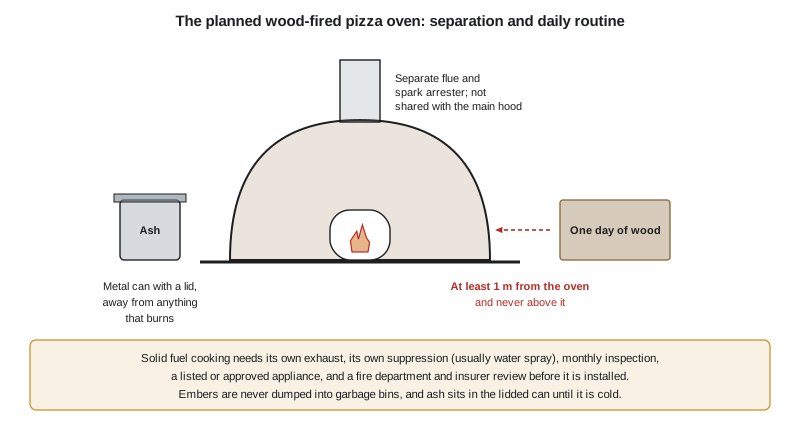
NFPA 96 limits how much fuel can be stored near a solid fuel appliance and where. Only about one day's supply is kept near the oven. It is never stored above the oven, its flue or any other heat-producing appliance, and it is kept at least 0.9 m (3 ft) from any part of the appliance. The bulk supply of wood is stored in a separate area away from the building and from heat sources, kept dry, and protected as the fire code requires. Wood is never dried on top of the oven or in the space beneath it, a habit that has started many pizzeria fires. Fire-starting materials are limited to what the manufacturer recommends; flammable liquids such as lighter fluid, alcohol or gasoline are never used to start or revive a fire.
For Juniper, the plan put a lockable steel storage box for one day's wood on the far side of the patio, and the main woodpile in a covered rack at the back of the lot, away from the building and the dumpster enclosure. The program below estimates how much wood a day of service will use, so that the daily box is sized correctly. The numbers are typical for a medium restaurant oven: a heavy charge of wood to bring the oven up to temperature, then a steady feed during service.
# Estimate daily wood use for a wood-fired oven, to size the daily storage box.
warm_up_kg = 18            # bringing the oven up to cooking temperature
feed_kg_per_hour = 5.5     # steady feed during service
service_hours = 7
box_capacity_kg = 75       # steel box beside the oven
reserve = 1.15             # a little extra for a busy night

daily = (warm_up_kg + feed_kg_per_hour * service_hours) * reserve
print(f"Wood for one day: about {daily:.0f} kg")
print(f"Daily box holds {box_capacity_kg} kg:", "enough" if box_capacity_kg >= daily else "TOO SMALL")
print(f"Over a 120-day patio season: about {daily * 120 / 1000:.1f} tonnes in the main storage area")Wood for one day: about 65 kg Daily box holds 75 kg: enough Over a 120-day patio season: about 7.8 tonnes in the main storage area
One day's wood fits comfortably in the box, while the season's supply is more than a hundred times as much, which is why the main woodpile has to live well away from the building. Wood is moved from the rack to the box once a day, before service, by the opening cook.
Ash and embers
Ash from a wood or charcoal fire can hold live embers for days. Many restaurant fires have started in dumpsters and garbage rooms where ash that looked cold was thrown out. NFPA 96 and the fire codes require ash, cinders and other fire debris to be removed in a metal container with a tight-fitting lid, and the container kept away from combustible materials, outdoors or on a non-combustible surface, until the ash is completely cold. At Juniper the closing cook shovels the ash into the lidded steel can beside the oven, carries it to a bare concrete pad at the back of the lot, and leaves it there overnight. Ash goes into the garbage only after it has sat for at least a full day and is cold to the touch when stirred.
The oven door is closed at night and the fire is allowed to burn down; it is never doused with water, which can crack the oven floor and send up a cloud of steam and ash. The closing check includes the hearth in front of the door, the area around the base and the wood box, looking for stray embers.
Monthly inspection and cleaning
As Lesson 4 explained, NFPA 96 requires the exhaust system for solid fuel cooking to be inspected monthly, the most frequent interval in the standard, and cleaned whenever buildup is found. Wood smoke deposits creosote, a tar-like substance that is highly flammable, on the inside of flues and ducts, and a creosote fire in a flue burns very hot. The patio oven's flue will be inspected monthly during the season by the same contractor that cleans the main hood, and swept as needed.
Charcoal grills and smokers
Charcoal grills and smokers follow the same principles. Indoors, they need a listed appliance, a solid fuel exhaust system and suppression, which is why most restaurants cook with charcoal only outdoors. Outdoors, they need clearance from the building, from overhangs, umbrellas and awnings, and from anything that burns; a stable, non-combustible surface; and the same care with ash. Charcoal must never be used indoors or in a covered space without proper exhaust, because burning charcoal produces large amounts of carbon monoxide. The smoker Juniper tested in the spring of 2026 sat on the concrete pad at the back of the lot, well clear of the building.
Woks
Wok cooking uses very high-output burners, large open flames and oil heated to high temperatures, and the food is often tossed so that the oil vapour ignites in the pan. NFPA 96 treats wok cooking as high-volume cooking for exhaust cleaning, and wok ranges need suppression nozzles designed for them. A wok station that is added to an existing line almost always means changes to the hood, the suppression system and the gas supply, as Juniper discovered in Lesson 7.
Flambé and tableside cooking
Flambé dishes are set alight with spirits for flavour and show. In the kitchen, flambéing is done away from the hood filters, with the pan pulled off the burner while the spirit is added, poured from a small measured container rather than the bottle, and lit with a long lighter. A spirit bottle is never held over a hot pan, because the flame can travel back into the bottle and cause it to burst.
Tableside flambé in the dining room brings an open flame close to guests, napkins, hair, decorations and drapes. Many fire codes restrict open flames in assembly occupancies, and some require approval for tableside cooking. Juniper does not flambé in the dining room. If it ever wanted to, the first step would be a call to the fire department.
Chafing fuel, candles and butane stoves
Small open flames in the dining room and at events cause a surprising number of fires and burns.
- Chafing fuel cans, used to keep buffet dishes warm, burn with a flame that can be almost invisible in daylight. Burns happen when a server lifts a pan and puts a hand over a can they thought was out, or refills a hot can, which can flare. Cans are lit with a long lighter, never moved while lit, put out with the snuffer cap, and allowed to cool before they are handled or replaced. Two entries in Aisha's log from Lesson 1 were chafing fuel flare-ups at refill time.
- Candles on tables are kept in stable, enclosed holders, away from menus, napkins and decorations, and are put out before tables are cleared. Fire codes in some places restrict open-flame candles in restaurants or require them to be in approved holders.
- Portable butane stoves, used for tableside cooking and catering, have cans that can overheat and burst if the stove is used with an oversized pan or griddle that covers the can compartment, if two stoves are placed side by side, or if the stove is used near another heat source. They are used only as the manufacturer directs, and spare cans are stored away from heat.
Propane cylinders
The patio heaters and the barbecue that the bar uses for summer events run on propane cylinders. CSA B149.2 and the BC Fire Code limit where propane cylinders can be stored and used. Cylinders are stored outdoors in a secure, ventilated cage away from building openings, ignition sources and exits, upright and protected from damage, never in the basement, the kitchen or a storage room. Patio heaters are certified for outdoor use, placed on a level surface with clearance from umbrellas, awnings and walls, and never brought indoors, even on a cold night. Cylinders are inspected for dents and rust, and are exchanged and refilled by a certified supplier.
The outcome of Juniper's review
The safety review produced a list of conditions for the pizza oven: a listed oven on a non-combustible base, its own flue with a spark arrester, a water-based suppression system designed with the fire department, a day box and a separate main woodpile, a lidded ash can and an ash pad, monthly flue inspection, two trained oven cooks on every shift the oven runs, and an opening and closing checklist. Elena also called her insurer, who asked for the same things and added one more: no oven on windy days above a set wind speed, because embers can carry. The oven is scheduled to open in May 2027.
Summary and key terms
- Solid fuel fires cannot be switched off, throw sparks and embers, leave hot ash and coat exhaust systems quickly, so NFPA 96 has special rules for them.
- Solid fuel appliances must be listed or approved, have their own exhaust with a spark arrester, and usually need water-based suppression; their exhaust is inspected monthly.
- Keep only about one day of fuel near the appliance, never above it and at least the required distance away, and never use flammable liquids to start the fire.
- Remove ash in a lidded metal container to a non-combustible spot and leave it until it is completely cold.
- Woks, flambé, chafing fuel, candles, butane stoves and propane cylinders each bring their own fire risks and need specific routines and, in some cases, fire department approval.
- Solid fuel cooking
- Cooking with wood, charcoal, pellets or other solid fuels, for heat or for flavour.
- Spark arrester
- A screen or device at the top of a flue that stops sparks and embers from escaping.
- Creosote
- A tar-like, highly flammable deposit left in flues and ducts by wood smoke.
- Day supply
- The amount of solid fuel needed for one day of cooking, the most that should be kept near the appliance.
- Chafing fuel
- Small cans of gel or liquid fuel used to keep buffet dishes warm, which often burn with a nearly invisible flame.
Common mistakes
MistakeStack the wood on top of the oven so it stays dry.
InsteadFuel is never stored above or against the appliance; keep one day of wood at the required distance and the rest well away.
MistakeAsh that has stopped glowing can go straight into the dumpster.
InsteadAsh can hide live embers for days; it goes into a lidded metal can on a non-combustible surface until it is completely cold.
MistakeA patio heater can be brought inside for a private party on a cold night.
InsteadOutdoor propane heaters are never used indoors; they produce carbon monoxide and the cylinder is a fire hazard.
Practice problems
Work each problem on paper first, then reveal the answer to check.
Why can a wood-fired oven not share the main hood and duct with the gas cooking line?
Show answer
Its sparks, embers and creosote would be carried into a duct coated with grease, and solid fuel needs its own exhaust built and inspected for it.
A server wants to refill a chafing fuel can that went out halfway through a buffet. What should they do?
Show answer
Make sure the flame is really out with the snuffer cap, let the can cool completely, and replace it with a new can rather than refilling a hot one.
Using the program's numbers, roughly how much wood does one day of service need, and why does it matter?
Show answer
About 65 kg (143 lb); it shows the daily box beside the oven is big enough, so no extra fuel needs to be stored near the oven.
Lesson quiz · 5 questions
Score 60% or more to complete this lesson.
Create a free account to save your progress, take quizzes and earn a certificate.