
HSE-381 · Lesson 4 of 12 · 16 min
Time and temperature control
▶ Video coming soon A video version of this lesson is on the way.
If a restaurant could do only one thing to prevent foodborne illness, it would be to control time and temperature. Bacteria need time and warmth to grow, so keeping food cold, keeping it hot, cooking it thoroughly and cooling it quickly take away the conditions they need. Time and temperature control is also the area where inspectors find the most problems, because it depends on people checking, writing down and acting on numbers every shift, including the busiest ones.
This lesson covers the danger zone, holding food cold and hot, using thermometers properly, keeping temperature logs, and using time instead of temperature for short periods. Lesson 5 covers receiving and storage, and Lesson 6 covers thawing, cooking, cooling and reheating, which are also time and temperature controls.
The danger zone
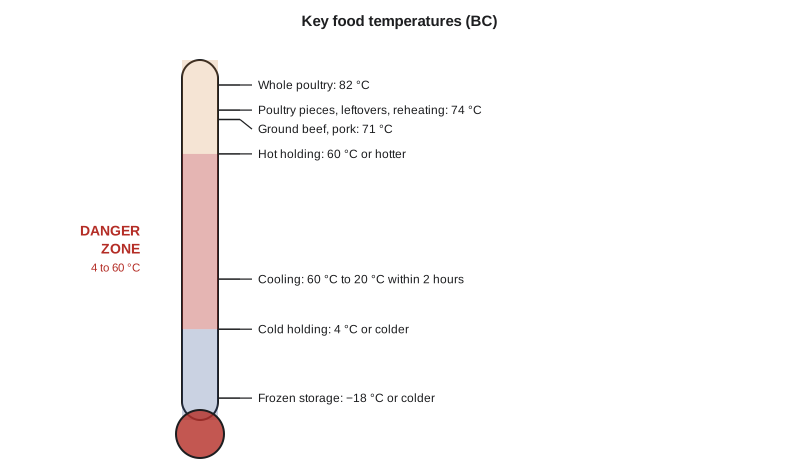
The danger zone is the range of temperatures in which most pathogenic bacteria can grow. In BC law and in most Canadian guidance it runs from 4 °C to 60 °C. Below 4 °C most pathogens grow very slowly or not at all, although Listeria and a few others can still grow slowly in the fridge. Above 60 °C most stop growing and begin to die. Bacteria grow fastest in the middle of the range, around body temperature, which is about the temperature of a pan of food left on a warm kitchen counter.
Cold holding
Potentially hazardous food that is kept cold must be at 4 °C or colder, measured in the food itself, not just in the air of the cooler. Frozen food must stay at −18 °C or colder. Juniper's walk-in cooler is set to run at about 3 °C, the reach-ins on the line at about 2 °C, and the walk-in freezer at about −20 °C. Setting the equipment a little colder than the limit gives some room for the door to open during a rush without the food warming past 4 °C.
Cold holding fails in predictable ways, and most of them are easy to prevent.
- Overloading. A cooler packed to the walls cannot move cold air around the food. Leave space between containers and do not block the fan.
- Hot food going in. A large pot of hot stock put straight into a reach-in can warm everything around it. Hot food is cooled first, as Lesson 6 describes.
- Doors left open. A walk-in door propped open while a delivery is put away, or a reach-in on the line opened every few seconds, lets warm air in. Strip curtains and self-closing doors help, and so does putting deliveries away in one trip.
- Worn gaskets and dirty coils. Torn door gaskets leak cold air, and condenser coils clogged with grease and dust make the unit work harder and fail sooner. Both belong on the maintenance schedule.
- Ice wells and cold rails on the line. Salad and sandwich rails often keep the top layer of food warmer than the bottom. Fill pans only to the level the unit can keep cold, keep the lids closed when possible, and check the food, not the dial.
Hot holding
Food kept hot for service must be at 60 °C or hotter throughout. Hot holding equipment such as steam tables, bain-maries, soup wells, heat lamps and holding cabinets is built to keep hot food hot, not to heat cold food, which it does too slowly. Food is cooked or reheated to the right temperature first, then placed in the hot holding unit.
- Stir soups, sauces and beans regularly so the top and edges do not cool while the bottom stays hot.
- Cover food when you can; lids and covers hold heat and keep debris out.
- Use small batches. Juniper's line keeps a third-size pan of braised short rib in the steam table and replaces it from the oven every hour, rather than holding a full hotel pan all night.
- Check the water level and the setting of steam tables at the start of each shift; a dry well heats unevenly.
- Never top up old food with new. Each batch is finished, then replaced with a fresh pan.
Thermometers
None of this works without a good thermometer, used correctly. Every cook at Juniper carries a pocket probe thermometer, and every cooler and freezer has its own hanging thermometer so anyone opening the door can see the air temperature at a glance.
- Digital probe thermometers (thermistors) read quickly and accurately from a small tip, so they work well for thin foods such as chicken breasts and burgers. They are the main tool on Juniper's line.
- Bimetallic stemmed dial thermometers are cheap and durable, but they sense temperature over the bottom few centimetres of the stem, marked by a small dimple, so they are not accurate in thin foods. Many can be adjusted with a nut under the dial.
- Thermocouples with interchangeable probes are used for very thin foods, for surface probes on griddles and for checking dish machine temperatures.
- Infrared thermometers measure only the surface they are pointed at. They are useful for a quick check of a delivery or a cooler shelf, but they cannot tell you whether the inside of a chicken thigh is cooked, and they read shiny stainless steel poorly.
- Oven-safe probes and data loggers stay in the food or the cooler and record the temperature over time, which is very useful for cooling large batches and for proving that a walk-in stayed cold overnight.
Thermometers must be accurate. A food thermometer should read within about 1 °C of the true temperature, and a common way to check it is the ice-point method: fill a glass with crushed ice, add cold water, stir, and hold the probe in the middle without touching the glass for about 30 seconds. It should read 0 °C. A thermometer that reads more than a degree off is adjusted if it can be, or replaced. Juniper checks every probe thermometer weekly and any time one is dropped, and records the check in the thermometer log.
- Probe the thickest part of the food, away from bone, fat and gristle, and the pan.
- For thin foods such as burger patties, insert the probe sideways into the middle.
- For a pan of food or a large roast, check in more than one place; the coldest spot is what counts.
- Wait until the reading stops changing before you read it.
- Clean and sanitize the probe before and after each use, and especially between raw and ready-to-eat foods, so the thermometer does not carry bacteria from one food to the next.
Temperature logs and checks
A thermometer only protects guests if someone uses it at the right times and acts on what it shows. Temperature logs build the check into the routine and give the restaurant proof that food was safe. They are also one of the first things an inspector asks to see.
Juniper's line checks hot and cold holding every two hours, starting when service begins. The interval matters. If a pan of food has dropped into the danger zone, checking every two hours means it was found while there was still time to fix it, by reheating it or moving it to a colder unit. Food that has been in the danger zone for an unknown time, or long enough that its safety cannot be assured, is thrown out. The walk-in and the reach-ins are checked at opening and closing and logged with the time and the initials of the person who checked.
The program below checks one shift's holding log and decides what to do with each reading.
# Check an invented holding log against BC limits.
COLD_MAX = 4      # degrees C
HOT_MIN = 60      # degrees C

log = [
    # (time, item, unit, reading in C)
    ("17:00", "short rib", "hot", 71),
    ("17:00", "cut tomatoes", "cold", 3),
    ("19:00", "short rib", "hot", 63),
    ("19:00", "cut tomatoes", "cold", 7),
    ("21:00", "short rib", "hot", 54),
    ("21:00", "cut tomatoes", "cold", 4),
]

for time, item, unit, temp in log:
    if unit == "cold":
        ok = temp <= COLD_MAX
        action = "ok" if ok else "move to a colder unit, find the cause, check again in 30 min"
    else:
        ok = temp >= HOT_MIN
        action = "ok" if ok else "reheat to 74 C now; discard if it cannot be reheated quickly"
    mark = " " if ok else "!"
print(f"{mark} {time} {item:<13} {unit:<4} {temp:>3} C {action}")17:00 short rib hot 71 C ok 17:00 cut tomatoes cold 3 C ok 19:00 short rib hot 63 C ok ! 19:00 cut tomatoes cold 7 C move to a colder unit, find the cause, check again in 30 min ! 21:00 short rib hot 54 C reheat to 74 C now; discard if it cannot be reheated quickly 21:00 cut tomatoes cold 4 C ok
Two problems show up. At 19:00 the cut tomatoes on the sandwich rail were too warm. They had been above the limit for no more than two hours, since they were fine at 17:00, so the cook moved them into the reach-in, found that the rail's lid had been left open through the rush, and checked again. At 21:00 the short rib had dropped below the hot holding limit; it had been fine at 19:00, so it could be reheated quickly on the range and returned. If the 19:00 check had been skipped, nobody would know how long either food had been out of temperature, and both would have to go.
Using time instead of temperature
Sometimes it is not practical to keep a food hot or cold, for example a tray of sushi rice at a sushi counter or a platter of sandwiches on a catering buffet. BC allows time to be used as the control instead of temperature only when the method is written into the operator's food safety plan and approved by the health authority. The plan sets a firm time limit after which any food left over is thrown out, and each container is marked with the time it came out of temperature control. Juniper uses this only for its patio brunch buffet, with a written procedure that Island Health approved.
Time as a control works only if the times are written down and the food really is thrown out at the end. A buffet pan marked 11:15 is discarded at the time on the label even if it looks perfect and the brunch is still busy. The label is the control; without it the method is just leaving food out.
When the power goes out
Power failures test cold holding. A full, closed walk-in will usually keep food cold for a few hours, and a closed freezer longer, so the first rule is to keep doors shut. The manager on duty notes the time the power went off and checks food temperatures with a probe when it comes back. Under section 7 of the Food Premises Regulation, a health officer must be told of any circumstance that may cause a health hazard, and a long outage that warms the coolers is one. Island Health can advise on what to keep and what to discard. Food that has been above 4 °C for an unknown or long time is thrown out.
| What | How often at Juniper | Limit | If it fails |
|---|---|---|---|
| Walk-in and reach-in coolers | Opening and closing | 4 °C or colder | Check food, move it, call for service |
| Walk-in freezer | Opening and closing | −18 °C or colder | Keep closed, check food, call for service |
| Hot holding on the line | Every 2 hours | 60 °C or hotter | Reheat to 74 °C or discard |
| Cold holding on the line | Every 2 hours | 4 °C or colder | Chill quickly or discard |
| Probe thermometers | Weekly and after a drop | Within about 1 °C at the ice point | Adjust or replace |
Summary and key terms
- The danger zone runs from 4 °C to 60 °C; potentially hazardous food is held at 4 °C or colder or 60 °C or hotter.
- Cold holding fails through overloading, hot food going in, open doors, worn gaskets and warm rails; hot holding equipment keeps food hot but does not heat it.
- Probe thermometers must be accurate, checked at the ice point, used in the thickest part of the food, and cleaned and sanitized between foods.
- Checking holding temperatures every two hours finds problems while there is still time to correct them.
- Time can replace temperature as a control only with written procedures, marked discard times and strict discarding.
- Danger zone
- The range from 4 °C to 60 °C in which most pathogenic bacteria can grow.
- Cold holding
- Keeping food cold enough that pathogens grow very slowly or not at all until it is used.
- Hot holding
- Keeping cooked food hot enough that pathogens do not grow until it is served.
- Ice-point method
- Checking a thermometer's accuracy in a mixture of crushed ice and water, which should read the freezing point of water.
- Time as a public health control
- Using a strict, written time limit instead of temperature to control pathogen growth for a short period.
Common mistakes
MistakeThe cooler dial says it is cold, so the food is cold.
InsteadCheck the food itself with a probe; air temperature and dial settings do not show what is happening inside a deep pan.
MistakeThe steam table can be used to warm up cold leftovers.
InsteadHot holding equipment heats too slowly; reheat food on the range or in the oven first, then hold it.
MistakeAn infrared thermometer is fine for checking whether chicken is cooked.
InsteadInfrared thermometers only read the surface; cooking temperatures must be checked inside the food with a probe.
Practice problems
Work each problem on paper first, then reveal the answer to check.
A pan of chili in the steam table reads 57 °C. It read 66 °C at the last check, an hour ago. What should the cook do?
Show answer
Reheat it quickly on the range to 74 °C and return it, and find out why the unit is not holding.
A probe thermometer reads 2 °C in ice water. Is it accurate enough?
Show answer
No. It should read 0 °C; it is 2 °C off and must be adjusted or replaced.
Why does Juniper check holding temperatures every two hours rather than every four?
Show answer
A two-hour interval finds food that has fallen out of temperature while there is still time to correct it instead of throwing it out.
Lesson quiz · 5 questions
Score 60% or more to complete this lesson.
Create a free account to save your progress, take quizzes and earn a certificate.