
HSE-381 · Lesson 1 of 12 · 20 min
Foodborne illness and who is at risk
▶ Video coming soon A video version of this lesson is on the way.
The first course in this track, HSE-380, was about keeping the people who work in a kitchen safe. This course is about keeping the people who eat the food safe. The two are closely linked. The same rushed shift that leads to a knife cut can lead to a pan of chicken left on the counter, and the same habits that protect workers, such as a clean station, a calm pace and a supervisor who checks, also protect guests. But the hazards are different, and so are the laws, the inspectors and the consequences.
A guest who gets sick from a restaurant meal rarely connects the illness to a single dish. Symptoms may start hours or days later, and most people assume they caught a bug somewhere. That is exactly why food safety has to be built into the daily routine instead of waiting for complaints. By the time a restaurant hears about a problem, dozens of people may already be ill.
We return to Juniper Street Kitchen and Bar in Victoria, British Columbia, the invented restaurant used throughout the food services track. The team is the same: Elena Varga owns it, Daniel Okafor is the general manager, Tomás Reyes is the executive chef and Aisha Rahman is the sous chef and safety lead. In this course Aisha also takes on food safety: she keeps the food safety plan, runs the temperature logs and walks the health inspector through the kitchen. Tomás holds the FOODSAFE Level 2 certificate, and every kitchen worker has FOODSAFE Level 1.
A lesson Juniper learned the hard way
In its first year, before Aisha joined, Juniper Street hosted a private rehearsal dinner for 40 guests. Within two days, 14 of them were sick with vomiting and diarrhea. Several called the health authority, which investigated. Stool samples from three guests tested positive for norovirus, and interviews showed that a prep cook had come in for his Saturday shift the morning after he had been sick at home. He felt better, he needed the hours and nobody asked. He made the salads, the bread service and the garnishes for the dessert, all foods that are not cooked after they are handled.
Nobody died and nobody was hospitalized, but the restaurant refunded the party, paid for a deep clean, threw out food, closed for a day, and spent months answering questions from the couple, their families and a local reporter. Elena still describes it as the worst week of her working life. It also changed the restaurant. Juniper now has a written illness policy, a sign-in question at the start of every shift, paid sick time for kitchen staff, and a rule that nobody ever comes in the day after vomiting or diarrhea. Lesson 8 explains those rules in detail. This lesson explains why they matter.
What foodborne illness is
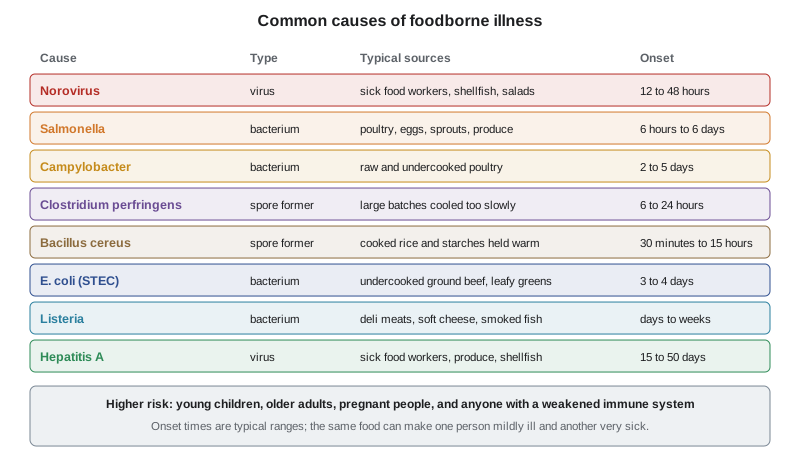
A foodborne illness is any illness caused by eating or drinking something contaminated with a harmful microorganism, a toxin or a chemical. People often call it food poisoning, but most cases are infections: living viruses, bacteria or parasites that get into the body with food and multiply there. Some are intoxications, in which a toxin that bacteria or other organisms made in the food causes the illness even if the organisms themselves are dead. A few are a mix of the two.
- Viruses, such as norovirus and hepatitis A, do not grow in food at all. They only need to get onto it, usually from the hands of an infected person or from contaminated shellfish or produce. A very small number of virus particles is enough to make someone sick.
- Bacteria, such as Salmonella, Campylobacter, E. coli and Listeria, can grow in food when it is held at the wrong temperature. A small, harmless number at delivery can become a dangerous number after a few hours on a warm counter.
- Spore-forming bacteria, such as Clostridium perfringens and Bacillus cereus, survive cooking as tough, dormant spores. When cooked food cools slowly, the spores wake up and grow. Some of them also make toxins that reheating does not destroy.
- Parasites, such as Anisakis worms in raw fish and Toxoplasma in undercooked meat, are killed by proper cooking or by freezing at specific temperatures for specific times.
- Natural toxins, such as scombrotoxin (histamine) in tuna, mackerel and mahi-mahi held too warm, ciguatoxin in some reef fish, and toxins in shellfish from harmful algae, are not destroyed by cooking at all. They can only be controlled by buying from safe sources and keeping fish cold from the boat to the plate.
How big the problem is
The Public Health Agency of Canada estimates that about one in eight Canadians, roughly 4 million people, gets sick from a domestically acquired foodborne illness each year. About 11,600 of them are hospitalized and about 238 die. Norovirus causes more cases than any other single agent, while bacteria such as Salmonella, Listeria and E. coli cause a larger share of hospitalizations and deaths. Most cases are never reported, because most people recover at home without seeing a doctor or giving a stool sample.
Restaurants are not the only source. Many cases come from food prepared at home, from manufactured products and from produce contaminated on the farm. But restaurants and other food service settings are a leading setting for the outbreaks that public health investigators do identify, partly because one mistake in a commercial kitchen can reach dozens or hundreds of people in a single service. A home cook who undercooks a chicken affects a family. A restaurant that cools a batch of rice badly affects everyone who orders the fried rice for two days.
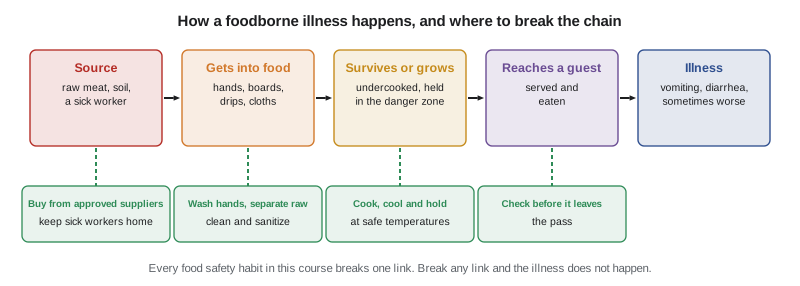
Investigators look for contributing factors: the specific things that went wrong. Across many years of outbreak reports, the same short list appears again and again. Public health agencies in both countries group them into five risk factors, and much of this course is organized around them.
- Food from unsafe sources: food from an unapproved supplier, shellfish without tags, home-canned products, or food that arrived warm or damaged.
- Inadequate cooking: chicken, ground meat or eggs not cooked to a temperature that kills the pathogens in them.
- Improper holding temperatures: food left in the danger zone while it is stored, cooled, held hot or held cold.
- Contaminated equipment: cutting boards, knives, slicers and cloths that move germs from raw food to ready-to-eat food, or that were not cleaned and sanitized.
- Poor personal hygiene: sick workers handling food, hands not washed, bare hands on ready-to-eat food.
Two other factors are often added. Allergens, which are not germs but can kill a guest within minutes, are covered in Lesson 10. Chemical contamination, such as sanitizer or degreaser getting into food, is covered with the other hazards in Lesson 3.
Who is most at risk
Most healthy adults who get a foodborne illness feel miserable for a day or two and recover completely. For some people, though, the same meal can mean a hospital stay, a lasting disability or death. Food safety rules are written with these people in mind, and restaurant staff should know who they are, because they are in the dining room every day.
- Young children, especially under five, have immune systems that are still developing and small bodies that dehydrate quickly. Shiga toxin-producing E. coli can cause hemolytic uremic syndrome, a form of kidney failure that strikes young children most often.
- Older adults, especially over 65, have weaker immune responses and often other health conditions. They are more likely to be hospitalized or die from Salmonella, Listeria and norovirus.
- Pregnant people are much more likely than others to get listeriosis, and Listeria can cross the placenta and cause miscarriage, stillbirth or serious illness in the newborn even when the mother feels only mildly unwell. Toxoplasma is also a risk in pregnancy.
- People with weakened immune systems, including those having chemotherapy, those who have had an organ transplant, and those living with HIV, diabetes, liver disease or kidney disease, or taking drugs that suppress the immune system, can develop severe, invasive infections.
When food is served mainly to these groups, as in hospitals, long-term care homes and child care centres, the rules are stricter. BC health authorities expect these facilities to avoid raw or undercooked animal foods and unpasteurized products entirely. A restaurant is not one of these facilities, but on any night it serves grandparents, toddlers, pregnant guests and people in treatment. That is why Juniper's menu notes which dishes are served raw or undercooked, and why servers are trained to answer questions about them honestly.
Long-term effects are another reason to take food safety seriously. Some people develop reactive arthritis after Salmonella or Campylobacter infections, Campylobacter is the most common known trigger of Guillain-Barré syndrome, a rare paralysis, and children who survive hemolytic uremic syndrome may have kidney damage for life. These outcomes are uncommon, but a busy restaurant serves enough people that uncommon is not the same as never.
Reading the timeline
The time from eating contaminated food to the first symptoms is called the incubation period or onset time. It differs a great deal from one cause to another, and it is one of the main clues investigators use. Toxins already in food act fastest: Bacillus cereus toxin from rice and Staphylococcus aureus toxin from foods handled and then left warm can cause vomiting within an hour or a few hours. Norovirus usually takes 12 to 48 hours. Salmonella and Campylobacter take one to several days, E. coli three to four days, and hepatitis A two weeks to almost two months. Listeria can take weeks.
This matters for anyone who takes a complaint. A guest who calls on Sunday to say that Saturday's dinner made them sick an hour after they got home may be right, or may have eaten something else at lunch. A guest who became ill with hepatitis A is very unlikely to have caught it from last night's meal. Front-of-house staff should never argue about the cause, never admit fault and never dismiss a complaint; they should take it seriously, record the details and pass them on.
Spotting an outbreak: the attack rate
When several people who ate the same meal get sick, investigators interview everyone they can reach, both sick and well, and ask what each person ate. For each food, they compare the share of people who ate it and got sick with the share of people who did not eat it and got sick. That share is called the attack rate. A food with a high attack rate among those who ate it and a low one among those who did not is the likely vehicle. The ratio of the two attack rates is called the relative risk.
The program below uses invented interview results from Juniper's rehearsal dinner. Every guest was asked whether they ate the green salad, the bread service, the braised short rib and the chocolate tart with whipped cream.
# Food-specific attack rates for an invented outbreak (40 guests, 14 ill).
# For each food: (ate and ill, ate and well, did not eat and ill, did not eat and well)
foods = {
    "green salad":      (13, 9, 1, 17),
    "bread service":    (12, 20, 2, 6),
    "braised short rib": (11, 21, 3, 5),
    "chocolate tart":   (12, 18, 2, 8),
}

def rate(ill, well):
    return ill / (ill + well) if ill + well else 0.0

print(f"{'food':<18}{'ate %ill':>9}{'not ate %ill':>14}{'relative risk':>15}")
best = None
for food, (a, b, c, d) in foods.items():
    r_ate, r_not = rate(a, b), rate(c, d)
    rr = r_ate / r_not if r_not else float("inf")
    print(f"{food:<18}{r_ate * 100:>8.0f}%{r_not * 100:>13.0f}%{rr:>15.1f}")
    if best is None or rr > best[1]:
        best = (food, rr)
print(f"Most likely vehicle: {best[0]} (relative risk {best[1]:.1f})")food ate %ill not ate %ill relative risk green salad 59% 6% 10.6 bread service 38% 25% 1.5 braised short rib 34% 38% 0.9 chocolate tart 40% 20% 2.0 Most likely vehicle: green salad (relative risk 10.6)
The salad stands out. Of the 22 guests who ate it, 13 became ill, and only 1 of the 18 who skipped it did, a relative risk of about 10. Bread, short rib and tart all show relative risks close to 1, meaning that eating them made little difference. The salad was handled by the sick prep cook after it was washed and was never cooked again, which fits the evidence. Real investigations add laboratory results and statistical tests, but the logic is the same, and it shows why ready-to-eat foods handled by people are such a common vehicle for norovirus.
What to do when a guest reports an illness
A single complaint is not proof of anything, but two or more unrelated parties reporting similar symptoms after eating at the same restaurant is a warning sign of an outbreak. BC's Food Premises Regulation requires operators to notify a health officer immediately of any circumstance that may cause a health hazard, and Island Health asks restaurants to call its environmental health office when they receive illness complaints they cannot rule out. Juniper's rule is simple: every illness complaint goes to the manager on duty, is written on the complaint form, and is reported to Aisha the same day; two or more go to Island Health immediately.
- Listen and record: the guest's name and phone number, the date and time of the visit, what each person in the party ate and drank, when symptoms began, what the symptoms are, and whether anyone saw a doctor.
- Do not diagnose, argue or speculate about the cause, and do not offer money in exchange for silence. Express concern and explain that the restaurant takes the report seriously.
- Check the kitchen records for that service: temperature logs, cooling logs, staff on duty and any illness reported by staff.
- Hold any leftover food from the suspect service if it is still in the building, labelled and set aside in the walk-in, in case the health authority wants to test it.
- Report as the restaurant's policy and the health authority require, and cooperate fully with any investigation.
| Risk factor | Example at Juniper Street | Main controls | Lesson |
|---|---|---|---|
| Unsafe source | Oysters arriving without their harvest tags | Approved suppliers, receiving checks, keeping tags | 5 |
| Inadequate cooking | Chicken thighs pulled from the oven by colour, not temperature | Calibrated thermometers, cooking limits, logs | 4 and 6 |
| Improper holding | A deep pot of stock left to cool on the range overnight | Two-stage cooling, cold and hot holding limits | 4 and 6 |
| Contaminated equipment | The same board for raw chicken and salad greens | Separate boards, washing and sanitizing | 7 and 9 |
| Poor personal hygiene | A cook working the morning after vomiting | Illness reporting, handwashing, no bare hands on ready-to-eat food | 8 |
| Allergens | Pesto with pine nuts served to a guest with a tree nut allergy | Allergen matrix, ticket flags, separate preparation | 10 |
How the course is organized
Lesson 2 explains the laws and the inspection system. Lesson 3 covers the three kinds of food hazard and how bacteria grow. Lessons 4 to 7 follow the food through the kitchen: temperature control, receiving and storage, thawing, cooking, cooling and reheating, and keeping raw and ready-to-eat foods apart. Lesson 8 covers personal hygiene and the rules on working while ill, Lesson 9 cleaning, sanitizing and pest control, and Lesson 10 allergens. Lesson 11 pulls it together in a food safety plan built on HACCP, and Lesson 12 walks through a full health inspection of Juniper Street.
Summary and key terms
- Foodborne illness is caused by viruses, bacteria, spores, parasites and toxins in food; viruses only need to reach food, while bacteria can grow in it.
- Millions of people in North America get a foodborne illness every year, and most cases are never reported.
- Five risk factors cause most outbreaks: unsafe sources, inadequate cooking, improper holding, contaminated equipment and poor personal hygiene.
- Young children, older adults, pregnant people and people with weakened immune systems face the most serious outcomes.
- Food-specific attack rates and relative risk point to the food that most likely caused an outbreak; ready-to-eat foods handled by sick workers are a common vehicle.
- Every illness complaint should be recorded calmly and passed on, and two or more related complaints should be reported to the health authority.
- Foodborne illness
- An illness caused by eating or drinking food contaminated with a harmful microorganism, toxin or chemical.
- Onset time
- The time from eating contaminated food to the first symptoms; also called the incubation period.
- Outbreak
- Two or more people becoming ill with the same illness after eating the same food.
- Attack rate
- The share of people in a group who became ill, such as those who ate a particular dish.
- Highly susceptible population
- People at higher risk of serious foodborne illness, such as young children, older adults, pregnant people and people with weakened immune systems.
Common mistakes
MistakeIf food looks, smells and tastes fine, it is safe.
InsteadMost pathogens change nothing you can see, smell or taste; only time and temperature control and clean handling make food safe.
MistakeCooking always makes contaminated food safe.
InsteadCooking kills most bacteria and viruses, but heat-stable toxins and bacterial spores survive, and ready-to-eat foods are never cooked after handling.
MistakeA guest who got sick an hour after dinner must have been poisoned by that meal.
InsteadOnset times range from under an hour to several weeks, so the meal before the illness is not always the cause; record the complaint and let investigators decide.
Practice problems
Work each problem on paper first, then reveal the answer to check.
Of 25 guests who ate a seafood pasta, 10 became ill; of 15 who did not, 1 became ill. What is the relative risk?
Show answer
The attack rate is 10/25 = 40% among those who ate it and 1/15 = about 6.7% among those who did not, so the relative risk is about 6.
Why can a single sick worker cause an outbreak through a salad but not through a well-cooked soup served hot?
Show answer
Cooking kills norovirus in the soup, but a salad is ready-to-eat and is not cooked after the worker handles it.
Name two groups of guests who face higher risk from Listeria.
Show answer
Pregnant people and people with weakened immune systems; older adults are also at higher risk.
Lesson quiz · 5 questions
Score 60% or more to complete this lesson.
Create a free account to save your progress, take quizzes and earn a certificate.