
HSE-381 · Lesson 3 of 12 · 17 min
Biological, chemical and physical hazards
▶ Video coming soon A video version of this lesson is on the way.
A food safety hazard is anything in food that can cause harm to the person who eats it. Food safety training sorts hazards into three groups: biological, chemical and physical. The groups matter because each one is controlled in a different way. Heat kills most biological hazards but does nothing to a sliver of glass. Washing removes soil from lettuce but not a toxin that formed in fish on a warm dock. Knowing which kind of hazard you are dealing with tells you which control will work.
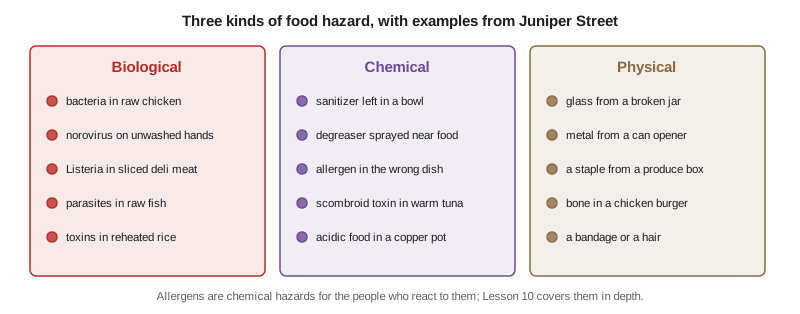
Biological hazards
Biological hazards are living things, or the toxins they make, that cause illness: bacteria, viruses, parasites and some fungi. They cause the great majority of foodborne illnesses and almost all outbreaks, which is why most food safety rules are aimed at them. Lesson 1 introduced the main organisms. This lesson looks at what they need, because the controls in Lessons 4 to 7 work by taking those things away.
What bacteria need to grow
Bacteria need six things to grow, and food safety courses often remember them with the letters FAT TOM.
- Food: a source of nutrients, especially protein and carbohydrate. Meat, poultry, fish, eggs, dairy, cooked grains, cooked vegetables and cut melons are all rich food for bacteria.
- Acidity: most bacteria grow best near neutral pH, about 6.6 to 7.5, and struggle in acid. Foods with a pH of 4.6 or below, such as most vinegar pickles, citrus juice and properly acidified sauces, do not support the growth of most pathogens.
- Time: bacteria need time to multiply. A few minutes in the danger zone is not a problem; several hours can be.
- Temperature: most pathogens grow fastest at body temperature and grow at some rate across the danger zone. Lesson 4 gives the limits.
- Oxygen: some bacteria need air, some cannot tolerate it, and many can grow either way. Clostridium botulinum grows only without air, which is why garlic stored in oil and vacuum-packed foods need special care.
- Moisture: bacteria need water. Food scientists measure available water as water activity, from 0 to 1; most pathogens need 0.85 or more. Dry foods such as flour, crackers and dried pasta keep for months because bacteria cannot grow in them, although they can survive.
Foods that provide all six are called potentially hazardous foods in BC law and in most Canadian guidance: they need time and temperature control to stay safe. Examples include meat, poultry, fish and shellfish, eggs, milk and dairy products, cooked rice, beans, pasta and potatoes, cut melons, cut tomatoes and cut leafy greens, sprouts, garlic in oil, tofu and soy proteins, and sauces and soups made with any of these.
How fast bacteria grow
Bacteria multiply by dividing in two. Under good conditions, some pathogens can divide every 20 minutes or so. That means one cell becomes 8 in an hour, 64 in two hours, and more than 260,000 in six hours. A cooked chicken breast that picked up a few hundred Salmonella cells from a cutting board can carry tens of millions after an afternoon on the counter, which is easily enough to make someone sick.
Real growth is not that simple. When bacteria first land on a food they go through a lag phase while they adjust, during which they barely multiply. Then comes the rapid log phase, then a stationary phase when nutrients run out, and finally a decline. The lag phase is one reason why short times in the danger zone are tolerated. Every time food warms up, though, the clock does not reset: time spent in the danger zone during receiving, prep, cooling and service all adds up.
The program below estimates growth in a pan of cooked rice that picked up some Bacillus cereus spores, comparing three ways it could be handled. The doubling times are rough teaching values that change with temperature, not laboratory data.
# Rough growth estimate for bacteria in cooked rice (teaching values only).
start = 100          # cells per gram after cooking
doubling_min = {     # approximate doubling time in minutes at each temperature
    30: 30, 22: 60, 10: 360, 4: None,   # None = little or no growth
}

def grow(cells, temp_c, hours):
    d = doubling_min[temp_c]
    if d is None:
        return cells
    return cells * 2 ** (hours * 60 / d)

plans = {
    "left on a warm counter (30 C) for 6 h": [(30, 6)],
    "on the counter (22 C) for 3 h, then cooled": [(22, 3), (4, 3)],
    "spread thin, cooled fast to 4 C": [(22, 1), (4, 5)],
}
for name, steps in plans.items():
    cells = start
    for temp, hrs in steps:
        cells = grow(cells, temp, hrs)
    flag = "UNSAFE" if cells >= 100_000 else "ok"
print(f"{name:<44} {cells:>14,.0f} cells/g {flag}")left on a warm counter (30 C) for 6 h 409,600 cells/g UNSAFE on the counter (22 C) for 3 h, then cooled 800 cells/g ok spread thin, cooled fast to 4 C 200 cells/g ok
The pan left on a warm counter all afternoon reaches levels at which Bacillus cereus can produce enough toxin to cause vomiting, and reheating will not destroy that toxin. The pan that sat for three hours is borderline. The pan that was cooled quickly barely changes. The numbers are only illustrations, but they show why the rules focus so heavily on cooling and holding, and why fried rice made from rice cooked the day before must start from rice that was cooled properly.
Spores and toxins
Some bacteria protect themselves by forming spores, tough dormant cells that survive boiling, drying and many sanitizers. Clostridium perfringens, Bacillus cereus and Clostridium botulinum all form spores. Cooking kills the active cells but leaves the spores, and when the food cools slowly through the danger zone, the spores germinate and grow quickly with no competition. This is why big batches of chili, gravy, beans and braised meats, cooled overnight in a deep pot, are classic causes of Clostridium perfringens outbreaks.
Some bacteria also make toxins. Staphylococcus aureus, which many healthy people carry in their nose and on their skin, can contaminate food handled with bare hands; if the food is then left warm, it makes a toxin that causes sudden, violent vomiting and is not destroyed by reheating. Bacillus cereus makes a similar heat-stable toxin in rice and other starches. Clostridium botulinum makes the most dangerous toxin of all, which can paralyse and kill; restaurants control it by keeping garlic and herbs in oil refrigerated and used quickly, by not making home-style canned foods, and by following strict rules for vacuum packing and sous vide.
Viruses, parasites and moulds
Viruses do not grow in food, so temperature control does not stop them. They are controlled by keeping sick workers away from food, by hand washing, by avoiding bare-hand contact with ready-to-eat food, and by buying shellfish from approved sources. Norovirus is especially hard to kill: it survives on surfaces for days, resists many hand sanitizers and some disinfectants, and spreads through vomit particles in the air. Lesson 9 covers cleaning up after someone vomits.
Parasites are animals, such as roundworms and tapeworms, that live in fish and meat. Thorough cooking kills them. Fish served raw or undercooked, such as Juniper's halibut crudo, must be frozen first to kill parasites; Canadian guidance follows the same approach as the international standard, freezing at −20 °C or colder for at least 7 days, or at −35 °C or colder until solid and then for at least 15 hours. Juniper buys its crudo fish already frozen to that standard and keeps the supplier's letter on file.
Moulds grow on bread, cheese, fruit and many other foods. Most are a quality problem, but some produce toxins, called mycotoxins, that can cause illness. Hard cheeses and firm vegetables with a small spot of mould can usually be saved by cutting well around it, but soft foods, bread, cooked dishes and anything with mould throughout should be thrown out.
Chemical hazards
Chemical hazards are substances that can poison or injure someone who eats them. In restaurants they come from three main places.
- Chemicals used in the kitchen: detergents, sanitizers, degreasers, oven cleaners, descalers, polishes and pest control products. A spray bottle of degreaser used near the prep table, a bowl not rinsed after sanitizing, or a cleaner stored in an old drink bottle can all put chemicals into food. HSE-380 Lesson 9 covered these products as worker hazards; here the concern is the guest.
- Metals and materials: acidic foods such as tomato sauce, citrus and wine can dissolve metals from copper, brass, galvanized steel and some old or decorative cookware and pottery. Only food-grade containers, utensils and bags should touch food, and containers that held chemicals must never be reused for food.
- Food additives and natural toxins: too much of an additive such as sulphites or nitrite curing salt, scombrotoxin in fish that was not kept cold, ciguatoxin in some tropical reef fish, shellfish toxins from harmful algae, toxins in wild mushrooms, and lectins in red kidney beans that are not boiled hard.
Food allergens are a special kind of chemical hazard: foods that are harmless to most people can cause a severe or fatal reaction in someone who is allergic. They are covered fully in Lesson 10.
Controlling chemical hazards
- Store all chemicals below and away from food, food-contact surfaces and single-use items, ideally in a separate cabinet or room. Juniper keeps its cleaning products on the bottom shelf of a rack in the dish pit, well away from the dry storage.
- Keep products in their original containers. When a product is moved to a spray bottle or bucket, label it with the product's name.
- Use the right amount. Sanitizer that is too strong can leave a residue on surfaces and is not more effective; test strips confirm the strength.
- Rinse food-contact surfaces after cleaning products are used, and sanitize as the label directs.
- Buy fish from reputable suppliers who keep it cold, check temperatures at receiving, and never accept tuna, mackerel or mahi-mahi that arrives warm.
- Use only food-grade equipment and never store acidic foods in metal containers that are not approved for it.
Physical hazards
Physical hazards are hard or sharp objects that can cut the mouth, break teeth or choke someone. Some come from the food itself, such as bones, shells and fruit pits, and some come from the kitchen, such as glass, metal, plastic, wood, staples, jewellery, bandages and fingernails. Hard objects about 7 to 25 millimetres long are generally treated as a serious hazard; smaller pieces can still injure, and very small children can choke on objects that an adult would not notice.
- Glass: Juniper never uses glass containers on the line or in the prep area and never scoops ice with a glass. If a glass breaks near the ice well at the bar, Nadia empties the well, melts the ice with hot water (staff call this burning the ice), cleans it and refills it, because nobody can see clear glass in clear ice.
- Metal: can openers are cleaned and checked for wear, steel wool and wire brushes are not used on food-contact surfaces, and anything that breaks, such as a whisk wire or a blade tip, is accounted for before the food is served.
- Packaging and supplies: staples, twist ties, plastic film and cardboard are removed during receiving and prep, not on the line.
- Personal items: Juniper's kitchen staff wear no jewellery except a plain band, keep fingernails short and unpolished, cover cuts with brightly coloured waterproof bandages and a glove, and wear hair restraints.
- From the food: fish and poultry dishes advertised as boneless are checked, and olives, cherries and dates are served with a warning if they still have pits.
| Hazard | Examples | Main controls |
|---|---|---|
| Biological | Bacteria, viruses, parasites, moulds and their toxins | Time and temperature control, cooking, cooling, hygiene, sick worker rules, approved sources, freezing for parasites |
| Chemical | Cleaners, sanitizers, pesticides, metals, additives, natural toxins, allergens | Storage away from food, labels, correct strengths, food-grade equipment, approved suppliers, allergen controls |
| Physical | Glass, metal, plastic, staples, bones, pits, jewellery, bandages | Glass rules, equipment checks, careful receiving and prep, personal item rules |
For supervisors: thinking in hazards
- When something goes wrong, ask which kind of hazard it is before deciding what to do. A broken glass near an open bin of garnish needs the garnish thrown out; a warm pan of sauce needs a time and temperature decision; a bottle of degreaser near the salad station needs to move.
- Look for the hidden hazards in new menu items. A new dish with raw egg, rare duck, house-cured fish or garlic confit needs a new control, and Lesson 11 shows how to work it into the food safety plan.
- Make reporting easy. A cook who chips a bowl or loses a glove fingertip should feel comfortable saying so and throwing out the food, even in the middle of a rush.
Summary and key terms
- Food hazards are biological, chemical or physical, and each kind needs its own controls.
- Bacteria need food, acidity near neutral, time, temperature, oxygen (or its absence) and moisture; taking away any one slows or stops growth.
- Under good conditions bacteria can double every 20 minutes, so time in the danger zone adds up quickly.
- Spore-forming bacteria survive cooking and grow when food cools slowly, and some bacteria make toxins that reheating does not destroy.
- Chemical hazards include cleaning products, metals, additives, natural toxins and allergens; physical hazards include glass, metal, bones and personal items.
- Biological hazard
- A bacterium, virus, parasite or fungus, or a toxin it makes, that can cause illness.
- Potentially hazardous or TCS food
- A food that supports the growth of pathogens and needs time and temperature control to stay safe.
- Water activity
- A measure from 0 to 1 of the water in a food that is available to microorganisms; most pathogens need 0.85 or more.
- Spore
- A tough, dormant form of some bacteria that survives cooking and grows again when conditions improve.
- Physical hazard
- A hard or sharp object in food, such as glass, metal, bone or plastic, that can injure the person who eats it.
Common mistakes
MistakeReheating food that sat out overnight makes it safe again.
InsteadReheating kills active bacteria but not the heat-stable toxins some of them make, such as Bacillus cereus and Staphylococcus toxins.
MistakeA little extra sanitizer makes surfaces even safer.
InsteadSanitizer that is too strong can leave a chemical residue; use the strength on the label and check it with test strips.
MistakeA broken glass in the ice well is fine once the large pieces are picked out.
InsteadClear glass cannot be seen in ice; the whole well must be emptied, melted out, cleaned and refilled.
Practice problems
Work each problem on paper first, then reveal the answer to check.
A food has a pH of 4.2. Does it normally support the growth of most pathogens?
Show answer
No. Foods at pH 4.6 or below do not support the growth of most pathogenic bacteria.
Starting with 50 bacteria that double every 20 minutes, how many are there after two hours?
Show answer
Two hours is six doublings, so 50 times 64 = 3,200 bacteria.
Why is a deep pot of beef chili cooled overnight a risk even though it was boiled?
Show answer
Clostridium perfringens spores survive boiling and grow quickly while the chili cools slowly through the danger zone.
Lesson quiz · 5 questions
Score 60% or more to complete this lesson.
Create a free account to save your progress, take quizzes and earn a certificate.