
HSE-375 · Lesson 8 of 12 · 20 min
Selecting and prequalifying subcontractors
The cheapest way to control a subcontractor's hazards is not to hire a subcontractor that creates them. Tallgrass learned that lesson the hard way on an earlier project, when a small roofing firm hired at the last minute turned out to have no fall protection program, no trained supervisor and a history of orders and citations. Its crew worked untied on a steep roof for two days before a Tallgrass superintendent noticed. Since then, every subcontractor that works on a Tallgrass site goes through a prequalification process before it can bid, and its safety performance is reviewed while it works and after it leaves.
This lesson follows that process for Cottonwood Place, from the questionnaire to the final evaluation.
Why selection is part of the legal duty
The prime contractor's duty to ensure, so far as is reasonably practicable, that everyone on the site complies with the Act starts before anyone arrives. Choosing contractors who can work safely is one of the most reasonably practicable steps available. Section 7.1 of the Act also requires a contractor that engages others to ensure, so far as is reasonably practicable, that the work they do complies. Courts considering due diligence have looked at whether a general contractor checked a subcontractor's safety record and program before hiring it.
The prequalification questionnaire
Tallgrass's questionnaire asks for information in six areas. Each subcontractor fills it in once a year, and updates it if anything significant changes.
- Safety program. A copy of the written program, or its table of contents and key procedures, and the name of the person responsible for safety.
- Certification. COR or SECOR certificate and its expiry date.
- Performance. Hours worked, lost time and recordable injury frequencies, and fatalities for the past three years; WCB rate history.
- Enforcement history. Improvement orders, stop work orders, administrative penalties and prosecutions in the past three years, with an explanation of each and what changed.
- Training. The training the company requires for supervisors and workers, and how it tracks it.
- Insurance and coverage. WCB clearance and commercial general liability insurance.
Scoring and decisions
Owen scores each questionnaire on a 100-point scale with weights that reflect what Tallgrass has learned matters most. The score puts each firm in one of three bands: approved to bid, approved with conditions, or not approved. A firm can move up a band by fixing the problems found.
# Prequalification score for three drywall bidders (weights sum to 100).
weights = {"program": 25, "certification": 15, "rates": 20,
           "enforcement": 20, "training": 15, "coverage": 5}
# each criterion scored 0.0 to 1.0 by the reviewer
bidders = {
    "Pinecrest": {"program": 0.6, "certification": 1.0, "rates": 0.3,
                  "enforcement": 0.4, "training": 0.6, "coverage": 1.0},
    "Bidder B":  {"program": 0.9, "certification": 1.0, "rates": 0.9,
                  "enforcement": 1.0, "training": 0.8, "coverage": 1.0},
    "Bidder C":  {"program": 0.8, "certification": 1.0, "rates": 0.8,
                  "enforcement": 1.0, "training": 0.7, "coverage": 1.0},
}
for name, s in bidders.items():
    total = sum(weights[k] * s[k] for k in weights)
    band = "approved" if total >= 80 else "conditions" if total >= 60 else "not approved"
print(f"{name:10s} {total:5.1f} {band}")Pinecrest 58.0 not approved Bidder B 92.5 approved Bidder C 86.5 approved
Pinecrest scored 63, which put it in the conditional band. As lesson 5 described, it was awarded the work with conditions because its price and availability met the schedule. The score made the conditions specific: its weakest areas were injury rates and enforcement history, both driven by fall protection, so the conditions focused on a written fall protection plan, a full-time foreman and monthly reviews.
The pre-award safety meeting
Before signing a subcontract, Tallgrass holds a pre-award meeting with the subcontractor's project manager and the foreman who will run the work. The meeting goes through the site safety plan, the hazards in the subcontractor's scope, the documents it must submit before starting (hazard assessments, safe work procedures, training records, the names of its competent persons and its emergency contacts), Tallgrass's site rules, and any conditions from prequalification. The subcontractor's foreman must attend; a meeting with only the estimator does not count, because the estimator will not be on site.
At the Pinecrest meeting, Owen asked Jordan Pike to walk through how his crew would work near openings and at the perimeter. Jordan's answer made clear that the company's fall protection plan assumed ground-floor tenant fit-outs, not a seven-storey building with openings and slab edges. The written fall protection plan required by the conditions was drafted with Owen's help before the crew started.
Monitoring during the work
Prequalification predicts performance; it does not guarantee it. While a subcontractor works on Cottonwood Place, Tallgrass tracks its record: findings from inspections, deficiencies raised and how quickly they were closed, incidents and near misses, attendance at coordination meetings, and compliance with the conditions of award. Subcontractors in the conditional band get a monthly review meeting with Owen. Any serious incident or repeated serious deficiency triggers an immediate review, which can lead to a corrective action plan, replacement of the foreman, removal of workers or, as a last resort, termination of the subcontract.
After the level 5 fall, Pinecrest's monthly review became a weekly one for two months. Its corrective action plan added a second supervisor on site, a daily floor walk by the foreman before work started, and fall protection retraining for the whole crew. Its record improved, and it finished the job without another serious incident.
Lower-tier subcontractors
Many subcontractors hire their own subcontractors: the mechanical contractor hires an insulation firm, the drywall contractor hires a taping crew. These lower-tier firms are just as much on Tallgrass's site. Tallgrass's subcontracts require every subcontractor to apply the same prequalification standards to its own subcontractors, to tell Tallgrass in advance who they are, and to make sure they attend orientation and follow the site plan. Lower-tier firms that do high-risk work, such as scaffolding or crane work, must prequalify with Tallgrass directly.
Post-job evaluation
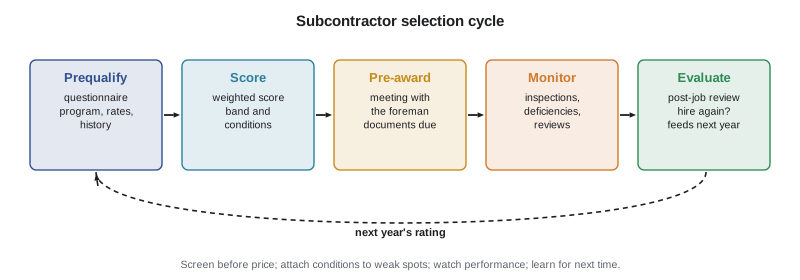
When a subcontractor finishes, the superintendent and safety coordinator complete a one-page evaluation: inspection and deficiency record, incidents, cooperation, quality of documents, and whether they would hire the firm again. The evaluation feeds back into next year's prequalification. A firm that worked well gets a higher score; a firm that caused problems has to explain what it has changed before it can bid again.
| Stage | Key question | Evidence |
|---|---|---|
| Prequalification | Can this firm work safely on our kind of project? | Program, COR, rates, enforcement history, training, WCB clearance |
| Scoring | How confident are we, and what are the weak spots? | Weighted score and band; conditions |
| Pre-award meeting | Does the foreman understand the site and the scope hazards? | Meeting record; documents due before start |
| Monitoring | Is the firm performing as predicted? | Inspections, deficiencies, incidents, reviews |
| Evaluation | Would we hire them again, and what should change? | Post-job evaluation feeding next year's rating |
Price, schedule and safety
General contractors face real pressure to hire the lowest bidder, especially on public projects where procurement rules may require it. Prequalification resolves much of that tension: firms that cannot work safely are screened out before price is considered, so the lowest qualified bid can be accepted with confidence. On public projects, the prequalification criteria must be published in advance and applied fairly to all bidders. Where a firm with a weaker record must be hired, conditions in the subcontract are how the general contractor manages the risk.
Worked problem
A firm that did not make the list
Show solution
- A scaffold contractor new to Winnipeg applied to prequalify for the facade work.
- Its questionnaire showed no COR, a lost time frequency it could not calculate because it did not track hours, and two stop work orders in the previous year for scaffold collapse hazards.
- Owen scored it at 38: not approved.
- He sent the firm a letter explaining the gaps and what it would need to show to be reconsidered: a written program, scaffold competent person training for its foremen, and a year of tracked performance.
- The firm came back eighteen months later with all three and was approved with conditions for a smaller Tallgrass project.
Answer: Prequalification is not just a gate; clear feedback gives firms a path to improve.
What the subcontract says
Prequalification decides who gets to bid. The subcontract decides what they must do once they are hired. Tallgrass's standard subcontract has a safety article that every subcontractor signs, and its key clauses reinforce everything in this course.
- Compliance. The subcontractor must comply with the Act, the regulation, the site safety plan and Tallgrass's site rules, and must make sure its own subcontractors do too.
- Documents before start. The subcontractor must submit its hazard assessments, safe work procedures, training records, list of competent persons, WCB clearance and emergency contacts before mobilizing.
- Supervision. A competent foreman must be on site whenever the subcontractor's workers are working.
- Stop work and removal. Tallgrass may stop any unsafe work immediately and require the removal of any worker who repeatedly breaks safety rules.
- Correction at the subcontractor's cost. If the subcontractor fails to correct a hazard after notice, Tallgrass may correct it and deduct the cost.
- Reporting. The subcontractor must report every injury, near miss and regulatory visit to Tallgrass immediately.
- Cooperation. The subcontractor must attend coordination meetings and cooperate with investigations.
These clauses are only as strong as Tallgrass's willingness to use them. On Cottonwood Place, Tallgrass stopped work 23 times over two years, removed four workers from site for repeated violations, and corrected hazards at a subcontractor's cost twice, both for guardrails left down after repeated notices. Each use was recorded and discussed at the next coordination meeting, without naming individual workers, so that every firm knew the clauses were real.
Owners who prequalify the general contractor
The same process works one level up. Cottonwood Place Developments prequalified Tallgrass before inviting it to bid, asking for its program, its certification, its rates, its enforcement history and references from other owners. During construction, the owner's project manager received Owen's monthly safety report and attended one coordination meeting each quarter. At the end of the job, the owner completed its own evaluation of Tallgrass. Owners who take safety seriously in their selection send a clear message down the chain: firms that cannot work safely will not get the work, whatever their price.
Small firms and capacity
Prequalification can be hard on small firms, which may do good work safely but lack the staff to write a long program or the hours to produce a meaningful injury rate. Tallgrass treats small firms differently in two ways. It accepts simpler programs that cover the firm's actual hazards rather than a generic manual, and it gives more weight to references, interviews with the owner and foreman, and a trial on a smaller scope of work. It also points small firms to their safety association's small employer programs and to free consultation services, so that a good small firm can grow into a strong one.
Tallgrass also asks prospective subcontractors for two or three references from other general contractors, and Owen calls at least one of them. He asks the same questions each time: did the firm's foreman run a safe crew, did it close deficiencies promptly, did it report incidents honestly, and would the reference hire it again. The answers often tell him more than the questionnaire. A reference that hesitates, or that says the firm was fine once they put a superintendent on its back every day, is a warning that the scores alone would miss.
Common mistakes
MistakeHiring the lowest bidder without checking its safety record.
InsteadScreen firms through prequalification before price is considered.
MistakeHolding the pre-award meeting with the estimator only.
InsteadThe foreman who will run the work must attend.
MistakeTreating prequalification as the end of the review.
InsteadMonitor performance during the work and evaluate after.
MistakeIgnoring lower-tier subcontractors.
InsteadRequire subcontractors to apply the same standards and identify their own subcontractors in advance.
MistakeTaking a firm's answers at face value.
InsteadCheck certificates and clearances with the issuing bodies, and ask for explanations of any orders.
Summary and key terms
- Selecting subcontractors who can work safely is one of the most practicable ways for a general contractor to meet its duty.
- Prequalification collects information on program, certification, performance, enforcement history, training and coverage, and scores it into bands.
- Conditions of award target a firm's weak spots and are backed by the pre-award meeting and closer monitoring.
- Lower-tier subcontractors must meet the same standards and be known in advance.
- Post-job evaluations feed back into future prequalification and give firms a path to improve.
- Prequalification
- Reviewing a firm's safety program and record before allowing it to bid.
- Conditional approval
- Approval to work subject to specific requirements that address identified weaknesses.
- Pre-award meeting
- A meeting before signing the subcontract to review the site plan, scope hazards and required documents.
- Lower-tier subcontractor
- A firm hired by a subcontractor rather than by the general contractor.
- Corrective action plan
- A written plan to fix identified problems, with actions, owners and dates.
- Post-job evaluation
- A review of a subcontractor's performance when its work ends.
Practice problems
Work each problem on paper first, then reveal the answer to check.
Name the six areas in Tallgrass's prequalification questionnaire.
Show answer
Safety program, certification, performance, enforcement history, training, insurance and coverage.
Why did Pinecrest's conditions focus on fall protection?
Show answer
Its weakest scores were injury rates and enforcement history, both driven by fall protection.
Who must attend the pre-award meeting?
Show answer
The subcontractor's project manager and the foreman who will run the work.
What happened to Pinecrest's review schedule after the level 5 fall?
Show answer
It went from monthly to weekly for two months, with a corrective action plan.
What must subcontractors do about their own subcontractors?
Show answer
Apply the same standards, tell Tallgrass in advance who they are and make sure they attend orientation; high-risk lower-tier firms prequalify directly.
Lesson quiz · 5 questions
Score 60% or more to complete this lesson.
Create a free account to save your progress, take quizzes and earn a certificate.