
HSE-375 · Lesson 7 of 12 · 20 min
Coordinating trades and subcontractors
After the level 5 fall, Carla Mendes asked the foremen of all 14 trades then on site to meet in the trailer. She put a single question on the whiteboard: 'Who owns the guardrail around an opening?' The mechanical foreman said the scaffold company did, because it installed the rails. The scaffold foreman said whoever cut the opening did. The drywall foreman said Tallgrass did, because Tallgrass was in charge. Each answer was reasonable, and together they explained why a guardrail could be removed on a Saturday and stay off until Monday.
Coordinating the work of many employers is the prime contractor's central legal duty under section 7(3) of the Act. This lesson describes the tools Tallgrass uses to do it on Cottonwood Place.
Why coordination fails
Most coordination failures on construction sites come from a small number of patterns.
- Shared hazards with no owner. Guardrails, openings, temporary power, housekeeping on shared floors and access routes are used by everyone and maintained by no one unless someone is assigned.
- Stacked trades. Two or more trades working in the same space at the same time, especially one above the other, create hazards for each other: falling objects, blocked access, dust from one trade in another's breathing zone.
- Changes nobody hears about. A trade removes a guardrail, cuts an opening, isolates a circuit or moves a ladder, and the next trade does not know.
- Handovers that are not handovers. One trade finishes an area and another starts, but nobody checks the condition of the area in between.
- Schedule pressure. When the job falls behind, trades are pushed into areas before they are ready, and coordination meetings are skipped to save time.
The foremen's coordination meeting
Every Tuesday morning at Cottonwood Place, Carla chaired a one-hour meeting of every subcontractor's foreman. The agenda never changed: safety issues from the past week, the three-week look-ahead schedule floor by floor, shared hazards and who owns them, deliveries and crane time, and anything that needed another trade's help. Owen presented the week's inspection findings and open deficiencies. The meeting produced a short set of minutes with actions, owners and dates, posted on the site board and sent to every subcontractor's office.
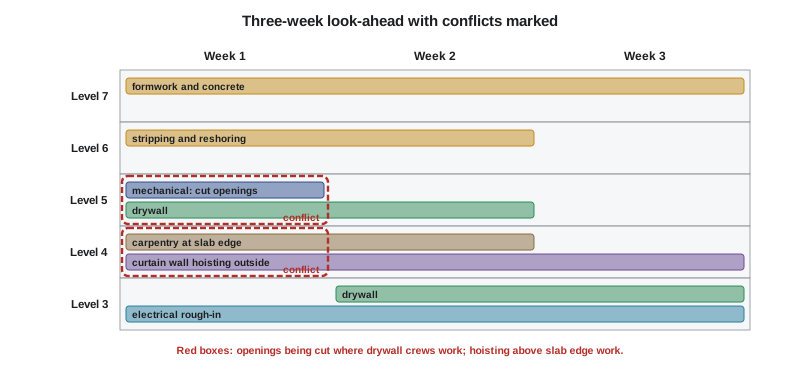
The look-ahead was the key tool. Laying out three weeks of work by floor and zone on one sheet showed where trades would be stacked, where deliveries would block access, and where one trade's work, such as cutting openings or removing temporary protection, would affect another.
Assigning shared hazards
After Carla's whiteboard question, the foremen agreed on a list of shared hazards and wrote down who owns each one. The list went into the site safety plan as a revision.
| Shared hazard | Who owns it | Rule |
|---|---|---|
| Perimeter guardrail | Tallgrass installs and maintains | Only removed under a guardrail removal permit; reinstated before the end of the shift |
| Floor openings | The trade that cuts the opening, until it is covered or guarded | Entered on the opening register before cutting; cover or rail installed immediately |
| Scaffolds | Highline Scaffold Ltd. | Only the scaffold contractor alters scaffolds; tags show status |
| Temporary power | Brooks Electric Ltd. | Ground fault protection on every circuit; damaged cords removed |
| Housekeeping on shared floors | Each trade cleans its own debris daily; Tallgrass labourers sweep common areas | Floor-by-floor cleanup schedule in the minutes |
| Stair towers and access routes | Tallgrass | Kept clear; no material storage |
| Crane time and lift zones | Tallgrass | Booked at the coordination meeting; lift zones barricaded |
Two new tools came out of that list. The opening register is a sheet for each floor, kept at the floor's stair tower, where any trade that plans to cut an opening must enter it in advance, with the size and the cover or rail that will protect it. The guardrail removal permit is a short form that any trade must get from Tallgrass's assistant superintendent, Ben Nakamura, before removing any section of guardrail. It states why the rail is coming off, what protection replaces it while it is off, who is responsible and when it will be reinstated. Ben checks each permit at the end of the shift.
Permit-to-work systems
The guardrail removal permit is one example of a permit-to-work system: a written authorization, issued by a responsible person, before a hazardous activity can start. Permits force the planning to happen before the work, make sure the people affected know about it, and leave a record. On Cottonwood Place, Tallgrass ran permits for hot work, confined space entry, energy isolation on permanent systems during commissioning, guardrail removal, critical crane lifts, excavation near utilities, and roof access during roofing. Each permit had a fixed form, a named issuer and a time limit.
Permits only work if they are issued with thought. A permit book where the superintendent signs blank forms at the start of the week defeats the purpose. Tallgrass audits a sample of permits each month against what was actually happening on site.
Stacked work and work above others
When the curtain wall crew began hoisting panels past floors 3 to 5, the look-ahead showed carpenters working at the floor 4 slab edge the same week, directly in the hoisting path. The coordination meeting moved the slab edge work to the following week and set an exclusion zone below the hoist on the days panels were lifted. Where stacking cannot be avoided, the trade above must protect the trade below with toe boards, debris netting or overhead protection, and the trade below must stay out of marked drop zones.
Owen uses a simple check to flag stacked work on the look-ahead before the meeting.
# Flag zones where incompatible activities overlap in the same week.
plan = [
    (1, "L5-north", "mechanical", "cut openings"),
    (1, "L5-north", "drywall", "board walls"),
    (1, "L4-east", "curtain wall", "hoist panels outside"),
    (1, "L4-east", "carpentry", "slab edge work"),
    (2, "L3-west", "drywall", "board walls"),
    (2, "L3-west", "electrical", "pull wire"),
]
conflicts = {("cut openings", "board walls"), ("hoist panels outside", "slab edge work")}
from collections import defaultdict
zones = defaultdict(list)
for week, zone, trade, act in plan:
    zones[(week, zone)].append((trade, act))
for (week, zone), items in sorted(zones.items()):
    acts = [a for _, a in items]
    for a in acts:
        for b in acts:
            if (a, b) in conflicts:
print(f"week {week} {zone}: '{a}' conflicts with '{b}' -> resolve at meeting")week 1 L4-east: 'hoist panels outside' conflicts with 'slab edge work' -> resolve at meeting week 1 L5-north: 'cut openings' conflicts with 'board walls' -> resolve at meeting
The script only knows the conflicts it is told about; the meeting finds the rest. Its value is in making sure the obvious ones are on the agenda every week.
Handovers between trades
When a trade finishes in an area and another moves in, the condition of the area changes hands. Tallgrass requires a short walk between the outgoing and incoming foremen for any floor or zone handover, using a one-page checklist: openings covered or guarded, guardrails complete, temporary power safe, debris cleared, access clear, any hazards left behind identified. Both foremen sign. The checklist takes ten minutes and replaces the assumption that the last trade left things in good shape.
When a subcontractor does not cooperate
Most subcontractors cooperate readily, but the prime contractor's duty does not depend on their goodwill. Tallgrass's subcontracts require compliance with the Act, the regulation and the site safety plan, give Tallgrass the right to stop unsafe work and to remove workers who repeatedly break safety rules, and allow it to withhold payment or correct a hazard at the subcontractor's cost if the subcontractor will not. These clauses give Tallgrass the practical authority to carry out its legal duty to ensure compliance.
Worked problem
The opening register in its first month
Show solution
- In the first month after the opening register started, trades entered 37 planned openings across five floors.
- Ben Nakamura checked the register against the floors daily and found four openings that had been cut without an entry, all by the same plumbing crew.
- Each was found guarded, but the plumbing foreman said his crew had not known about the register.
- Owen added the register to the orientation and the plumbing foreman briefed his crew; there were no unregistered openings the following month.
- Over the next year, the register recorded more than 300 openings, and no worker fell through or into one.
Answer: Coordination tools work when they are simple, checked daily and backed by orientation and follow-up.
Communication that reaches every crew
Decisions made at the Tuesday meeting only protect workers if they reach the crews. Tallgrass requires each subcontractor's foreman to brief their crew on the meeting's safety items at their next toolbox talk and to sign the minutes to confirm it. Owen checks a sample each week by asking workers on the floors about the week's changes. When the guardrail removal permit started, he found that most crews knew about it within two days, but two crews that started on Wednesday had not heard, because their foremen had missed the meeting. Since then, any foreman who misses the meeting gets a short phone briefing from Ben the same day.
Site-wide changes, such as a new delivery route or a new muster point, also go on the site board, on signs where the change happens, and on a short text message to every foreman's phone. For urgent hazards, such as a high wind warning that stops crane work, Carla uses a group radio call followed by a text. The goal is simple: no worker should learn about a change by walking into it.
Coordinating with neighbours and the public
Coordination does not stop at the property line. The office building on the west side of Cottonwood Place had tenants who used the shared lane for parking and deliveries, and the street on the north side carried buses, cyclists and pedestrians. Tallgrass met monthly with the office building's property manager to share the look-ahead, warn of noisy or dusty work, and agree on lane closures. It gave the bus company advance notice of street closures for crane lifts. Its traffic plan, described in HSE-373, set out how pedestrians would be routed around the site safely. When the curtain wall hoisting started, Tallgrass notified the office tenants whose windows faced the lift zone and agreed that blinds would be closed during lifts.
When coordination meets the schedule
The biggest threat to coordination is schedule pressure. When Cottonwood Place fell three weeks behind after a wet spring, the owner asked whether trades could be stacked more heavily to catch up. Carla and Owen did not refuse; they planned it. They identified which floors could safely hold two trades at once, added a second shift for some work so that trades could be separated in time rather than space, added overhead protection where work had to be stacked vertically, and increased Ben's daily floor walks from one to two. The plan was presented to the owner with its costs. The job recovered two of the three weeks, and the extra measures were recorded in the site plan as revision 6.
The lesson Carla draws from that period is that schedule recovery is itself a high-risk activity and deserves its own plan. The worst outcome is not a late finish but an injury caused by trades pushed together without anyone thinking through how they will affect each other.
Common mistakes
MistakeAssuming someone owns each shared hazard.
InsteadWrite down who owns each shared hazard and what the rule is.
MistakeSkipping the coordination meeting when the job is busy.
InsteadBusy weeks are when stacked work and rushed handovers create the most risk.
MistakeSigning permits in advance in bulk.
InsteadIssue each permit for a specific task after checking the conditions, and audit permits against the site.
MistakeLetting trades work one above the other without protection.
InsteadSeparate them in time or space, or protect the lower trade with netting, toe boards and drop zones.
MistakeMoving into an area without a handover walk.
InsteadUse a short checklist signed by both foremen at every handover.
Summary and key terms
- Coordinating trades is the prime contractor's central duty, and subcontract clauses give it the authority to carry that duty out.
- Coordination fails most often through shared hazards with no owner, stacked trades, unannounced changes, poor handovers and schedule pressure.
- A weekly foremen's meeting with a three-week look-ahead finds conflicts before they happen.
- Shared hazards need named owners and rules, such as an opening register and a guardrail removal permit.
- Permit-to-work systems, stacked-work controls and signed handover walks turn coordination into daily practice.
- Look-ahead schedule
- A short-range schedule, often three weeks, showing work by area to find conflicts and plan resources.
- Opening register
- A record of planned floor openings, entered before cutting, with the protection to be used.
- Permit to work
- A written authorization issued by a responsible person before a hazardous activity starts.
- Stacked trades
- Two or more trades working in the same space at the same time, especially one above the other.
- Handover walk
- A joint inspection by outgoing and incoming foremen when an area changes hands.
- Drop zone
- A marked area below overhead work that others must stay out of.
Practice problems
Work each problem on paper first, then reveal the answer to check.
Name three patterns that cause coordination failures.
Show answer
Any three of: shared hazards with no owner, stacked trades, changes nobody hears about, poor handovers, schedule pressure.
What does the guardrail removal permit require?
Show answer
Why the rail is removed, the replacement protection, who is responsible and when it will be reinstated, checked at shift end.
How was the floor 4 curtain wall conflict resolved?
Show answer
Slab edge work was moved to the next week and an exclusion zone set below the hoist on lifting days.
What does a handover checklist cover?
Show answer
Openings, guardrails, temporary power, debris, access and any hazards left behind, signed by both foremen.
What did the opening register reveal in its first month?
Show answer
Four unregistered openings by one plumbing crew that had not been told about the register.
Lesson quiz · 5 questions
Score 60% or more to complete this lesson.
Create a free account to save your progress, take quizzes and earn a certificate.