
HSE-375 · Lesson 1 of 12 · 21 min
Who is responsible: owners, prime contractors, employers, supervisors and workers
On a Monday morning in March, a drywall worker employed by Pinecrest Interiors Ltd. stepped backwards off the edge of an unguarded floor opening on level 5 of Cottonwood Place and fell 3.4 m (11 ft) to the floor below. He broke his wrist and two ribs. The opening had been cut for a mechanical shaft the previous Friday by Keystone Mechanical Ltd.. The guardrail around it had been removed by a Highline Scaffold Ltd. crew moving material on Saturday and never put back. The drywall foreman had not walked the floor before sending his crew up, and nobody from Tallgrass had been on level 5 since Thursday.
Four employers had a hand in that opening. When the a safety and health officer from the Branch arrived that afternoon, the first question was not 'whose worker fell?' but 'who was responsible for the hazard, and what did each of them do about it?' This course is about the answer to that question on a construction project: the legal duties of each party, and the safety program a general contractor builds to meet them.
Earlier courses in this track followed the hazards themselves: site organization in HSE-370, concrete and masonry in HSE-371, demolition in HSE-372, traffic control in HSE-373 and steel erection in HSE-374. CON-355 looks at safety leadership from the supervisor's chair. HSE-375 steps back and looks at the legal frame that holds all of that together, and at how Tallgrass turns those duties into a working program on Cottonwood Place.
A construction site is a shared workplace
A factory usually has one employer, one set of managers and one safety program. A construction site is different. At the peak of Cottonwood Place, about 140 workers from 18 different employers were on site on a typical day: Tallgrass's own carpenters and labourers, the excavation and shoring crew, the formwork, rebar and concrete trades, electricians, plumbers and sheet metal workers, the elevator installers, the roofers, the glaziers, the drywallers and painters, plus delivery drivers, inspectors and the owner's representatives. Each employer brings its own supervisors and its own way of working, and their work overlaps in space and time. A hazard created by one trade, like the shaft opening, often injures a worker from another.
The law deals with this in two ways. It gives every party a duty for the things it controls, and it puts one party in charge of coordinating everyone. The details differ between Manitoba and the United States, but the logic is the same.
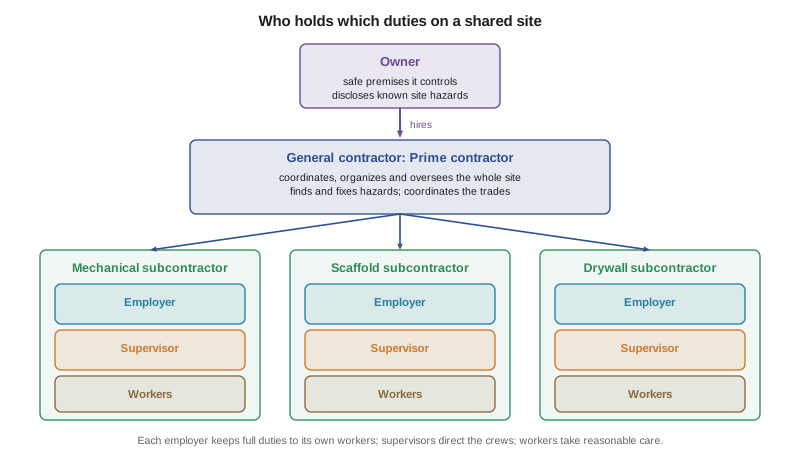
The legal frame in Manitoba
In Manitoba, the main law is The Workplace Safety and Health Act, together with the Workplace Safety and Health Regulation (Man. Reg. 217/2006). The Act sets out general duties for employers, workers, supervisors, owners, contractors, prime contractors, suppliers and self-employed persons. The regulation sets out the detailed technical rules: fall protection, excavations, cranes, scaffolds, hazardous substances and so on. The Workplace Safety and Health Branch of the provincial government enforces both. Workers compensation is a separate system, run by the Workers Compensation Board of Manitoba (WCB), and its prevention arm, SAFE Work Manitoba, promotes safety programs and certification. Manitoba amended the Act in 2025, adding psychological safety to its objectives, requiring a competent person to carry out required risk assessments, and requiring improvement and stop work orders to be posted for at least seven days.
The owner
The owner of Cottonwood Place is Cottonwood Place Developments Ltd.. Under section 7.2 of the Act, an owner must ensure, so far as is reasonably practicable, that the land and premises it controls are provided and maintained without risk to anyone's safety and health, must cooperate with others who have duties under the Act, and must comply with the Act and regulations. In practice the owner's most important duties come before construction starts: telling the contractor about hazards it knows of on the site, such as buried services, contaminated soil or asbestos in an existing building, and choosing a competent contractor. Under section 7 of the Act, the owner is also the prime contractor unless it contracts with someone else to take on that role, which is what Cottonwood Place Developments did with Tallgrass.
The prime contractor
Under section 7(1) of the Act, a construction project site where more than one employer or self-employed person works at the same time must have a prime contractor. The prime contractor is the person who contracts with the owner to be prime contractor; if there is no such contract, the owner is the prime contractor (section 7(2)). Tallgrass's contract with Cottonwood Place Developments names it as prime contractor for the whole site from mobilization to handover. Under section 7(3), the prime contractor must ensure, so far as is reasonably practicable, that every person working on the project complies with the Act and the regulations; must coordinate, organize and oversee the work at the site and conduct its own activities so that no person is exposed to risks; must cooperate with others who have duties under the Act; and must comply with the Act and regulations itself. Under section 7.4(8), where two or more employers with safety and health programs are on the site, the prime contractor must coordinate those programs.
Either way, the general contractor does not become responsible for every act of every subcontractor. It is responsible for running the site so that hazards are found and fixed, for coordinating trades whose work affects each other, and for acting when it sees or should see a problem. On level 5, that meant Tallgrass should have had a way to know that an opening had been cut and that its guardrail had come off.
Employers
Every employer on site keeps its full duties to its own workers. Under section 4 of the Act, an employer must ensure, so far as is reasonably practicable, the safety, health and welfare of all its workers: providing safe equipment and systems of work, information, instruction, training and supervision, competent supervisors, and the protective equipment the regulation requires. Employers with 20 or more regularly employed workers at a workplace must have a written workplace safety and health program (section 7.4(1)). Under section 7.1, a contractor that directs the activities of workers of other employers also has duties for those workers.
On level 5, Pinecrest Interiors Ltd. was the exposing employer. Keystone Mechanical Ltd. created the opening and Highline Scaffold Ltd. removed the guardrail. Each owed duties to its own workers and, under the general duties, to anyone affected by its work.
Supervisors
Manitoba's Act gives supervisors their own duties in section 4.1. A supervisor must, so far as is reasonably practicable, take all precautions necessary to protect the safety and health of the workers under their supervision, ensure that those workers comply with the Act and regulations, use and wear required protective equipment themselves, advise workers of all known or reasonably foreseeable risks in the area where they work, cooperate with others who have duties under the Act, and comply with the Act and regulations. A supervisor is any person who has charge of a workplace or authority over a worker: foremen and lead hands count, whatever their job title.
Jordan Pike, the Pinecrest foreman, had sent his crew to level 5 without walking the floor first. That was a supervision failure, whatever else had gone wrong.
Workers
Workers have duties too. Under section 5 of the Act, a worker must take reasonable care to protect their own safety and health and that of others affected by their acts, use the protective equipment and devices required, cooperate with their employer and supervisor, and comply with the Act and regulations. Workers also have three rights that run through Canadian safety law: the right to know about hazards, the right to participate (through committees and representatives) and the right to refuse dangerous work. The 2025 amendments define dangerous work as an imminent risk of serious physical or health injury from a hazard where reasonable controls are not in place.
Self-employed workers and others on site
Self-employed persons on a construction site, such as an independent tile setter, must under the Act protect themselves and others affected by their work and comply with the regulation, and they fall under the prime contractor's coordination. Suppliers must provide equipment that is safe when used as directed, with the information needed to use it safely. Visitors, inspectors and delivery drivers are not workers of Tallgrass, but Tallgrass must still conduct its activities so they are not exposed to risk.
Overlapping duties are the point
Students sometimes ask who is really responsible for a hazard like the open shaft. The honest answer is that several parties were, at once, and that this is deliberate. Overlapping duties mean that if one layer of protection fails, another should catch the problem. The scaffold crew should have replaced the guardrail. The mechanical contractor should have checked its opening before leaving on Friday. Tallgrass should have had a system for openings and a walk of each active floor at the start of each shift. The drywall foreman should have walked the floor. The drywall worker should have looked behind him. Any one of those would have prevented the fall.
| Party | Main duties under Manitoba law | On level 5 at Cottonwood Place |
|---|---|---|
| Owner | Safe premises it controls; disclose known hazards; cooperate; is prime contractor unless it contracts the role out (ss. 7, 7.2) | Named Tallgrass as prime contractor; disclosed site hazards before construction |
| Prime contractor | Ensure compliance by all; coordinate, organize and oversee the work; coordinate employers' programs (ss. 7(3), 7.4(8)) | Tallgrass: no system to track openings, no floor walk since Thursday |
| Employer | Safety, health and welfare of its workers; training, supervision, equipment; written program at 20+ workers (ss. 4, 7.4) | Mechanical created the opening; scaffold removed the rail; drywall exposed its crew |
| Supervisor | Protect workers, enforce rules, advise of known and foreseeable risks (s. 4.1) | Drywall foreman did not walk the floor |
| Worker | Reasonable care; use protective equipment; cooperate; right to refuse (s. 5) | Stepped back without looking |
Counting how many layers failed
After the incident, Owen Hartley used a short script with the investigation team to list each party's expected control and whether it worked. Seeing all five failures in one place made the point that this was not one person's mistake.
# Layers of protection around the level 5 shaft opening.
layers = [
    ("Mechanical contractor", "check opening guarded before leaving", False),
    ("Scaffold contractor", "replace any guardrail it removes", False),
    ("General contractor", "opening register and daily floor walk", False),
    ("Drywall foreman", "walk the floor before sending the crew", False),
    ("Drywall worker", "look before stepping back", False),
]
failed = [name for name, control, worked in layers if not worked]
print(f"{len(failed)} of {len(layers)} layers failed")
for name, control, worked in layers:
    print(f"- {name}: {control} -> {'worked' if worked else 'FAILED'}")
print("Any single working layer would have prevented the fall.")5 of 5 layers failed - Mechanical contractor: check opening guarded before leaving -> FAILED - Scaffold contractor: replace any guardrail it removes -> FAILED - General contractor: opening register and daily floor walk -> FAILED - Drywall foreman: walk the floor before sending the crew -> FAILED - Drywall worker: look before stepping back -> FAILED Any single working layer would have prevented the fall.
Worked problem
Who gets an order after the level 5 fall?
Show solution
- The officer interviews the injured worker, the drywall foreman, the mechanical and scaffold foremen and Owen Hartley, and photographs the opening.
- She finds that the opening was unguarded, contrary to the fall protection requirements of the regulation.
- She issues an improvement order to Tallgrass as prime contractor for failing to coordinate and oversee the work so that no person was exposed to the risk.
- She also issues orders to the scaffold contractor, which removed the guardrail, and to the drywall contractor for inadequate supervision.
- Tallgrass must report in writing how it has complied by the date on the order, and the order must be posted at the site.
Answer: More than one employer can be held responsible for the same hazard, because each had a duty that would have prevented it.
Common mistakes
MistakeAssuming the employer of the injured worker is the only one responsible.
InsteadCreating, exposing, correcting and coordinating parties can all be responsible for the same hazard.
MistakeThinking the prime contractor must personally inspect every subcontractor's work at every moment.
InsteadThe general contractor must run a reasonable system to find and fix hazards and coordinate trades; subcontractors keep their own duties.
MistakeTreating foremen as workers with no special duties.
InsteadForemen are supervisors under section 4.1 and must protect, inform and direct their crews.
MistakeLeaving the owner out of the picture.
InsteadOwners must disclose known site hazards and choose competent contractors, and may hold legal duties depending on how much they control.
MistakeRelying on one layer of protection.
InsteadOverlapping duties exist so that when one control fails, another catches the hazard.
Summary and key terms
- A construction site is a shared workplace where one trade's hazard often injures another trade's worker.
- Manitoba's Workplace Safety and Health Act gives duties to owners, prime contractors, employers, supervisors, workers, contractors, suppliers and the self-employed.
- A prime contractor is required when more than one employer works at a site; it must ensure compliance, coordinate and oversee the work and coordinate the employers' programs.
- Every employer keeps full duties to its own workers, and supervisors are central to whether those duties are met.
- Overlapping duties are deliberate: any working layer can prevent an injury.
- Prime contractor
- The person who contracts with the owner to coordinate and oversee a multi-employer construction site, or the owner if no one does.
- Owner
- The person who owns or controls the land or premises used as a workplace.
- Supervisor
- A person who has charge of a workplace or authority over a worker.
- Self-employed person
- A person who works for themselves with no workers, who still has duties under the Act.
- Reasonably practicable
- Everything that could be done, balancing the risk against the cost and difficulty of the measures.
- Workplace safety and health program
- The written program an employer with 20 or more regular workers must have, setting out how it manages safety and health.
Practice problems
Work each problem on paper first, then reveal the answer to check.
When must a Manitoba construction site have a prime contractor?
Show answer
When more than one employer or self-employed person works at the site at the same time.
Who is the prime contractor if the owner does not contract the role to anyone?
Show answer
The owner.
Why are duties on a construction site deliberately overlapping?
Show answer
So that if one party's control fails, another party's control can still prevent the injury.
Give three duties of a supervisor under section 4.1.
Show answer
Any three of: take precautions to protect workers, ensure workers comply, wear required equipment, advise workers of known or foreseeable risks, cooperate, comply.
Which party created the hazard on level 5, and which exposed workers to it?
Show answer
The mechanical contractor cut the opening and the scaffold crew removed its guardrail; the drywall contractor exposed its workers.
Lesson quiz · 5 questions
Score 60% or more to complete this lesson.
Create a free account to save your progress, take quizzes and earn a certificate.