
HSE-375 · Lesson 5 of 12 · 20 min
COR certification, WCB rates and injury rates
When Cottonwood Place Developments invited contractors to bid on Cottonwood Place, its tender documents required each bidder to hold a valid Certificate of Recognition (COR) and to submit its injury frequency for the past three years. Two of the seven firms that asked for the documents could not meet the COR requirement and dropped out. Tallgrass has held COR since 2009. Its safety numbers are part of how it wins work, and they are also one of the ways it finds out whether its program is working.
This lesson looks at how safety programs are certified and measured, what the numbers mean and do not mean, and how Tallgrass uses the same measures when it chooses its subcontractors.
The Certificate of Recognition
COR is a national safety program certification for construction employers, endorsed by the Canadian Federation of Construction Safety Associations, with each province's safety association acting as the certifying body. In Manitoba, COR for construction is granted by WorkSafely, the safety arm of the Manitoba Heavy Construction Association, and it is part of SAFE Work Certified, the provincial certification standard run by SAFE Work Manitoba, the WCB's prevention arm. A COR shows that an employer's health and safety management system has been audited against a recognized standard and met it.
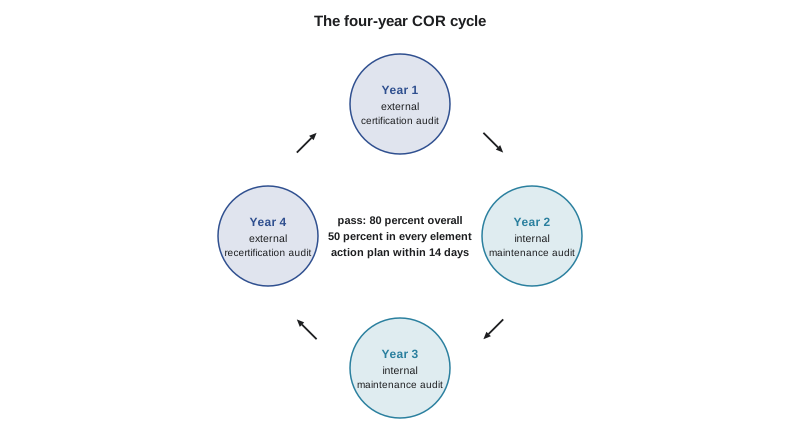
The Manitoba program runs on a four-year cycle. In the first year, an external auditor certified by WorkSafely audits the employer's system through document review, interviews with workers and supervisors, and site observations. In the second and third years, a trained internal auditor employed by the company carries out a maintenance audit, which WorkSafely reviews. In the fourth year, an external auditor carries out a recertification audit. To pass, an employer must score at least 80 percent overall and at least 50 percent in every element, and it must submit a corrective action plan for findings within 14 days. Employers must keep at least one full-time employee with valid internal auditor certification. Small employers with fewer than 10 workers can certify through SECOR, a simpler version with the same audit cycle.
COR audits look at elements such as management commitment and policy, hazard assessment, safe work practices and procedures, company rules, personal protective equipment, preventive maintenance, training and communication, inspections, investigations, emergency preparedness, statistics and records, and legislation. The interviews matter: an auditor who finds a perfect manual but workers who cannot describe the company's hazard assessment process will score the element low.
What COR is worth
In Manitoba, employers with COR or SECOR can receive a rebate on their WCB assessment premium, currently 15 percent, and small employers can receive up to $3,000 through the WCB's prevention rebate. Many public and large private owners require COR or SECOR to bid, and general contractors often require it of their subcontractors. COR is also recognized in other provinces through reciprocity agreements among the safety associations, so a Manitoba contractor can bid in Saskatchewan or Alberta. But the real value is the discipline of the audit cycle: every year, someone looks hard at whether the system works and the company has to fix what is found.
WCB rates and experience rating
The WCB of Manitoba sets an assessment rate for each industry rate group based on the group's claim costs, and then adjusts each employer's rate up or down based on its own claim experience compared with its group. An employer with fewer and less costly claims than its peers pays less; one with more pays more. Owners sometimes ask for an employer's rate history, and a rising rate can be an early sign of trouble. Like any measure based on claims, it reflects what has already gone wrong, not what is being done now to prevent harm.
Injury rates
Injury rates let companies of different sizes compare their records. The most common in Canadian construction is the lost time injury frequency, the number of lost time claims per 200,000 hours worked, which is roughly 100 workers working a full year. Many companies also track a total recordable injury frequency, counting medical aid and modified work cases as well as lost time. Some owners and associations use claims per 100 workers instead. Whichever is used, the method must be stated, because different methods give very different numbers.
Owen calculates Tallgrass's rates for Cottonwood Place each month and compares them with the company's three-year average.
# Injury rates for the Tallgrass workforce on Cottonwood Place, year to date.
hours = 186_400          # hours worked by Tallgrass employees
recordable = 3           # medical aid + modified work + lost time cases
lost_time = 1            # cases with days away from work
restricted = 1           # cases with restricted work or transfer
base = 200_000
trif = recordable * base / hours
ltif = lost_time * base / hours
dart = (lost_time + restricted) * base / hours
print(f"total recordable rate: {trif:.2f}")
print(f"lost time rate:        {ltif:.2f}")
print(f"days away/restricted:  {dart:.2f}")
print(f"rule of thumb: one case adds {base / hours:.2f} to each rate at this size")total recordable rate: 3.22 lost time rate: 1.07 days away/restricted: 2.15 rule of thumb: one case adds 1.07 to each rate at this size
The last line of the output is the reason Owen is careful with these numbers. For a workforce of this size, a single injury moves the total recordable rate by more than 1. A low rate over a few months says little about whether serious injuries are being prevented; it may just be luck.
Leading and lagging indicators
Injury rates, WCB rates and experience rating are lagging indicators: they measure harm after it has happened. Good programs also track leading indicators, which measure the activities that prevent harm. On Cottonwood Place, Owen's monthly report put both on the same page.
| Indicator | Type | What it shows | Cottonwood Place target |
|---|---|---|---|
| Total recordable rate | Lagging | How often injuries needing more than first aid occur | Below the company three-year average |
| WCB rate trend | Lagging | Claim costs compared with peers | Stable or falling |
| Planned inspections completed | Leading | Whether hazards are being looked for | 100 percent |
| Deficiencies closed on time | Leading | Whether hazards are being fixed | 90 percent or more |
| Near misses reported per month | Leading | Whether workers trust the reporting system | Rising, then steady |
| Pre-task plans reviewed by a supervisor | Leading | Whether planning is real | Weekly sample of 10 |
| Serious injury and fatality potential events | Lagging and leading | Close calls that could have killed someone | Every one investigated |
A rising count of near-miss reports is usually good news in the first months of a project: it means workers trust that reporting leads to fixes rather than blame. A sudden drop with no change in conditions is a warning sign that people have stopped reporting.
When numbers are managed instead of hazards
Any number that is used to award contracts or bonuses will be managed. Some companies have been found to discourage injury reporting, to pressure injured workers to return to light duty the same day to avoid a lost time case, or to treat injuries with first aid when medical care was needed. Those practices harm workers and break the law in both countries. Tallgrass bases supervisors' safety bonuses on leading indicators, such as inspections and deficiency closure, and never on injury counts, and it audits its injury records against first aid logs and the site's daily reports.
Worked problem
Using COR and rates in subcontractor selection
Show solution
- Tallgrass received three bids for the drywall and ceiling package: Pinecrest Interiors Ltd., and two others.
- All three held COR or SECOR, which Tallgrass's prequalification requires.
- Pinecrest reported a lost time frequency of 3.1 for the past year, against 0.9 and 1.2 for the others, and had received two improvement orders for fall protection the previous summer.
- Pinecrest's price was lowest, and it was the only firm with crew available on the schedule. Tallgrass awarded it the work with conditions: a written fall protection plan for openings, a full-time foreman on site, and a monthly safety review with Owen.
- The level 5 fall in lesson 1 happened in the fourth month. The conditions gave Tallgrass a clear basis to require further changes.
Answer: Certification and rates are screens, not guarantees; conditions attached to a contract turn a warning sign into a plan.
Reading a safety record properly
When Owen reviews a subcontractor's numbers, he asks four questions before he draws any conclusion. First, how many hours are behind the rate? A firm with 40,000 hours a year can go from a perfect record to a poor one with a single injury, so he looks at three years together rather than one. Second, how serious were the injuries? Three minor recordable cases are a different story from one amputation, even if the rate looks better. Third, what kind of work produced them? A drywall firm's injuries should be compared with drywall firms, not with electricians. And fourth, what has changed since? A firm that had a bad year, investigated it honestly and changed its practices may be a better choice than one with a clean record and no system for learning.
He also looks at the enforcement history in the same way. An improvement order for a missing fire extinguisher tag is not the same as a stop work order for workers in an unshored trench. A firm that lists its orders openly, with what it did about each, earns more confidence than one that claims to have none when the Branch's records say otherwise.
Serious injury and fatality potential
Many companies now look beyond total injury counts to events with serious injury or fatality potential: incidents and near misses that could reasonably have killed or permanently disabled someone, whatever the actual outcome. Research in several industries has found that total injury rates can fall for years while serious injuries and deaths stay flat, because the causes of minor injuries, such as cuts and strains, are often different from the causes of fatal ones, such as falls from height, struck-by incidents and contact with energy. A dropped wrench that misses a worker by a metre is a near miss with serious injury potential; a paper cut is not.
On Cottonwood Place, every event with serious injury or fatality potential, whether or not anyone was hurt, was investigated with the same depth as a lost time injury and reported to Tallgrass's vice president of operations within 24 hours. In the first year there were nine such events: three involving dropped objects from upper floors, two involving the crane, two involving excavation edges, and two involving openings, one of them the level 5 fall. That list, not the total recordable rate, drove the priorities in the site plan's revisions.
Owen also shares the site's indicators with the workers themselves. Each month, the site board shows the inspections completed, the deficiencies closed, the near misses reported and what was done about the three most important ones. When workers can see that a near miss they reported led to a new cover, a new rule or a changed sequence, they report more. When the numbers are kept in the office, the people best placed to improve them never see them. The board also shows the number of days since the last event with serious injury potential, but Owen is careful never to present it as a target to be protected, because a counter that workers feel responsible for keeping alive can become one more reason not to report.
Common mistakes
MistakeTreating a COR certificate as proof that a contractor is safe on this site.
InsteadCertification and rates show the past and the system on paper; site performance has to be watched.
MistakeComparing injury rates calculated by different methods.
InsteadState the formula and the hours; compare like with like.
MistakeCelebrating a low injury rate over a few months on a small workforce.
InsteadAt small hour totals, one injury swings the rate; look at leading indicators too.
MistakeRewarding supervisors for low injury counts.
InsteadReward leading indicators; injury-count bonuses encourage under-reporting.
MistakeIgnoring a sudden drop in near-miss reports.
InsteadAsk why; it often means workers have stopped reporting.
Summary and key terms
- COR certifies a construction employer's safety management system; in Manitoba it runs on a four-year audit cycle with external and internal audits, and SECOR serves employers with fewer than 10 workers.
- COR brings a WCB premium rebate, is often required to bid, and is recognized across provinces.
- Injury rates use a 200,000-hour base so firms of different sizes can be compared, but small workforces see large swings.
- Lagging indicators measure harm; leading indicators measure the work that prevents it, and good programs track both.
- Numbers used for contracts or bonuses can be manipulated, so they must be audited and never used to discourage reporting.
- COR
- Certificate of Recognition: a certification that a construction employer's safety management system meets a recognized audit standard.
- SECOR
- The small employer version of COR, for employers with fewer than 10 workers.
- Maintenance audit
- The internal audit carried out in the years between external COR audits.
- Experience rating
- The adjustment of an employer's WCB rate based on its claim costs compared with its industry group.
- Lost time injury frequency
- Lost time claims per 200,000 hours worked.
- Leading indicator
- A measure of activities that prevent harm, such as inspections completed.
Practice problems
Work each problem on paper first, then reveal the answer to check.
Describe the four-year COR cycle in Manitoba.
Show answer
External certification audit in year 1, internal maintenance audits in years 2 and 3, external recertification in year 4.
What scores are needed to pass a COR audit?
Show answer
At least 80 percent overall and at least 50 percent in every element.
Calculate a total recordable rate for 4 recordable cases in 250,000 hours.
Show answer
4 x 200,000 / 250,000 = 3.2.
Give two leading indicators Owen tracks.
Show answer
Any two of: planned inspections completed, deficiencies closed on time, near misses reported, pre-task plans reviewed.
Why does Tallgrass not base supervisor bonuses on injury counts?
Show answer
Because injury-count bonuses encourage under-reporting; it rewards leading indicators instead.
Lesson quiz · 5 questions
Score 60% or more to complete this lesson.
Create a free account to save your progress, take quizzes and earn a certificate.